
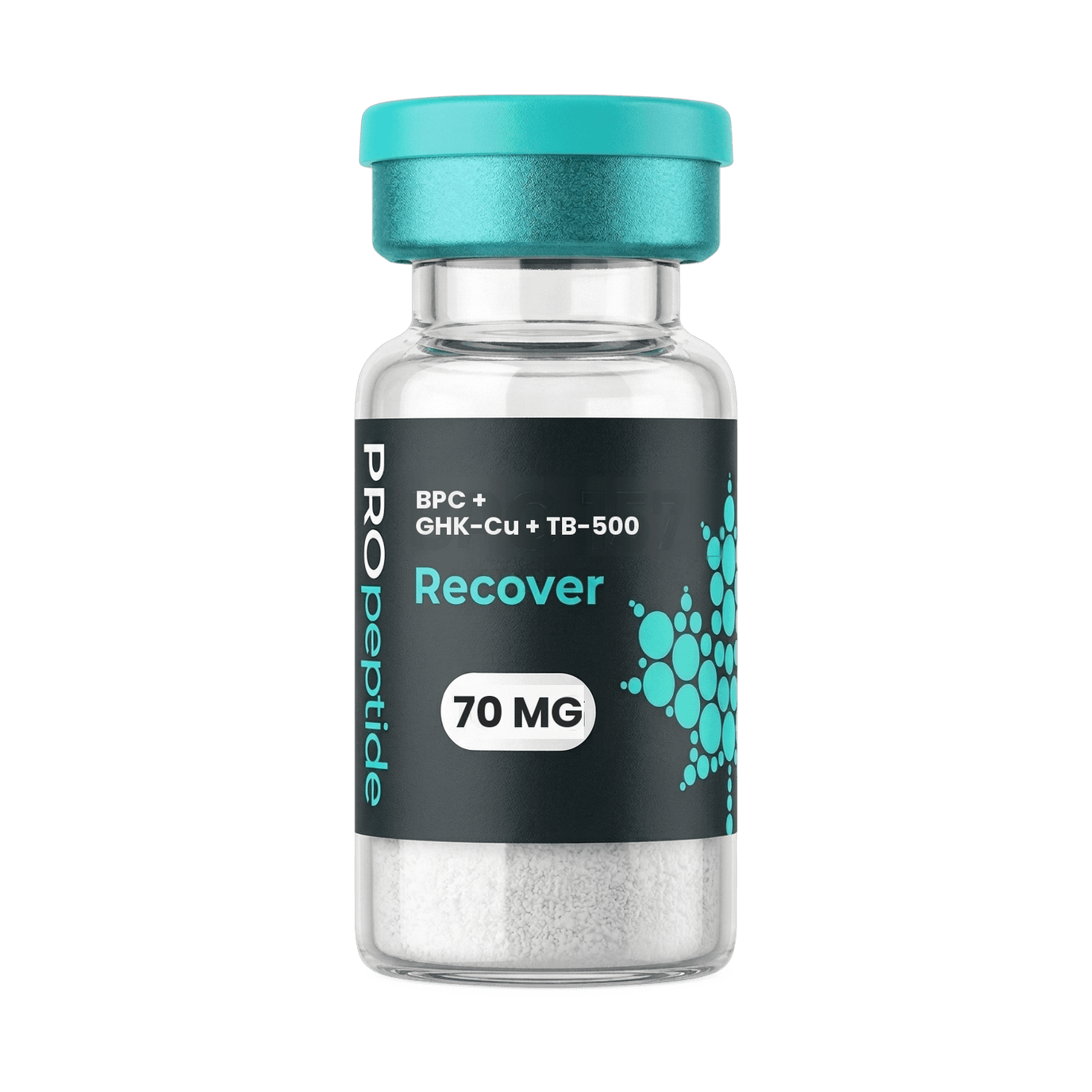
BPC + GHK-Cu + TB-500 Triple Blend
Three compounds in one vial, and not one published study on the three of them together.
Choose your pack
For research use only. Not for human or veterinary use.
What BPC + GHK-Cu + TB-500 Triple Blend is
The plain-language version, first.
Three compounds, one vial, and a copper atom with an open seat.
BPC + GHK-Cu + TB-500 Triple Blend is a research-use preparation supplying three compounds together: BPC-157 (GEPPPGKPADDAGLV, approximately 1419.5 Da), the acetylated thymosin beta-4 fragment TB-500 (Ac-LKKTETQ, approximately 889.0 Da), and the copper complex of the tripeptide glycine-histidine-lysine, whose 1:1 form has a molecular weight of 402.92 Da. No published study has evaluated the three compounds in combination in any species or model.
Three compounds, three different origins, one vial. BPC-157 is fifteen residues, GEPPPGKPADDAGLV, formula C62H98N16O22, molecular weight about 1419.5.
The sequence was identified inside a larger protein found in human gastric juice. TB-500 is seven residues, Ac-LKKTETQ, C38H68N10O14, about 889.0.
It is residues 17 through 23 of thymosin beta-4, roughly eighteen percent of that protein by mass. It is not thymosin beta-4 itself, whatever a label says. GHK is the odd one out, and it is also the one with a naming problem. Free GHK is the tripeptide glycine-histidine-lysine, C14H24N6O4, 340.38 daltons. Bind a copper and you get the 1:1 complex, C14H23CuN6O4 carrying a positive charge, 402.92 daltons. There is also a bis complex, one copper holding two GHK molecules, at 742.3. A vial that says GHK-Cu and stops there has not told you which of those three you are looking at, and those masses are far enough apart that the difference is not academic. So the honest starting point for a triple blend is this. Three compounds, one of them ambiguous by name alone, and no published work on the set.
What is in the BPC, GHK-Cu and TB-500 triple blend
Mechanism studied, not outcome promised.
Three separate mechanisms sharing a ride, with no study of the carpool.
Each of these has its own story, and none of those stories were written with the other two in the room. BPC-157 rodent work points at angiogenesis and VEGF signalling.
TB-500 binds actin through its LKKTET stretch, and actin is what cells use to crawl into damaged tissue. GHK-Cu gets studied as a copper carrier and for its effects on collagen expression in skin models.
Three separate literatures, none of them overlapping. What nobody covers is what happens when the three share a solution. Start by killing the lazy answer.
The concern you will see repeated is that copper oxidises methionine. Computed straight from the sequences, neither BPC-157 nor TB-500 contains a single methionine, cysteine, tryptophan, histidine or tyrosine. Not one oxidation-prone side chain between them.
That specific worry is fiction here and we would rather say so than let it sit. The real version is smaller and a lot more interesting. Copper's documented oxidation target in formulation work is histidine, and the only histidine anywhere in this vial belongs to GHK itself.
So the most likely copper chemistry in a triple blend is GHK-Cu going after GHK-Cu. Then there is the coordination question, which is the one nobody asks. Cu(II)GHK is not redox-silent.
Glutathione reduces it, and the published work reports the reduction rate being tuned by ternary ligands. In a closely analogous copper system, both binary complexes were redox-silent with ascorbate while a ternary complex could generate reactive oxygen species. The fifth seat is open, aspartate is one of the donors observed sitting in it, and BPC-157 shows up carrying two adjacent aspartates.
None of that is a result. It is a stack of documented facts pointing at an experiment nobody has run.
The research so far for BPC + GHK-Cu + TB-500 Triple Blend
Where the evidence is thin, we say so.
Each passenger has a file. The vehicle has none.
There is no study of this blend. That is the finding, and it belongs at the top rather than buried.
What does exist is one controlled test of two of the three. Bicer O, Adanir O, Guleryuz Y and colleagues, Jt Dis Relat Surg 2026;37(3):822-837, DOI 10.52312/jdrs.2026.2951, PMID 42542926.
Thirty-two male Sprague-Dawley rats, Achilles tendon transected and repaired, four groups of eight, intraperitoneal, four weeks. Verbatim: "Combined BPC-157 and TB-500 treatment did not confer additional benefits compared to either agent alone." The authors suggest convergence on shared downstream pathways. Eight per group is small and they call the work exploratory, and the peptides were given as separate injections rather than mixed, so the paper says nothing about co-formulation.
On the chemistry side the citations are real, but they are about the parts and not about this product. Ufnalska and colleagues, Inorg Chem 2021, PMID 34781677, report glutathione reducing Cu(II)GHK with the rate tuned by ternary ligands. Mehr and colleagues, Acta Crystallogr D 2020, PMC7709198, describe residues including His, Asp and His/Pro from symmetry molecules completing copper's square-pyramidal coordination sphere in a GHK-tagged fusion protein.
Bossak-Ahmad and colleagues, PMC7503498, show GHK-Cu forming ternary complexes with a third ligand in solution. Mital and colleagues, Inorg Chem 2016, PMID 27409140, found a ternary copper complex able to generate reactive oxygen species where the binary complexes were silent. Nobody has connected any of that to this vial.
That connection is a hypothesis, and we are labelling it as one rather than selling it as a finding.
All three compounds, one vial. Canadian stock, ships from BC.
BPC + GHK-Cu + TB-500 Triple Blend specs
The chemistry, exactly as released.
Who studies BPC + GHK-Cu + TB-500 Triple Blend
Who tends to order this one, and why.
- 1
Coordination chemists
An open axial position on a copper centre, a documented set of donors that occupy it, and a second peptide in the vial carrying an Asp-Asp motif. The speciation in this solution has never been characterised and the tools to characterise it already exist.
- 2
Formulation scientists
Three compounds with three different stability optima and no validated formulation to build from. The adjacent aspartates in BPC-157 are a known hotspot for aspartimide formation and deamidation, both strongly pH dependent, so a buffer chosen to suit a copper complex is not automatically kind to BPC-157.
- 3
Analytical chemists
Reversed-phase purity methods are validated one analyte at a time. A three-peptide vial needs a method that resolves three parent peaks plus the degradants of each, and copper complicates reversed-phase chromatography on its own terms.
- 4
Anyone weighing a blend against singles
The one controlled comparison in this space, covering two of these three compounds, found the pair no better than either alone. If you want a reason to run single vials instead, that paper is the reason.
Sold for laboratory research only. This is not guidance for personal use, and nothing here is a recommendation.
BPC + GHK-Cu + TB-500 Triple Blend backstory
How it got here.
Three compounds that arrived from three different questions and got introduced to each other by a product catalogue.
GHK was identified as a small copper binding tripeptide in human plasma. It is the only one of the three that brings a metal to the party, and that single fact drives most of what is interesting about the blend.
BPC-157 came out of research into proteins in human gastric juice, chasing the question of why the stomach lining survives sitting in acid all day.
TB-500 came from thymosin beta-4, a protein isolated from thymus tissue, with the actin binding stretch synthesised separately later and handed a nickname that stuck harder than its chemistry name.
Nobody proposed combining them in a paper. The blend is a catalogue decision. It exists because each compound sells on its own and somebody reasoned that three would sell better than one, which is a business hypothesis rather than a scientific one.
That is not a knock on the compounds. It is just where the vial came from, and it explains why the literature has nothing at all to say about the combination.
- 1
The one that brings a metal
GHK was identified as a small copper binding tripeptide in human plasma. Free GHK is 340.38 daltons. The 1:1 copper complex is 402.92. A bis complex holding two GHK per copper sits at 742.3, which is why the label matters.
- 2
A stomach protein and a thymus protein
BPC-157 came from work on proteins in human gastric juice. TB-500 is a seven residue slice of thymosin beta-4, a protein isolated from thymus tissue. Neither fragment occurs on its own in nature.
- 3
The blend has no paper
No group has published the three together in any species or model. Every document naming all three is a review listing them separately in a table. This vial came out of a catalogue, not out of a hypothesis.
Buying BPC + GHK-Cu + TB-500 Triple Blend in Canada
What ships, how fast, and the paperwork.
GHK-Cu without a stoichiometry is ambiguous. Free GHK is 340.38 daltons. The 1:1 copper complex is 402.92. The bis complex, one copper to two GHK, is 742.3. A label reading GHK-Cu and nothing else does not tell you which species is in the vial, and the gap between them is large.
A blend makes purity analysis harder, not easier. Purity methods get validated for one analyte. Three peptides plus a copper complex in one solution would need a method resolving every parent peak and every degradant, so a single combined percentage would not be analytically meaningful even in principle.
Status, said once. Research use only, not for human or veterinary use. WADA names BPC-157 under S0 for 2026 and covers thymosin beta-4 and its derivatives including TB-500 under S2.3. GHK-Cu is not listed by name, which is not the same thing as permitted, since S0 is a catch-all. Health Canada named all three compounds in its April 2026 advisory on peptides bought online, and all three sit in the FDA table of bulk drug substances nominated then withdrawn rather than on the 503A bulks list.
Common questions
5 answers, none of them dodges.
Does the BPC, GHK-Cu and TB-500 triple blend work better than the compounds on their own?
No published study has tested the three together, so there is no evidence either way on the trio. On the one pair that has been compared, Bicer and colleagues reported in 2026 that combining BPC-157 and TB-500 in a rat Achilles model did not confer additional benefits compared to either agent alone. That is a small exploratory study, and it is also the only head to head anybody has run.
How many studies exist on all three compounds together?
Zero, in any species and any model. Searches do turn up documents naming all three, but every one of them is a narrative review listing the compounds separately in a table rather than testing them as a set. That is an unusual thing to put on a product page, and it is also the most accurate thing anyone can say about this blend right now.
Does the copper in GHK-Cu damage BPC-157 or TB-500?
Nobody has measured it, and the usual version of that worry is wrong on the chemistry. Neither BPC-157 nor TB-500 contains methionine, cysteine, tryptophan, histidine or tyrosine, so neither carries an oxidation-prone side chain for copper to attack. Copper oxidation in formulation work targets histidine, and the only histidine in this vial belongs to GHK itself.
What does the label GHK-Cu actually tell you?
Less than it looks like it does. Free GHK is the tripeptide glycine-histidine-lysine at 340.38 daltons. The 1:1 copper complex is 402.92 daltons, and a bis complex holding two GHK molecules per copper sits at 742.3. A label reading GHK-Cu with no stated stoichiometry does not identify which of those species is in the vial.
Why would three compounds in one vial be harder to formulate than one?
Each peptide has its own stability-optimal pH and a single buffer cannot be optimal for three of them. None of the three has a validated formulation to start from. The adjacent aspartate residues in BPC-157 are a classic hotspot for aspartimide formation and deamidation, both strongly pH dependent, so a buffer picked to suit the copper complex could work against BPC-157.
BPC + GHK-Cu + TB-500 Triple Blend vs TB-500 + BPC-157 Combo
Stacked together constantly, compared almost never.
The double next to the triple, and one controlled experiment sitting between them.
The triple adds GHK-Cu and its copper atom to the famous pairing. No published study of the three-way combination exists at all.
The double is the internet's favourite stack, and the one controlled test of it found the combination conferred no additional benefit over either compound alone.
The only combination in this family anybody has tested came back negative, and the answer to that was apparently to add a third compound. We sell both. We are not going to pretend the arithmetic improved. TB-500 + BPC-157 Combo has its own page here
Good pairing options with BPC + GHK-Cu + TB-500 Triple Blend
What researchers stack alongside it.
Pairing is where research gets ahead of itself. These are the compounds researchers put in the same order as BPC + GHK-Cu + TB-500 Triple Blend, which is a statement about ordering habits, not about evidence. Two things in one cart have not been studied together unless somebody studied them together.
A fifteen-amino-acid fragment of a protective gastric protein, studied in animal models of tendon, gut and blood vessel repair.
Seven residues clipped out of a 43-residue protein, and they happen to be the exact seven that grip actin. The rest of the protein turned out to be commentary.
It is water. We know. But it is the one bottle on this shelf where the boring ingredient is the entire product, and getting it wrong ruins everything else you bought.
Order BPC + GHK-Cu + TB-500 Triple Blend right now
One last look before you decide.
Freeze-dried, ships cold from Canada
You've got the whole file now, the thin parts included. Nothing above pretended otherwise. If that's the kind of source you were after, BPC + GHK-Cu + TB-500 Triple Blend is right here.
Not for human consumption. Not approved by Health Canada or any other regulatory body.
Page last updated October 4, 2026
People also search for BPC + GHK-Cu + TB-500 Triple Blend
Related searches.