
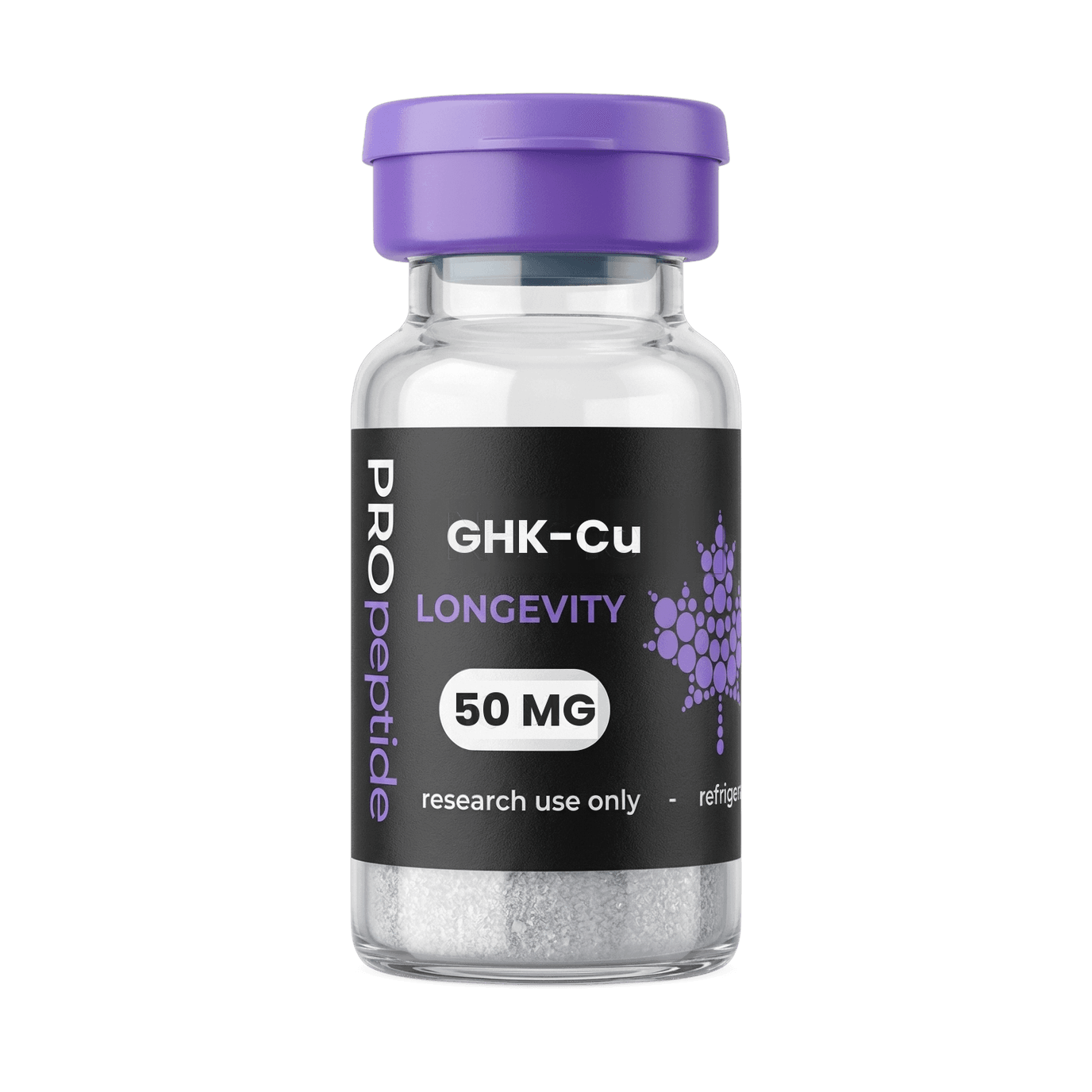
GHK-Cu Peptide
Every credible human study is topical. FDA deliberately kept the injectable route outside its enforcement discretion in 2026.
Choose your pack
For research use only. Not for human or veterinary use.
What GHK-Cu is
The plain-language version, first.
GHK-Cu is three amino acids, first found in human blood in 1973, permanently holding a copper ion.
GHK-Cu peptide is the tripeptide glycyl-L-histidyl-L-lysine bound to copper. It was first isolated from human plasma in 1973 and is listed in cosmetics as copper tripeptide-1. Researchers study it in wound and skin-matrix work because copper is a cofactor for lysyl oxidase. Its controlled human trials used topical formulations. It isn't approved as a drug in Canada or anywhere else.
Most compounds on this shelf got invented. This one got found, floating around in human plasma like it owned the place, back when Loren Pickart was looking at what made old liver cells act young in a dish.
Glycine, histidine, lysine, plus a copper ion it holds onto so tightly the copper made it into the name.
Stay with me on the copper. Think of GHK as a delivery driver and the copper as the pizza, except the driver's legally married to the pizza. Plasma levels drop as you age, which handed the skincare aisle its favourite sentence, and forty years of copper peptide creams got built on top of that one line.
Underneath the creams there's real chemistry. A genuine copper-binding motif, with a real job in the enzyme that builds skin's scaffolding. That part isn't marketing.
A real molecule with a real decline curve, and an industry parked in the gap between those two facts and proof. The research section keeps score.
What GHK-Cu copper peptide actually does
Mechanism studied, not outcome promised.
Copper isn't decoration in here. It's a working part.
Lysyl oxidase, the enzyme that rivets collagen and elastin into scaffolding, needs a copper atom to run at all. No copper, no rivets, and the scaffolding's a pile of loose rebar.
The GHK motif grips copper hard, and the proposed job is courier work: peptide carries the ion, the enzyme gets its copper, the scaffolding work carries on.
There's also cell-culture work on gene expression that the forums quote like scripture. It's real. It's also cells in a dish.
We're not gonna dress it up. What a plausible courier does in a dish and what it does in your skin are two different questions, and only one of them has been tested properly, roughly twice, in thirty years.
A courier with a good story, two real tests, and a split decision.
The research so far for GHK-Cu
Where the evidence is thin, we say so.
Forty years of cosmetic marketing sits on a remarkably small pile of controlled tests, and the two best ones don't agree with each other.
The 1994 trial (Mulder and colleagues, Wound Repair and Regeneration): a topical gel on foot ulcers caused by diabetic nerve damage, several hospitals, patients assigned at random, and judges who didn't know who got the real gel. Ulcers on the gel closed by a median of 98.5 percent against 60.8 for the plain gel. It's a wound result, not a wrinkle result.
The blinded aesthetic trial (Miller and colleagues, 2006): 13 patients finished, blinded evaluators, and the objective measures found no difference. The one time the cosmetic claim faced a blindfold, it didn't show up.
Everything else is cell work, small open-label studies, and papers from people with a cream to sell. The gene-expression claims trace back to a 2018 review by the peptide's discoverer, and a review isn't a trial.
Even the news has caught up. NPR's headline on 7 September 2026: "The copper peptide trend has gone from creams to injections, ahead of the science."
Nothing approved as a drug anywhere. Not for skin. Not for wounds either, which surprises people.
Here's the honest part. One old win in wounds, one modern null in aesthetics, and an industry that only quotes the first. Both results are real, so both live on this page.
You'll read the 1994 number on forty other sites. You'll read the 2006 one here, with the link.
GHK-Cu vial sizes and current stock are listed below.
GHK-Cu specs
The chemistry, exactly as released.
Who studies GHK-Cu
Who tends to order this one, and why.
- 1
Wound care
Foot ulcers from diabetic nerve damage, where the 1994 gel trial gave this compound its best result.
- 2
Dermatology and cosmetic science
Everywhere, as copper tripeptide-1. The one blinded wrinkle trial, 13 patients, measured no improvement.
- 3
Matrix biology
The enzyme that rivets collagen and elastin together needs copper, and this is a copper carrier. That's the whole research question.
- 4
Regulatory reviewers
In 2026 the FDA split the injectable route off from every other form of GHK-Cu, on purpose. Rare move, worth understanding before you read the forums.
Sold for laboratory research only. This is not guidance for personal use, and nothing here is a recommendation.
GHK-Cu backstory
How it got here.
GHK turned up by accident. Researchers were studying what in human plasma changed how liver cells behaved in a dish, and one of the things they fished out was a three-residue peptide that wouldn't let go of its copper. The copper wasn't a side note. It was the whole personality.
The first serious use was wounds. Long-lasting foot ulcers in people with diabetes are a real clinical problem, and a small peptide that hauls copper to the enzymes rebuilding tissue looked like a sensible bet. That bet became the 1994 trial, still the best evidence the compound has.
The skincare world picked it up on its own, as copper tripeptide-1, on the strength of the chemistry and the wound data. Nobody ran the wrinkle trials first. When one finally got run properly, in 2006, the judges couldn't measure a difference.
The injectable version is the newest chapter and the thinnest. There's no clinical literature behind it at all.
- 1
Found in plasma
1973, human plasma, copper attached. Nobody built it.
- 2
Sent to wounds
Diabetic foot ulcers were the target. The 1994 gel trial, still its best result, came out of that work.
- 3
Adopted by cosmetics, then by compounders
Skincare took it as Copper Tripeptide-1 without wrinkle trials. Injectables came last, with no trials at all.
Buying GHK-Cu in Canada
What ships, how fast, and the paperwork.
Route is the whole question. The evidence for this compound is topical. In May 2026 the FDA let every form of GHK-Cu back onto the list compounding pharmacies may work from, except the injectable ones, and said the human data for that route are limited. Health Canada hasn't approved it as a drug in any form.
Then into the fridge. Keep it cold and keep it dark. Sealed and freeze-dried it handles a rough trip without ice. Once it lands, fridge.
Common questions
11 answers, none of them dodges.
Topical or injectable, which one has the evidence?
Topical. Both controlled human trials used a gel or a complex applied to the skin. No published human study by the injectable route exists that we could find, and no injectable trial is registered anywhere.
Does GHK-Cu work for wrinkles?
Not in the one trial that hid the answer from the judges. Miller and colleagues, 2006, 13 patients, blinded evaluators: no measurable change in wrinkles or skin quality. The only thing that moved was how satisfied patients said they felt.
Does it do anything for hair?
Nothing controlled. The hair claims mostly come from GHK-Cu's cousin AHK-Cu, whose whole independent file is one 2007 study of hair follicle cells in a dish.
What about scars and collagen?
The 1994 wound trial is the closest real data, and it was foot ulcers, not scars. Collagen is where the mechanism points, through the copper enzyme. Pointing isn't proving.
Can it be used with retinol or vitamin C?
Nobody has tested the combination in a controlled study that we could find. Anyone giving you a confident answer is giving you an opinion.
What are the side effects?
The 2006 trial reported no significant difference in redness against the control. Beyond that there's no controlled safety data, which is exactly what the FDA said about the injectable route in 2026.
What did the FDA do about GHK-Cu in 2026, and does it matter in Canada?
It put injectable GHK-Cu on its list of substances that may carry significant safety risks, citing clumped peptide and peptide impurities. In May 2026 it restored every non-injectable form and plans to put the question to its advisory committee before the end of February 2027. Canada's position is shorter: not approved as a drug, in any form.
What does “for research use only” mean here?
It means what it says. We sell these compounds to people doing research, in the form a lab needs, and nothing on this page tells you how to use one on a person. If that was the answer you were after, we're the wrong shop, and we'd rather say so.
How much do I use?
That's not a question a research vendor can answer, and we won't. The calculator works out draws per vial from the mass on the label. What you do in the lab is your protocol, not ours.
How do I pay, and when does it ship?
Interac e-Transfer, autodeposit, usually confirmed within 30 minutes. Paid before noon Pacific on a business day, it ships that day, tracked, and lands in 1 to 3 business days.
How do I store it?
Sealed and freeze-dried, it travels fine at room temperature for a few days. Once it arrives, refrigerate it and keep it out of the light.
GHK-Cu Peptide vs AHK-Cu
Stacked together constantly, compared almost never.
Two copper peptides, one residue apart, and two very different files.
GHK-Cu has the deepest record on this shelf for a copper peptide: found in human plasma in 1973, a topical wound-gel trial in 1994, and one blinded aesthetic trial in 2006 that came back null. Both results are on this page.
AHK-Cu swaps one residue and keeps the copper habit. Its independent evidence base is a single 2007 study of hair follicle cells in a dish, and most of what gets said about it is borrowed from this page's compound.
Same copper, same courier idea. Only one of them has been asked a hard question twice. AHK-Cu has its own page here
Good pairing options with GHK-Cu
What researchers stack alongside it.
Pairing is where research gets ahead of itself. These are the compounds researchers put in the same order as GHK-Cu Peptide, which is a statement about ordering habits, not about evidence. Two things in one cart have not been studied together unless somebody studied them together.
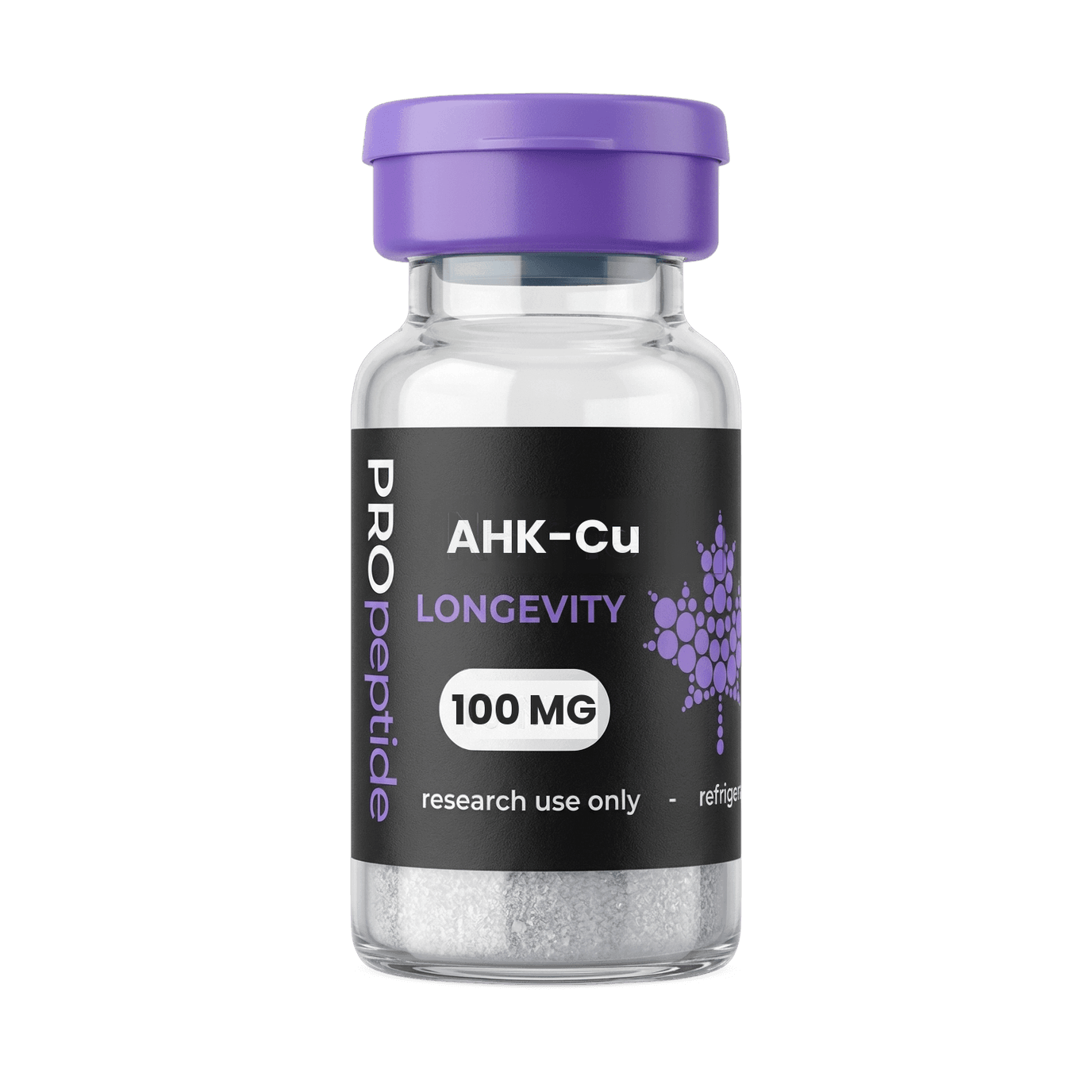
GHK-Cu's synthetic cousin, one residue different, same copper habit. Its entire independent evidence base is a single study from 2007.
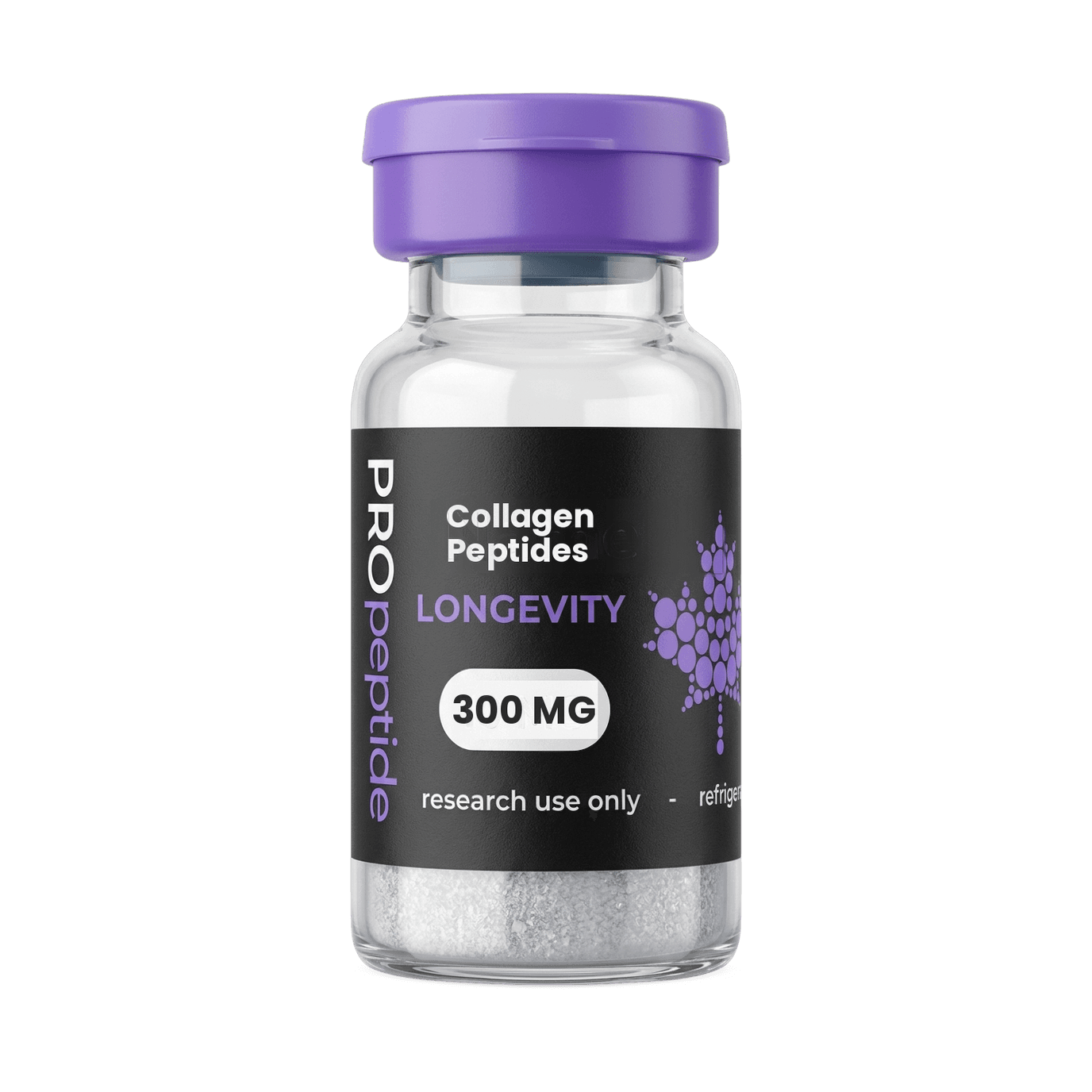
The least glamorous thing in the catalogue, and the one with a 35-trial human evidence base in osteoarthritis. A batch-variable hydrolysate, not a defined molecule, and honestly the best-evidenced item on this shelf.
It is water. We know. But it is the one bottle on this shelf where the boring ingredient is the entire product, and getting it wrong ruins everything else you bought.
Order GHK-Cu right now
One last look before you decide.
Freeze-dried, ships cold from Canada
You've got the whole file now, the thin parts included. Nothing above pretended otherwise. If that's the kind of source you were after, GHK-Cu is right here.
Not for human consumption. Not approved by Health Canada or any other regulatory body.
Page last updated October 4, 2026
People also search for GHK-Cu
Related searches.