
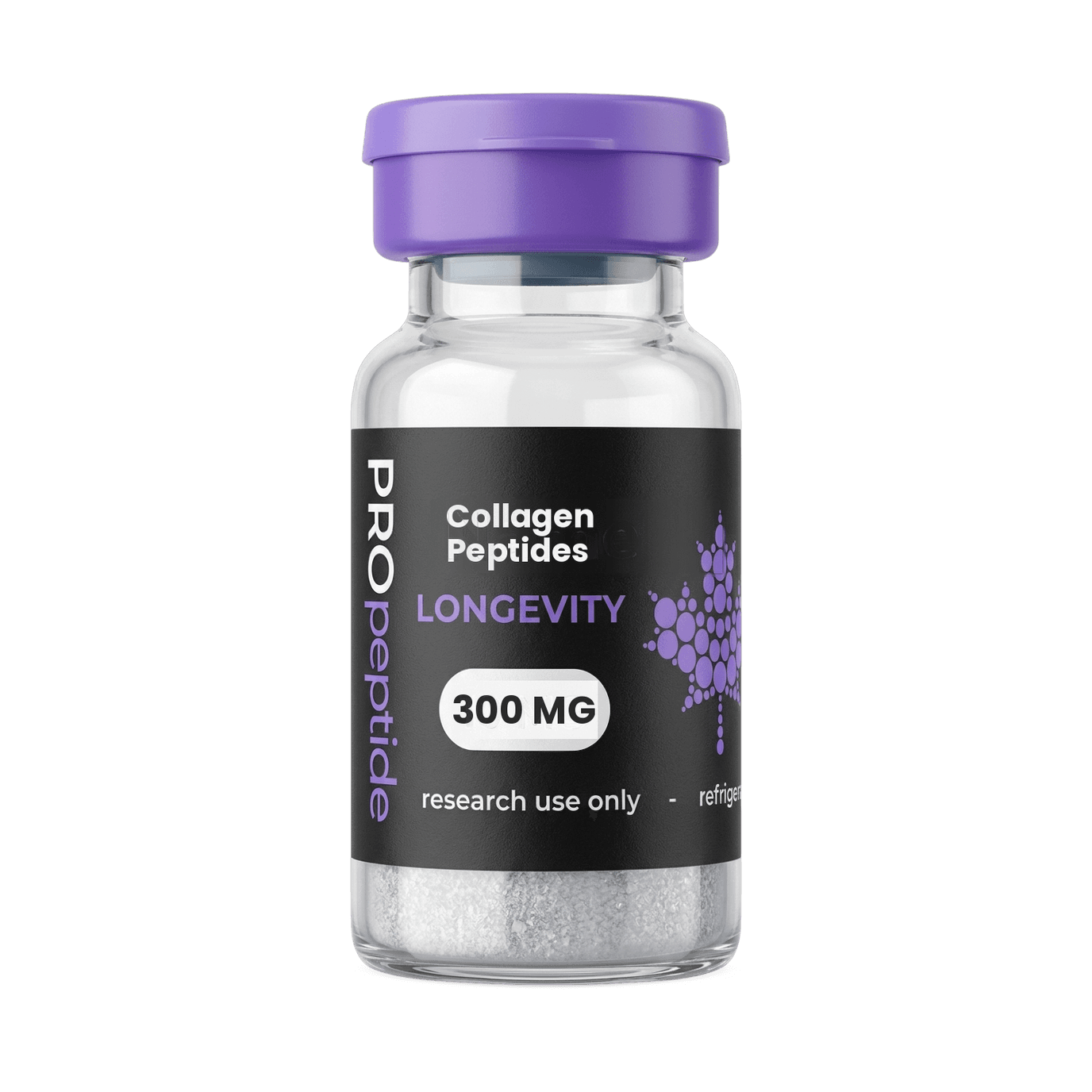
Collagen Peptides
Enzymatic hydrolysate of animal collagen. No single sequence, formula or CAS number.
Choose your pack
For research use only. Not for human or veterinary use.
What Collagen is
The plain-language version, first.
Ground-up structural protein, and the shelf's quiet evidence champion.
Collagen peptides are a heterogeneous, batch-variable mixture of low molecular weight peptides produced by enzymatic hydrolysis of animal collagen, without a single defined sequence, molecular formula, molecular weight or CAS number, commonly specified by nominal average molecular weight such as 2,000 or 5,000 daltons. In osteoarthritis they are supported by a trial sequential meta-analysis of 35 randomised controlled trials and 3,165 patients reporting a standardised mean difference of negative 0.35 for pain and negative 0.31 for function.
Here is the joke of this entire catalogue, delivered deadpan.
The exotic compounds with the underground reputations have animal files and empty human columns. And the boring one, the one your grandmother buys at the grocery store, has thirty-five human trials in osteoarthritis alone.
Collagen peptides: hydrolysed structural protein, batch-variable, unglamorous, and better-evidenced in humans than anything else we sell.
It is not a defined molecule. Hydrolysis chops collagen into a mixed population of fragments, so composition varies by source and process.
Which makes it the honest opposite of most of the shelf: weak on molecular definition, strong on human data.
We find this genuinely funny and also worth saying plainly.
What are collagen peptides?
Mechanism studied, not outcome promised.
Digested into fragments, some of which appear to signal.
The naive version of the mechanism is wrong, so let's clear it first: you do not eat collagen and wear it as collagen. Digestion dismantles it like any other protein.
The interesting version: some fragments, particularly proline-hydroxyproline pairs, survive absorption and appear to act as signals that cartilage-building cells respond to.
So the proposal is not raw material delivery. It is that the fragments function as a work order, nudging synthesis machinery.
Amino acid supply is a co-traveller too, less interesting but real.
Here's the honest part, which for once cuts the other way.
The mechanism is the weakest part of this file and the human results exist anyway. That is the mirror image of everything else here, where mechanisms sparkle and human results do not exist.
The research so far for Collagen
Where the evidence is thin, we say so.
Thirty-five human trials. Nothing else here comes close.
The file is genuinely substantial and worth stating without the usual hedging reflexes.
Around 35 randomised human trials in osteoarthritis contexts, plus more in skin and tendon settings. Effects are modest, gradual, and repeatedly detected against placebo.
Modest and real beats dramatic and imaginary, which is this shelf's whole lesson compressed into one product.
Caveats that survive: batch variability is genuine, trial quality varies, and several studies carry industry funding. Weigh all three.
Sold as food in most jurisdictions, which is its own kind of regulatory clearance.
The least exciting product we stock and the one with the most human evidence behind it. If that ordering surprises you, this catalogue has done its job.
Collagen peptides. Hydrolysed animal collagen, specified by molecular weight profile.
Collagen specs
The chemistry, exactly as released.
Who studies Collagen
Who tends to order this one, and why.
- 1
Osteoarthritis researchers
The Liang 2024 trial sequential meta-analysis is the current reference point, with high GRADE certainty on function across 3,165 patients.
- 2
Food science and formulation groups
Molecular weight distribution is the specification that matters here, not a formula. Size exclusion chromatography on the actual lot is how you know what you have.
- 3
Absorption and bioavailability work
Pro-Hyp in human serum after gelatin hydrolysate ingestion is one of the cleaner absorption findings for any orally administered peptide material.
- 4
Anyone comparing this to the rest of the catalogue
It is a food ingredient rather than an unapproved drug, the evidence base is orders of magnitude larger, and the two should not be reasoned about the same way.
Sold for laboratory research only. This is not guidance for personal use, and nothing here is a recommendation.
Collagen backstory
How it got here.
Collagen is the most abundant protein in most animals and it's been in the human food supply forever, which is why this compound has a completely different paper trail from everything else we sell.
Gelatin is partially hydrolysed collagen. People have been eating it for centuries without anybody calling it a peptide. The modern version just takes the hydrolysis further, using specific enzymes to drive the fragments down into the low kilodalton range where absorption gets easier.
Because it entered through food rather than through pharmacology, the regulatory position followed food rules. That single fact is the biggest structural difference between this product and every other product on this site, and it explains why the clinical literature is so much larger. It's easy to run a trial on a food ingredient. It is very hard to run one on an unapproved drug.
- 1
It came in through food
Gelatin is partially hydrolysed collagen and has been eaten for centuries. Modern collagen peptides simply push the hydrolysis further into the low kilodalton range.
- 2
Food rules, not drug rules
Because collagen entered through the food supply rather than through pharmacology, it was assessed as a food ingredient from the start.
- 3
Which is why the trials exist
Running randomised trials on a food ingredient is far easier than on an unapproved drug, and that regulatory difference is the direct reason 35 RCTs exist here and nowhere else in this batch.
Buying Collagen in Canada
What ships, how fast, and the paperwork.
This one is a food ingredient. Collagen peptides are not in scope for the WADA Prohibited List, FDA GRAS notices exist (GRN 21 and GRN 1171), and Health Canada maintains a Natural Health Product monograph for Hydrolyzed Collagen, so licensed products carrying an NPN can legally be sold in Canada. That is the opposite position from the rest of this catalogue, where Health Canada's advisory of 9 April 2026 states that peptides are generally regulated as prescription drugs.
Specify by molecular weight distribution. There is no formula or CAS to check against. What identifies a hydrolysate is its molecular weight profile, its source species and the enzyme used. Nominal averages such as 2,000 or 5,000 daltons describe a spread, not a compound.
Read the effect sizes honestly. Pain at a standardised mean difference of negative 0.35 and function at negative 0.31 are small to moderate. The evidence quality is the impressive part, not the magnitude.
Common questions
5 answers, none of them dodges.
Why don't collagen peptides have a molecular weight or CAS number?
Because they aren't a single molecule. Collagen peptides are a heterogeneous mixture produced by enzymatically hydrolysing animal collagen, and the mixture varies between batches, species and enzymes. One commercial hydrolysate measured 1.35 to 17 kilodaltons by size exclusion chromatography (López-Morales, 2019). Products are specified by nominal average molecular weight, commonly 2,000 or 5,000 daltons, which describes a distribution rather than a compound.
How strong is the osteoarthritis evidence?
Strong for its type. A 2024 trial sequential meta-analysis in Osteoarthritis and Cartilage pooled 35 randomised controlled trials and 3,165 patients (Liang, PMID 38218227). Pain came out at a standardised mean difference of negative 0.35 with moderate GRADE certainty, function at negative 0.31 with high certainty, and adverse events did not increase. The effects are small to moderate, and the certainty grades are the notable part.
What about skin, hydration and wrinkles?
Weaker than the joint evidence, and we'd rather you heard it from us. A 2021 review of 19 RCTs and 1,125 participants reported favourable results for hydration, elasticity and wrinkles (de Miranda, International Journal of Dermatology). A published comment then criticised the heterogeneity of the pooled studies (Peres, 2022), and much of that literature is short duration and industry funded. Cite joints before skin.
Do collagen peptides actually get absorbed?
Yes, and this is verified in humans rather than inferred. After people ingested gelatin hydrolysate, peptide-form hydroxyproline in blood rose to 20 to 60 nanomoles per millilitre at one to two hours, and the major food-derived collagen peptide identified in human serum was Pro-Hyp, a two residue fragment (Iwai, 2005, Journal of Agricultural and Food Chemistry, PMID 16076145).
Are collagen peptides regulated differently from other peptides?
Completely differently, because they're a food ingredient. FDA GRAS notices exist (GRN 21 and GRN 1171), and Health Canada maintains a formal Natural Health Product monograph for Hydrolyzed Collagen, so licensed products with an NPN can legally be sold. They're also not on the WADA Prohibited List and not in scope for it. Nothing else in this batch sits in that position.
Good pairing options with Collagen
What researchers stack alongside it.
Pairing is where research gets ahead of itself. These are the compounds researchers put in the same order as Collagen Peptides, which is a statement about ordering habits, not about evidence. Two things in one cart have not been studied together unless somebody studied them together.
A tripeptide from your own plasma that refuses to travel without its copper atom. The strongest card in its file is a 1994 topical gel trial, and the one blinded aesthetic trial found no objective benefit.
GHK-Cu's synthetic cousin, one residue different, same copper habit. Its entire independent evidence base is a single study from 2007.
It is water. We know. But it is the one bottle on this shelf where the boring ingredient is the entire product, and getting it wrong ruins everything else you bought.
Order Collagen right now
One last look before you decide.
Freeze-dried, ships cold from Canada
You've got the whole file now, the thin parts included. Nothing above pretended otherwise. If that's the kind of source you were after, Collagen is right here.
Not for human consumption. Not approved by Health Canada or any other regulatory body.
Page last updated October 4, 2026
People also search for Collagen
Related searches.