
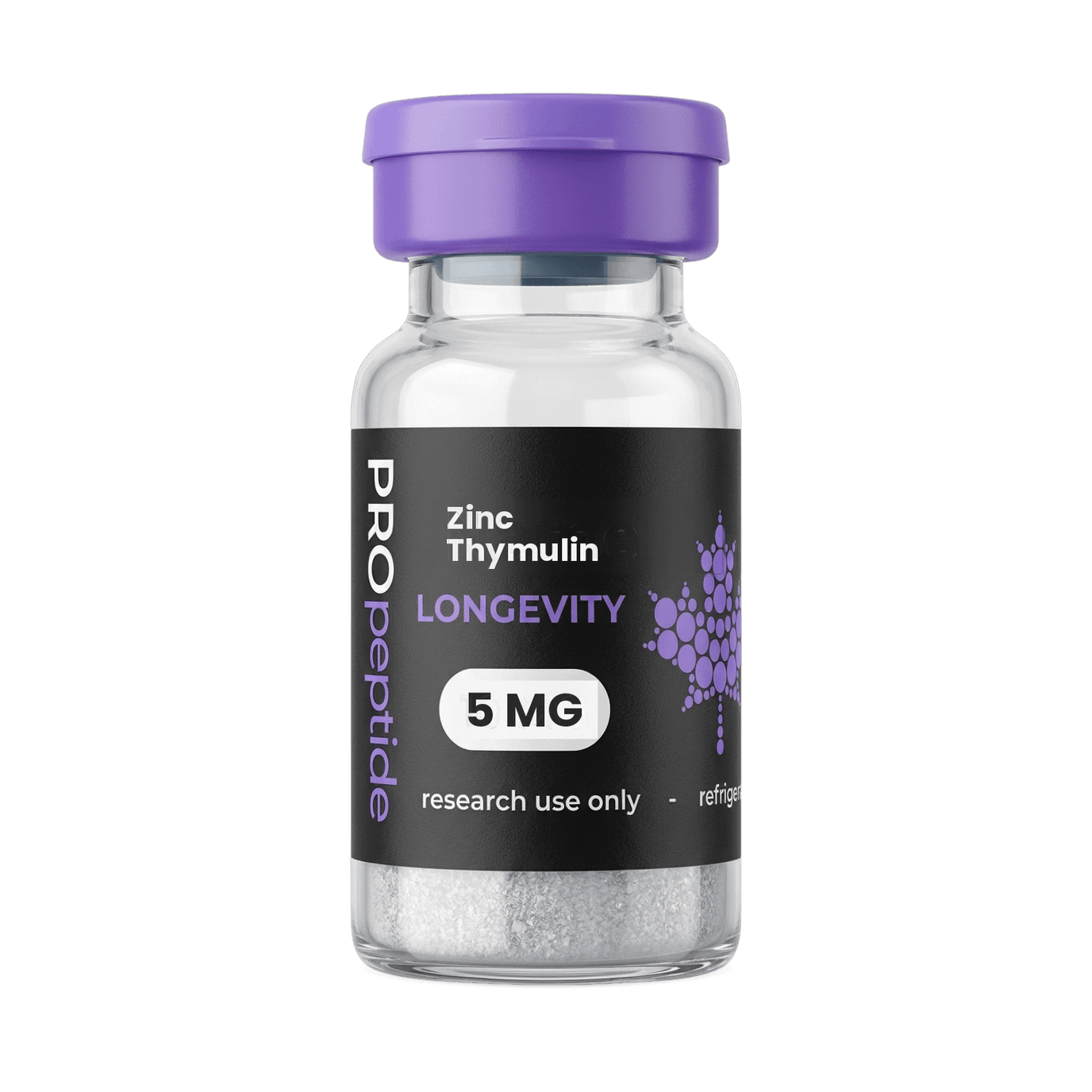
Zinc Thymulin Peptide
pGlu-Ala-Lys-Ser-Gln-Gly-Gly-Ser-Asn. Research use only, not for human consumption.
Choose your pack
For research use only. Not for human or veterinary use.
What Zinc Thymulin is
The plain-language version, first.
A peptide that does nothing at all until a metal atom clicks into it.
Zinc thymulin is the zinc-bound active form of thymulin, a thymic epithelial nonapeptide (pGlu-Ala-Lys-Ser-Gln-Gly-Gly-Ser-Asn, apo-peptide C33H54N12O15, molecular weight 858.9, CAS 78922-62-0) that is biologically inactive in the metal-free state and binds a single zinc ion with an apparent dissociation constant of 5 plus or minus 2 times ten to the minus seven molar at pH 7.5, with no binding detected below pH 6.0. No registered interventional human trial exists.
Most peptides work because of their shape. This one works because of what it is holding.
Thymulin is a nonapeptide from the thymus. On its own, with no zinc bound, it has no measurable activity whatsoever.
Not reduced, not weaker: none. Add a zinc atom and it becomes active.
That is an unusually binary arrangement and it is the whole reason the compound is named the way it is. The zinc is not an additive, it is a constituent.
It also means the compound's behaviour tracks zinc availability, which is a strange property for a signalling molecule to have.
A peptide whose activity is effectively a readout of whether a mineral is present.
What is zinc thymulin?
Mechanism studied, not outcome promised.
Zinc is the switch, and the switch is the interesting part.
Think about a key that only works when it is holding a magnet.
Same cuts, same shape, same everything. Without the magnet the lock does not recognise it at all.
That is zinc-thymulin, and it makes the molecule useful for a purpose most people are not expecting.
Because activity depends on zinc binding, measuring active thymulin tells you something about zinc status rather than about thymulin production.
Which is exactly how the modern literature uses it. Not as something to give, but as something to measure.
Here's the honest part, and it reframes the whole page.
The serious contemporary work regards this as a marker rather than an intervention. That is a real research role and it is not the one it gets sold for.
The research so far for Zinc Thymulin
Where the evidence is thin, we say so.
Observational in humans, which is a specific and limited kind of evidence.
The evidence here has a specific shape and the shape matters more than the volume.
The thymus work goes back to the seventies and eighties, and it is real endocrinology from a period when thymic peptides got substantial attention.
The human evidence is observational. Not a randomised trial that disappointed. Observational, which is a different category entirely.
Observational work can establish an association and it cannot establish a direction. That is not a criticism, it is what the design can and cannot do.
No modern randomised trial. Nothing approved.
A well-characterised molecule with a genuinely interesting zinc dependency, an honest observational file, and a marketing story considerably ahead of both.
Zinc thymulin, research grade, sold for laboratory use only.
Zinc Thymulin specs
The chemistry, exactly as released.
Who studies Zinc Thymulin
Who tends to order this one, and why.
- 1
Zinc nutrition researchers
Thymulin activity is a more sensitive index of marginal zinc restriction than serum zinc, which makes it useful as a readout rather than as an input.
- 2
Metallopeptide chemists
A nine residue peptide whose activity is entirely conditional on a single bound metal ion, with a measured binding constant and a sharp pH dependence, is a compact model system.
- 3
Thymic immunology groups
Thymulin's original characterisation as a thymic epithelial hormone inducing T cell differentiation remains the reference frame for the compound.
- 4
Anyone evaluating vendor hair loss claims
The topical study behind those claims is not retrievable through PubMed or Europe PMC. Knowing that before you read a marketing page is worth more than the claims themselves.
Sold for laboratory research only. This is not guidance for personal use, and nothing here is a recommendation.
Zinc Thymulin backstory
How it got here.
1977, Nature. Bach, Dardenne, Pleau and Rosa describe a factor from the thymus that makes T cells grow up. It's a clean piece of endocrinology and for five years that's what it is.
Then somebody asks the question that changes it. What happens if you take the metal out?
The answer was that the molecule stops working. Not works less. Stops. And when you put zinc back, it starts again, best at exactly one zinc per peptide. Dardenne's group proposed the name thymulin for the zinc-containing form in 1982, which is a rare case of a naming decision carrying a scientific argument inside it.
Two years later Gastinel's group put numbers on it and found the pH floor. Below 6.0, no binding.
Where it went after that is the interesting part. Thymulin didn't become a drug. It became an instrument. If you want to know whether an animal or a person is marginally zinc deficient, thymulin activity tells you sooner than serum zinc does.
- 1
Nature, 1977
Bach, Dardenne, Pleau and Rosa characterise a thymic factor that drives T cell differentiation (DOI 10.1038/266055a0).
- 2
The chelation experiment, 1982
Strip the metal and the activity goes. Add zinc back and it returns, best at one to one. The name thymulin was proposed for the zinc-containing active form.
- 3
The pH floor, 1984
One zinc per peptide, apparent Kd around 5 times ten to the minus seven molar at pH 7.5, and no binding at all below pH 6.0.
Buying Zinc Thymulin in Canada
What ships, how fast, and the paperwork.
Research use only. Sold for laboratory research use only, not for human or veterinary consumption. Health Canada's advisory of 9 April 2026 states that peptides are generally regulated as prescription drugs in Canada, and that "For Research Use Only" labelling does not make these products legal. Zinc thymulin is not named in that advisory, which is not the same as being permitted.
We won't print a complex molecular weight. The apo-peptide is 858.9 daltons, C33H54N12O15, CAS 78922-62-0. A weight for the zinc complex depends on stoichiometry and counter-ions and is not established, so any single figure you see for it is a guess with a decimal point.
The pH detail is not trivia. Zinc binding to thymulin was not detectable below pH 6.0 in the original binding work. Whatever the metal is doing, it stops doing it in acidic conditions.
Common questions
5 answers, none of them dodges.
Why is it called zinc thymulin instead of just thymulin?
Because the zinc is part of the definition. Dardenne's 1982 PNAS work showed the metal-free peptide is biologically inactive, that chelation abolishes activity, and that zinc salts restore it best at a one to one ratio. The authors proposed the name thymulin specifically for the zinc-containing active form. The metal isn't an additive, it's the difference between active and inert.
What is thymulin's molecular weight?
The apo-peptide is C33H54N12O15 at 858.9 daltons, CAS 78922-62-0. For the zinc complex there is no established figure, because it depends on the stoichiometry and the counter-ions present. Plenty of listings print a single number for the complex anyway. We'd rather explain the gap than fill it with something we can't source.
Are there human studies on zinc thymulin?
No registered interventional trial exists. The genuine human literature is observational and treats thymulin as a marker rather than a treatment, for instance reduced thymulin activity in anorexia nervosa (Wade, 1985, PMID 3927699). Its only formal US regulatory mention is negative, since thymulin acetate sits on the FDA's 503A Category 3 list of bulk substances nominated without adequate support.
What about the hair loss study everyone cites?
We couldn't retrieve it. It's a topical hair loss paper in a low-tier journal that isn't indexed in PubMed or Europe PMC, which means we can't read the methods, the sample size or the endpoints. Citing numbers out of a paper you can't open isn't research, it's repetition. So we've left it out entirely rather than pass it along.
Does pH really matter that much?
It does for the binding. Gastinel and colleagues in 1984 found one zinc bound per peptide with an apparent Kd around 5 times ten to the minus seven molar at pH 7.5, and no detectable binding below pH 6.0. That's a hard floor rather than a gradual decline, and it means the active complex is conditional on its environment.
Zinc Thymulin Peptide vs Thymalin
Stacked together constantly, compared almost never.
Two thymus products, one defined and one not, and the difference decides what you can actually know about each.
Zinc-thymulin is a defined nonapeptide with a genuinely odd property: zero activity until a zinc ion clicks in. The modern literature reads it as a zinc-status marker.
Thymalin is a calf thymus extract, standardised by activity rather than structure, with a substantial and almost entirely Russian clinical record.
One you can write a sequence for and one you cannot. Every downstream question about mechanism and evidence inherits that difference first. Thymalin has its own page here
Good pairing options with Zinc Thymulin
What researchers stack alongside it.
Pairing is where research gets ahead of itself. These are the compounds researchers put in the same order as Zinc Thymulin Peptide, which is a statement about ordering habits, not about evidence. Two things in one cart have not been studied together unless somebody studied them together.
Licensed in more than thirty countries as Zadaxin, which makes it the diplomat of this catalogue. Its biggest randomised trial found no mortality benefit, and both facts belong in the first sentence.
It has no sequence and no CAS number, because it is not a molecule. It is an extract of calf thymus, still in clinical use across Russia, and that combination is genuinely unusual.
It is water. We know. But it is the one bottle on this shelf where the boring ingredient is the entire product, and getting it wrong ruins everything else you bought.
Order Zinc Thymulin right now
One last look before you decide.
Freeze-dried, ships cold from Canada
You've got the whole file now, the thin parts included. Nothing above pretended otherwise. If that's the kind of source you were after, Zinc Thymulin is right here.
Not for human consumption. Not approved by Health Canada or any other regulatory body.
Page last updated October 4, 2026
People also search for Zinc Thymulin
Related searches.