
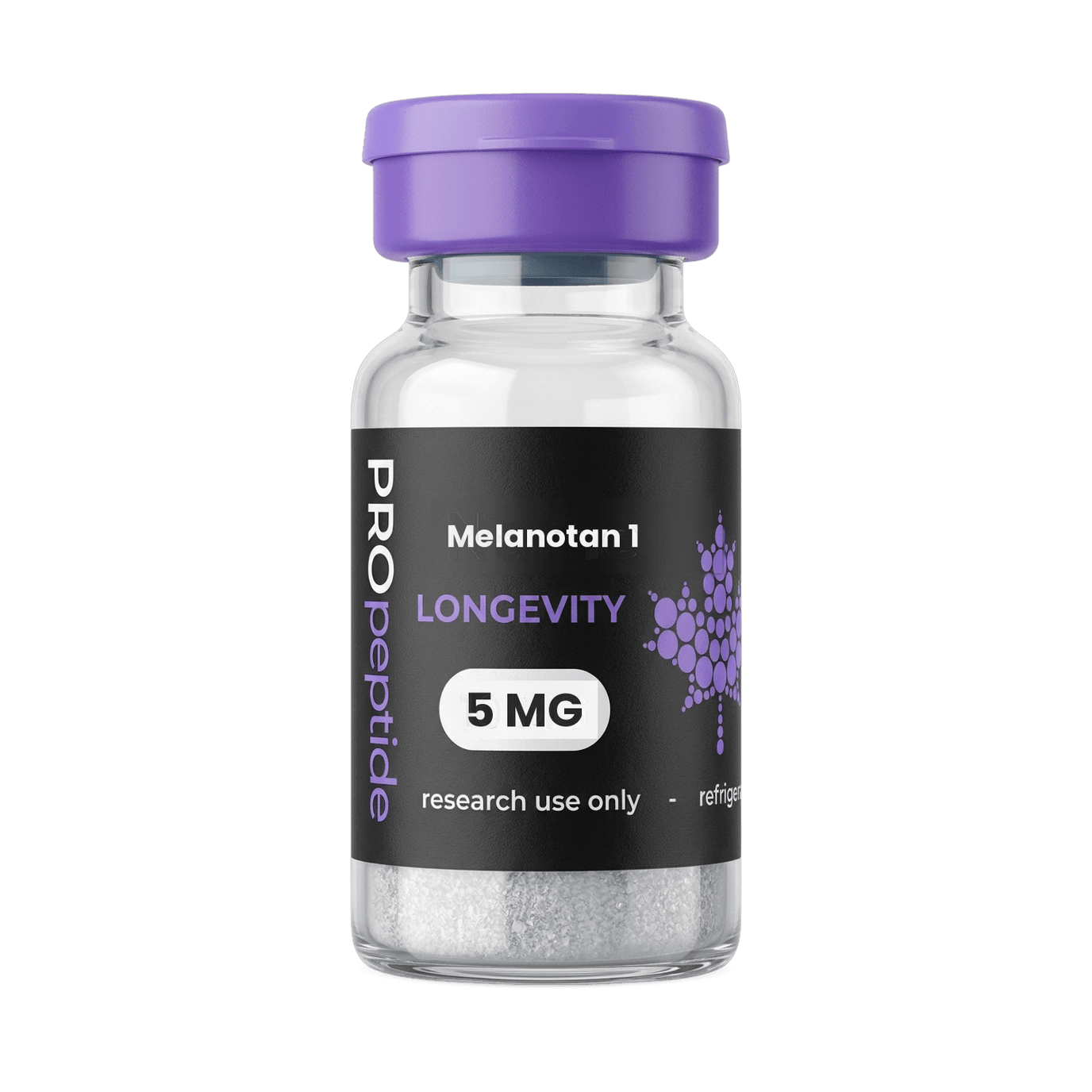
Melanotan 1 Peptide (Afamelanotide)
FDA approved in 2019, for a rare light sensitivity disorder, and delivered as an implant rather than an injection.
Choose your pack
For research use only. Not for human or veterinary use.
What Melanotan 1 Peptide (Afamelanotide) is
The plain-language version, first.
The respectable sibling: an approved orphan drug with a research-vial twin.
Melanotan 1 is afamelanotide, a 13 amino acid analogue of alpha melanocyte stimulating hormone that binds the melanocortin 1 receptor and increases eumelanin production in the skin. It is an approved medicine sold as SCENESSE and delivered as a subcutaneous implant rather than an injection, cleared by the FDA in 2019 for erythropoietic protoporphyria and carrying Canadian DIN 02569825.
Two melanotans exist and their lives went in opposite directions. This is the one that made it.
Melanotan-1, generic name afamelanotide, is approved in Europe and the US as SCENESSE, for erythropoietic protoporphyria, a rare disorder where sunlight causes burning pain.
The molecule is alpha-MSH, your natural pigmentation hormone, with one substitution that makes it stable enough to be useful.
For EPP patients, driving protective pigmentation is genuinely life-changing, which is what carried it through a full approval.
And the approved product is a controlled-release implant, placed under the skin in a clinic, on a schedule.
An implant, in a clinic, for a rare disease. Hold that image next to a research vial and the gap between them is this entire page.
What is Melanotan 1?
Mechanism studied, not outcome promised.
One substitution stabilises the tanning hormone your pituitary already makes.
Alpha-MSH tells melanocytes to produce melanin. That is the tanning signal, and this molecule is that signal with better structural stamina.
One residue swap resists enzymatic breakdown, turning a fleeting hormone into a workable drug.
The melanocortin receptor family runs several departments, and MT-1 is relatively selective toward the pigmentation one, which is part of why it is the sibling that got approved.
Melanin genuinely does absorb light. For EPP patients that is protection. The mechanism is about as clean as this receptor family offers.
Here's the honest part.
The approval validates the molecule for one disease, in one formulation, under supervision. It does not validate anything about unsupervised versions of the same sequence.
The research so far for Melanotan 1 Peptide (Afamelanotide)
Where the evidence is thin, we say so.
A real EMA and FDA approval, for a disease most people have never heard of.
A complete, respectable file: orphan drug development, EMA approval in 2014, FDA in 2019, and post-market data in EPP since.
Documented efficacy in its indication, with a safety profile monitored in the implant context.
All of it belongs to SCENESSE: the implant, the clinic, the follow-up. That is what the evidence covers.
Unregulated vial versions of the sequence inherit none of the manufacturing control and all of the pharmacology.
The success story of its family, and the success is specific: one disease, one formulation, one supervised setting. Precision about that is the difference between citing the file and abusing it.
Have a look at current stock and vial sizes.
Melanotan 1 Peptide (Afamelanotide) specs
The chemistry, exactly as released.
Who studies Melanotan 1 Peptide (Afamelanotide)
Who tends to order this one, and why.
- 1
Dermatology
Erythropoietic protoporphyria, and the melanocytic monitoring the label requires given that the drug stimulates melanocytes directly.
- 2
Porphyria medicine
The approved indication. A rare inherited disorder that had no approved treatment at all before 2019.
- 3
Melanocortin pharmacology
MC1R selectivity and the eumelanin versus pheomelanin switch, which is the cleanest example of a receptor determining a visible phenotype.
- 4
Drug delivery
A bioresorbable implant chosen over injection because sustained low-level exposure is what the indication requires.
Sold for laboratory research only. This is not guidance for personal use, and nothing here is a recommendation.
Melanotan 1 Peptide (Afamelanotide) backstory
How it got here.
Alpha-MSH analogues came out of melanocortin research at the University of Arizona in the 1980s, where the goal was understanding pigmentation biology rather than building a drug. Melanotan 1 and Melanotan 2 both trace to that programme and then diverged sharply.
Melanotan 1 was licensed and developed properly. Clinuvel Pharmaceuticals took it through clinical trials in erythropoietic protoporphyria, secured European approval, and then FDA approval in October 2019. It is now a marketed prescription medicine.
Melanotan 2 was never developed by anyone. It has no approval anywhere and its literature is largely case reports.
Same research origin, two completely different regulatory outcomes, and that contrast is the most useful thing to understand about either of them.
- 1
Arizona, the 1980s
Melanocortin research aimed at understanding pigmentation biology produced the alpha-MSH analogues that became Melanotan 1 and 2.
- 2
One got developed
Clinuvel took afamelanotide through clinical trials in erythropoietic protoporphyria to European approval and then FDA approval on 8 October 2019.
- 3
The other did not
Melanotan 2 was never developed by any sponsor, has no approval anywhere, and its human literature is largely case reports.
Buying Melanotan 1 Peptide (Afamelanotide) in Canada
What ships, how fast, and the paperwork.
Same day out of British Columbia. Our building, our cold packs, our people, and nothing sitting in a customs queue while you refresh a tracking page.
Then into the fridge. Keep it cold and keep it dark. Sealed and freeze-dried it handles a rough trip without ice. Once it lands, fridge.
The approval is real and it is narrow. Approved for one rare disorder, in one delivery format, an implant placed by a clinician every two months. That is not the same as evidence for a reconstituted vial in someone without the condition, and we would rather draw that line than blur it.
Common questions
5 answers, none of them dodges.
Is Melanotan 1 an approved drug?
Yes. Afamelanotide was approved by the FDA on 8 October 2019 under NDA 210797, brand name SCENESSE, and had been approved earlier by the European Medicines Agency. The indication, verbatim, is to increase pain free light exposure in adult patients with a history of phototoxic reactions from erythropoietic protoporphyria.
What form is the approved product?
A bioresorbable implant, not an injection. Each implant contains 16 milligrams of afamelanotide in a rod approximately 1.7 centimetres long and 1.45 millimetres in diameter, placed subcutaneously by a clinician every two months. There is no approved reconstituted injectable form.
What is erythropoietic protoporphyria?
A rare inherited disorder in which protoporphyrin accumulates in the skin. Light striking it releases energy and produces severe burning pain, often with no visible burn. It had no approved treatment at all before afamelanotide, and patients frequently avoided daylight entirely.
How is Melanotan 1 different from Melanotan 2?
They share a research origin in 1980s melanocortin work and diverged completely. Melanotan 1 is relatively MC1R selective, was developed through clinical trials by a sponsor, and is an approved medicine. Melanotan 2 acts across more melanocortin receptors, was never developed by anyone, has no approval in any country, and its human literature is largely case reports.
What are the documented side effects?
From the FDA label, above 2 percent: implant site reaction 21 percent, nausea 19 percent, oropharyngeal pain 7 percent, cough 6 percent, fatigue 6 percent, dizziness 4 percent, skin hyperpigmentation 4 percent, melanocytic nevus 4 percent, respiratory tract infection 4 percent, and somnolence, non-acute porphyria and skin irritation at 2 percent each.
Melanotan 1 Peptide (Afamelanotide) vs Melanotan-2
Stacked together constantly, compared almost never.
Two siblings from the same tanning-peptide programme, and their lives could not have diverged harder.
Melanotan-1 is the selective one. It stayed close to the natural hormone, aimed mostly at the pigmentation receptor, and finished development as SCENESSE, an approved implant for a rare light-sensitivity disorder.
Melanotan-2 is the shortcut: shorter, cyclic, more potent, and promiscuous across the receptor family. No sponsor finished it, and its modern human literature is substantially adverse-event case reports.
Selectivity is the entire difference. One sibling kept its aim narrow and became a medicine. The other hit everything at once and became a cautionary tale. Melanotan-2 has its own page here
Good pairing options with Melanotan 1 Peptide (Afamelanotide)
What researchers stack alongside it.
Pairing is where research gets ahead of itself. These are the compounds researchers put in the same order as Melanotan 1 Peptide (Afamelanotide), which is a statement about ordering habits, not about evidence. Two things in one cart have not been studied together unless somebody studied them together.
The sibling no sponsor ever developed and no regulator ever approved. Its published human record is substantially adverse-event case reports, which is a sentence worth reading twice.
Bremelanotide, the melanocortin agonist that went all the way to FDA approval in 2019, carrying a documented blood pressure signal and a hyperpigmentation risk on its label.
It is water. We know. But it is the one bottle on this shelf where the boring ingredient is the entire product, and getting it wrong ruins everything else you bought.
Order Melanotan 1 Peptide (Afamelanotide) right now
One last look before you decide.
Freeze-dried, ships cold from Canada
You've got the whole file now, the thin parts included. Nothing above pretended otherwise. If that's the kind of source you were after, Melanotan 1 Peptide (Afamelanotide) is right here.
Not for human consumption. Not approved by Health Canada or any other regulatory body.
Page last updated October 4, 2026
People also search for Melanotan 1 Peptide (Afamelanotide)
Related searches.