
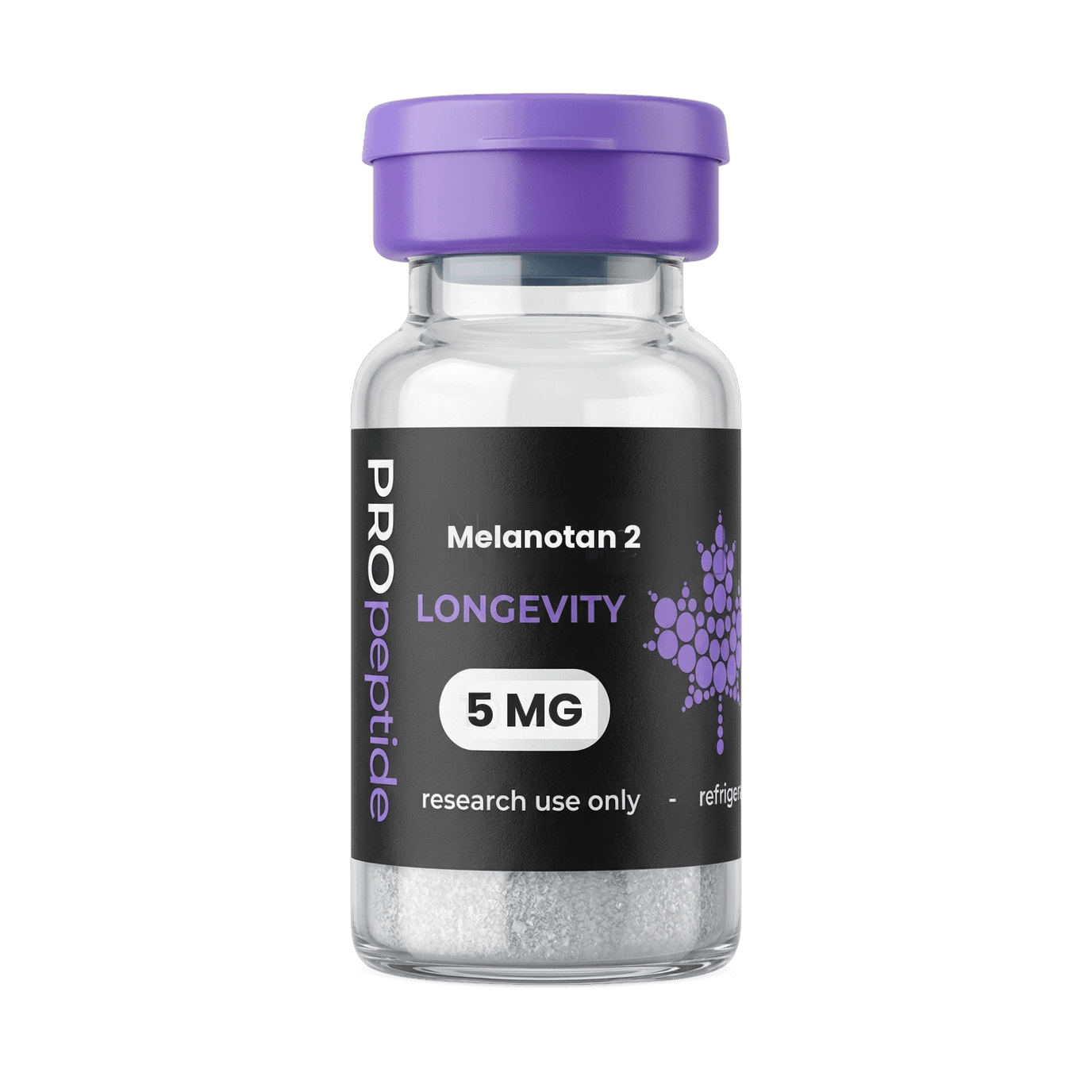
Melanotan 2 Peptide
Never developed by anyone, approved nowhere, and its human literature is mostly case reports of things going wrong.
Choose your pack
For research use only. Not for human or veterinary use.
What Melanotan 2 is
The plain-language version, first.
The shortcut version of the tanning peptide, and the one medicine abandoned.
Melanotan 2 is a cyclic seven amino acid analogue of alpha melanocyte stimulating hormone that acts as a non-selective agonist at melanocortin receptors including MC1R, MC3R and MC4R. It was never taken through clinical development by any sponsor, is approved in no country, and its human literature consists largely of case reports describing adverse events.
Same family as the approved implant. Opposite biography.
Melanotan-2's a shortened cyclic analogue of alpha-MSH: more potent, less selective, and dropped by legitimate development decades ago.
No sponsor carried it forward. No regulator anywhere has approved it. It's a grey-market product today, and that's all it is.
Think of two cousins from the same Arizona lab in the 1980s. One finished school, got the diploma, and has an FDA label with monitoring requirements on it. The other one's the one your buddy knows a guy for.
The cyclic structure that makes it potent also makes it promiscuous across the melanocortin family, hitting departments its approved sibling was chosen specifically to avoid. Which is exactly why one sibling's got a drug label and the other's got case reports.
The difference between MT-1 and MT-2 is the difference between selectivity and reach, and the file below shows you what reach costs.
What is Melanotan 2?
Mechanism studied, not outcome promised.
Less selective than its approved sibling, and the extra receptors are the problem.
Recall that the melanocortin family runs pigmentation, appetite and arousal signalling through related receptors.
MT-2's cyclic structure grips across all of them. It's a master key, and a master key opens the doors you wanted locked too.
The passengers are documented: nausea, appetite effects, spontaneous arousal effects, and the pigmentation itself arriving unevenly, with darkening moles a recurring clinical observation.
Its arousal-signalling activity is literally how PT-141 got discovered, as a breakdown product of this molecule during trials that were then pointed somewhere else.
Here's the honest part.
A molecule can be potent, interesting and abandoned for cause all at once. The abandonment wasn't an accident of funding. Selectivity was the reason, and it's the whole reason.
The research so far for Melanotan 2
Where the evidence is thin, we say so.
The human literature is mostly case reports of things going wrong.
The published human record on MT-2 has an unusual shape, and the shape is the story.
There's a handful of small trials from the 1990s and 2000s, before development stopped. What's piled up since is case reports, and case reports in medicine are how bad outcomes get written down. They're the incident log at the front desk, not the brochure.
Darkening and changing moles come up again and again, which, given the mechanism, is exactly what a dermatologist would predict and worry about.
No approval anywhere, no sponsor, and no safety programme watching the grey market that actually uses it.
We're not gonna dress it up. Case reports don't have a denominator, so nobody can tell you how often any of this happens. They can tell you it's happened, and that clinicians thought it was worth writing up.
The approved sibling proves this family can make a real medicine. This molecule is the version of the story where nobody finished the work, and the case-report literature is what unfinished looks like in humans.
Have a look at the vial sizes we keep in stock.
Melanotan 2 specs
The chemistry, exactly as released.
Who studies Melanotan 2
Who tends to order this one, and why.
- 1
Melanocortin pharmacology
The non-selective profile across MC1R, MC3R, MC4R and MC5R makes it a tool compound for probing multiple receptors at once, which is also its clinical problem.
- 2
Dermatology
The case literature on changes in melanocytic naevi and melanoma. Melanotan 1, the more selective analogue, carries dermatologic monitoring in its approved label.
- 3
Toxicology and emergency medicine
Rhabdomyolysis and posterior reversible encephalopathy syndrome are the published serious presentations, and they came from clinicians treating them.
- 4
Nobody, in clinical development
No sponsor has ever run a completed clinical programme on this compound. That is the honest answer for this row.
Sold for laboratory research only. This is not guidance for personal use, and nothing here is a recommendation.
Melanotan 2 backstory
How it got here.
The Arizona melanocortin programme was studying pigmentation biology, not building a tanning product. Alpha-MSH analogues came out of it, engineered for stability and potency at melanocortin receptors.
Melanotan 1 found a genuine unmet medical need in erythropoietic protoporphyria, a rare disorder where patients cannot tolerate daylight, and a company committed to the decade of trials required to get it approved.
Melanotan 2 found a market instead of a sponsor. Its non-selective receptor profile produced effects people wanted, it spread through informal channels, and the clinical development that would have characterised its risks never happened.
What filled that gap was case reports, written by clinicians treating the consequences.
- 1
One laboratory, two molecules
University of Arizona melanocortin research in the 1980s produced both Melanotan 1 and Melanotan 2 as engineered alpha-MSH analogues.
- 2
One found a sponsor
Clinuvel took Melanotan 1 through clinical trials in erythropoietic protoporphyria to European and then FDA approval in October 2019.
- 3
One found a market
Melanotan 2 was never developed. It spread through informal channels and the characterisation of its risks came from clinicians writing case reports.
Buying Melanotan 2 in Canada
What ships, how fast, and the paperwork.
Same day out of British Columbia. Our building, our cold packs, our people, and nothing sitting in a customs queue while you refresh a tracking page.
Then into the fridge. Keep it cold and keep it dark. Sealed and freeze-dried it handles a rough trip without ice. Once it lands, fridge.
The case literature is the safety data. There is no trial safety profile for this compound because there was never a trial. What exists instead are published case reports including melanoma and changes in existing moles, rhabdomyolysis, and posterior reversible encephalopathy syndrome. We would rather you read that here than not at all.
Common questions
5 answers, none of them dodges.
Has Melanotan 2 ever been through a clinical trial?
No completed clinical development programme exists. No sponsor took it forward, there is no phase 3, no approval application in any country and no regulator has ever assessed it. Melanotan 1, which came out of the same 1980s Arizona research, went through the full process and was approved by the FDA in October 2019.
What harms are documented in the literature?
The published human record is largely case reports, and the signals in it include melanoma and changes in existing melanocytic naevi, rhabdomyolysis, and posterior reversible encephalopathy syndrome. Case reports have no denominator so they cannot tell you how often these occur, but they do establish that they have happened and that clinicians thought them worth publishing.
How is it different from Melanotan 1?
Receptor selectivity, and regulatory history. Melanotan 1 is relatively selective for MC1R, the pigmentation receptor, and is an approved medicine. Melanotan 2 is non-selective, agonising MC1R, MC3R, MC4R and MC5R, which brings appetite, sexual function and autonomic pathways into play alongside pigmentation. It has no approval anywhere.
Why does the melanoma signal matter more here than elsewhere?
Because of the mechanism. This compound acts directly on melanocytes, the cells melanoma arises from. A melanocyte-stimulating drug appearing in melanoma case reports is not a coincidental pairing, it is the specific risk you would design monitoring around. Melanotan 1, the more selective and approved analogue, carries dermatologic monitoring requirements in its FDA label for that reason.
Is Melanotan 2 legal to sell?
It is not an approved drug in any country and is not authorised for human use. Regulators in several jurisdictions have issued warnings about products containing it. Everything on this site is supplied for research use only and not for human consumption.
Good pairing options with Melanotan 2
What researchers stack alongside it.
Pairing is where research gets ahead of itself. These are the compounds researchers put in the same order as Melanotan 2 Peptide, which is a statement about ordering habits, not about evidence. Two things in one cart have not been studied together unless somebody studied them together.
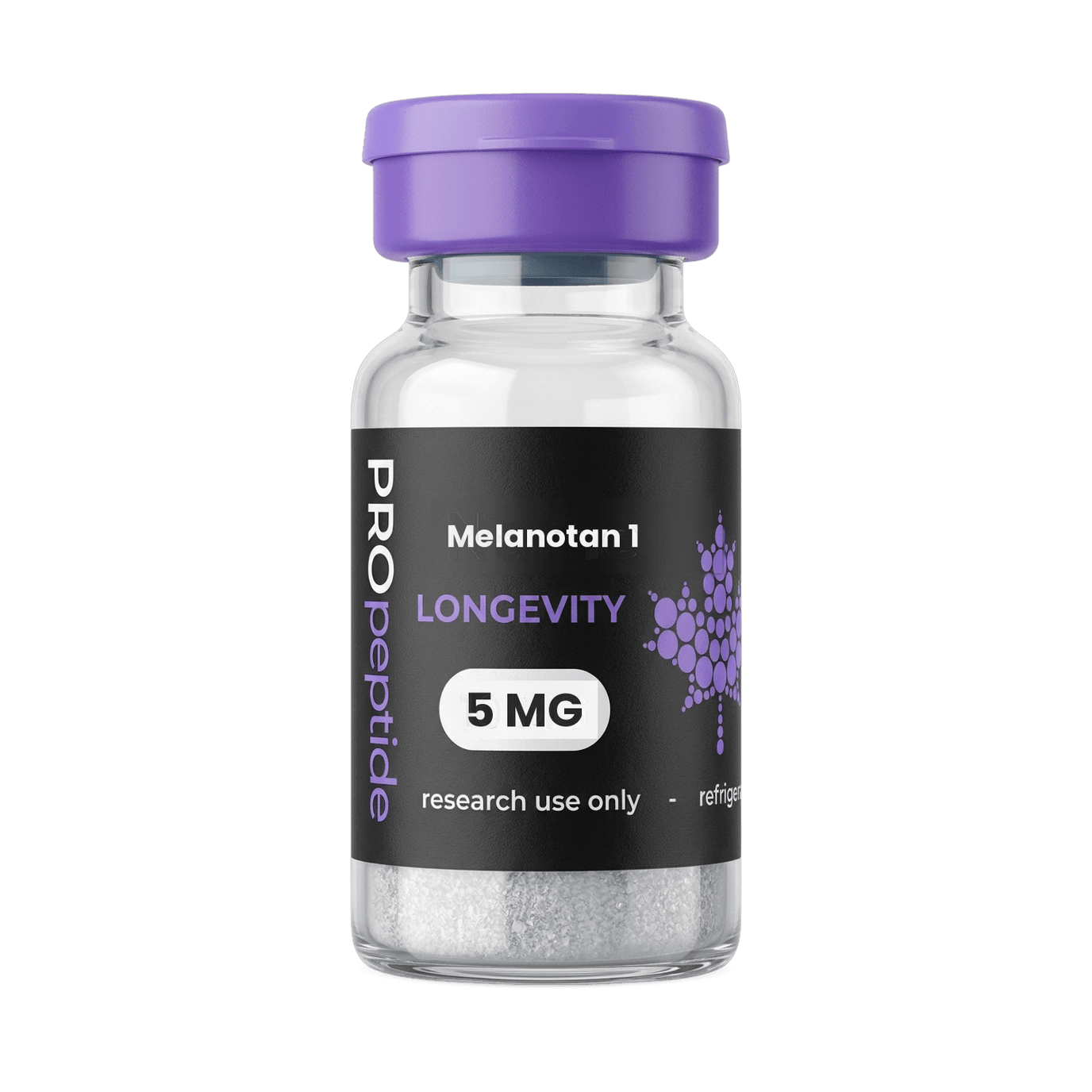
The alpha-MSH analogue that grew up and got approved as SCENESSE for a rare light-sensitivity disorder. The approved product is a subdermal implant in a clinic. This is not that, and the difference is the page.
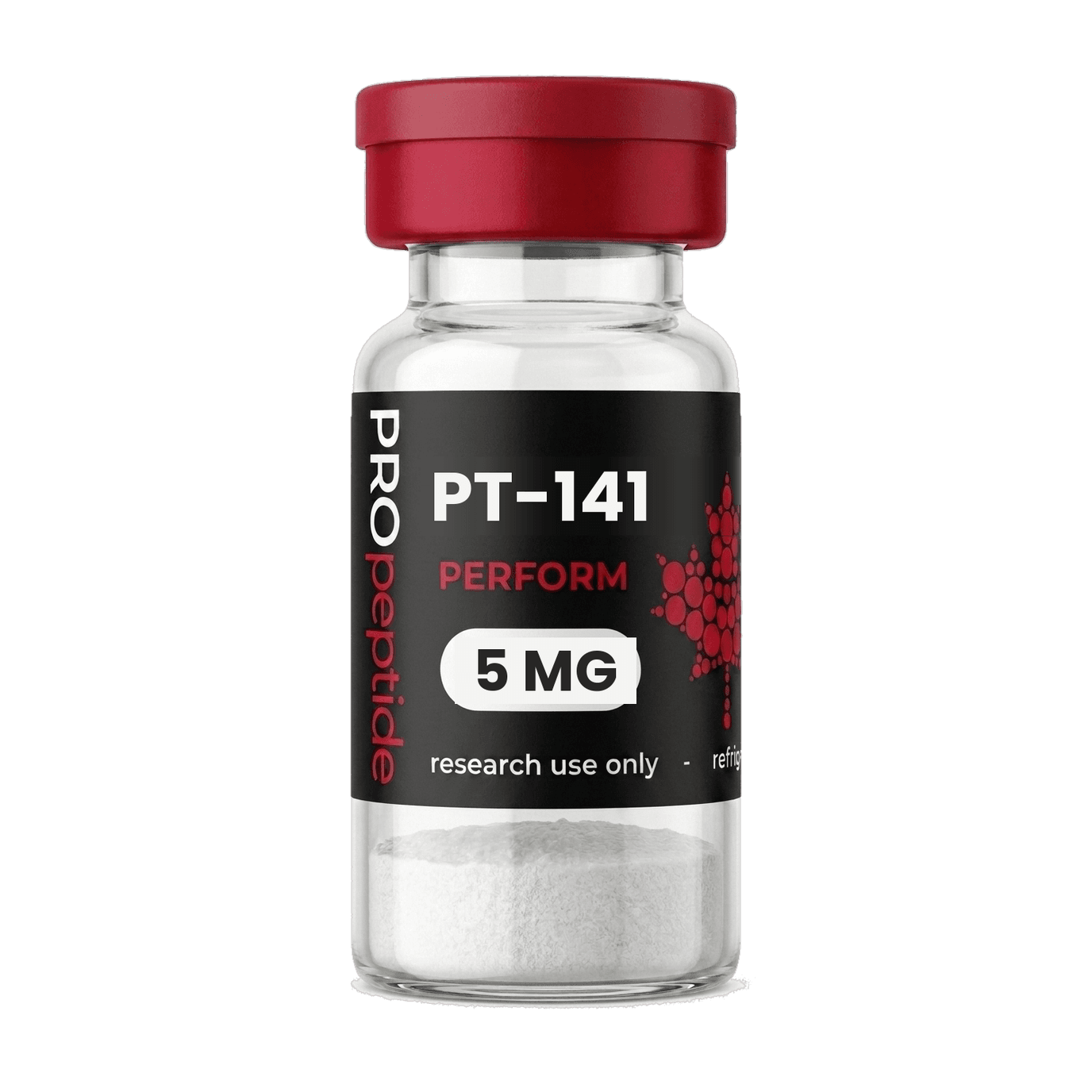
Bremelanotide, the melanocortin agonist that went all the way to FDA approval in 2019, carrying a documented blood pressure signal and a hyperpigmentation risk on its label.
It is water. We know. But it is the one bottle on this shelf where the boring ingredient is the entire product, and getting it wrong ruins everything else you bought.
Order Melanotan 2 right now
One last look before you decide.
Freeze-dried, ships cold from Canada
You've got the whole file now, the thin parts included. Nothing above pretended otherwise. If that's the kind of source you were after, Melanotan 2 is right here.
Not for human consumption. Not approved by Health Canada or any other regulatory body.
Page last updated October 4, 2026
People also search for Melanotan 2
Related searches.