
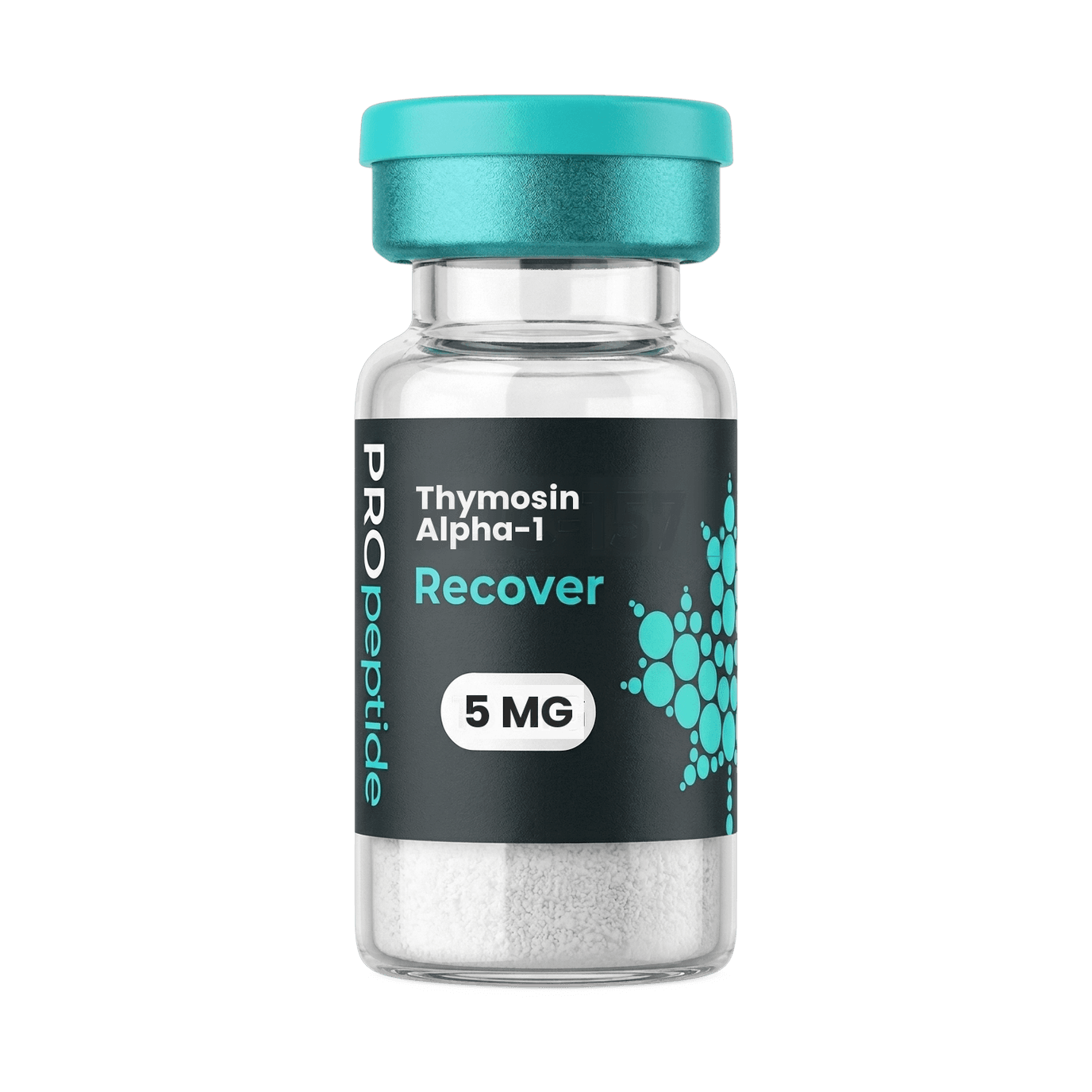
Thymosin Alpha-1 Peptide
Approved in over thirty countries. Its largest trial, 1,106 patients, came back null.
Choose your pack
For research use only. Not for human or veterinary use.
What Thymosin Alpha-1 is
The plain-language version, first.
Thymosin alpha-1 is a defined 28 amino acid peptide, originally identified in a crude thymus fraction and now produced synthetically, studied as an immune modulator acting on T cell maturation and Toll-like receptor signalling. It is approved as a medicine in more than thirty countries under the name thymalfasin, sold as Zadaxin, and its largest trial, with 1,106 patients, returned a null result.
By passport count, this is the most legitimate peptide in the catalogue.
Thymosin alpha-1, licensed as Zadaxin in more than thirty countries, prescribed for decades in hepatitis and as an immune adjunct, mostly across Asia and parts of Europe.
Not the United States. Not Canada. The thirty-plus licences trace a specific map, and the gaps in that map are where the strictest regulators sit.
Twenty-eight residues from the thymus, the gland that trains immune cells, discovered in the seventies during the great thymic gold rush.
A molecule with real credentials and a geographically split verdict.
The diplomat of the shelf: welcomed in thirty countries, still waiting in the lobby of the two most demanding ones.
What is thymosin alpha-1?
Mechanism studied, not outcome promised.
The proposed role is conductor rather than soloist: nudging T-cell maturation and immune coordination rather than driving one pathway hard.
Immune modulation is the vaguest phrase in biology, and for this molecule it is also the honest one. The effects are broad, modest and distributed.
That breadth explains both the long clinical interest and the difficulty proving decisive benefit: a conductor's contribution is real and famously hard to measure.
Here's the honest part, and it has a date on it.
When COVID gave this molecule its biggest modern randomised test, in exactly the immune-support role it is licensed for elsewhere, the mortality benefit did not appear. That trial is part of the file now.
The research so far for Thymosin Alpha-1
Where the evidence is thin, we say so.
Two files, one molecule, and the tension between them is the whole story.
The licence file: thirty-plus countries, decades of clinical use, hepatitis and immune-adjunct indications, real pharmacovigilance history.
The trial file: its largest modern randomised test found no mortality benefit, and the strictest regulators have never granted approval.
Both files are genuine. A molecule can accumulate licences in one regulatory era and fail to confirm in another's methods.
Prohibited nowhere in sport, incidentally, which is a rarity on this page of the catalogue.
Thirty passports, one hard modern no, and an honest page carries both without blinking.
Have a look at current stock and vial sizes.
Thymosin Alpha-1 specs
The chemistry, exactly as released.
Who studies Thymosin Alpha-1
Who tends to order this one, and why.
- 1
Hepatology
Chronic hepatitis B and C are the indications the approvals in thirty-plus countries actually rest on, and where the clinical dossiers were built.
- 2
Vaccine research
Used as an adjuvant in several markets, which is a direct test of whether a compound can push an immune response harder.
- 3
Critical care
The sepsis programme, including the 1,106-patient randomised trial that returned a null primary mortality endpoint.
- 4
Immunology
T cell maturation, dendritic cell function, natural killer activity and Toll-like receptor signalling, particularly TLR9 and TLR2.
Sold for laboratory research only. This is not guidance for personal use, and nothing here is a recommendation.
Thymosin Alpha-1 backstory
How it got here.
The thymus was a puzzle for a long time. It is large in children, it shrinks through adulthood, and working out what it actually secreted took decades of fractionating calf thymus tissue and testing the fractions.
Thymosin fraction 5 was one of the crude preparations that came out of that work in the 1960s and 70s. It was a mixture, and researchers then went looking for which components in it carried the activity. Alpha-1 was one of the peptides identified and characterised, 28 residues with an acetylated N terminus.
Unlike most compounds in this catalogue it then went through actual pharmaceutical development, got an international nonproprietary name, and was licensed across more than thirty countries. The sepsis programme was the attempt to extend it into critical care, and that is where it stalled.
- 1
Fractionating calf thymus
Decades of work in the 1960s and 70s to find out what the thymus secretes produced thymosin fraction 5, a crude mixture.
- 2
One peptide out of the mixture
Alpha-1 was identified and characterised from that fraction. Twenty-eight residues, acetylated N terminus, and unusually for this catalogue it went through real pharmaceutical development.
- 3
Licensed widely, then stalled
Approved in more than thirty countries for hepatitis and as an adjuvant. The attempt to extend into sepsis produced a 1,106-patient trial with a null primary endpoint.
Buying Thymosin Alpha-1 in Canada
What ships, how fast, and the paperwork.
Same day out of British Columbia. Our building, our cold packs, our people, and nothing sitting in a customs queue while you refresh a tracking page.
Then into the fridge. Keep it cold and keep it dark. Sealed and freeze-dried it handles a rough trip without ice. Once it lands, fridge.
Approved is not the same as proven for everything. This compound is licensed in more than thirty countries for hepatitis and as an adjuvant. That does not transfer to other indications, and the largest trial outside those indications came back null. Approval is indication-specific and it is worth knowing which indication.
Common questions
5 answers, none of them dodges.
Is thymosin alpha-1 an approved drug?
Yes, in more than thirty countries, largely across Asia, Latin America and parts of Europe, under the international nonproprietary name thymalfasin and the brand name Zadaxin. Approved indications include chronic hepatitis B, chronic hepatitis C and use as a vaccine adjuvant. It has never been approved by the FDA.
What did the largest trial find?
A randomised controlled trial in sepsis enrolling 1,106 patients found no significant difference on its primary mortality endpoint. That is the biggest and best-powered randomised study ever conducted on this compound, and it is null. Smaller positive trials exist, but a null result from the largest study is the more informative finding.
Where does thymosin alpha-1 come from?
It was originally isolated from thymosin fraction 5, a crude preparation obtained by fractionating calf thymus tissue during work in the 1960s and 70s to determine what the thymus secretes. Alpha-1 is one of the peptides identified from that fraction, 28 residues with an acetylated N terminus. The material sold now is synthetic.
How does thymosin alpha-1 work?
It is an immunomodulator acting on T cell maturation and function, studied for effects on dendritic cell maturation, T helper differentiation, natural killer cell activity and cytokine profiles, largely through Toll-like receptor signalling and particularly TLR9 and TLR2. That mechanism is why the approved indications are viral hepatitis and vaccine adjuvancy.
Why is it approved in thirty countries but not by the FDA?
Different regulators reviewed different dossiers at different times and reached different conclusions, which happens more often than people assume. The approvals that exist rest largely on hepatitis B and C data generated in those markets. The FDA has never approved it for any indication.
Good pairing options with Thymosin Alpha-1
What researchers stack alongside it.
Pairing is where research gets ahead of itself. These are the compounds researchers put in the same order as Thymosin Alpha-1 Peptide, which is a statement about ordering habits, not about evidence. Two things in one cart have not been studied together unless somebody studied them together.
It has no sequence and no CAS number, because it is not a molecule. It is an extract of calf thymus, still in clinical use across Russia, and that combination is genuinely unusual.
Without a zinc atom it is completely inert. Not less active. Inert. The metal is not a supporting player here, it is half the molecule's identity.
It is water. We know. But it is the one bottle on this shelf where the boring ingredient is the entire product, and getting it wrong ruins everything else you bought.
Order Thymosin Alpha-1 right now
One last look before you decide.
Freeze-dried, ships cold from Canada
You've got the whole file now, the thin parts included. Nothing above pretended otherwise. If that's the kind of source you were after, Thymosin Alpha-1 is right here.
Not for human consumption. Not approved by Health Canada or any other regulatory body.
Page last updated October 4, 2026
People also search for Thymosin Alpha-1
Related searches.