
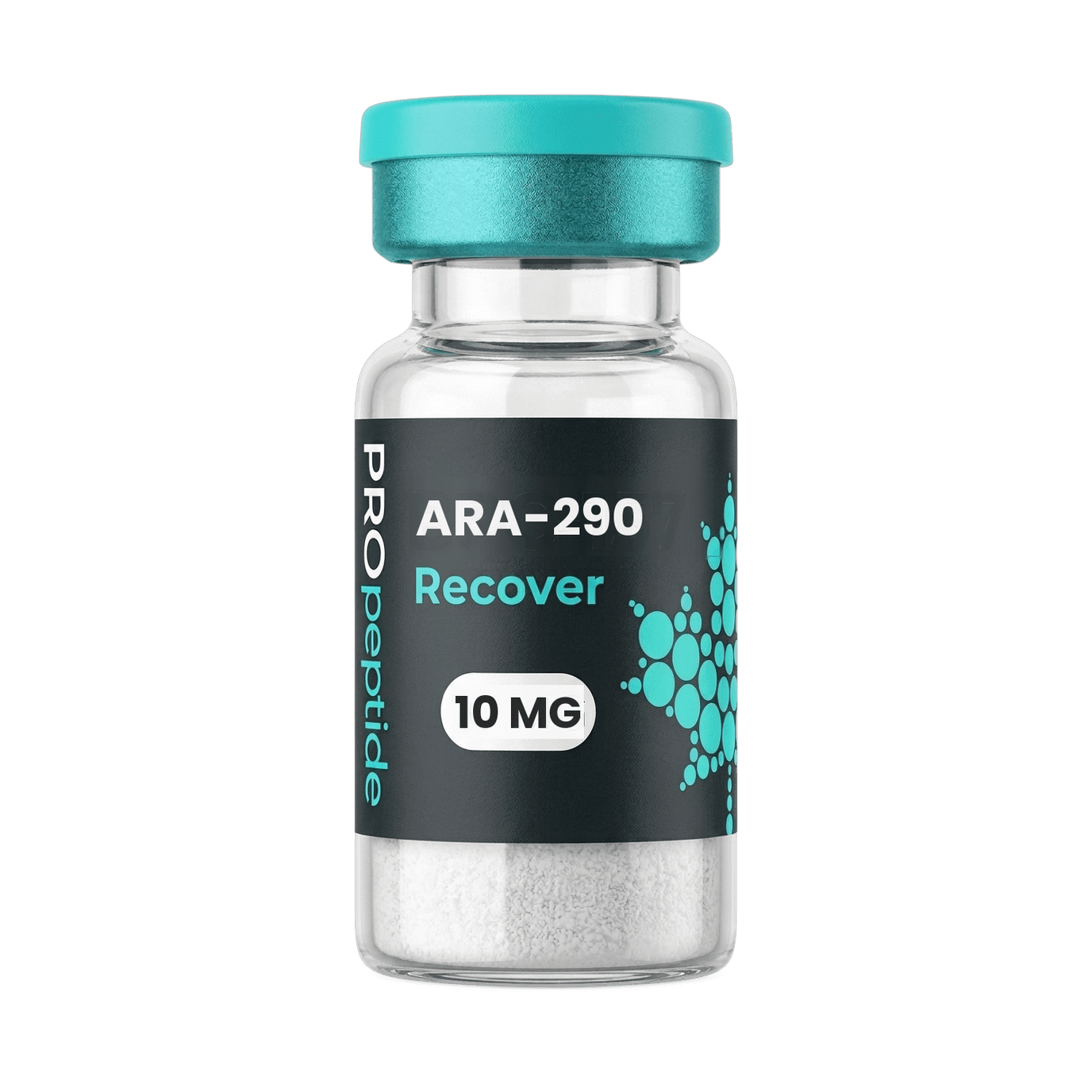
ARA-290 Peptide
Eleven amino acids off the face of erythropoietin. It grew nerve fibres and missed on pain.
Choose your pack
For research use only. Not for human or veterinary use.
What ARA-290 is
The plain-language version, first.
The half of EPO nobody talks about, isolated on purpose.
ARA-290, also called cibinetide, is an eleven-amino-acid peptide beginning with pyroglutamate, sequence pyroGlu-Glu-Gln-Leu-Glu-Arg-Ala-Leu-Asn-Ser-Ser, molecular formula C51H84N16O21 and molar mass about 1257.3, which mimics the helix-B aqueous face of erythropoietin and binds the innate repair receptor without raising haematocrit. Its pivotal study was a quadruple-masked trial in 64 patients with sarcoidosis-associated small nerve fibre loss, and across every registered trial roughly 193 people have received it.
EPO is famous for exactly one thing, and this molecule was built to do the other thing.
Erythropoietin has two lives. The famous one raises red blood cell production. The quiet one is a tissue-protection signal, working through a different receptor assembly entirely.
ARA-290 is eleven residues designed from EPO's structure to work the quiet receptor only. It cannot raise red cells. Structurally cannot.
That design goal deserves a moment of respect: it is a deliberate separation of a molecule's two jobs, keeping the interesting one and removing the one with the notoriety.
The part of EPO that never made headlines, cut free from the part that did.
What is ARA-290?
Mechanism studied, not outcome promised.
Two receptors, two jobs, and this key only fits one of them.
The two-receptor story is the whole mechanism, so here it is properly.
Classical EPO signalling runs through a homodimer receptor on blood-forming cells. The tissue-protective signalling runs through a different assembly, pairing the EPO receptor with a partner called the beta common receptor.
Two locks that both respond to EPO, and ARA-290 is a key filed down to fit only the second.
The proposed downstream story involves damping inflammatory signalling in stressed tissue, particularly around small nerve fibres, which is where its human work went.
Here's the honest part. The receptor selectivity is well established. What the selective signal achieves in people is a question the small trials asked without settling.
A clean key. An unfinished answer about the door.
The research so far for ARA-290
Where the evidence is thin, we say so.
Real human trials, small numbers, and a programme that went quiet.
This file contains something rare for the shelf: actual human trials, plural, in a defined condition.
The work centred on small-fibre neuropathy in sarcoidosis, with roughly 193 people studied in total across the programme.
The last trial finished in 2015, and the thread has been quiet since. Quiet is data of a kind.
Small trials showed signals interesting enough to publish and not decisive enough to carry development onward. No approval anywhere.
A genuinely clever molecule, a real but small human file, and a decade of silence after it. The silence is worth weighing alongside the papers.
ARA-290 vial sizes and current stock are listed below.
ARA-290 specs
The chemistry, exactly as released.
Who studies ARA-290
Who tends to order this one, and why.
- 1
Small fibre neuropathy
Sarcoidosis-associated neuropathy was the lead indication, measured by corneal confocal microscopy and skin biopsy fibre counts.
- 2
Ophthalmology
Corneal confocal microscopy is the primary readout, and a separate phase 2 tested it in diabetic macular oedema. That trial was terminated and negative.
- 3
Transplant medicine
The live EMA orphan designation is for prevention of graft loss in pancreatic islet transplantation, granted August 2016 and never converted to an approval.
- 4
EPO biology
Groups separating erythropoietin tissue-protective signalling from its erythropoietic signalling. This peptide is the tool that separation produced.
Sold for laboratory research only. This is not guidance for personal use, and nothing here is a recommendation.
ARA-290 backstory
How it got here.
Erythropoietin's tissue-protective effects were noticed well before anyone separated them from its effects on blood. The problem was obvious: you cannot give a neuroprotective dose of EPO without also raising haematocrit and its associated risks.
The helix-B surface peptide work was the answer to that problem. Copy the repair-receptor-binding face, leave the erythropoietic face behind. ARA-290 is the pyroglutamate variant of that peptide.
Araim Pharmaceuticals took it through phase 2 in sarcoidosis-associated small fibre neuropathy, secured an EMA orphan designation in 2016 for prevention of graft loss in pancreatic islet transplantation, and announced an FDA orphan designation for sarcoidosis the same year. Neither designation has converted into an approval. I could not find any primary source on the company's status after 2019.
- 1
Splitting EPO in two
Erythropoietin protects tissue and makes red cells through different receptors. The helix-B surface peptide copies the repair-binding face and leaves the rest.
- 2
Phase 2b, 2017
Culver and colleagues, 64 patients with sarcoidosis-associated small fibre neuropathy, quadruple-masked, four arms. The 4 milligram dose met its structural primary endpoint.
- 3
Then silence
The last trial completed February 2015. Two orphan designations, no approvals, no phase 3 in any indication in the decade since.
Buying ARA-290 in Canada
What ships, how fast, and the paperwork.
Same day out of British Columbia. Our building, our cold packs, our people, and nothing sitting in a customs queue while you refresh a tracking page.
Then into the fridge. Keep it cold and keep it dark. Sealed and freeze-dried it handles a rough trip without ice. Once it lands, fridge.
Prohibited in tested sport. The WADA 2026 list prohibits innate repair receptor agonists under section S2.1.5. Cibinetide is not named individually, but the section prohibits substances with similar biological effect, and this compound is defined by that effect. S2 substances are non-specified and prohibited at all times.
Common questions
5 answers, none of them dodges.
Did ARA-290 reduce pain in its trials?
Not against placebo. In the 64-patient phase 2b, pain improved significantly in all groups including placebo, and the placebo-corrected reduction in the moderate to severe pain subgroup carried a p value of 0.157, which is not significant. The endpoint that did separate was structural: corneal nerve fibre area at the 4 milligram dose, p equals 0.012.
Does ARA-290 raise haematocrit like EPO?
No, and that is the point of it. It is a mimetic of the helix-B aqueous face of erythropoietin and binds the innate repair receptor, the EPO receptor paired with the beta-common receptor, rather than the erythropoietic receptor homodimer. It is described in the literature as non-erythropoietic.
How many people have been studied on ARA-290?
Roughly 193 across all registered trials: a 22-patient pilot in 2012, a 38-patient study in 2013, the 64-patient phase 2b in 2017, plus smaller studies in depression and prediabetes and a terminated 9-patient diabetic macular oedema trial. The highest phase ever reached is 2b.
Why did the 8 milligram dose work worse than 4 milligrams?
Nobody has explained it. Registry-posted mean corneal nerve fibre area changes were minus 64.3 at 1 milligram, plus 533.8 at 4 milligrams, plus 203.8 at 8 milligrams and minus 170.0 on placebo. A middle dose outperforming both neighbours is an unexplained curve, and it is one of the reasons the programme is hard to interpret.
Is ARA-290 approved anywhere?
No. It holds an EMA orphan designation granted in August 2016 for prevention of graft loss in pancreatic islet transplantation, and the sponsor announced an FDA orphan designation for sarcoidosis in 2016. A designation is a development incentive, not an approval, and neither has converted in the years since.
Good pairing options with ARA-290
What researchers stack alongside it.
Pairing is where research gets ahead of itself. These are the compounds researchers put in the same order as ARA-290 Peptide, which is a statement about ordering habits, not about evidence. Two things in one cart have not been studied together unless somebody studied them together.
Licensed in more than thirty countries as Zadaxin, which makes it the diplomat of this catalogue. Its biggest randomised trial found no mortality benefit, and both facts belong in the first sentence.
It has no sequence and no CAS number, because it is not a molecule. It is an extract of calf thymus, still in clinical use across Russia, and that combination is genuinely unusual.
It is water. We know. But it is the one bottle on this shelf where the boring ingredient is the entire product, and getting it wrong ruins everything else you bought.
Order ARA-290 right now
One last look before you decide.
Freeze-dried, ships cold from Canada
You've got the whole file now, the thin parts included. Nothing above pretended otherwise. If that's the kind of source you were after, ARA-290 is right here.
Not for human consumption. Not approved by Health Canada or any other regulatory body.
Page last updated October 4, 2026
People also search for ARA-290
Related searches.