
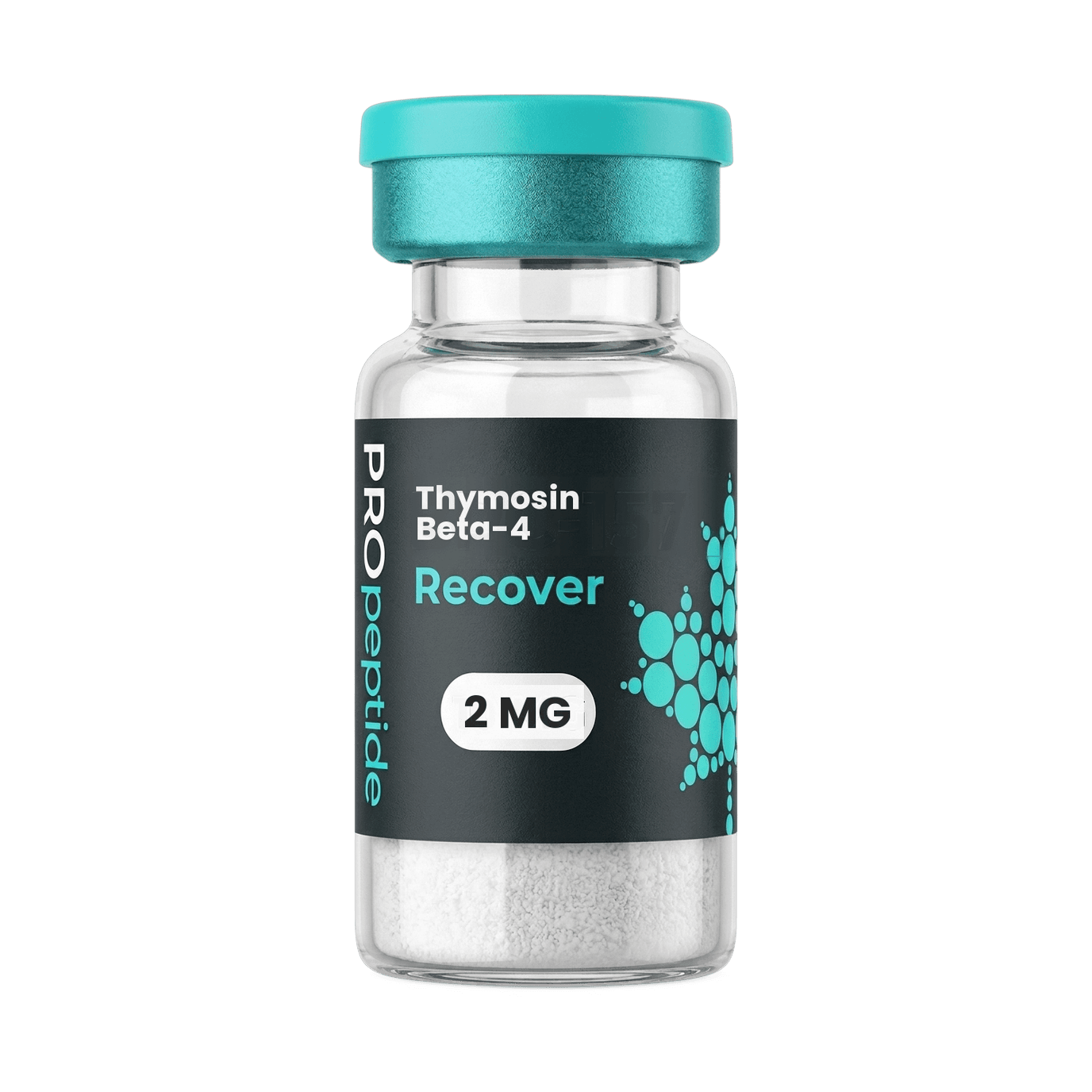
Thymosin Beta-4 Acetate Peptide (TB4)
There are two acetates in this product name and they have nothing to do with each other. One is a tattoo. One is a sticker.
Choose your pack
For research use only. Not for human or veterinary use.
What Thymosin Beta-4 Acetate Peptide (TB4) is
The plain-language version, first.
The complete sentence, where TB-500 is the famous quote.
Thymosin beta-4 is a 43-residue peptide, sequence SDKPDMAEIEKFDKSKLKKTETQEKNPLPSKETIEQEKQAGES, that is N-terminally acetylated on serine 1 in its native form, giving formula C212H350N56O78S and a molecular weight of approximately 4963.5 Da. The word acetate in a product name usually refers instead to a non-covalent acetate counterion from purification, which is a separate and unrelated feature from the covalent N-terminal acetyl group.
This is the whole protein. All 43 residues, nearly five kilodaltons, exactly as your cells express it.
If TB-500 is the famous quote, this is the complete sentence it was pulled from.
Thymosin beta-4 is one of the most abundant small proteins in many of your cell types, which is nature's way of saying it has a day job. That job is actin management, holding the cell's building material in ready reserve.
The fragment keeps the actin-binding paragraph. The full protein carries other regions with their own proposed activities, which is precisely what gets lost in the clipping.
Buying the full protein versus the fragment is a real choice with a real difference, and most of the internet writes about them as if they were one product.
What Thymosin Beta-4 Acetate actually is
Mechanism studied, not outcome promised.
Everything the fragment does, plus the parts that got cut.
Same actin story as the fragment, with more chapters.
The core activity is sequestration: holding actin monomers in reserve so the cell can build quickly where it needs to.
The full protein also carries regions the fragment lacks, with proposed roles in cell migration signalling beyond simple actin holding.
Whether those extra regions matter for any given research question is, genuinely, the reason a laboratory would choose one over the other.
Here's the honest part. Abundance and importance inside the cell do not translate to knowing what administering it from outside does.
Your cells making a lot of something is a fact about your cells. It is not a fact about a vial.
The research so far for Thymosin Beta-4 Acetate Peptide (TB4)
Where the evidence is thin, we say so.
The parent molecule's file is bigger, and it is still an animal file.
The parent protein's file is larger than the fragment's and has the same shape: strong biochemistry, real animal work, thin human record.
The research spans wound models, cardiac models and eye models, mostly rodent, some larger animals.
There was genuine clinical development interest in thymosin beta-4 historically, including early-phase human work in specific settings, and it did not mature into any approval.
So the human column is not perfectly empty here, it is early-stage and stalled, which is a different kind of thin.
Prohibited in sport, same as its fragment.
The better-documented half of the TB-500 conversation, still waiting on the evidence everyone assumes it already has.
The acetyl versus acetate distinction and the trial record are laid out below. Research use only.
Thymosin Beta-4 Acetate Peptide (TB4) specs
The chemistry, exactly as released.
Who studies Thymosin Beta-4 Acetate Peptide (TB4)
Who tends to order this one, and why.
- 1
Cytoskeleton and actin dynamics labs
The canonical G-actin sequestering peptide and a standard reagent for work on monomer pools, filament assembly and cell motility.
- 2
Ocular surface and wound repair groups
The corneal and dry eye application is the one that produced large randomised human trials, which makes full-length material the relevant comparator rather than the fragment.
- 3
Redox and inflammation researchers
A single methionine whose oxidation state changes the peptide's function is an unusual and useful model system, anchored by the 1999 Nature Medicine sulfoxide work.
- 4
Analytical chemists and anti-doping labs
WADA section S2.3 covers thymosin-beta4 and its derivatives such as TB-500, and telling a 4963.5 Da protein from an 889 Da fragment is a routine but essential identity question.
Sold for laboratory research only. This is not guidance for personal use, and nothing here is a recommendation.
Thymosin Beta-4 Acetate Peptide (TB4) backstory
How it got here.
Tβ4 came out of thymus extracts, which is where the name comes from, and for years it was studied as an actin-binding housekeeping peptide rather than anything therapeutic. The interesting turn came from immunology.
In 1999 a group in Glasgow was chasing a mystery factor in the supernatant of monocytes cultured with glucocorticoids, something that stopped neutrophils behaving normally. It turned out to be Tβ4 with its one methionine oxidised. Not a new gene, not a new protein, the same peptide wearing a different oxidation state and doing a different job. That paper landed in Nature Medicine and it is still the most surprising thing in this compound's file.
The commercial arc went a different direction. The eye programme got serious and ran two Phase 3 trials. Meanwhile the market latched onto a seven-residue fragment, gave it a catchier name, and spent fifteen years borrowing credibility from a protein six times its size.
- 1
Named for the thymus
Thymosin beta-4 was isolated from thymus preparations and studied for years as an intracellular actin-sequestering peptide, well before anyone framed it as a repair compound.
- 2
1999, Glasgow, the oxidised twist
Young and colleagues traced an anti-inflammatory factor in glucocorticoid-treated monocyte supernatant to thymosin beta-4 sulfoxide, and reported in Nature Medicine that only the oxidised form inhibited paw edema in mice.
- 3
2016 to 2021, the eye trials
ReGenTree ran the ophthalmic formulation RGN-259 through two Phase 3 dry eye studies, ARISE-2 and ARISE-3, enrolling 601 and 700 participants. The full-length protein, not the fragment, is what went into those trials.
Buying Thymosin Beta-4 Acetate Peptide (TB4) in Canada
What ships, how fast, and the paperwork.
Acetyl group and acetate salt are unrelated. The N-terminal acetyl is covalent, permanent and part of the native molecule. The acetate counterion is a non-covalent purification artefact that varies between lots. A product name containing acetate tells you about the salt form, not about whether the peptide is natively acetylated.
Acetate does not mean authentic. A TFA-salt thymosin beta-4 is just as N-acetylated as an acetate-salt one. Salt form is a purification choice and says nothing about sequence, structure or provenance. Judge those separately.
Thymosin beta-4 is not TB-500. Full-length Tβ4 is 43 residues at about 4963.5 Da. TB-500 is Ac-LKKTETQ, residues 17 to 23, seven residues at about 889 Da, roughly 18 percent of the parent by mass. The Phase 3 dry eye trials used the full-length protein. Health Canada's April 2026 advisory names TB-500 and does not name full-length thymosin beta-4.
Common questions
5 answers, none of them dodges.
What is the difference between the acetyl group and the acetate salt?
The acetyl group is covalently bonded to serine 1 in native thymosin beta-4. It adds 42.04 Da permanently, forms part of the formula C212H350N56O78S, and cannot be removed by washing. The acetate salt is a non-covalent counterion paired with protonated lysine side chains, weighing about 60.05 Da per equivalent, varying lot to lot and exchanging freely. The product name merges two unrelated things.
Does a 10 mg acetate salt vial contain 10 mg of peptide?
Not unless the label separately states net peptide content. Thymosin beta-4 has nine lysines, so an acetate-salt preparation can carry several acetate equivalents at roughly 60.05 Da each. The gross mass includes that salt. This is normal chemistry for basic peptides rather than a defect, but it means gross weight and peptide weight are different numbers.
Is Thymosin Beta-4 the same thing as TB-500?
No. Full-length thymosin beta-4 is 43 residues at about 4963.5 Da. TB-500 is Ac-LKKTETQ, residues 17 to 23, seven residues at about 889 Da, which is roughly 18 percent of the parent by mass. They have separate literatures. The completed Phase 3 dry eye trials used the full-length protein and their results do not transfer to the fragment.
Does acetate salt form indicate a higher quality peptide?
No. Salt form is a downstream purification choice and carries no information about sequence, structure or origin. A thymosin beta-4 supplied as a TFA salt is just as N-terminally acetylated as one supplied as an acetate salt, because that acetyl group is part of the native molecule. Assess identity and characterisation separately from salt form.
Why does the single methionine matter?
Because oxidising it changes what the peptide does rather than simply degrading it. Young and colleagues reported in Nature Medicine in 1999 that thymosin beta-4 sulfoxide is generated by monocytes exposed to glucocorticoids and acts as an anti-inflammatory signal, and that the oxidized peptide, but not the native form, inhibited carrageenin-induced paw edema in mice. Oxidation state is functionally meaningful here.
Thymosin Beta-4 Acetate Peptide (TB4) vs TB-500
Stacked together constantly, compared almost never.
The complete sentence next to the famous quote. These two get merged into one product by most of the internet, and they are not one product.
This is the full 43-residue protein, everything your cells actually express, including the regions the fragment leaves behind.
TB-500 is the seven-residue actin-binding core, clipped out and acetyl-capped. Cheaper to make, and carrying only the famous paragraph.
Most published work used the full protein. Most products sold are the fragment. Check which one any claim you read was actually about, because the answer is usually the other one. TB-500 has its own page here
Good pairing options with Thymosin Beta-4 Acetate Peptide (TB4)
What researchers stack alongside it.
Pairing is where research gets ahead of itself. These are the compounds researchers put in the same order as Thymosin Beta-4 Acetate Peptide (TB4), which is a statement about ordering habits, not about evidence. Two things in one cart have not been studied together unless somebody studied them together.
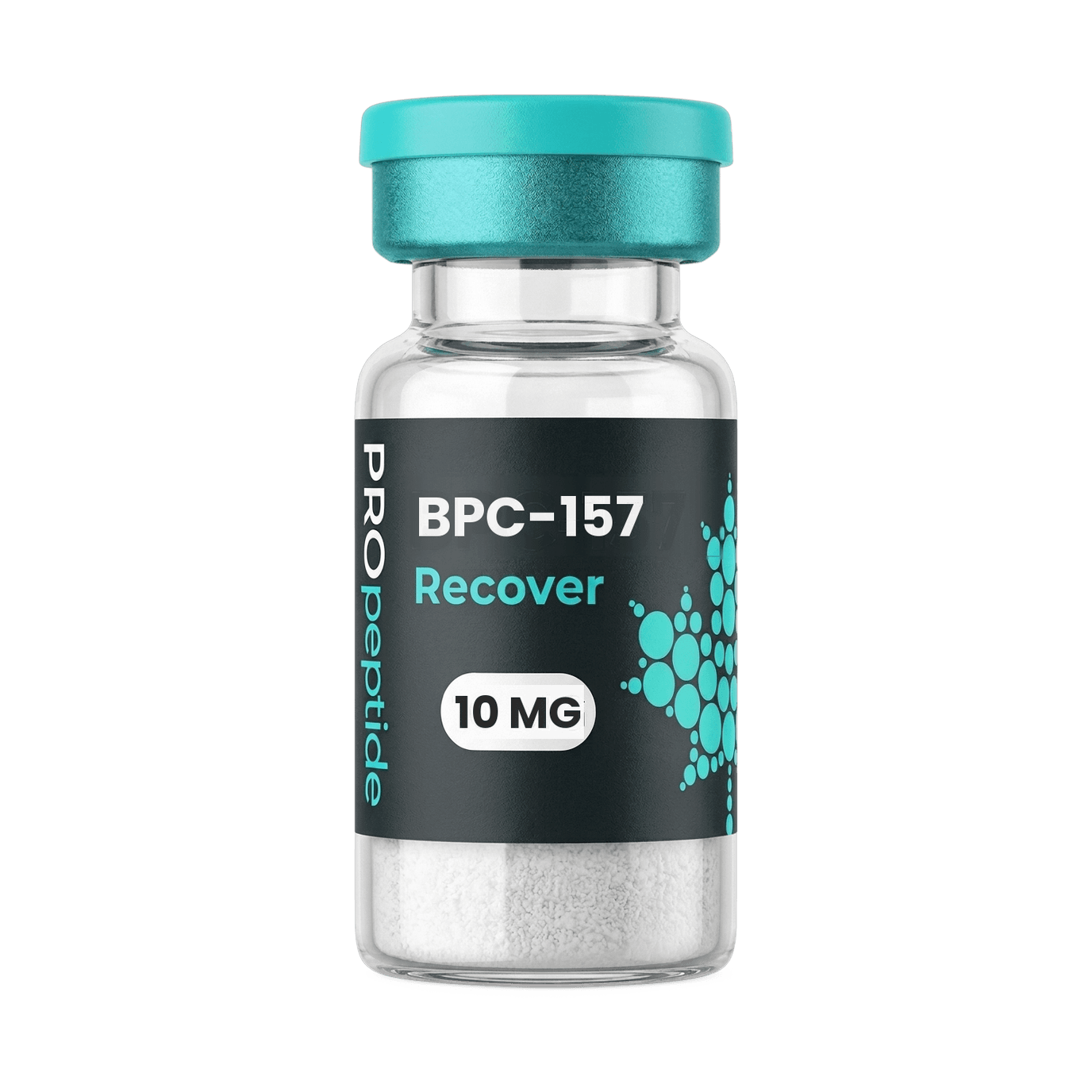
A fifteen-amino-acid fragment of a protective gastric protein, studied in animal models of tendon, gut and blood vessel repair.
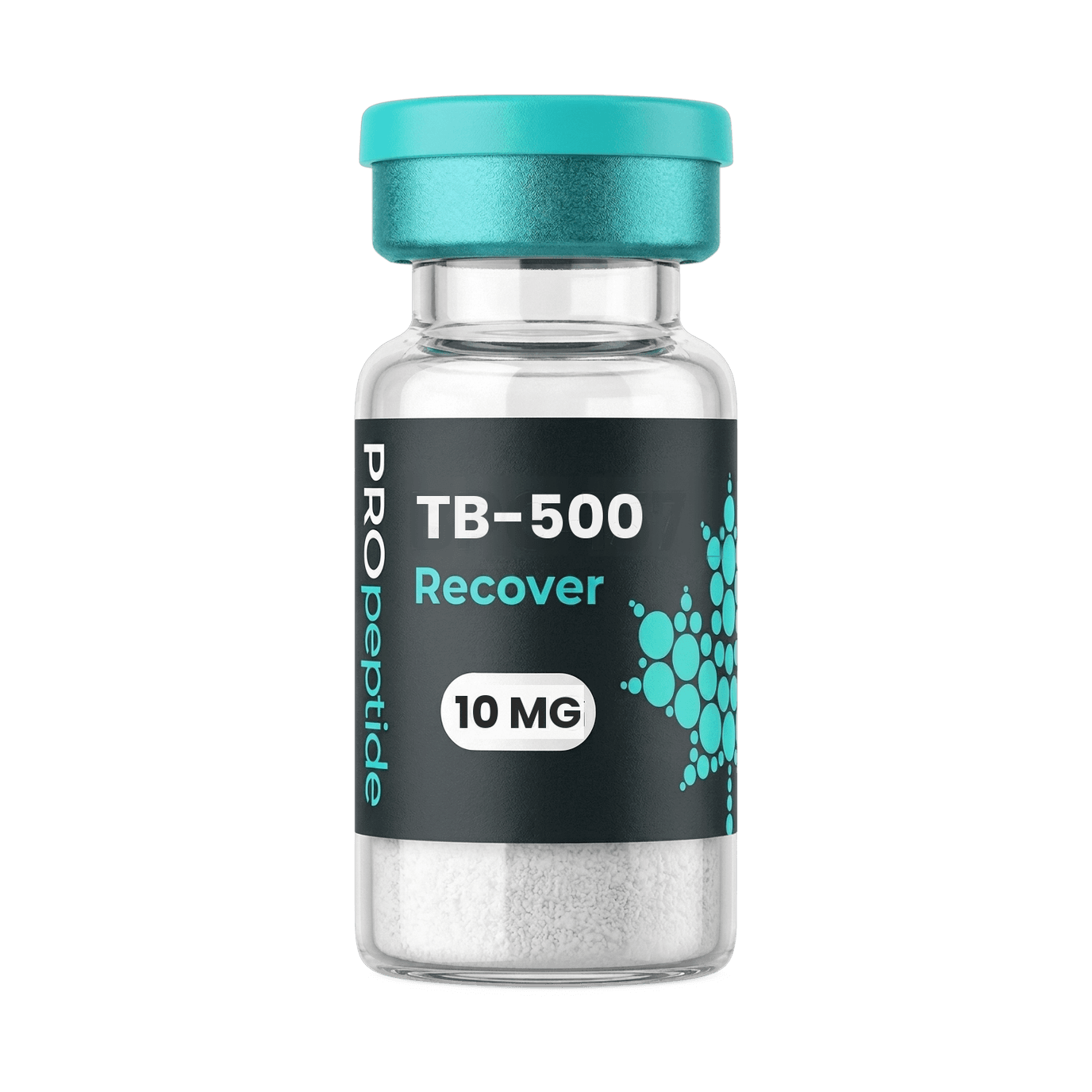
Seven residues clipped out of a 43-residue protein, and they happen to be the exact seven that grip actin. The rest of the protein turned out to be commentary.
It is water. We know. But it is the one bottle on this shelf where the boring ingredient is the entire product, and getting it wrong ruins everything else you bought.
Order Thymosin Beta-4 Acetate Peptide (TB4) right now
One last look before you decide.
Freeze-dried, ships cold from Canada
You've got the whole file now, the thin parts included. Nothing above pretended otherwise. If that's the kind of source you were after, Thymosin Beta-4 Acetate Peptide (TB4) is right here.
Not for human consumption. Not approved by Health Canada or any other regulatory body.
Page last updated October 4, 2026
People also search for Thymosin Beta-4 Acetate Peptide (TB4)
Related searches.