
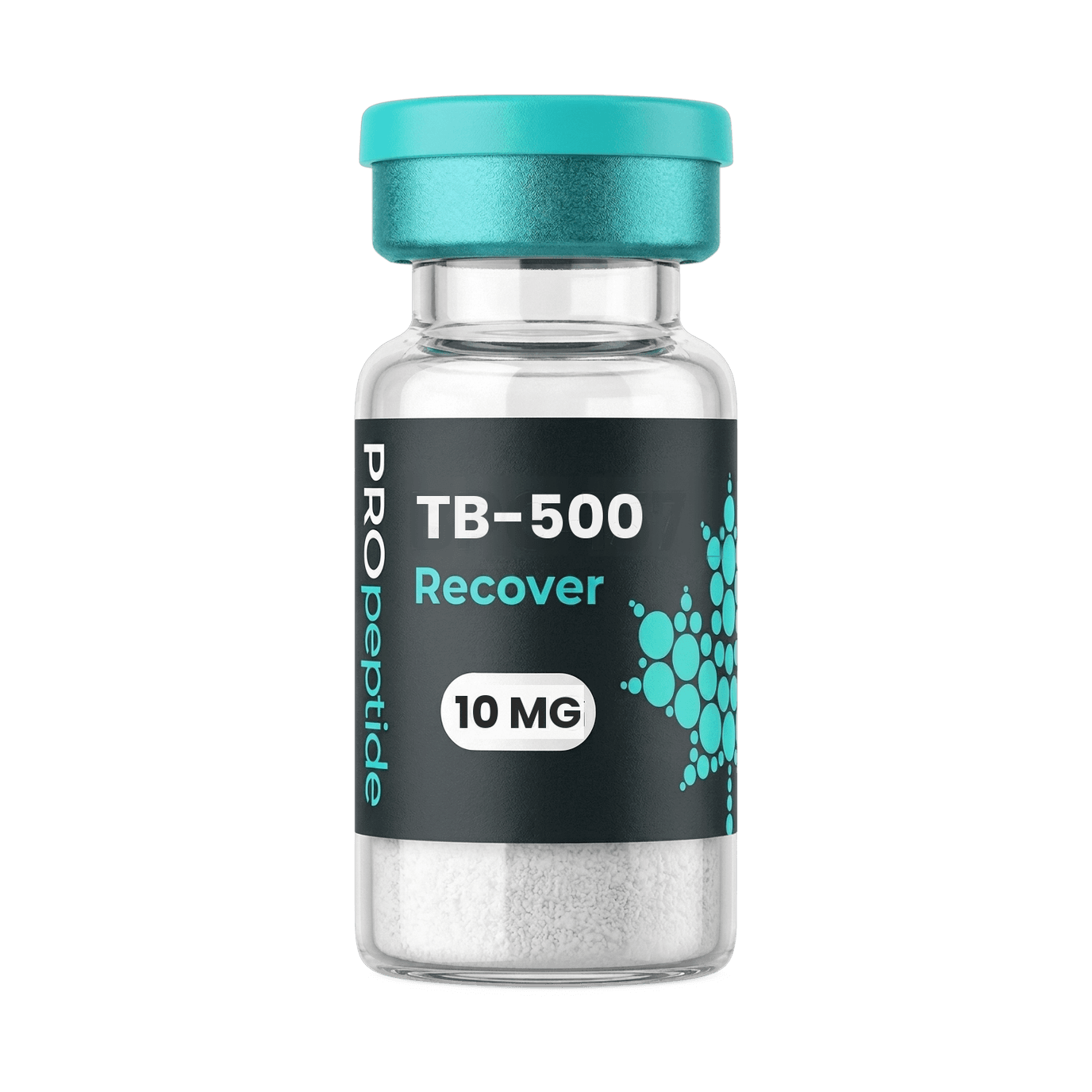
TB-500 Peptide
Seven amino acids lifted out of the middle of a protein that sits in almost every cell you own.
Choose your pack
For research use only. Not for human or veterinary use.
What TB-500 is
The plain-language version, first.
It is studied for its role in regulating actin, a protein involved in cell migration and tissue repair, primarily in animal and cell models.
Thymosin beta-4 is a 43-residue protein your cells make by the bucket. Somewhere in the middle of it sit seven residues doing the famous part of the job.
TB-500 is those seven, clipped out, capped with an acetyl group, and put in a vial.
Picture a guy on a deck build. The protein's the whole guy: the vest, the lunch, the truck, the forty-three things he brought with him. The seven residues are his hands. That stretch is the actin-binding domain, and actin's the most important protein you've never once thought about. More on that below.
Gang, one bit of housekeeping most sellers skip: TB-500 and full-length thymosin beta-4 aren't the same product. We sell both, separately, because they aren't the same molecule, and we keep the full protein as its own listing so nobody mixes them up.
It's even got its own FDA registry entry, UNII QHK6Z47GTG, which is an ID card, not a gold star.
Seven amino acids with paperwork. The interesting question is what the other thirty-six were for.
What TB-500 peptide actually does
Mechanism studied, not outcome promised.
Actin is what your cells are made of, in the structural sense. The internal skeleton, the thing that lets a cell hold a shape, split in two, and above all move.
A cell crawling toward a wound is running on actin assembly the whole way there.
Thymosin beta-4's job is actin logistics: it keeps single actin units in reserve, like the same deck guy keeping a stack of boards by the wall so nobody has to walk back to the truck.
The seven-residue fragment keeps that grip. So the research question isn't whether it binds. It does. The question is whether managing the board supply changes how fast the wall goes up, in the specific case of cells migrating to where they're needed.
Migration, note. Not supply. Its shelf-mate BPC-157 gets studied for the supply side, which is why comparing the two is actually useful instead of forum noise.
Here's the honest part. Actin biology is rock solid. The fragment's binding is real.
What that adds up to in a whole animal, let alone a person, is the part still living in rodent papers.
The research so far for TB-500
Where the evidence is thin, we say so.
The file here is wide, animal, and tangled up in an identity problem.
A lot of the published work is about full-length thymosin beta-4, not the fragment, and results migrate from one to the other in casual writing constantly. Same name on the forum, different molecule in the paper.
Same rule as everywhere on this shelf: check the methods section for which molecule they actually used.
The fragment itself has real in-vitro actin-binding data and animal injury-model work. Human trials of the fragment as sold: none. Not one.
Prohibited in sport, and named explicitly in the anti-doping documentation, so if you're subject to testing, that's your answer right there.
A fragment with genuine biochemistry, a borrowed reputation from its parent, and the standard empty human column. Read it carefully and it's an interesting molecule. Read it carelessly and it's somebody else's data.
TB-500 10mg lyophilised. Ships same day out of BC.
TB-500 specs
The chemistry, exactly as released.
Who studies TB-500
Who tends to order this one, and why.
- 1
Cytoskeletal biology
Thymosin beta-4 is the textbook example of monomer sequestration and one of the most abundant intracellular proteins in mammals. The fragment is a way to interrogate the binding motif in isolation.
- 2
Fragment pharmacology
A clean test case for a general question: how much of a protein function survives when you keep only the binding motif. Here the structural rationale is strong and the in vivo evidence is thin.
- 3
Analytical and anti-doping chemistry
Most of the rigorous published work on TB-500 as a product comes from anti-doping laboratories characterising what is actually in the vials, using Orbitrap and UHPLC-MS methods.
- 4
Comparative fragment studies
Thymosin beta-4 yields bioactive fragments from both ends, Ac-SDKP at residues 1 to 4 and the TB-500 motif at 17 to 23, which makes it useful for side-by-side fragment work.
Sold for laboratory research only. This is not guidance for personal use, and nothing here is a recommendation.
TB-500 backstory
How it got here.
In 1981 a group led by Allan Goldstein sequenced a 43-residue peptide out of calf thymus and published it in PNAS. The title called it a thymic hormone, and for a decade that is what the field believed it was, one of a family of thymus-derived signalling peptides isolated from a preparation called thymosin fraction 5.
Then in 1991 Safer, Elzinga and Nachmias published a paper in the Journal of Biological Chemistry with a title that quietly ended the idea: thymosin beta 4 and Fx, an actin-sequestering peptide, are indistinguishable. Fx had been isolated from human platelets. The molecule was not a thymic hormone, was not particularly about the thymus, and was present at high concentration in cell after cell throughout the body. Its job was cytoskeletal housekeeping.
The name never changed. Every vial of TB-500 sold today carries a reference to a gland that had nothing to do with what the molecule turned out to be.
- 1
Named for the wrong organ
Sequenced from calf thymus in 1981 and published as a thymic hormone, then shown in 1991 to be identical to a peptide from platelets. The name stuck anyway.
- 2
The motif became the product
Residues 17 to 23, LKKTETQ, do the actin binding. Somebody cut them out, acetylated the front, and a market category was born.
- 3
A Y-chromosome twin
Humans carry a Y-linked paralog, TMSB4Y, differing at three residues. The LKKTETQ motif is identical in both, so males express a variant females do not.
Buying TB-500 in Canada
What ships, how fast, and the paperwork.
Identity is the thing to check. TB-500 is a market name, not a standardised chemical identity. The reference definition is the acetylated heptapeptide Ac-LKKTETQ, FDA UNII QHK6Z47GTG. Published analytical surveys of the category have found product content inconsistent, so the sequence on the label matters more here than for most compounds.
Not the same as thymosin beta-4. Almost all published clinical work uses the full 43-residue protein, not the fragment. Anyone reading Tb4 trial results as TB-500 evidence is reading across a gap the literature does not bridge.
Keep it cold and dark. Short lyophilised peptides are best stored refrigerated and away from light. Handle as a laboratory reagent.
Common questions
5 answers, none of them dodges.
Is TB-500 the same thing as thymosin beta-4?
No. Thymosin beta-4 is a 43-residue protein of roughly 4,963 daltons. TB-500 is a seven-residue acetylated fragment of it, Ac-LKKTETQ, at 889 daltons, corresponding to residues 17 to 23. Nearly all published clinical research uses the full protein. The two are routinely conflated in marketing, but they are different molecules and the evidence for one does not transfer automatically to the other.
Are there human clinical trials of TB-500?
No registered human interventional trial of TB-500 exists. A scoping review published in Applied Sciences in June 2026 screened 1,772 records, included 80 studies, and reported that no human interventional studies of thymosin beta-4 or TB-500 were identified in tendon, ligament, muscle, bone, cartilage, fat graft or spine categories. Direct TB-500 evidence in that review came down to a single rat and in vitro study. Full-length thymosin beta-4 does have registered trials, including completed phase 3 studies in dry eye disease.
What is its status in sport?
Prohibited at all times, and named explicitly. The 2026 WADA Prohibited List includes Thymosin-beta-4 and its derivatives, giving TB-500 as the example, under S2.3, Growth Factors and Growth Factor Modulators. It applies both in and out of competition. The Canadian Centre for Ethics in Sport issued a four-year sanction to a U SPORTS athlete in April 2025 involving TB-500 and BPC-157.
Why is it called TB-500?
Nobody has documented it. TB plausibly stands for thymosin beta, and 500 appears to be a product suffix, but we could not trace the name to any patent, trademark, company code or primary record, so we are not going to assert an origin story we cannot support.
What does the actin-binding motif actually do?
Actin exists as free monomers and as assembled filaments, and cells shift between the two constantly. Thymosin beta-4 binds free monomers one-to-one and holds them out of the filament pool, functioning as a reservoir the cell can draw on quickly. The LKKTETQ stretch at residues 17 to 23 is the part that does the binding, which is why it became the basis for a fragment.
Good pairing options with TB-500
What researchers stack alongside it.
Pairing is where research gets ahead of itself. These are the compounds researchers put in the same order as TB-500 Peptide, which is a statement about ordering habits, not about evidence. Two things in one cart have not been studied together unless somebody studied them together.
A fifteen-amino-acid fragment of a protective gastric protein, studied in animal models of tendon, gut and blood vessel repair.
The internet's favourite research pairing, supplied together in one order. Exactly one controlled experiment has tested whether combining them adds anything, and we quote it below.
It is water. We know. But it is the one bottle on this shelf where the boring ingredient is the entire product, and getting it wrong ruins everything else you bought.
Order TB-500 right now
One last look before you decide.
Freeze-dried, ships cold from Canada
You've got the whole file now, the thin parts included. Nothing above pretended otherwise. If that's the kind of source you were after, TB-500 is right here.
Not for human consumption. Not approved by Health Canada or any other regulatory body.
Page last updated October 4, 2026
People also search for TB-500
Related searches.