
What are peptides? A plain-English guide
Peptides are short chains of amino acids. Here's what that means, where the line with proteins sits, where peptides come from and why labs study them.
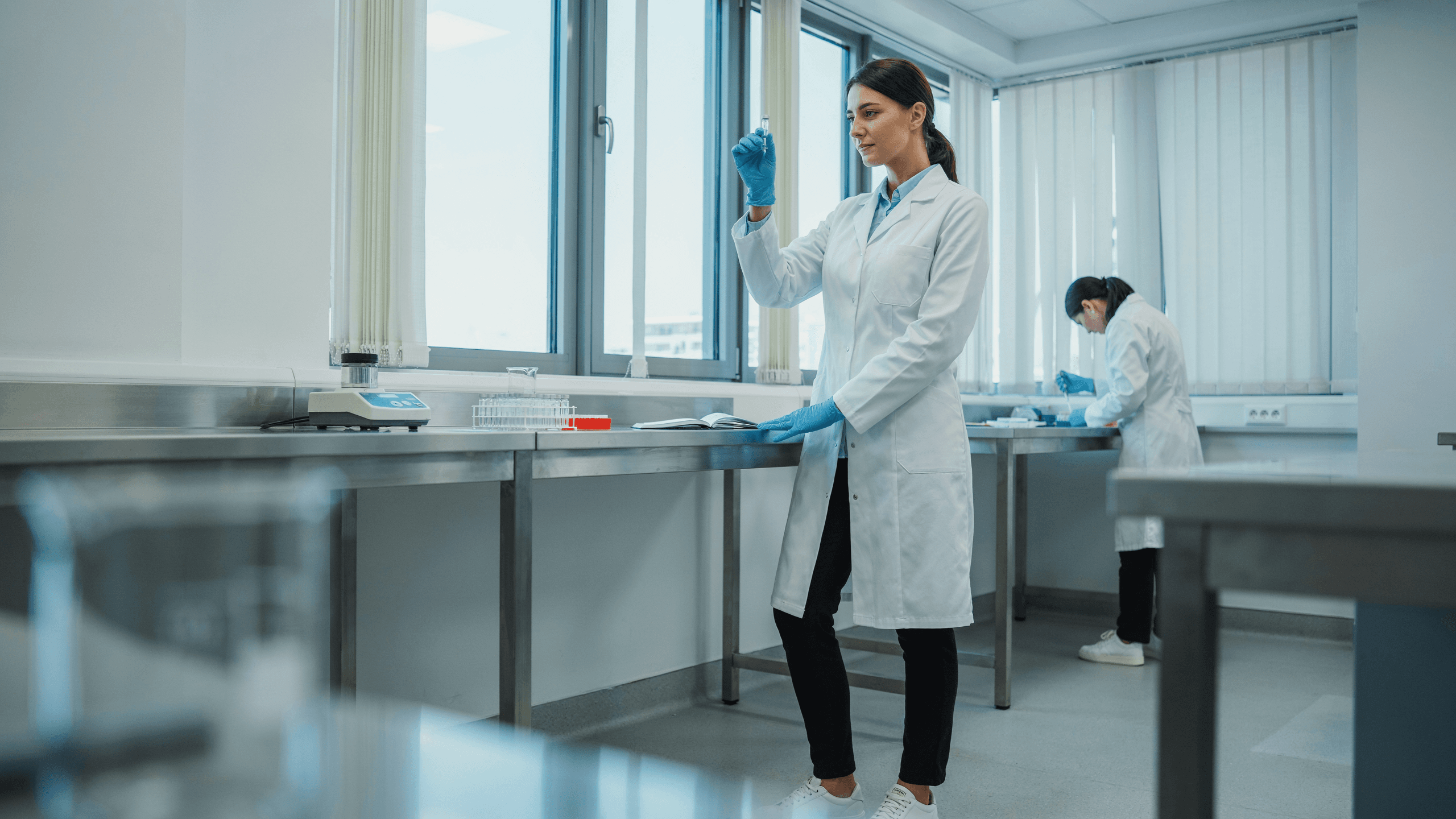
Peptides are short chains of amino acids (the building blocks of protein) clipped together by chemical links called peptide bonds. The usual cutoff is about 50 amino acids, and past that most scientists start saying protein. Your body makes peptides every day, chemists build them one link at a time, and the research peptides Pro Peptide ships cold across Canada are studied in cells and animals.
That's the one-breath answer. The long version has a Toronto lab, a British chemist who spent years spelling out one molecule, and a Nobel ceremony that counted to eight when today's chemists count to nine. Pull up a chair.
The line between a peptide and a protein is a convention people agreed on. Biology never signed off on it.
What are peptides, in plain words?
A peptide is a string of amino acids linked end to end, like charms on a bracelet. Each charm is one amino acid, and the little metal ring joining two charms is the peptide bond.
Your genes work with 20 standard amino acids, so you've got 20 kinds of charm to choose from. Order is everything. Swap two charms and you've made a different bracelet, and in chemistry a different bracelet is a different molecule that behaves differently.
Don't bother memorizing all 20. You need one idea for this whole page: put the charms in a certain order and you get a certain molecule.
So what makes it a peptide and not a protein? Length, mostly. A protein (a large working molecule your cells build from the same amino acids) is a bracelet so long it tangles into a knot, and for a protein the knot is the point, because the folded shape is what lets it do its job. A peptide is the short bracelet that never got that tangled. Some stay floppy. Others close into a small loop.
How do amino acids link into a chain?
Two amino acids link when the acid end of one meets the amine end of the next and the pair gives off a molecule of water. The new connection is the peptide bond, and chemists call the move a condensation reaction.
Every amino acid has two different ends, like a charm with a hook on one side and a loop on the other. One end carries an amine group, built around a nitrogen atom. The other carries a carboxyl group, which is the acid part. Hook meets loop, water leaves, and the bond holds.
Because the two ends differ, every chain has a direction. Scientists always write a sequence starting from the amine end, called the N-terminus, and finish at the carboxyl end, the C-terminus. Read it backwards and you're describing a different molecule.
Two amino acids make a dipeptide. Three make a tripeptide, and glutathione is a famous one of those, made by your own cells. Longer chains get called polypeptides. That's exactly where the naming fight starts.
Peptide vs protein: where's the line?
The usual line sits at about 50 amino acids. The US National Human Genome Research Institute's glossary says a peptide typically runs 2 to 50 amino acids, and a chain of 51 or more is a polypeptide.
Proteins are built from one or more of those polypeptides. Tidy, right? Now meet insulin.
Insulin, the molecule that ruined the cutoff
Insulin was discovered in Toronto. The 1923 Nobel Prize in Physiology or Medicine went to Frederick Banting and John Macleod of the University of Toronto for its discovery, according to the Nobel Foundation's record.
Nobody knew its sequence yet, though. Frederick Sanger started working it out in the early 1940s, and in 1958 he got the Nobel Prize in Chemistry for that work, as the Nobel Foundation reported. His answer was 51 amino acids, split across two chains held together.
Fifty-one. One past the line. So is insulin a peptide or a protein? Each of its two chains on its own is under 50, so depending on who's talking, you'll hear both answers.
Here's the honest part. The 50 line is a convention people use to keep conversations short, and nature never agreed to it. Arguing about it is not worth your evening. We'd rather you remember the bracelet.
Where do peptides come from?
Peptides come from two places: living cells and chemistry labs. Your cells build them from instructions in your genes, and chemists build them on a bench from bottles of amino acids.
Your body is basically a tiny bracelet factory that never closes.
Inside you, peptides show up in a few jobs:
- Messengers. Oxytocin and insulin are both peptide hormones, chemical messages your body sends through the blood.
- Cell staff. Glutathione, the tripeptide from earlier, is made inside your cells.
- Leftovers from lunch. Digestion chops the protein you eat into peptides and single amino acids before your gut takes them in.

So if your body already makes peptides all day, why would anyone build one in a lab? Because a lab can make the exact same chain again and again, in amounts you can actually weigh.
Research needs the same molecule every time. A scientist comparing two experiments wants identical bracelets in both, down to the last charm, and cells don't take custom orders.
How are peptides made in a lab?
Chemists build peptides one amino acid at a time on tiny resin beads that hold the growing chain in place while everything else gets washed away. The method is called solid-phase peptide synthesis.
Bruce Merrifield published the first version in 1963 in the Journal of the American Chemical Society, building a chain of just four amino acids. It won him the 1984 Nobel Prize in Chemistry. Before the beads, chemists built peptides in solution and had to fish the product out after every single step, which is about as fun as it sounds.
The Nobel speech that counted to eight
The first big synthetic win came a decade before Merrifield's. In 1953, Vincent du Vigneaud's lab reported in the Journal of the American Chemical Society that it had made oxytocin from scratch, and two years later he won the Nobel Prize in Chemistry "for the first synthesis of a polypeptide hormone."
Here's the fun part. The paper's title calls oxytocin an octapeptide, and the 1955 ceremony speech said eight amino acids too. Chemists today count nine. One of those eight was cystine, which is really two cysteines bolted together by a sulfur bridge, so the same molecule got counted two ways.
Today, automated synthesizers run Merrifield's cycle around the clock. One lap looks like this:
- Strip the protective cap off the free end of the growing chain.
- Couple the next amino acid onto that end.
- Wash away everything that didn't stick.
- Repeat until the sequence is done, then cut the chain off its bead.
The finished peptide gets cleaned up. Then it's freeze-dried into the fluffy white powder you see in a research vial.
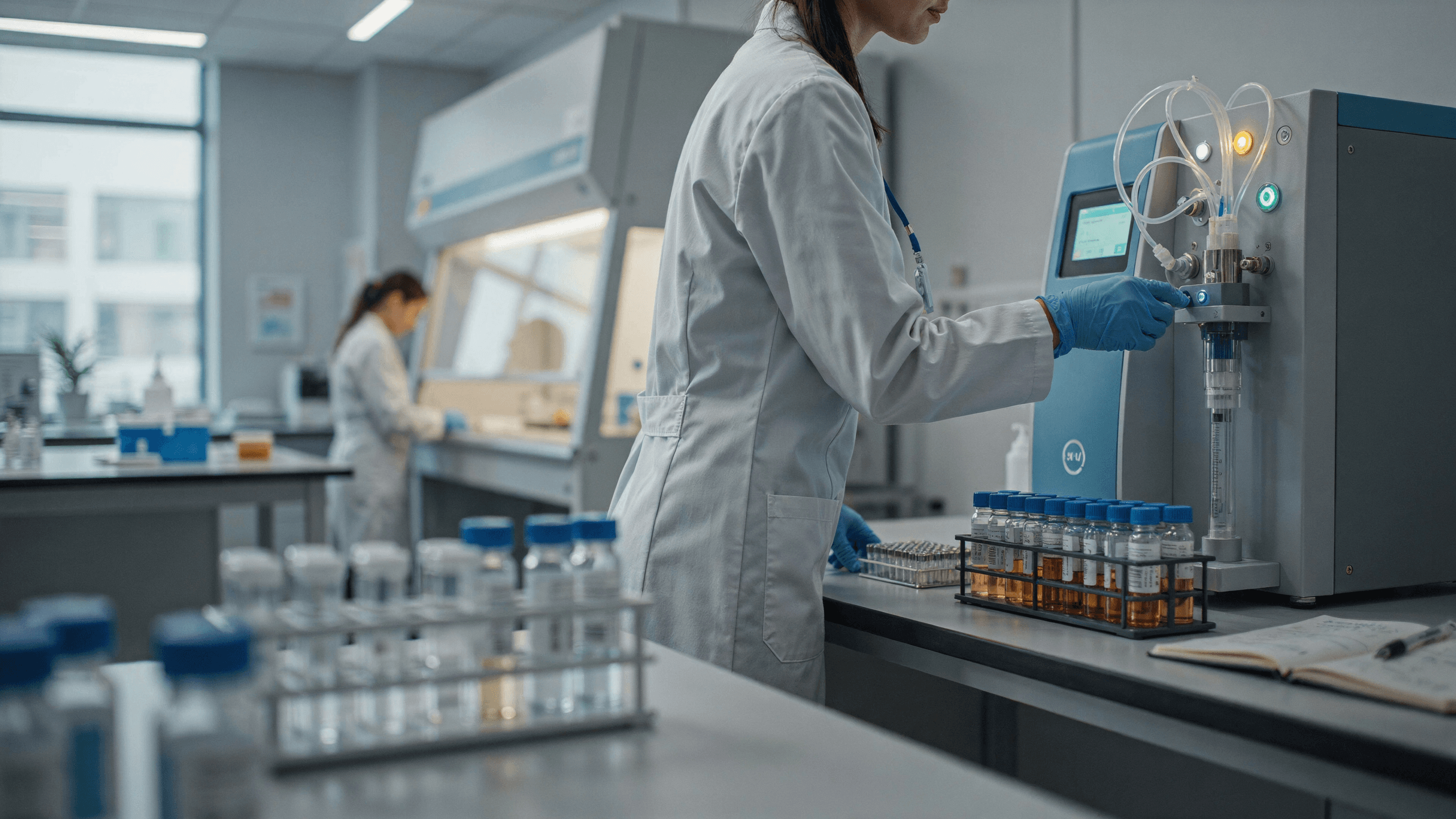
That powder is the stable form, and the guide to storing research peptides explains why it lasts longest kept cold and dry.
Why do researchers study peptides?
Researchers study peptides because many of the body's own signals are peptides, and a short chain can often be designed to fit one receptor (a docking site on a cell) and not much else. That's a useful trait in a lab.
A 2021 review in Nature Reviews Drug Discovery counted more than 80 peptide drugs that have reached the market since insulin arrived almost a century ago. That's the prescription end of the story, and it's where most of the solid human data lives.
Now the honest part. Most peptides are fragile. Enzymes in the gut and the blood chop them up quickly, so a lot of peptide chemistry is people trying to build chains that hold together longer.
Then there's the research-peptide shelf. Compounds like BPC-157, a 15-amino-acid chain, are studied mostly in lab dishes and rodents, with very little human data behind them. The BPC-157 product page lays out what was measured and in which animals.
Buying research peptides in Canada
Research peptides are lab-made peptides sold for laboratory research, not for use in people or animals. At Pro Peptide that means buyers 19 and over, and shipping within Canada only.
Here's what buying one looks like, with no sales pitch attached:
- Shipping and the cut-off: every order ships cold within Canada, and orders paid before noon Pacific on a business day go out the same day. The shipping policy with rates has the rest.
- Payment: Interac e-Transfer is the one payment method we take. The FAQ on payment explains the steps.
- Returns: sealed, unopened products can come back within 14 days of delivery under our returns and refunds policy.
- Legal status: everything is sold as laboratory research material, and the research use only page spells out what that means.
- Lab results: a product with a live lot report shows that report's figures on its page, and a product without one shows nothing instead of a guess. Questions about a specific lot go through the contact page.
Not ready to buy anything? Fair enough. The free Peptide Planner tool works out reconstitution volumes for any vial, and the rest of the Library covers storage and handling plus the comparisons people keep asking about.
The short version
Peptides are short chains of amino acids joined by peptide bonds, usually 50 or fewer. Your body makes them, chemists build them, and researchers study them because a short chain can be built to fit one target. When you're ready, browse the research peptides we stock or start with the BPC-157 product page.
Sources
- National Human Genome Research Institute, Talking Glossary of Genomic and Genetic Terms: Peptide
- National Human Genome Research Institute, Talking Glossary of Genomic and Genetic Terms: Amino Acids
- Encyclopaedia Britannica: Peptide bond
- The Nobel Prize in Physiology or Medicine 1923
- The Nobel Prize in Chemistry 1958, and the award ceremony speech, 1958
- The Nobel Prize in Chemistry 1955, and the award ceremony speech, 1955
- du Vigneaud V, et al. The synthesis of an octapeptide amide with the hormonal activity of oxytocin. Journal of the American Chemical Society, 1953
- Merrifield RB. Solid phase peptide synthesis. I. The synthesis of a tetrapeptide. Journal of the American Chemical Society, 1963
- Bruce Merrifield, facts, Nobel Prize in Chemistry 1984
- Muttenthaler M, et al. Trends in peptide drug discovery. Nature Reviews Drug Discovery, 2021
Common questions
What is a peptide in simple terms?
A peptide is a short chain of amino acids, usually 50 or fewer, joined by peptide bonds. Picture a short bracelet where every charm is one amino acid.
Are peptides the same as proteins?
No. Both are chains of amino acids, but proteins are longer, usually past 50, and fold into a working shape. The cutoff is a convention, so expect some overlap.
Does the body make its own peptides?
Yes. Your cells make peptide hormones such as oxytocin and insulin, and digestion breaks the protein you eat into peptides and single amino acids.
How are research peptides made?
Mostly by solid-phase peptide synthesis, where amino acids are added one at a time to a chain anchored on resin beads. The finished peptide is usually freeze-dried into a powder for storage and shipping.
Who can buy research peptides in Canada?
Pro Peptide sells research peptides for laboratory research use only, to buyers 19 and over, shipped cold within Canada.
Keep reading
Sold for laboratory research use only. Not for human or veterinary use. 19+.