
BPC-157 vs TB-500: What's the Difference?
BPC-157 vs TB-500 compared: how the two research peptides differ in structure and origin, plus what studies examined and how lyophilized vials are stored.
BPC-157 vs TB-500 is the comparison almost everyone gets wrong, because the two are not cousins at all. BPC-157 is a small lab-made chain of 15 amino acids, modelled on a protective compound found in stomach juice. TB-500 is a lab-made piece of thymosin beta-4, a 43 amino acid protein that works with actin inside your cells. Pro Peptide stocks both for research use in Canada, and here is what actually separates them, with the papers to check.
Most comparison pages treat these two like twins in matching vials. Same powder, same forum threads. Read the research and the twins turn out to be strangers: one came out of stomach science, and the other came out of the long story of how a cell builds its own scaffolding. This guide walks through the real differences in plain words, and it tells you which one we would start with.
Nearly all of this research is rodent and cell work. Human data for either peptide is thin.
The short answer on BPC-157 vs TB-500
BPC-157 is a lab-made 15 amino acid chain modelled on a protective compound in stomach juice, and TB-500 is a lab-made piece of thymosin beta-4, a protein found in nearly every cell. Different parents. Different piles of research.
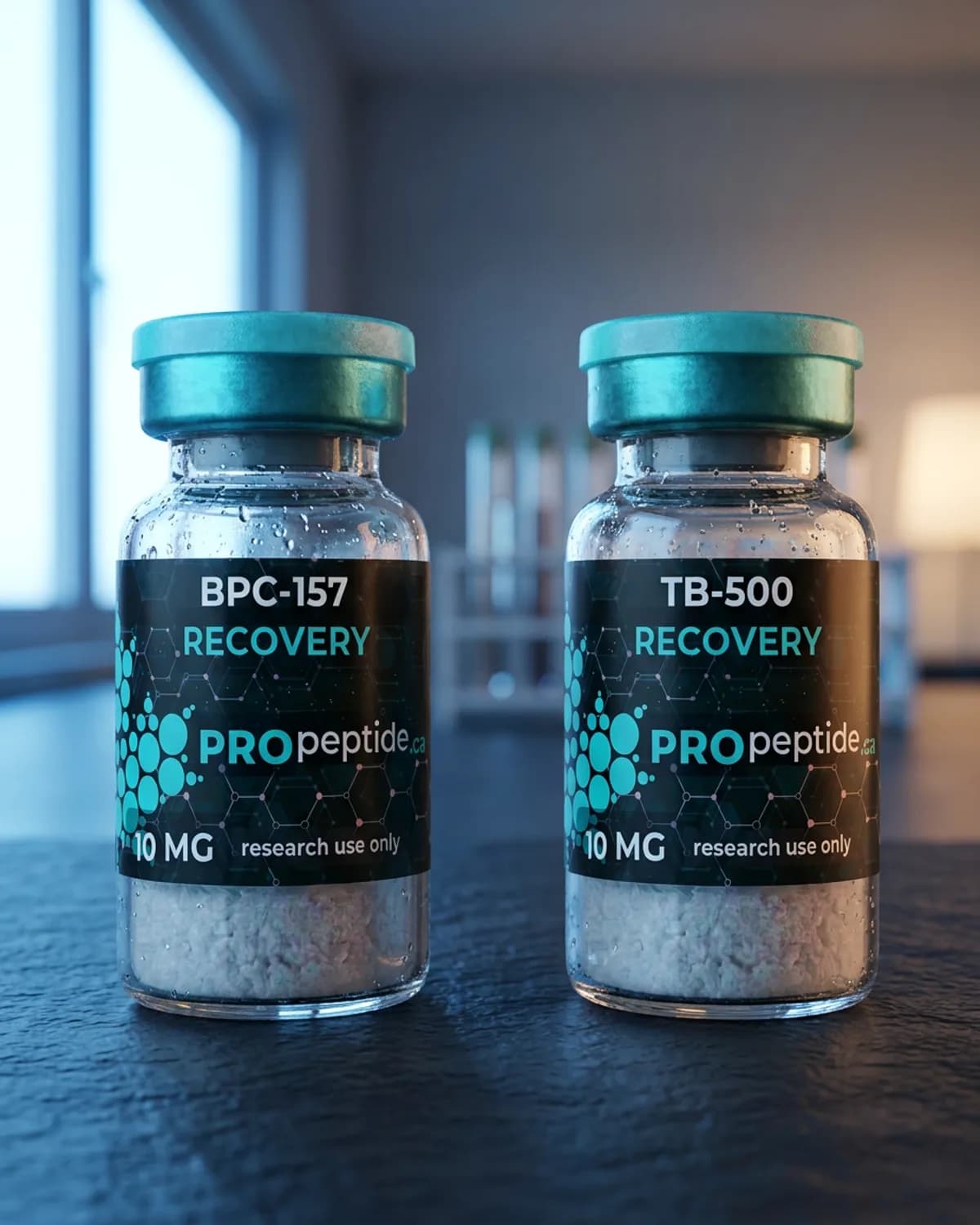
The mix-up makes sense. Both arrive as a white freeze-dried cake in a small glass vial, both show up in the same threads. Both get sold by the same shops, which is most of why people assume they are two flavours of one thing. The resemblance stops at the label.
Side by side:
- BPC-157 is 15 amino acids long. Thymosin beta-4 is 43.
- BPC-157's parent is a protective compound found in human stomach juice. That is where the name comes from: Body Protection Compound.
- TB-500's parent is thymosin beta-4, first isolated from calf thymus by Goldstein's group in 1981.
- No cell makes BPC-157 on its own. The sequence is entirely lab-made.
- TB-500 is lab-made too, but it copies a protein your cells make all day long.
- Thymosin beta-4 has two famous regions that researchers study: a four-piece tip called Ac-SDKP and an actin-binding stretch called LKKTETQ. BPC-157 has no famous sub-regions at all.
One quirk worth knowing. Material sold as TB-500 can be the full-length protein or a shorter fragment of it. Purity and lab results for our vials sit on the BPC-157 product page if you want them.
What have studies examined for BPC-157?
Nearly everything published on BPC-157 comes from rats and from cells in a dish, mostly stomach-lesion models and tendon cells. No completed human trial sits in the public record. That is the honest shape of the evidence, and we'd rather say it plainly than dress it up.
The stomach work came first. Through the 1990s Sikiric and colleagues published a long run of rat studies looking at BPC-157 in stomach-lesion models. Then in 2011 Chang and colleagues took rat Achilles tendon cells and put BPC-157 in the dish. They watched how the cells grew out and moved.
That is the whole foundation. Rats and dishes. Careful work, and still a long way from a person.
Want to look at the compound behind those papers yourself? View the BPC-157 research peptide.
Where does the TB-500 research actually sit?
The TB-500 research is really thymosin beta-4 research: cell biology from the early 1990s, plus a detection story from horse racing. Two separate threads, and neither one is about a product called TB-500. Two threads. Zero products.
The actin thread holds it all together. Actin is the protein a cell uses to build its inner scaffolding. In 1991 Safer and colleagues showed that thymosin beta-4 is one of the main molecules that holds spare actin in reserve inside the cell, a quiet job with a big consequence for anything a cell has to rebuild. A 1999 rat study looked at thymosin beta-4 in full-thickness wound models. Both lines are about the natural protein, in named models. Neither says a word about any commercial peptide.
The horse racing angle is where the TB-500 name took off. That compound was moving in equine sport, and in 2012 a doping-control group published a method to detect TB-500 in horse plasma. Regulators built a test because the stuff was moving.
The World Anti-Doping Agency lists thymosin beta-4 and its derivatives as prohibited in human sport too, which tells you that the people whose whole job is catching this stuff decided it was worth the trouble of building a test. We find that detection history more telling than any forum thread.
On legal status: everything in our catalogue is sold strictly as research material, and our Research Use Only page spells out exactly what that covers in Canada. Read it before you order.
Recovery and healing: what the papers actually measured
All the recovery and healing talk around these two peptides traces back to a handful of animal and cell studies, not to any finished human trial. That gap is the whole story, so let's be exact about it.
The tendon thread belongs to BPC-157. Chang and colleagues, in the 2011 study on rat Achilles tendon cells, reported more cell outgrowth and more cell movement in the dish. Cells, counted under a microscope. The paper says nothing about people.
The wound thread belongs to thymosin beta-4. Rat full-thickness wound models run through that literature in the late 1990s. Again animals. Again published.
Forum posts stretch these findings into promises. The papers stay in the dish and the rat, and so do we. If you read one thing this week, read the 2011 paper itself, because it takes ten minutes, it is written plainly, and it claims far less than any thread that quotes it.
Read it. It is short.
Stability and storage: why both ship as lyophilized powder
Both peptides ship freeze-dried because taking the water out is what stops a peptide chain from breaking down. Lyophilized is just the lab word for freeze-dried. The solution is frozen. Then the ice is pulled off under vacuum, and what is left is a dry white cake that keeps.
Water is the enemy. The moment liquid goes into the vial, two clocks start: the chain begins to break down, and microbes get their chance. That is why every serious supplier ships dry and tells you to reconstitute only when the work begins.
A reconstituted vial lives in the fridge, on a short timeline. A sealed dry vial lives in the freezer and can wait.
Transit is where we come in. Every order ships cold-packed at no extra cost, and orders paid before noon Pacific on a business day leave the same day. If Canadian shipping and the cut-off are your worry, the Shipping Policy lays it out: free over $150 CAD, flat-rate everywhere else. Short version: pay by noon, it's gone.
Payment is Interac e-Transfer only, which the FAQ walks through. Returns are plain too. Sealed, unopened products come back within 14 days under Returns & Refunds. Opened or warm vials can't.
Neither peptide is special here. The rules are the same for both, which makes this one of the few places the comparison ends in a tie. For the full protocol, freezer temperatures and light included, read our peptide storage guide before your vials arrive.
How do you reconstitute a lyophilized vial?
Reconstituting a vial means adding bacteriostatic water slowly down the inside of the glass and swirling gently until the cake dissolves. No shaking. Ever. The steps are the same for either peptide, and this is lab handling only, not usage guidance of any kind.
Why so gentle? Peptide chains shear and foam when they get knocked around. A shaken vial can look dissolved while the material inside has already been roughed up. Slow is right here.
- Inspect the vial. The powder cake should be intact and white; a melted or discoloured cake means contact your supplier, not your syringe.
- Swab the rubber stopper with an alcohol wipe and let it dry fully.
- Draw bacteriostatic water and introduce it slowly down the inside glass wall, never jetting it straight onto the powder.
- Swirl gently until the solution runs clear. Do not shake, ever.
- Label the vial with the date and refrigerate it immediately. Reconstituted material lives in the fridge, away from light.
Why labs research them together, and where to start
Labs pair BPC-157 and TB-500 in the same model because the two work through unrelated mechanisms, so one paired design can probe two separate pathways at once. One dish. Two questions. One pathway traces back to stomach protection, the other to actin biology. Pairing them is a study design choice, nothing more.
This is what first-page comparisons skip. They rank the two as rivals, as if a lab has to crown a winner for every purpose. Don't bother with that framing, since the top results mostly recycle each other anyway. The honest framing is coverage: unrelated mechanisms, complementary questions.
Still, a first project has to pick. For that, BPC-157 is the better pick, and it isn't close. Its published record runs deeper, and its fixed 15 amino acid sequence leaves no doubt about what sits in the vial.
TB-500 carries the identity question from earlier: material sold under that name may be the full-length protein or a fragment. That alone makes it the harder compound to document cleanly. We'd rather start you on the one we can document to the letter.
Which brings up the question people actually type: should you take them together? We sell these for research use only, so we give no usage guidance, and no published human trial has tested the combination. What exists is rat and cell work on each compound on its own. Anything beyond that is a forum talking, not a paper.
So here is the bottom line. BPC-157 and TB-500 come from different parents, and their research trails barely touch. For the better-documented of the two, start with the BPC-157 research peptide.
Questions customers ask about ordering from Pro Peptide
How orders leave the warehouse. Every vial ships cold from BC, same day before noon PT, packed with a gel pack so the lyophilized cake reaches you intact and white.
- Dry vials are packed the same way, because a short transit is still a transit.
- Tracking goes out by email the moment the label prints.
- Both compounds ship as research chemicals, labelled for laboratory research use only.
The question we hear most often: "Can I order TB-500 alongside BPC-157?" Yes. The TB-500 research peptide and the TB-500 + BPC-157 combo both sit in the Recovery category, and they leave the warehouse on the same cold chain as everything else.
One thing we say on every call: nothing we sell is intended for human use, and we make no health claims about any compound in the catalogue.
Sources
Common questions
What is the main difference between BPC-157 and TB-500?
Origin and size. BPC-157 is a fully lab-made chain of 15 amino acids, modelled on a protective compound found in stomach juice. TB-500 is a lab-made copy of thymosin beta-4, a natural 43 amino acid protein that binds actin, first isolated in 1981.
How should lyophilized vials be stored?
Sealed dry vials stay cold and dark in the freezer. Once reconstituted, a vial moves to the fridge on a short timeline. Our storage guide covers the full protocol, including transit and light.
Do I need bacteriostatic water to reconstitute a vial?
Bacteriostatic water is the lab convention for vials drawn from more than once, because its preservative slows microbial growth in the solution. Sterile water suits single-use preparation. Either way, add it slowly down the glass, then swirl gently. Never shake.
Are these peptides banned in sport?
Yes. The World Anti-Doping Agency's Prohibited List covers thymosin beta-4 and its derivatives, and BPC-157 falls under its non-approved substances category. Horse racing authorities test for TB-500 too, which is why the equine detection methods exist.
Keep reading
Sold for laboratory research use only. Not for human or veterinary use. 19+.