
Retatrutide vs Tirzepatide: Triple vs Dual Agonist
Retatrutide vs tirzepatide: tirzepatide targets GIP and GLP-1, retatrutide adds glucagon. Structure, half-life, trial status and lab handling in Canada.

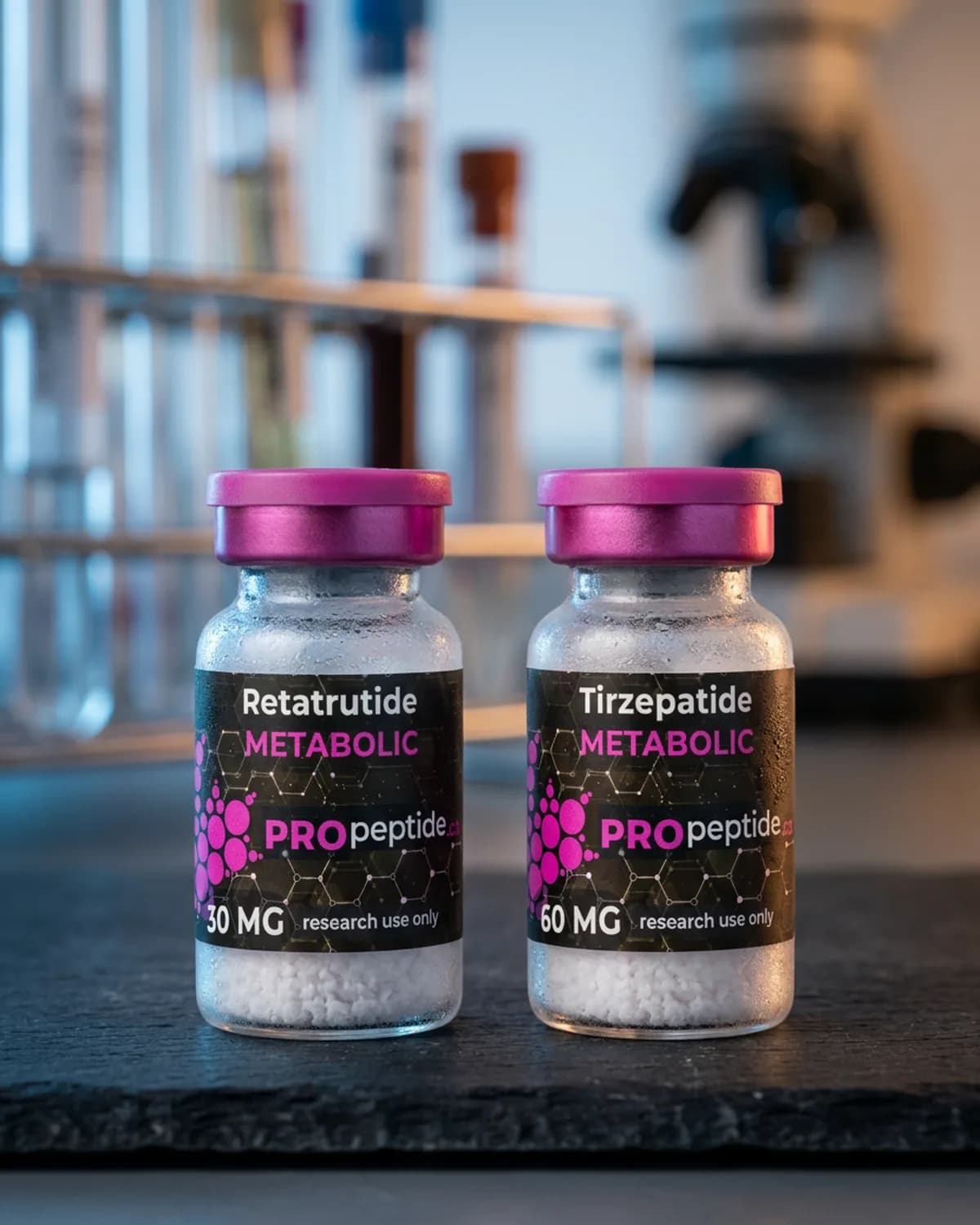
Retatrutide vs tirzepatide comes down to one extra receptor. Tirzepatide is a dual agonist, active at GIP and GLP-1, and retatrutide is a triple agonist, active at GIP, GLP-1 and glucagon. That third arm is what changes a receptor assay. Pro Peptide stocks both for research buyers in Canada, cold-packed on every order, 19+ at checkout.
Three receptor readouts instead of two, and most of the third one still comes from rodents.
Retatrutide vs tirzepatide: what actually separates them?
Tirzepatide engages two incretin receptors, GIP and GLP-1, while retatrutide engages those two plus the glucagon receptor, and that is the entire argument for calling it a triple agonist. One receptor more. That's the whole mechanism of action story, dual against triple.
Both are synthetic peptides built off a GIP-like sequence, and both carry a fatty acid chain that is reported to bind albumin and slow clearance, which is the stated reason each one stays in circulation as long as it does. Kind of like taping a pool noodle to a brick before you drop it in the water.
Set side by side, they differ in receptor coverage and little else:
- Receptor targets: tirzepatide hits GIP and GLP-1. Retatrutide hits those two plus glucagon.
- Backbone: both are described in their discovery papers as synthetic peptides built on a GIP-derived sequence.
- Half-life extension: both carry a fatty acid moiety reported to bind serum albumin.
- Class: incretin receptor agonist analogues, one dual, one triple.
That's the whole table. Everything else is assay design. Receptor potency ratios come out of cell assays and rodent work, not your bench, and we'd rather you knew that before the vial lands.
What are the differences between tirzepatide and Ozempic, and is anything better than retatrutide?
Semaglutide, sold as Ozempic, acts at the GLP-1 receptor alone, at least as its developers describe it, while tirzepatide adds GIP. The 2018 discovery paper frames that second receptor as the whole point of the molecule. So the differences between tirzepatide and Ozempic come down to one receptor against two, and in an assay that shows up fast, because a GLP-1-only control tells you nothing at all about GIP signalling. Different question, different tool.
Neither of them touches glucagon. That one is retatrutide's party trick.
Is anything better than retatrutide? Nothing published in late-stage trials covers more receptors than its three, so triple agonism is the current ceiling. That's a pharmacology answer, not a ranking.
More receptors isn't a score. It's more variables, which in a research setting mostly means more ways for your data to get weird. When people ask what is better than retatrutide they usually mean what comes next, and nobody has shown a fourth receptor in print yet.
FDA approval status and availability in Canada
Tirzepatide is an approved prescription drug, and retatrutide is not approved anywhere yet. The FDA cleared tirzepatide in 2022 as Mounjaro and in 2023 as Zepbound, and Health Canada approved Mounjaro in 2022. Retatrutide has no FDA or Health Canada approval at the time of writing. Its phase 3 programme, called TRIUMPH, was still reporting when this was written, so its approval status is pending and nothing more.
Availability follows from that. The prescription versions of tirzepatide move through pharmacies, and the cost sits with the drug plan: provincial coverage and private insurance decide what they pay case by case, which is a conversation for a pharmacist, not for us.
Research material is a different thing entirely. Pro Peptide sells lyophilized retatrutide and tirzepatide for laboratory research use only, priced per vial on the product page. With no insurance coverage in the picture because it is not a medicine. See the Retatrutide Peptide listing for the current price and lot.
Side effects and safety profiles: what the trial papers report
The side effects and safety profiles of both compounds live in their published trial papers, not on a vendor's page, and we'd rather point you at the papers than paraphrase them. Here is the shape of what they report.
In the retatrutide phase 2 trial the most common adverse events were gastrointestinal. They were dose-related and mostly mild to moderate. The tirzepatide trials describe the same pattern: gastrointestinal events, mostly mild to moderate, mostly during dose escalation.
That is the published record, and two things follow from it for a research buyer. First, an adverse event profile from people tells you nothing about how a vial behaves in a receptor assay. Second, Pro Peptide does not give medical information.
Questions about safety in people belong with the trial literature and a licensed healthcare professional, full stop. Our material is for laboratory research use only, and it stays that way.
What does a three-receptor assay have to account for?
A triple agonist needs three receptor readouts instead of two, plus a cell line that actually expresses the glucagon receptor you are claiming to measure.
Glucagon receptor cross-talk is the part people underestimate. A protocol written around dual incretin signalling does not transfer cleanly, and if you port it straight across you will read a three-receptor compound through a two-receptor window and never know it. I'd skip the patch job and rebuild the protocol from scratch.
If purity is your objection before any of that, the Retatrutide Peptide lab results page carries that lot's record. Not buying yet? Sketch the run first with our assay planner.
Handling lyophilized material, step by step
Lyophilized peptide stays stable longest cold, dark, sealed and left alone, and it goes into solution gently rather than fast.
Shaking a reconstituted vial is the single most common way a run gets ruined before it starts. Kind of like stirring soup with a leaf blower.
The full version lives in our peptide storage guide. On legal status, everything we ship is covered by Research Use Only terms, and checkout confirms you are 19 or over.
- Inspect the sealed vial on arrival for cracks, a lifted stopper or a collapsed cake.
- Store the lyophilized vial cold and dark until the day you reconstitute it.
- Add bacteriostatic water slowly, running it down the inside wall of the vial.
- Swirl gently until clear. Never shake, never vortex.
- Refrigerate the reconstituted vial and keep it out of light.
- Log the lot number, the date, the solvent and its volume in your records.

Which one to choose for a research plan
Choose by the question, not by the number of receptors: dual incretin signalling means tirzepatide, and the glucagon arm or triple agonism as a whole means retatrutide. Choose by the question, not by the number of receptors. Studying dual incretin signalling, use tirzepatide. Studying the glucagon receptor's contribution, or triple agonism as a whole, use retatrutide.
And if you make us take a side for a first receptor study, our pick is tirzepatide. Because two receptors and a finished late-stage record make for cleaner baselines. Order Retatrutide Peptide when the plan calls for the glucagon arm instead.
On logistics: orders paid before noon Pacific on a business day ship the same day. Simple. Canadian shipping is $20 flat to BC, Alberta and Saskatchewan and $25 everywhere else, free over $150, all in our Shipping Policy.
Payment is Interac e-Transfer only, and the FAQ walks through it. Sealed, unopened items come back within 14 days under Returns & Refunds.
The bottom line
Two receptors or three. That is the whole difference, and it decides your assay design before anything else does. Tirzepatide for dual incretin work, retatrutide when the glucagon arm is the point.
Not sure yet? Read the storage guide first. Ready? Order Retatrutide Peptide and we will ship it cold.
Sources
- Coskun et al., LY3298176, a dual GIP and GLP-1 receptor agonist (Molecular Metabolism, 2018)
- Coskun et al., LY3437943, a triple glucagon, GIP and GLP-1 receptor agonist (Cell Metabolism, 2022)
- Jastreboff et al., Triple-Hormone-Receptor Agonist Retatrutide, A Phase 2 Trial (NEJM, 2023)
- Jastreboff et al., Tirzepatide Once Weekly for the Treatment of Obesity, SURMOUNT-1 (NEJM, 2022)
Common questions
What are the bad side effects of tirzepatide?
Adverse event data for tirzepatide are reported in its published clinical trial papers, not by Pro Peptide. Pro Peptide sells material for laboratory research and does not provide medical information. Questions about side effects in people belong with the trial literature and a licensed healthcare professional.
What are the differences between tirzepatide and Ozempic?
Semaglutide, sold as Ozempic, is reported to act at the GLP-1 receptor only. Tirzepatide is described in its discovery paper as acting at both GIP and GLP-1 receptors. In receptor terms that's a one-receptor compound against a two-receptor compound.
Is tirzepatide a pill?
No. Tirzepatide is a peptide, and peptides break down in the digestive tract, which is why its published trials did not use oral tablets. Pro Peptide supplies lyophilized peptide material for laboratory research only.
What is better than retatrutide for receptor coverage?
Nothing published in late-stage trials covers more receptors than retatrutide's three. Triple agonism at GIP, GLP-1 and glucagon is the current ceiling in the published record, as far as receptor count goes.
How fast does Pro Peptide ship retatrutide in Canada?
Orders paid before noon Pacific on a business day ship the same day. Shipping is $20 flat to British Columbia, Alberta and Saskatchewan, $25 to every other province and territory, and free over $150 CAD. We ship within Canada only.
What happens if a vial arrives warm?
Email [email protected] within 7 business days of delivery with your order number and photos. Every order goes out cold-packed at no extra cost. Support answers within 24 hours.
Keep reading
Sold for laboratory research use only. Not for human or veterinary use. 19+.