
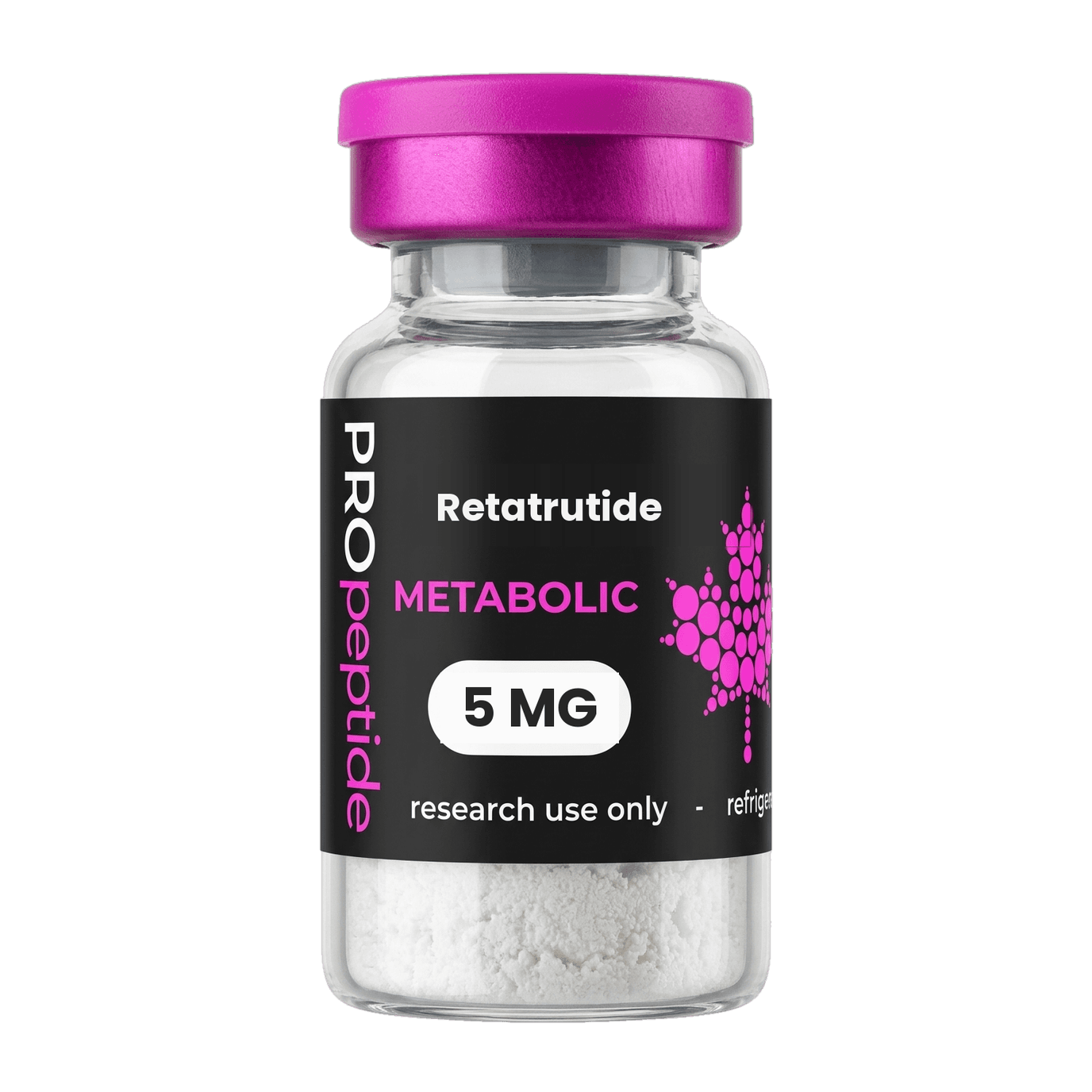
Retatrutide Peptide
A weight-loss peptide that deliberately turns glucagon on, after the whole industry spent a decade trying to switch it off.
Choose your pack
For research use only. Not for human or veterinary use.
What Retatrutide is
The plain-language version, first.
One receptor worked. Two got famous. Somebody asked why it stops there.
Retatrutide is a 39-amino-acid synthetic peptide that binds the GIP, GLP-1 and glucagon receptors in a single molecule. It carries the Lilly development code LY3437943 and is not approved by any regulator.
There is a thing that happens with recipes. Somebody makes a good one.
Somebody else adds a second ingredient and it gets famous. Then a third person stands in the kitchen going, alright, what if I kept going.
Retatrutide is the third person.
The chemistry is tidier than the story. Thirty-nine amino acids, a couple of them swapped for residues your enzymes cannot cut, and a twenty-carbon fatty acid hanging off lysine 17 like a keychain.
That chain grips albumin and drags the half-life out to roughly six days. It is the entire reason this is a weekly molecule instead of an hourly one.
Underneath, it is a GIP backbone with a ten-residue tail borrowed from exendin-4, which is a compound originally found in lizard saliva. Peptide chemistry is not a dignified field.
It also answers to LY3437943, which is what it went by back when it lived in a spreadsheet. Somebody's filing system got famous. Happens more than you would think.
What Retatrutide peptide actually does
Mechanism studied, not outcome promised.
Three receptors, one molecule, and a genuinely strange choice sitting in the middle of it.
You remember that universal remote your uncle had. Forty buttons, half of them unlabelled, and it somehow ran the TV, the DVD player and the ceiling fan.
Most compounds in this class are the little remote that came in the box. One receptor, one job, do not ask it for anything else.
This one is the universal.
GIP, GLP-1 and glucagon. Three receptors, one molecule holding all three buttons down.
The interesting question was never whether each button works on its own, because that was settled years ago. It is what happens when you press all three together, and at what relative potency at each.
And the glucagon receptor is the strange one to find on that list. Glucagon is the body's own counter-signal to insulin, so putting its receptor into a molecule that also engages the two incretin receptors reads, on paper, like wiring a switch to both terminals at once. That is the design question the whole programme exists to answer.
Here's the honest part. That is a hypothesis with a mechanism attached, not a settled account.
Receptor engagement is measurable. What the three arms add up to is not something we get to narrate for you.
Anybody explaining the balance to you with confidence is describing a preference and calling it a result.
The research so far for Retatrutide
Where the evidence is thin, we say so.
The thickest file in this catalogue, and nobody gets to call it yet.
This is where Retatrutide breaks our usual routine, and we would rather say so plainly than act cool about it.
Most of what sits on these shelves has animal data underneath it and a forum thread on top. That is just true.
This one has a real clinical file. Phase 1 through Phase 3, registered, peer-reviewed, thirty-four studies deep.
What that file establishes is pharmacology: binding and signalling potency at all three receptors, pharmacokinetics, the roughly six-day half-life, how the ramp schedule changes tolerability. That is a genuinely unusual amount of published chemistry for anything in this catalogue.
What it does not establish is anything we are permitted to summarise for you, and honestly anything you should take from a vendor. Endpoint results belong in the journals they were published in, read whole, not paraphrased by the people selling the powder.
And the ceiling, said plain: approved nowhere. Not in Canada, not anywhere. A completed Phase 3 is not an approval, and plenty of compounds have got this far and fallen over in the last mile.
Better evidenced than nearly anything else we stock, and still unfinished. Both of those are true at the same time.
Retatrutide lyophilised, five vial sizes from 5mg to 30mg, third-party tested. Ships same day out of BC.
Retatrutide specs
The chemistry, exactly as released.
Who studies Retatrutide
Who tends to order this one, and why.
- 1
Incretin pharmacology
The clearest available case study in what a third receptor adds to a dual agonist, with published potency data at all three targets to read it against.
- 2
Peptide chemistry
A worked example of half-life engineering: two substituted residues against enzymatic cleavage, and a twenty-carbon diacid on lysine 17 for albumin binding.
- 3
Trial design
The two 8 mg phase 2 arms reached an identical maintenance dose by different ramps and produced very different tolerability, which makes the programme a standing lesson in titration.
- 4
Regulatory watchers
A completed phase 3 programme with no approval anywhere, which is a live case study in how long the last mile actually takes.
Sold for laboratory research only. This is not guidance for personal use, and nothing here is a recommendation.
Retatrutide backstory
How it got here.
The triple agonist did not start at Lilly, and the man behind it had already left.
In 2015 Brian Finan, Matthias Tschöp and Richard DiMarchi published a single molecule in Nature Medicine that hit all three receptors at once. DiMarchi had been chief scientific officer at Lilly before moving to Indiana University and co-founding a string of companies. The paper argued the combination was superior to any existing dual co-agonist or best-in-class single agonist, and it spelled out the exact division of labour that retatrutide would later be built on.
The supporting evidence came from an unlikely direction. Glucagon receptor blockers had been developed first, pointing the receptor the other way, and that class ran into problems and was largely set aside. Lilly’s own antagonist demonstrated it. That history is the cleanest argument for pointing the receptor the opposite way, which is exactly what this molecule does. The phase 2 liver data suggests it does.
- 1
Built on purpose
Nobody tripped over this one. The multi-agonist programme went hunting for a third receptor to add to an established dual-agonist backbone, and filed what it found as LY3437943.
- 2
The glucagon question
Glucagon receptor blockers had been developed first, on the logic that blocking the receptor was the useful direction. That class ran into problems and was largely set aside. This molecule points the same receptor the opposite way, which is the single most argued-about design choice in the programme.
- 3
Made to last a week
A twenty-carbon diacid on lysine 17 and a pair of substituted residues stretched the half-life from hours out to roughly six days. That is engineering, not discovery.
- 4
Where it stands
Phase 3 complete, thirty-four registered studies, approved nowhere. The thickest research file in this catalogue and still open at the end of it.
Buying Retatrutide in Canada
What ships, how fast, and the paperwork.
Still investigational everywhere. Retatrutide has no approval from FDA, EMA or Health Canada. We checked all three registries directly and found no application, no EPAR and no DIN. Lilly has said it plans to file in the United States in the first quarter of 2027.
Chemistry references disagree. Some widely read sources give retatrutide as a 34-residue peptide with the fatty acid on lysine 6. The WHO INN listing and the FDA substance registry both give 39 residues with the chain on lysine 17. Use the registry figures.
Keep it cold and dark. Lyophilised peptides are best stored refrigerated and away from light. Handle as a laboratory reagent.
Common questions
5 answers, none of them dodges.
What is retatrutide?
A 39-amino-acid synthetic peptide, Lilly development code LY3437943, that binds the GIP, GLP-1 and glucagon receptors in a single molecule. It is built on a GIP backbone with a ten-residue exendin-4 derived tail, and carries a twenty-carbon diacid on lysine 17 that binds albumin and extends its half-life to roughly six days.
Why is a glucagon receptor in there at all?
Because the design question was what a third receptor adds to a dual agonist. Glucagon is the body's own counter-signal to insulin, so engaging its receptor alongside the two incretin receptors is the deliberately counterintuitive part of the molecule. Whether that combination is elegant or reckless is exactly what the trial programme was built to find out, and the results belong in the journals rather than in a product description.
How is it different from tirzepatide?
Tirzepatide is the two-receptor version, GIP and GLP-1. Retatrutide keeps both and adds glucagon. Same programme lineage, one extra target. Tirzepatide's file is further along and better understood, which counts for something real.
Is it approved anywhere?
No. Not in Canada, not in the United States, not anywhere. The phase 3 programme is complete and no regulator has approved it. Anyone telling you otherwise is wrong.
Why does everything say LY3437943?
That is the development code it was filed under, and most of the published literature still uses it. If you are reading journals rather than forums, that is the name you will keep hitting.
Retatrutide Peptide vs Tirzepatide
Stacked together constantly, compared almost never.
Everybody holds Retatrutide up against Tirzepatide, and for once everybody is right. Same programme lineage, one extra target.
Retatrutide engages three receptors: GIP, GLP-1 and glucagon. The third one is the entire argument, because glucagon is the counter-signal you would not expect to find here.
Tirzepatide engages the first two and stops. Its file is further along, better understood, and carries a regulatory approval.
More receptors is not automatically more of anything. A third signal is also a third thing that can go sideways, and Tirzepatide being better understood counts for something real. Tirzepatide has its own page here
Good pairing options with Retatrutide
What researchers stack alongside it.
Pairing is where research gets ahead of itself. These are the compounds researchers put in the same order as Retatrutide Peptide, which is a statement about ordering habits, not about evidence. Two things in one cart have not been studied together unless somebody studied them together.
Cut six amino acids off the front of a peptide and it got roughly ten thousand times more active. That result, from 1987, is the reason this entire shelf exists.
For twenty years GIP was the incretin receptor nobody wanted, written off as the one that was not earning its place in the system. Tirzepatide was built to pull it on purpose, and the field had to go back and re-read its own literature.
It is water. We know. But it is the one bottle on this shelf where the boring ingredient is the entire product, and getting it wrong ruins everything else you bought.
Order Retatrutide right now
One last look before you decide.
Freeze-dried, ships cold from Canada
You've got the whole file now, the thin parts included. Nothing above pretended otherwise. If that's the kind of source you were after, Retatrutide is right here.
Not for human consumption. Not approved by Health Canada or any other regulatory body.
Page last updated October 4, 2026
People also search for Retatrutide
Related searches.