
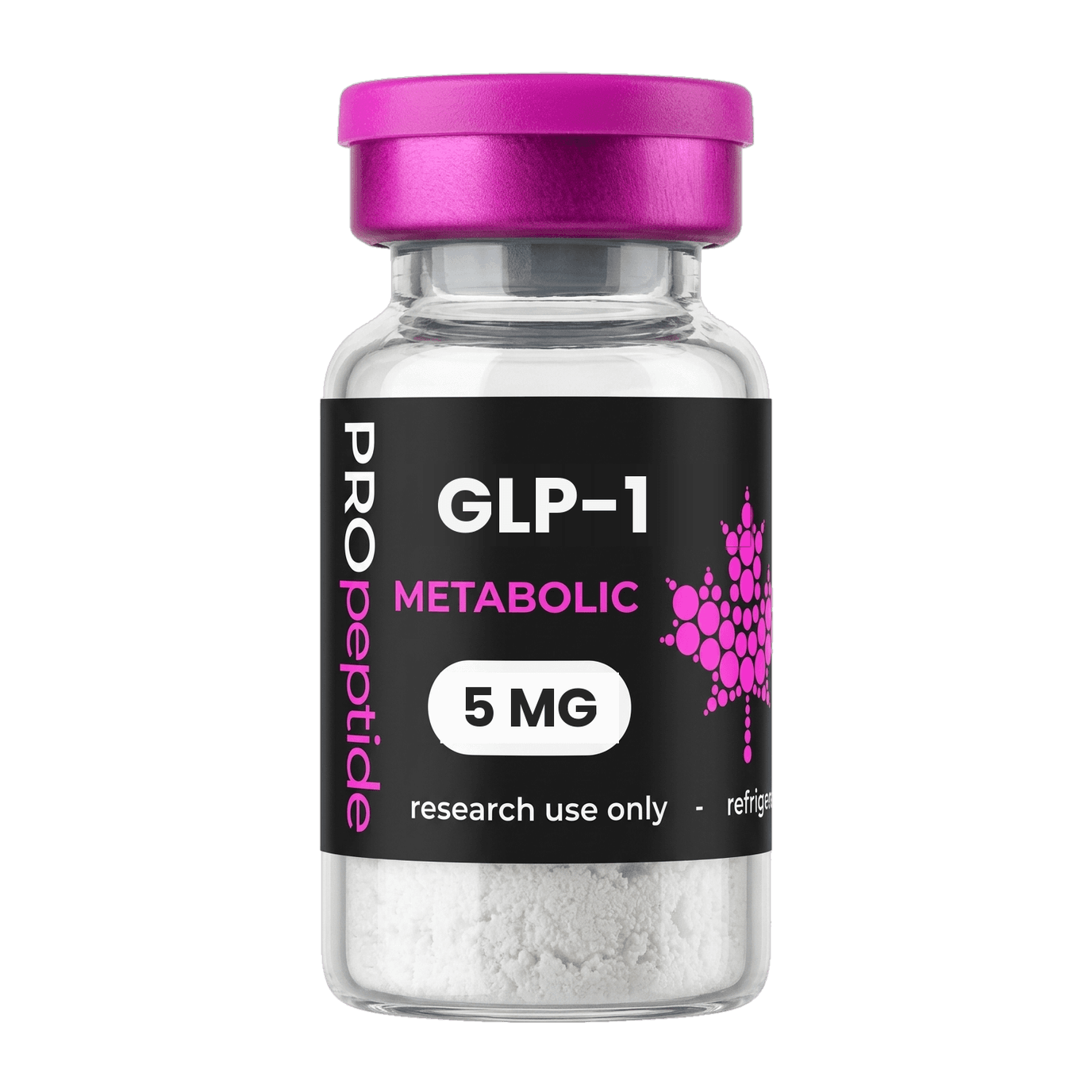
GLP-1 Peptide (Native 7-36 Amide)
The hormone every GLP-1 drug is an imitation of. It lasts about one minute, and that is the entire story.
Choose your pack
For research use only. Not for human or veterinary use.
What GLP-1 Peptide (Native 7-36 Amide) is
The plain-language version, first.
The unmodified original that a decade of famous molecules descends from.
GLP-1 (7-36) amide is the native human incretin hormone, a 30-amino-acid peptide with the sequence HAEGTFTSDVSSYLEGQAAKEFIAWLVKGR-NH2, molecular formula C149H226N40O45 and molecular weight 3297.6. Unmodified GLP-1 is inactivated by dipeptidyl peptidase-4 within minutes of release, with an intact-peptide plasma half-life measured at 1.0 plus or minus 0.1 minutes in anaesthetised pigs; it has never been approved as a drug by any regulatory authority.
Every famous molecule in the incretin category is a modification of this one.
This is GLP-1(7-37), the actual hormone, the sequence your intestinal cells release when food arrives. No substitutions, no fatty acid tails, no engineering.
Plasma half-life: about one minute. Sixty seconds, give or take, and the signal is gone.
That sounds like a defect and is actually the design. Meal signals are supposed to be brief. The body says something, the pancreas hears it, the message self-destructs.
Every analogue on this shelf and in every pharmacy exists because somebody wanted that message to last longer than evolution did.
This is the message before anybody edited it. That is its entire job here.
What GLP-1 is
Mechanism studied, not outcome promised.
A signal designed by evolution to disappear almost immediately.
The mechanism is the textbook one, because this molecule wrote the textbook.
Food arrives, gut cells release the hormone, and it binds its receptor on pancreatic beta cells, and insulin release gets amplified in a glucose-dependent way.
Glucose-dependent is the elegant part. The signal amplifies insulin when sugar is present and stands down when it is not.
Then DPP-4 destroys it, within about a minute, and the system resets for the next meal.
An enzyme this fast makes the native hormone impossible to use as anything but a laboratory reference, which is exactly what research supply of it is for.
Here's the honest part, short version.
Anybody selling the native hormone with a story about effects is selling you sixty seconds of molecule. The famous results belong to the analogues, full stop.
The research so far for GLP-1 Peptide (Native 7-36 Amide)
Where the evidence is thin, we say so.
The foundational molecule of its field, useless as a product, priceless as a reference.
The literature here is genuinely enormous and belongs to physiology rather than to product.
The incretin effect, the receptor, the glucose-dependence, the DPP-4 clearance: all foundational, all replicated to death, all about the biology.
The clinical literature belongs entirely to the engineered analogues. The native hormone has no approved use anywhere and never will, because sixty seconds is sixty seconds.
Its research role is as a reference standard: the baseline against which every modification is measured.
The most studied signalling system on this shelf, and the one molecule in it with no story to sell. What is in this vial is the control condition.
Canadian stock, cold-shipped from BC. Research use only.
GLP-1 Peptide (Native 7-36 Amide) specs
The chemistry, exactly as released.
Who studies GLP-1 Peptide (Native 7-36 Amide)
Who tends to order this one, and why.
- 1
Incretin and DPP-4 researchers
If you're studying degradation kinetics or DPP-4 inhibition, the native peptide is the substrate. Nothing else tells you what the enzyme actually does to the real thing.
- 2
Receptor pharmacology labs
GLP-1R assays need the endogenous ligand as the reference agonist. Analogue potency only means something relative to this.
- 3
Analytical method developers
A 3297.6 dalton peptide with a known sequence and a well-characterised truncation product is a useful test case for LC-MS methods that have to resolve intact from clipped forms.
- 4
Anyone comparing analogues honestly
The gap between one minute and one week is the entire value proposition of modern GLP-1 chemistry. You can't quantify it without the baseline in hand.
Sold for laboratory research only. This is not guidance for personal use, and nothing here is a recommendation.
GLP-1 Peptide (Native 7-36 Amide) backstory
How it got here.
1987 is the year the hormone got its name and its problem in the same paper. Svetlana Mojsov and colleagues published in J Clin Invest that GLP-1(7-37), co-encoded in the glucagon gene, is a potent stimulator of insulin release in the perfused rat pancreas. They called it insulinotropin. It worked at 5 x 10^-11 M.
Then 1990, and Gefel's group narrows the fragility down to a single residue. Take the N-terminal histidine off and insulin release stops.
Then 1995 and 1998, and Carolyn Deacon's work puts hard numbers on the disappearance. Thirty minutes after a subcutaneous dose in diabetic patients, 88.5% of what's circulating is the dead metabolite. In anaesthetised pigs, the intact peptide's half-life is one minute.
At that point the field had a choice. Give up on GLP-1, or engineer around DPP-4. It chose to engineer, and everything since, the DPP-4 inhibitors and the acylated analogues and the dual agonists, is downstream of those measurements.
The hormone didn't fail. It was never built to be a drug.
- 1
1987: insulinotropin
Mojsov and colleagues publish in J Clin Invest that GLP-1(7-37) stimulates insulin release in the perfused rat pancreas at 5 x 10^-11 M, while GLP-1(1-37) does almost nothing. Six residues, a ten-thousand-fold difference.
- 2
1990: one histidine
Gefel and colleagues report that removing the N-terminal histidine abolishes insulin release. That single result explains why DPP-4 clipping two residues shuts the whole hormone down.
- 3
1995 and 1998: the clock
Deacon and colleagues measure the damage. In diabetic patients, 88.5% of the signal at 30 minutes post-injection is the inactive truncated metabolite. In anaesthetised pigs, intact-peptide half-life is 1.0 plus or minus 0.1 minutes.
Buying GLP-1 Peptide (Native 7-36 Amide) in Canada
What ships, how fast, and the paperwork.
Never approved, anywhere. Native GLP-1 has no drug approval from any regulator on earth. It exists as an endogenous hormone and a laboratory reference peptide, and it is supplied here strictly for research use.
Caught by WADA S0. Because no governmental health authority has approved it, native GLP-1 falls under the S0 category on the WADA Prohibited List, which covers any pharmacological substance without regulatory approval.
It degrades for a living. This peptide's entire identity is that it doesn't last. Lyophilised powder kept cold is the stable form. Canadian stock shipped from BC means less time warm in transit.
Common questions
6 answers, none of them dodges.
How long does native GLP-1 actually last?
About a minute as intact peptide. Deacon and colleagues measured a plasma half-life of 1.0 plus or minus 0.1 minutes in anaesthetised pigs (Diabetes 1998). In humans, 30 minutes after subcutaneous dosing in participants with type 2 diabetes, the inactive N-terminally truncated metabolite made up 88.5% of the measurable signal. So most of a subcutaneous dose is inactivated inside half an hour.
Why do drug companies modify GLP-1 instead of using it directly?
Because DPP-4 clips two amino acids off the front and the hormone stops working. Every marketed analogue exists to defeat that. Semaglutide swaps in Aib at position 8 to block the enzyme and adds a fatty acid to bind albumin, which takes the reported half-life from about a minute to about a week. The modifications are the product.
What is the difference between GLP-1(7-36) amide and GLP-1(7-37)?
They're the two circulating active forms of the same hormone, produced by different C-terminal processing. The (7-36) amide form is the dominant one in human circulation and is what this listing is. Both activate the GLP-1 receptor. The classic Mojsov 1987 insulinotropic data was generated using the (7-37) form.
Is native GLP-1 approved as a medicine?
No, and it never has been anywhere. Its pharmacokinetics rule it out as a practical drug, which is precisely why the analogue class exists at all. It occurs naturally in the human gut and it's supplied here as a laboratory reference peptide. Any page telling you native GLP-1 is an approved treatment has it wrong.
Is GLP-1 prohibited in sport?
Native GLP-1 falls under WADA category S0, which covers pharmacological substances that no governmental regulatory health authority has approved for human therapeutic use. That's a broad catch-all and it reaches the unmodified hormone even though it isn't listed by name. Athletes in tested sport should confirm with their anti-doping authority.
Why is a two-amino-acid clip enough to switch it off?
Because the N-terminus is where the receptor contact happens. Gefel and colleagues showed in 1990 that removing just the N-terminal histidine abolishes insulin release. Mojsov's 1987 work made the same point from the other direction: GLP-1(1-37) with six extra front-end residues is basically inert, while GLP-1(7-37) works at picomolar concentrations.
GLP-1 Peptide (Native 7-36 Amide) vs Semaglutide
Stacked together constantly, compared almost never.
This is the before-and-after photo of the entire incretin category: the natural signal next to its most famous edit.
Native GLP-1 is the message exactly as the gut sends it, with a one-minute half-life because meal signals are built to self-destruct.
Semaglutide is the same signal taught to survive: one substitution against the cutting enzyme, one fatty diacid to ride albumin, half-life measured in days.
Sixty seconds against a week, and the chemistry between them is two modifications. Every claim you have ever read about this category belongs to the edited version, not to this one. Semaglutide has its own page here
Good pairing options with GLP-1 Peptide (Native 7-36 Amide)
What researchers stack alongside it.
Pairing is where research gets ahead of itself. These are the compounds researchers put in the same order as GLP-1 Peptide (Native 7-36 Amide), which is a statement about ordering habits, not about evidence. Two things in one cart have not been studied together unless somebody studied them together.
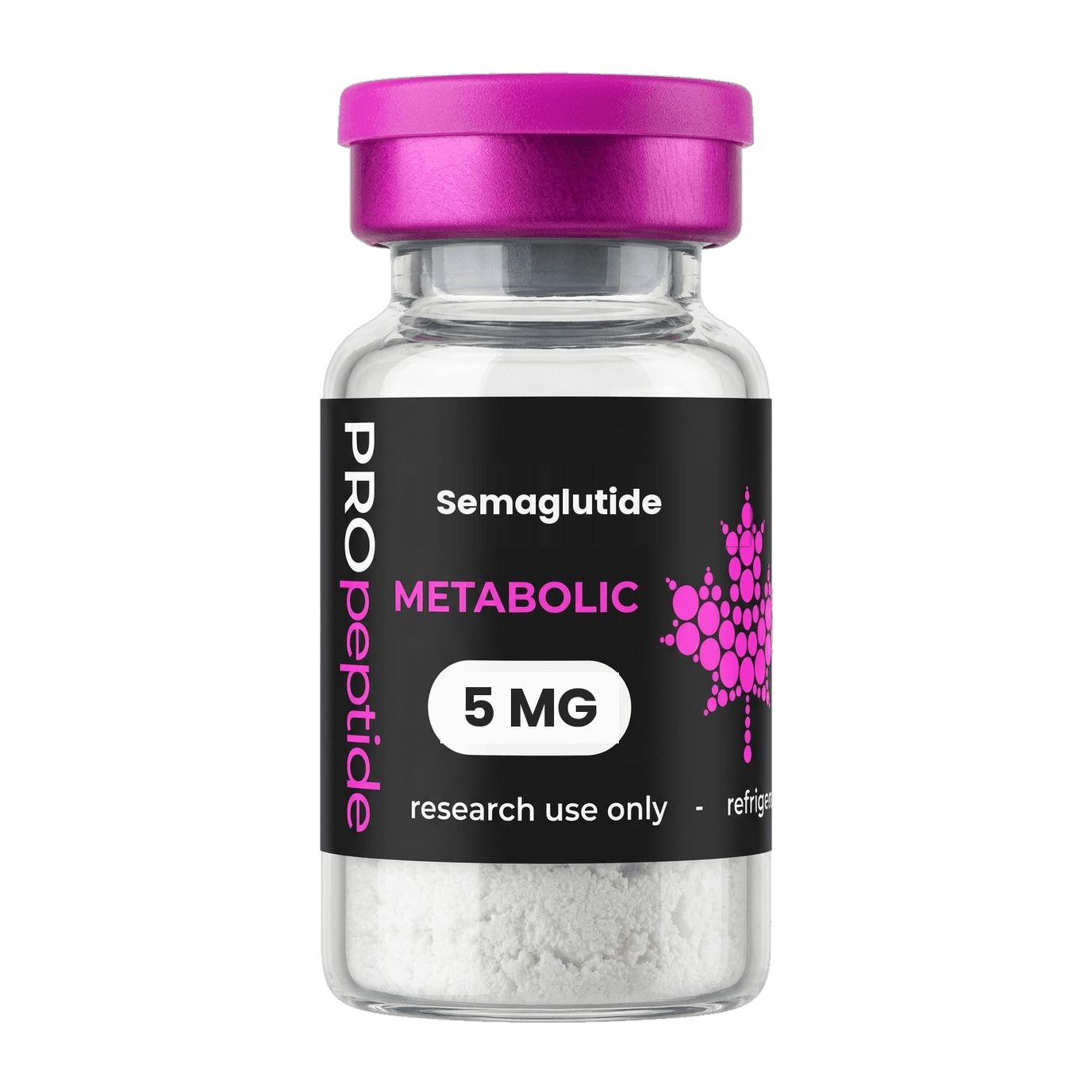
Cut six amino acids off the front of a peptide and it got roughly ten thousand times more active. That result, from 1987, is the reason this entire shelf exists.
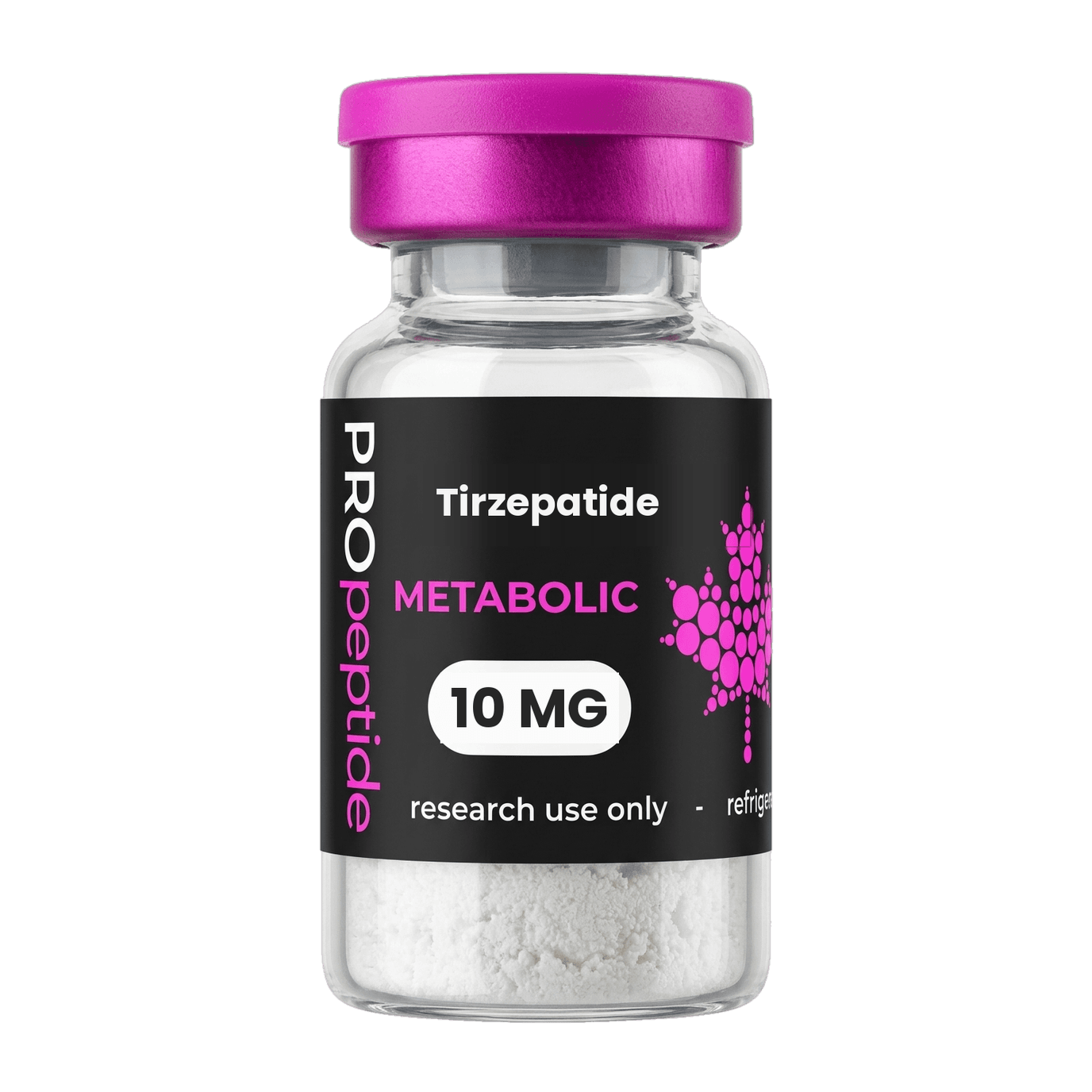
For twenty years GIP was the incretin receptor nobody wanted, written off as the one that was not earning its place in the system. Tirzepatide was built to pull it on purpose, and the field had to go back and re-read its own literature.
It is water. We know. But it is the one bottle on this shelf where the boring ingredient is the entire product, and getting it wrong ruins everything else you bought.
Order GLP-1 Peptide (Native 7-36 Amide) right now
One last look before you decide.
Freeze-dried, ships cold from Canada
You've got the whole file now, the thin parts included. Nothing above pretended otherwise. If that's the kind of source you were after, GLP-1 Peptide (Native 7-36 Amide) is right here.
Not for human consumption. Not approved by Health Canada or any other regulatory body.
Page last updated October 4, 2026
People also search for GLP-1 Peptide (Native 7-36 Amide)
Related searches.