
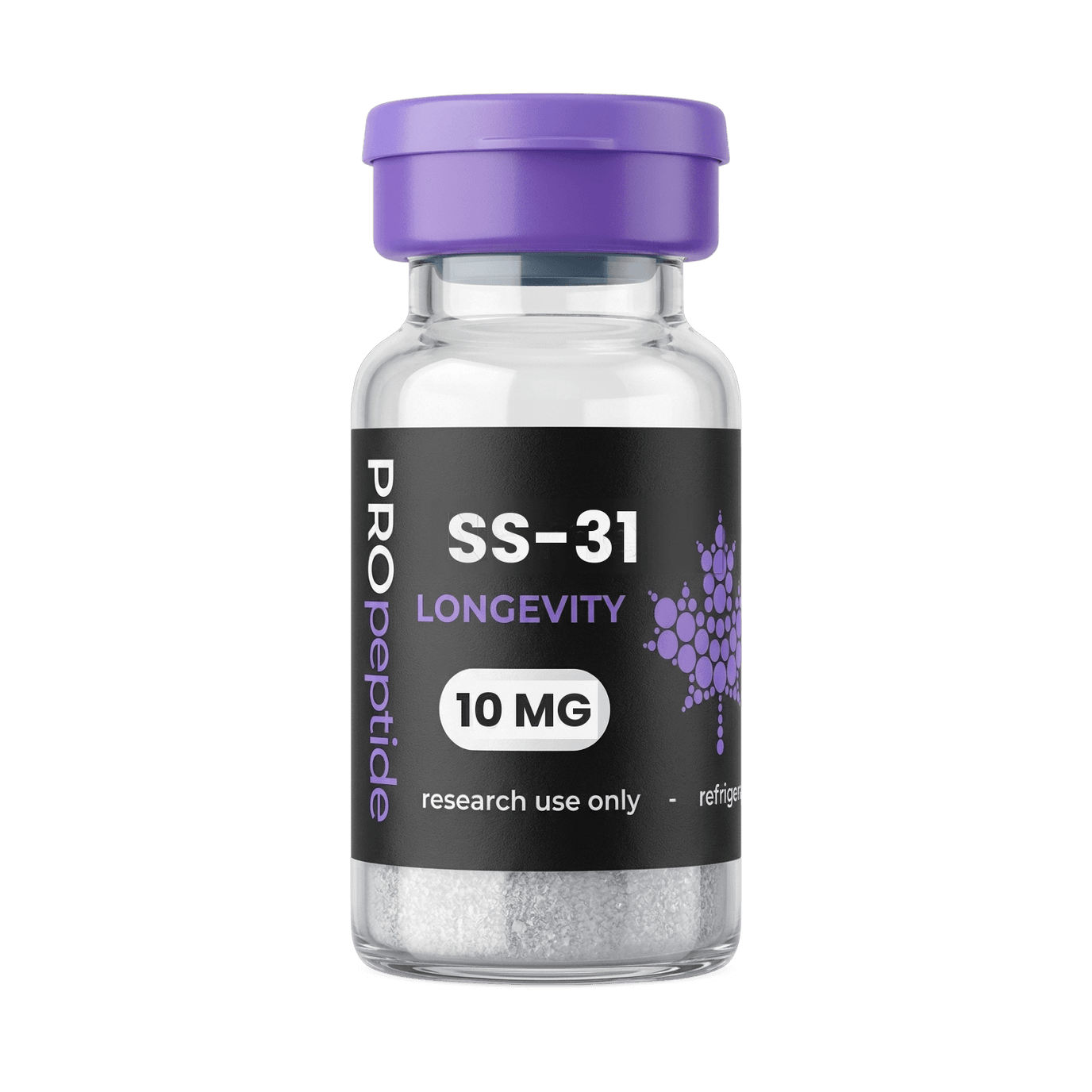
SS-31 Peptide (Elamipretide)
Its 218-patient phase 3 failed cleanly. It then got FDA approval on a 12-patient database for a different disease.
Choose your pack
For research use only. Not for human or veterinary use.
What SS-31 Peptide (Elamipretide) is
The plain-language version, first.
One of the newest approvals in peptide medicine, for one of the rarest diseases.
SS-31 is elamipretide, a four amino acid peptide that concentrates in the inner mitochondrial membrane and binds cardiolipin, the phospholipid required for normal cristae structure and electron transport chain function. Its 218 patient phase 3 trial in primary mitochondrial myopathy failed its prespecified endpoints, and it was later granted FDA approval for Barth syndrome on the basis of a much smaller patient database.
In September 2025 this molecule did something almost nothing on this shelf's ever done. It got approved.
FDA approval, for Barth syndrome, an ultra-rare inherited mitochondrial disease. The data behind it came from twelve patients, because twelve was a meaningful slice of everyone diagnosed.
SS-31, elamipretide on the paperwork, is a four-residue peptide with an unusual address. It doesn't sit in the bloodstream waiting for a receptor. It moves into mitochondria and binds cardiolipin, a lipid that's found almost nowhere else in the cell.
Rare-disease approvals run on different rules for honest reasons. You can't run a thousand-patient trial on a disease with a few hundred known cases. It's like polling a town of three hundred people: twelve answers is a real sample there.
We stock the 10mg vial, and the box of ten takes 25% off.
A real approval, a real molecule, and a data package whose size is a fact about the disease rather than a shortcut.
What is SS-31?
Mechanism studied, not outcome promised.
It targets a lipid, not a receptor, which is genuinely unusual.
Nearly everything on this shelf knocks on a door. Some receptor, some pocket.
This one doesn't knock. It parks on the garage floor.
Cardiolipin is a structural lipid of the inner mitochondrial membrane, the concrete the energy-making machinery is bolted to. Fold it wrong and the machinery wobbles.
SS-31 piles up inside mitochondria and binds cardiolipin, with the proposed effect of steadying that machinery under stress.
A peptide that targets a lipid instead of a receptor pocket is a genuinely different class of mechanism, and it's why this molecule spent years getting tried against a long list of mitochondrial conditions.
Here's the honest part. Most of those other trials didn't succeed. Not close, in some cases.
The approval's real and narrow. The heart-failure programme and the larger trials read out negative or equivocal along the way, and those results are part of the same file.
The research so far for SS-31 Peptide (Elamipretide)
Where the evidence is thin, we say so.
Approved on twelve patients. That sentence deserves its own explanation.
This file has both endings in it, which makes it unusually instructive.
The failures: larger trials in heart failure and other mitochondrial conditions that didn't meet their endpoints through the late 2010s and early 2020s. Its biggest trial, 218 patients, missed both primary endpoints.
The success: Barth syndrome, September 2025, an approval built on twelve patients in a disease where twelve is a cohort.
Both are real. The molecule isn't a fraud that finally slipped through, and it isn't a wonder that was always going to win. It's a targeted tool that found the one context narrow enough to show its worth, and even there FDA wants a confirmatory trial.
We're not gonna dress it up. Nobody has shown a benefit in people without a mitochondrial disease.
Approved for one ultra-rare disease, missed in several common ones, and an honest page carries both halves.
Have a look at current stock and vial sizes.
SS-31 Peptide (Elamipretide) specs
The chemistry, exactly as released.
Who studies SS-31 Peptide (Elamipretide)
Who tends to order this one, and why.
- 1
Mitochondrial medicine
The largest and best-designed trial programme in this space, which is why its failure is informative rather than ambiguous.
- 2
Barth syndrome
An ultra-rare X-linked condition affecting cardiolipin remodelling, and the only approved indication for this compound anywhere.
- 3
Membrane biophysics
Cardiolipin and cristae architecture, and how a small molecule associating with a phospholipid can alter organelle structure.
- 4
Regulatory reviewers
A case study in accelerated approval on an intermediate endpoint, in a disease with no alternative, from a twelve patient database, with a confirmatory trial required.
Sold for laboratory research only. This is not guidance for personal use, and nothing here is a recommendation.
SS-31 Peptide (Elamipretide) backstory
How it got here.
Mitochondrial medicine has been a difficult field to develop drugs in. The diseases are rare, heterogeneous, and endpoint selection is genuinely hard, because what patients experience is fatigue and exercise intolerance rather than something a lab value captures cleanly.
Elamipretide, developed by Stealth BioTherapeutics, was the most advanced candidate in that space for years. It went into primary mitochondrial myopathy as the lead indication, the largest addressable population, and into Barth syndrome, an ultra-rare X-linked condition affecting cardiolipin remodelling, as a second.
The large indication failed and the ultra-rare one produced an approval, which is an unusual sequence and reflects both the mechanism fit in Barth and the different evidentiary standards that apply when a disease affects a very small number of people and has no alternative.
A European orphan designation exists for Barth syndrome. There is no European marketing authorisation and no Health Canada product.
- 1
A hard field
Mitochondrial diseases are rare, heterogeneous and difficult to design endpoints for, because what patients experience is fatigue and exercise intolerance rather than a clean lab value.
- 2
The big indication failed
Primary mitochondrial myopathy was the lead programme and the largest population. MMPOWER-3 returned a clean negative in 218 patients.
- 3
The rare one got approved
Barth syndrome involves cardiolipin remodelling, which is exactly where the mechanism fits. FDA granted accelerated approval in September 2025 on a twelve patient database.
Buying SS-31 Peptide (Elamipretide) in Canada
What ships, how fast, and the paperwork.
Same day out of British Columbia. Our building, our cold packs, our people, and nothing sitting in a customs queue while you refresh a tracking page.
Then into the fridge. Keep it cold and keep it dark. Sealed and freeze-dried it handles a rough trip without ice. Once it lands, fridge.
The failure is the useful part. Most compounds here have thin evidence, which leaves room for hope. This one had 218 patients, randomisation, placebo and prespecified endpoints, and came back clean and negative in primary mitochondrial myopathy. That is a closed question rather than an open one, and it is worth more than an ambiguous file.
Common questions
5 answers, none of them dodges.
Did SS-31 work in its largest trial?
No. MMPOWER-3, published in Neurology in 2023, randomised 218 patients with primary mitochondrial myopathy to elamipretide 40 milligrams daily or placebo for 24 weeks. Both co-primary endpoints failed. Six minute walk distance was minus 3.2 metres, numerically favouring placebo, p equals 0.69, and the fatigue score gave p equals 0.37. The paper is graded Class I evidence that elamipretide does not improve those outcomes.
But it is FDA approved, so how does that fit?
The approval is for a different disease. FDA granted accelerated approval on 19 September 2025 for Barth syndrome, an ultra-rare X-linked condition, to improve muscle strength in patients weighing at least 30 kilograms. It was granted on knee extensor muscle strength, an intermediate endpoint FDA described as reasonably likely to predict benefit, and the entire clinical safety database on the label is twelve male patients. FDA requires a confirmatory randomised trial.
What is cardiolipin and why does it matter?
A distinctive four-tailed phospholipid found almost exclusively in the inner mitochondrial membrane, where it is structurally necessary for the cristae folds to form and for the respiratory complexes to organise. Elamipretide associates with it and is described as stabilising that architecture. Barth syndrome is caused by mutations affecting cardiolipin remodelling, which is why the mechanism and that indication line up.
Did the mechanism change during development?
Yes, and it is worth knowing. The compound was originally developed on a reactive oxygen species scavenging hypothesis. That explanation has been superseded in the current literature by the cardiolipin interaction. A revised mechanism mid-development is not unusual but it does affect how confidently anyone should extrapolate to new indications.
What about the Barth syndrome trial results?
The randomised portion missed too. TAZPOWER, published in Genetics in Medicine in 2021, enrolled twelve male patients in a double-blind placebo-controlled crossover, and the authors write that in part one neither primary endpoint was met. The positive figures came from the open-label extension, where six minute walk improved by 95.9 metres at 36 weeks with no control arm.
Good pairing options with SS-31 Peptide (Elamipretide)
What researchers stack alongside it.
Pairing is where research gets ahead of itself. These are the compounds researchers put in the same order as SS-31 Peptide (Elamipretide), which is a statement about ordering habits, not about evidence. Two things in one cart have not been studied together unless somebody studied them together.
Your mitochondria carry their own tiny genome, and it turns out that genome writes peptides. This is the famous one. The FDA searched six databases in 2026 and found no human trial data at all.
Not a peptide, and your cells burn through it constantly anyway. It is the currency molecule of metabolism, and there is no controlled trial of the injectable form in healthy adults.
It is water. We know. But it is the one bottle on this shelf where the boring ingredient is the entire product, and getting it wrong ruins everything else you bought.
Order SS-31 Peptide (Elamipretide) right now
One last look before you decide.
Freeze-dried, ships cold from Canada
You've got the whole file now, the thin parts included. Nothing above pretended otherwise. If that's the kind of source you were after, SS-31 Peptide (Elamipretide) is right here.
Not for human consumption. Not approved by Health Canada or any other regulatory body.
Page last updated October 4, 2026
People also search for SS-31 Peptide (Elamipretide)
Related searches.