
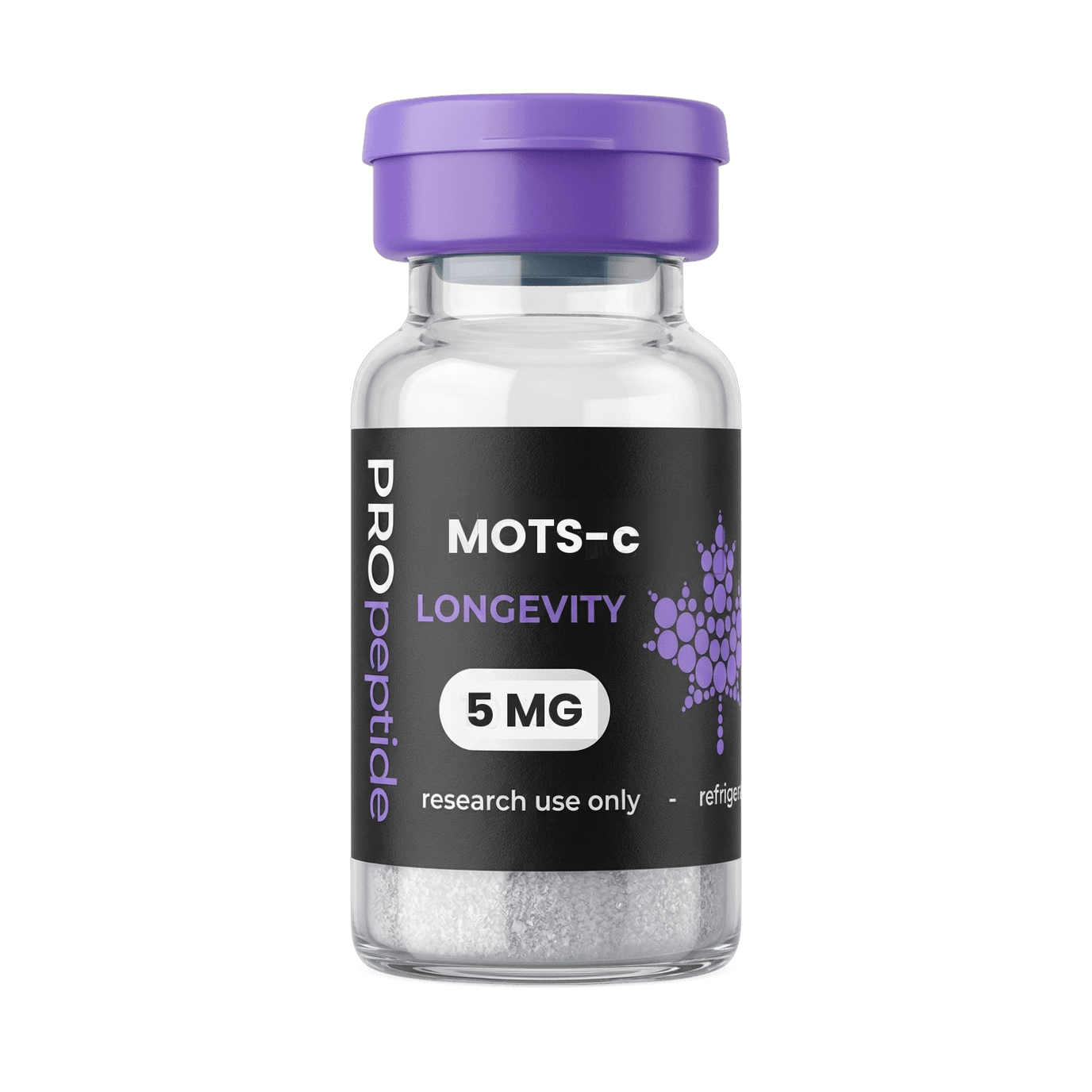
MOTS-c Peptide
Zero published human data of any kind, and the only compound in this catalogue WADA names by name.
Choose your pack
For research use only. Not for human or veterinary use.
What MOTS-c is
The plain-language version, first.
A peptide encoded by the genome inside your mitochondria, which was not supposed to do that.
MOTS-c is a 16 amino acid mitochondrial derived peptide encoded within the 12S rRNA gene of mitochondrial DNA rather than in the nuclear genome, and it is studied for its activation of the AMPK metabolic pathway. It has no published human clinical data of any kind and is named on the World Anti-Doping Agency prohibited list.
Here's a thing that rewrote a paragraph of the textbook.
Your mitochondria have their own DNA, a leftover from their bacterial past, and for decades it was catalogued as encoding exactly thirteen proteins plus housekeeping.
Then researchers found short open reading frames hiding inside it, producing actual signalling peptides. MOTS-c is the most famous of them.
Sixteen residues, encoded inside the 12S ribosomal RNA gene of the mitochondrial genome, which is roughly like finding a working sentence hidden inside a word.
The discovery is genuinely important. Mitochondria talk to the rest of the cell with their own peptides.
The biology is a legitimate landmark. What is in a vial is a different question, and the FDA recently asked it.
What is MOTS-c?
Mechanism studied, not outcome promised.
Exercise biology in a sixteen-residue package, in mice.
The proposed story is exercise biology in miniature.
In mouse work, MOTS-c moves with metabolic stress, travels to the nucleus, and influences gene expression tied to energy regulation, with effects on endurance and metabolic markers in the animals.
A mitochondrially-encoded peptide that talks back to the nuclear genome. As cell biology it is genuinely elegant.
The mouse exercise results are the ones that escaped the laboratory and built the compound's reputation.
Here's the honest part, and in 2026 it comes with a regulator's signature.
The FDA, evaluating this compound for compounding eligibility, searched six databases for human evidence and reported finding none. Not thin. None.
The research so far for MOTS-c
Where the evidence is thin, we say so.
A regulator went looking for the human data in 2026. Six databases. Nothing.
The file splits cleanly, and a regulator recently did the splitting for us.
The discovery science is real: mitochondrial-derived peptides are an established field now, published in serious journals, replicated across groups.
The intervention evidence is absent: the FDA's 2026 review searched six databases and found no human trial data for MOTS-c at all.
Mouse endurance work, cell work, real biology, zero human file. That is the complete honest picture.
Nothing approved anywhere.
A landmark discovery and an empty human column, and the discovery's fame keeps getting spent as if it were the missing evidence. It is not.
Have a look at current stock and vial sizes.
MOTS-c specs
The chemistry, exactly as released.
Who studies MOTS-c
Who tends to order this one, and why.
- 1
Mitochondrial biology
Mitochondrial-derived peptides are a genuinely new category of signalling molecule and MOTS-c is one of the best characterised examples in the laboratory.
- 2
Metabolic research
AMPK activation, glucose uptake and mitochondrial biogenesis, studied in diet-induced obesity models in mice.
- 3
Anti-doping laboratories
WADA names MOTS-c explicitly in section S4.4.1 among AMPK activators. Prohibited at all times, and a non-specified substance.
- 4
Nobody, in humans
FDA searched PubMed, Embase, Cochrane, DailyMed, Drugs@FDA, ClinicalTrials.gov and its adverse event system and identified no human data. That is the honest answer for this row.
Sold for laboratory research only. This is not guidance for personal use, and nothing here is a recommendation.
MOTS-c backstory
How it got here.
Mitochondria were once free-living bacteria and they kept a fragment of their own genome through the billion years since. That genome was assumed to be purely housekeeping.
The discovery that short open reading frames inside mitochondrial ribosomal RNA genes encode peptides which exit the mitochondrion and signal to the nucleus changed that picture. Humanin was the first found. MOTS-c came later, out of the 12S rRNA gene.
The research since has been preclinical: mouse metabolic models, rat bone and vascular work, cell culture. It reached the compounding market well ahead of any human study, which is the ordinary sequence for this category and the reason a regulator ended up reviewing it in 2026 with nothing to review.
- 1
A genome inside a genome
Mitochondria descend from free-living bacteria and kept part of their own DNA. It was long assumed to be purely housekeeping.
- 2
Peptides hiding in rRNA genes
Short open reading frames inside mitochondrial ribosomal RNA genes turned out to encode signalling peptides. Humanin was first. MOTS-c came out of the 12S gene.
- 3
On sale before the first trial
It reached the compounding market years ahead of any human study. The first registered human trial began recruiting in February 2026.
Buying MOTS-c in Canada
What ships, how fast, and the paperwork.
Same day out of British Columbia. Our building, our cold packs, our people, and nothing sitting in a customs queue while you refresh a tracking page.
Then into the fridge. Keep it cold and keep it dark. Sealed and freeze-dried it handles a rough trip without ice. Once it lands, fridge.
Named on the WADA list. Section S4.4.1 of the 2026 Prohibited List names MOTS-c explicitly among AMPK activators, alongside AICAR and BAM15. Prohibited at all times, in and out of competition, and classed as non-specified, which carries a heavier default sanction. Of everything in this catalogue, this is the one WADA names.
Common questions
5 answers, none of them dodges.
Are there any human studies of MOTS-c?
No. FDA searched PubMed, Embase, Cochrane, DailyMed, Drugs@FDA, ClinicalTrials.gov and its adverse event reporting system in preparation for a July 2026 advisory committee meeting and stated that it identified no clinical studies or human exposure data for MOTS-c via any route of administration. A first phase 2a trial began recruiting in February 2026 with estimated completion in 2027.
Is MOTS-c banned in sport?
Yes, explicitly. The WADA 2026 Prohibited List names MOTS-c by name in section S4.4.1 among activators of AMP-activated protein kinase, alongside AICAR and BAM15. It is prohibited at all times, in and out of competition, and is a non-specified substance, which carries a heavier default sanction.
What makes MOTS-c biologically unusual?
It is encoded in mitochondrial DNA rather than nuclear DNA. A short open reading frame inside the 12S ribosomal RNA gene produces a 16 residue peptide that leaves the mitochondrion and signals to the rest of the cell, including the nucleus. Mitochondrial-derived peptides were not known to exist until relatively recently.
What did FDA decide about MOTS-c?
FDA proposed not adding MOTS-c free base or MOTS-c acetate to the 503A bulk drug substances list, citing poor physicochemical characterisation, unknown use in compounding, nonclinical safety data inadequate to inform clinical use, and no clinical studies assessing safety and effectiveness in humans. The advisory committee voted against that recommendation, but committee votes are non-binding and FDA has issued no final decision.
What does AMPK activation actually do?
AMPK is the cell low-energy sensor. When the ratio of AMP to ATP rises it switches on and shifts metabolism toward generating fuel, increasing glucose uptake, fatty acid oxidation and mitochondrial biogenesis. Pharmacologically activating it mimics some metabolic consequences of exercise, which is both the appeal and the reason the class is prohibited in sport.
Good pairing options with MOTS-c
What researchers stack alongside it.
Pairing is where research gets ahead of itself. These are the compounds researchers put in the same order as MOTS-c Peptide, which is a statement about ordering habits, not about evidence. Two things in one cart have not been studied together unless somebody studied them together.
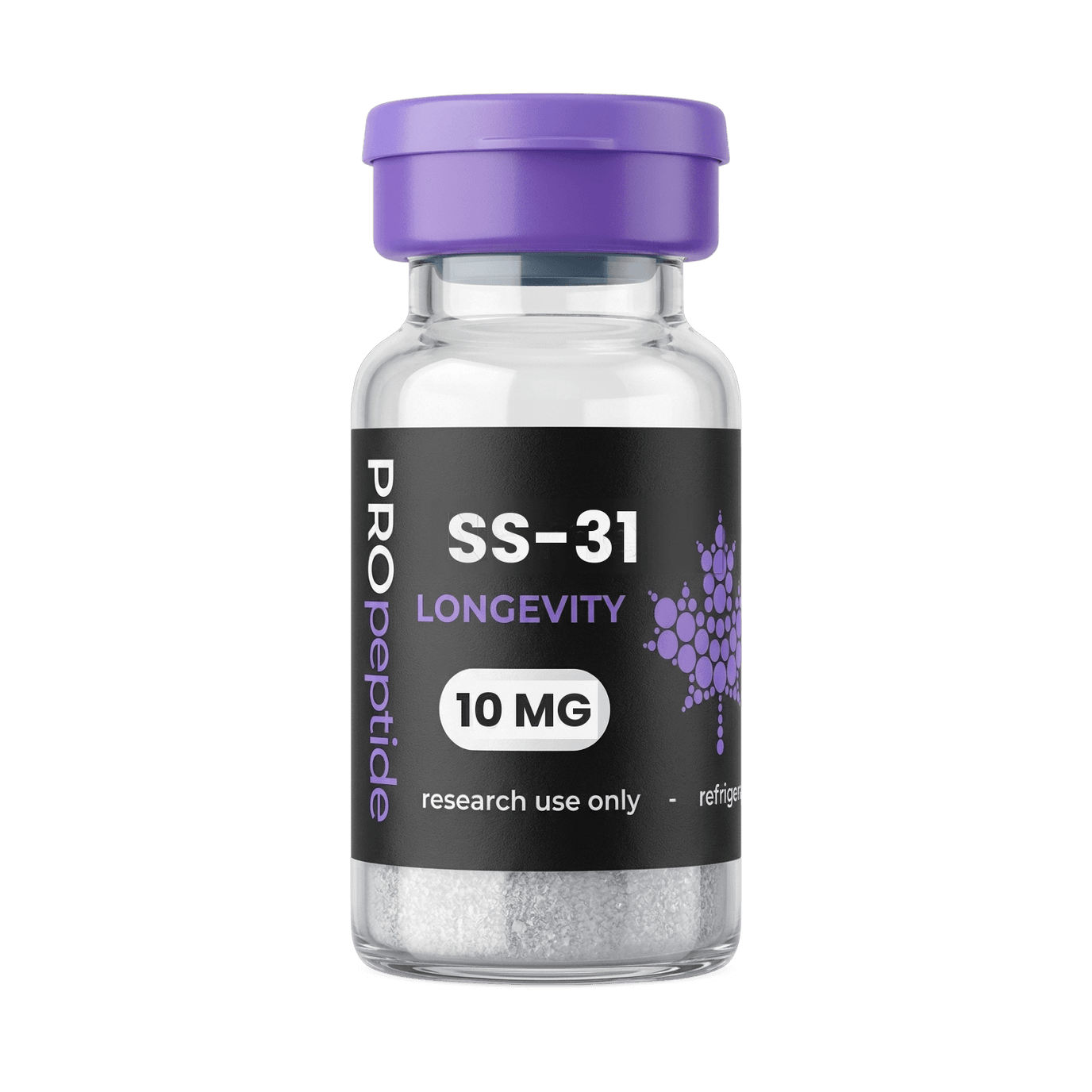
A tetrapeptide that parks itself on cardiolipin, the lipid mitochondria keep for themselves. FDA approved it in September 2025 for Barth syndrome, on data from 12 patients, which is a story about rare-disease medicine.
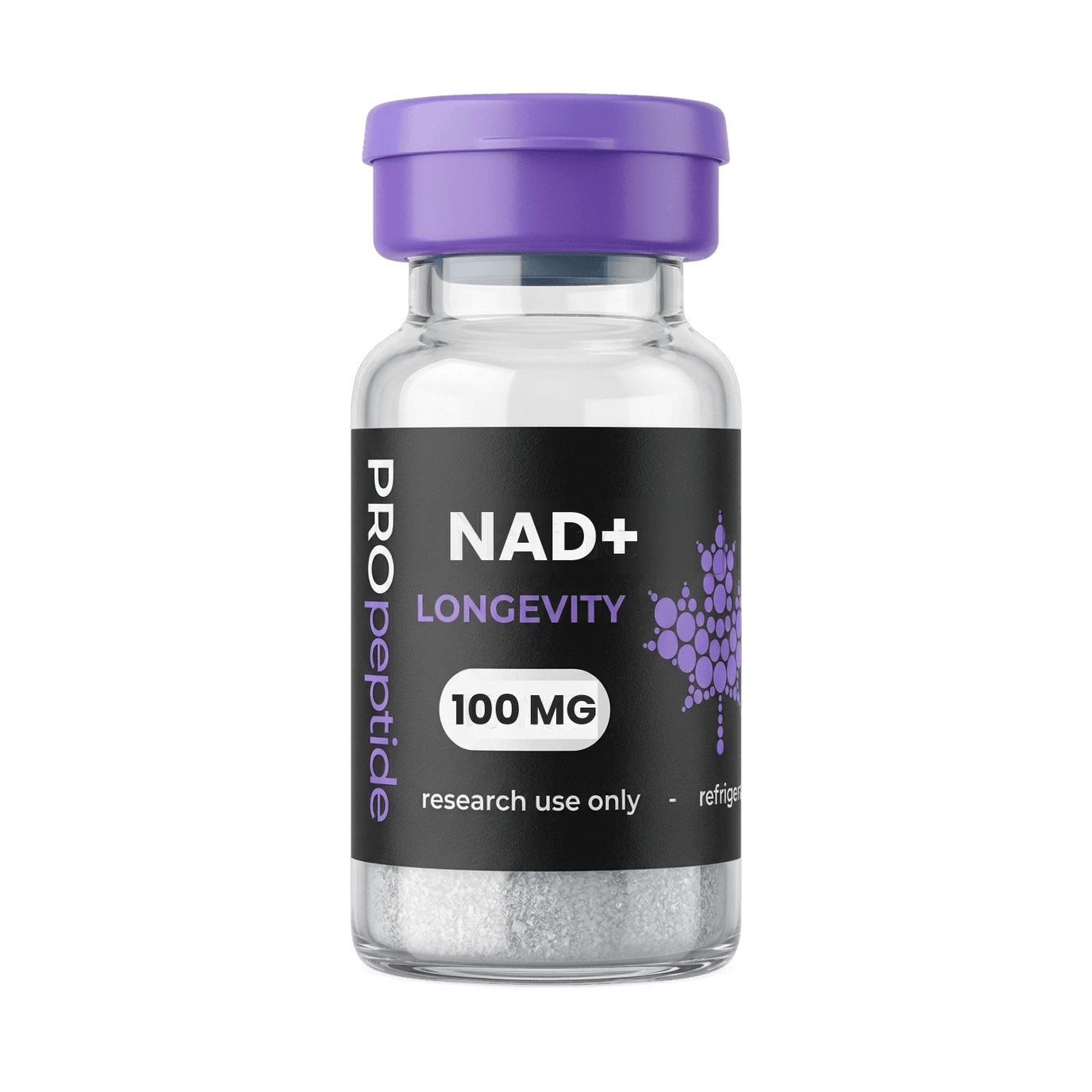
Not a peptide, and your cells burn through it constantly anyway. It is the currency molecule of metabolism, and there is no controlled trial of the injectable form in healthy adults.
It is water. We know. But it is the one bottle on this shelf where the boring ingredient is the entire product, and getting it wrong ruins everything else you bought.
Order MOTS-c right now
One last look before you decide.
Freeze-dried, ships cold from Canada
You've got the whole file now, the thin parts included. Nothing above pretended otherwise. If that's the kind of source you were after, MOTS-c is right here.
Not for human consumption. Not approved by Health Canada or any other regulatory body.
Page last updated October 4, 2026
People also search for MOTS-c
Related searches.