
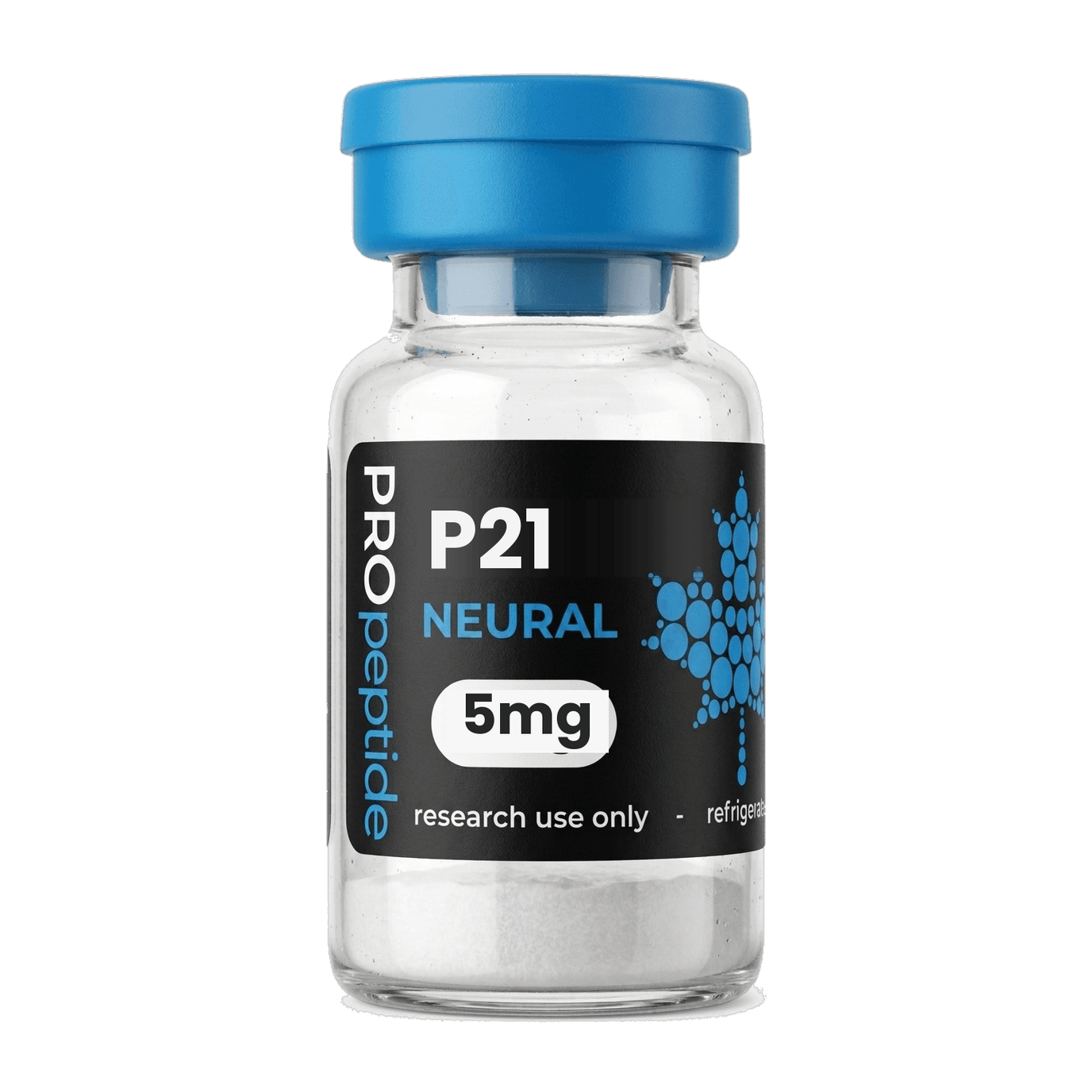
P21 Peptide
Ac-DGGL(A)G-NH2, C27H42N6O8. Research use only, not for human consumption.
Choose your pack
For research use only. Not for human or veterinary use.
What P21 is
The plain-language version, first.
A neurotrophin fragment wearing a chemical crash helmet.
P21 peptide (also written P021, Ac-DGGL(A)G-NH2, acetyl-Asp-Gly-Gly-Leu-(adamantyl)Gly-amide, C27H42N6O8, molecular weight 578.7, PubChem CID 56589645) is a synthetic non-natural peptide derived from a short region of ciliary neurotrophic factor, carrying an adamantane substitution on its C-terminal glycine to permit blood brain barrier penetration. It has been studied as an orally active compound in 3xTg-AD mice, with no human studies published to date.
The parent story matters here, because P21 exists to fix the parent's specific failure.
CNTF is a growth factor your nervous system uses. It went into development decades ago, and it ran into problems including immune reactions and a molecule too large and fragile to deliver well.
P21 is a small fragment derived from it, wearing an adamantane group, which is a rigid carbon cage bolted on so the fragment can cross the blood-brain barrier.
Adamantane is a real trick with real precedent. Several approved drugs use that cage for exactly this purpose.
So the design reads sensibly: keep a working piece, armour it, get it into the brain by mouth.
A rational repair job on a failed molecule. The design is the strong part of this file.
What is P21 peptide?
Mechanism studied, not outcome promised.
The parent molecule failed for a fixable reason, and this is the attempted fix.
The proposed mechanism sits in an interesting corner of brain biology: the birth of new neurons.
The mouse work points at P21 nudging neural progenitor cells toward becoming neurons, partly by interfering with a signal called LIF that normally holds them back.
Releasing a handbrake rather than pressing an accelerator. As mechanisms go it is a genuinely elegant one.
It is also, so far, a mouse mechanism. The models used are dementia models, the durations run long for rodent work, and the oral activity claim has held up in that setting.
Here's the honest part, in the plainest terms available.
No human has taken this compound in any registered trial. The entire file lives in animals, and elegance in a mouse is still a mouse.
The research so far for P21
Where the evidence is thin, we say so.
Mouse work with an interesting shape, and a human column that is empty.
The animal file has a specific strength worth naming: duration.
Rodent studies have run up to eighteen months, which is long for this kind of work, without the toxicity pattern that helped sink the parent molecule.
Long, clean animal runs are genuinely encouraging. They are also exactly where every failed neurology drug looked good, because the brain is where animal models betray you most.
Neurology has the worst translation rate in all of drug development. Compounds that cure mouse dementia are a crowded graveyard.
No human trials. Nothing approved. No safety data in people at all.
A well-designed molecule with promising mouse work, standing at the exact spot where hundreds of promising molecules have previously fallen over. Respect the design. Price in the graveyard.
P21 peptide, research grade, sold for laboratory use only.
P21 specs
The chemistry, exactly as released.
Who studies P21
Who tends to order this one, and why.
- 1
Groups working on oral peptide delivery
The adamantane cage is a concrete, reproducible answer to the blood brain barrier problem, and the feed-dosed study is the proof point.
- 2
Tau and amyloid model labs
The 3xTg-AD readouts in the Kazim work cover tau phosphorylation and soluble amyloid beta in the same animals, which is a convenient combined endpoint set.
- 3
Neurogenesis researchers
The LIF inhibition mechanism is an unusual route to progenitor differentiation and is not widely used as a tool approach.
- 4
Anyone confusing this with p21 the protein
P021 the peptide and p21 the cyclin-dependent kinase inhibitor share nothing but a label. Literature searches on the bare term return mostly the protein.
Sold for laboratory research only. This is not guidance for personal use, and nothing here is a recommendation.
P21 backstory
How it got here.
The New York State Institute for Basic Research sits on Staten Island, which is not where anybody expects Alzheimer's chemistry to come from. Khalid Iqbal's group there has been working on tau for a very long time.
The idea behind P021 is almost stubborn. CNTF failed in humans for reasons that had nothing to do with whether it helped neurons. It failed because the whole protein did too many things at once and some of them were awful. So rather than declare the target dead, they asked which small piece carried the useful signal.
Then they solved the delivery problem with an adamantane cage, which is a genuinely elegant piece of medicinal chemistry dressed up as brute force. And then they proved the point in the least glamorous way available. They put it in mouse chow and left it there for a year.
- 1
CNTF's bad trial
Ciliary neurotrophic factor went into ALS trials and produced anorexia, muscle pain and cramps. The protein was effectively shelved as a systemic therapeutic.
- 2
Staten Island, not Cambridge
Khalid Iqbal's lab at the New York State Institute for Basic Research took a short region of CNTF and built a peptide around it rather than abandoning the target.
- 3
Dosed in the chow
The pivotal twelve month 3xTg-AD study administered P021 in the feed. An orally active neuroactive peptide is rare enough that this is the headline detail.
Buying P21 in Canada
What ships, how fast, and the paperwork.
Research use only. Sold for laboratory research use only, not for human or veterinary consumption. Health Canada's advisory of 9 April 2026 states that peptides are generally regulated as prescription drugs in Canada, and that "For Research Use Only" labelling does not make these products legal. P21 is not named in that advisory, which is not the same as being cleared.
No CAS number, on purpose. We could not locate a CAS registry number for P021 in any primary source. Some listings print one anyway. A blank you can trust beats a number you can't.
Two molecular weights in circulation. PubChem CID 56589645 gives 578.7. A second source gives 578.3. They agree to within 0.4 daltons and both describe the same compound, C27H42N6O8.
Common questions
5 answers, none of them dodges.
Is P21 the same as the p21 protein?
No, and the name collision causes real confusion. p21, also called Cip1 or Waf1, is a cyclin-dependent kinase inhibitor involved in the cell cycle. P021 is a small synthetic peptide derived from ciliary neurotrophic factor, written Ac-DGGL(A)G-NH2. They're unrelated. If you search the bare term in a literature database, most of what comes back is the protein rather than the peptide.
What is the adamantane group for?
Brain access. P021 is a small water-loving peptide, and the blood brain barrier is built to keep those out. Attaching a rigid adamantane cage to the C-terminal glycine makes the molecule fat-soluble enough to cross. It's the modification that turns an otherwise ordinary CNTF fragment into something that works when a mouse eats it rather than only when it's injected.
Is P021 really orally active?
In rodents, yes, and that's the most distinctive thing about it. The pivotal twelve month study in 3xTg-AD mice dosed P021 in the feed rather than by injection (Kazim, 2014, PMID 25046994). Oral activity is uncommon for neuroactive peptides. Whether it carries into any other species is unknown, because no other species has been tested.
Why was P021 made if CNTF already existed?
Because CNTF failed people. In ALS trials the full-length protein caused anorexia, muscle pain and cramps, which made it unusable systemically no matter what it did for neurons. Khalid Iqbal's lab kept the short region that carried the useful signal and dropped the rest. In rodents dosed up to eighteen months, P021 didn't produce weight loss or signs of pain.
What did the mouse studies actually report?
Chronic oral P021 in 3xTg-AD mice reduced tau hyperphosphorylation and soluble amyloid beta, increased BDNF, and in the authors' words rescued deficits in cognition, neurogenesis and synaptic plasticity (Kazim, 2014, Neurobiology of Disease). Those are model-system endpoints in a genetically engineered mouse, which is a long way from a clinical outcome in a person.
P21 Peptide vs Dihexa
Stacked together constantly, compared almost never.
The two brain-penetrant hopefuls of this catalogue, and the difference between their files is a lesson in how evidence ages.
P21 is a rationally designed CNTF fragment in an adamantane cage, with long-duration mouse work and zero human subjects ever. Its file is thin but intact.
Dihexa had a bigger reputation and then three of its foundational papers were retracted in 2025, leaving one independent rodent study upright.
A small file that holds beats a large one that had to be taken back. Neither has touched a human, and the mouse-to-human gap in neurology is the widest in all of drug development. Dihexa has its own page here
Good pairing options with P21
What researchers stack alongside it.
Pairing is where research gets ahead of itself. These are the compounds researchers put in the same order as P21 Peptide, which is a statement about ordering habits, not about evidence. Two things in one cart have not been studied together unless somebody studied them together.
A seven-residue fragment built in Moscow, sold in Russian pharmacies as nasal drops, and listed among that country's Vital and Essential Medicines. The Western file on it is nearly empty. Both facts are true at once.
Semax's labmate from the same Moscow institute, built off an immune peptide called tuftsin. Registered in Russia, studied almost entirely without placebo controls, unknown to Western regulators.
It is water. We know. But it is the one bottle on this shelf where the boring ingredient is the entire product, and getting it wrong ruins everything else you bought.
Order P21 right now
One last look before you decide.
Freeze-dried, ships cold from Canada
You've got the whole file now, the thin parts included. Nothing above pretended otherwise. If that's the kind of source you were after, P21 is right here.
Not for human consumption. Not approved by Health Canada or any other regulatory body.
Page last updated October 4, 2026
People also search for P21
Related searches.