
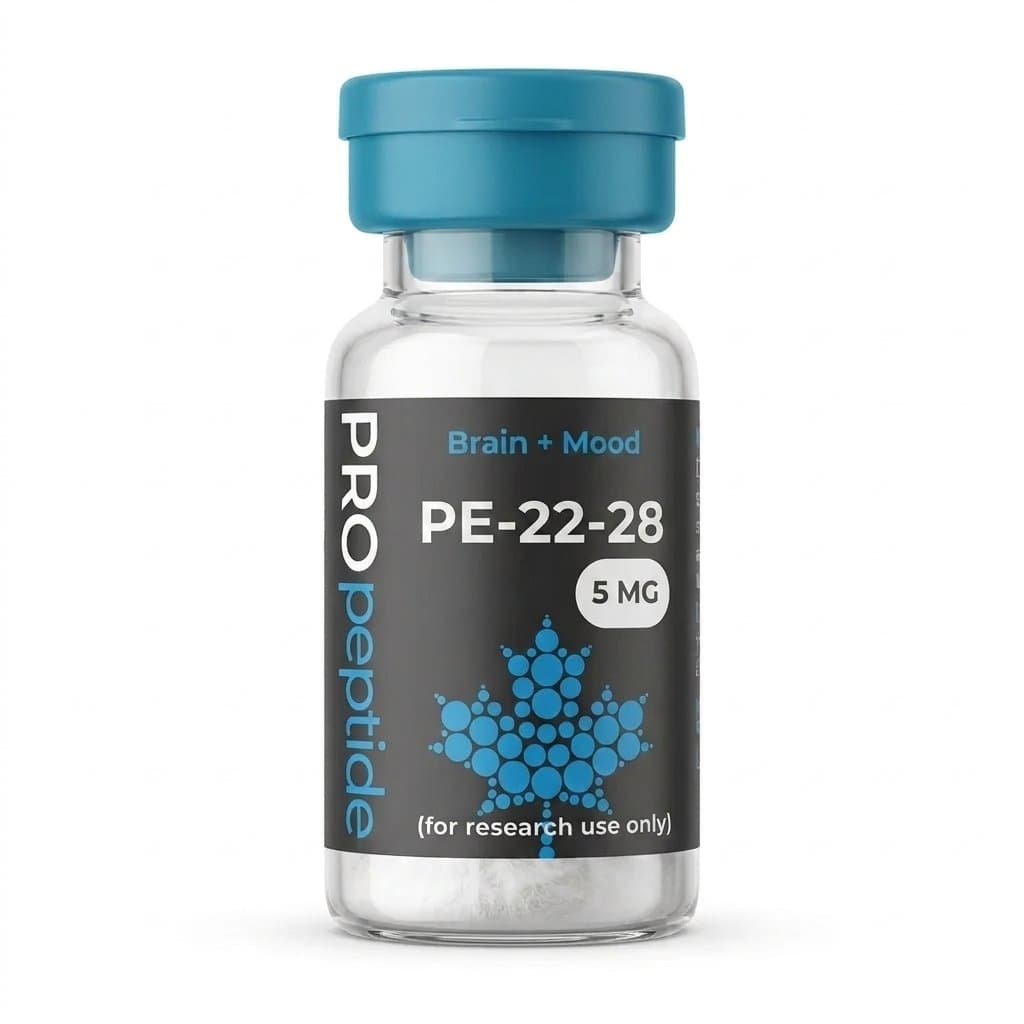
PE-22-28 Peptide
GVSWGLR, C35H55N11O9. Research use only, not for human consumption.
Choose your pack
For research use only. Not for human or veterinary use.
What PE-22-28 is
The plain-language version, first.
A seven-residue fragment aimed at a channel most people have never heard of.
PE-22-28 is a seven residue peptide (Gly-Val-Ser-Trp-Gly-Leu-Arg, C35H55N11O9, molecular weight 773.9, CAS 1801959-12-5) corresponding to residues 22 to 28 of the sortilin propeptide (UniProt Q99523) and derived from spadin. It is reported as a blocker of the TREK-1 two-pore domain potassium channel with an IC50 of 0.12 nanomolar compared with 40 to 60 nanomolar for spadin, characterised in rodent behavioural models with no human trials conducted.
Your brain runs on doors.
Not metaphorically. Ion channels are literal openings that let charged particles through a membrane, and almost everything a neuron does depends on which ones are open.
TREK-1 is one of those doors. PE-22-28 is seven amino acids studied for closing it.
That is an unusually specific thing to be aimed at, and specificity is generally a good sign in a research compound. Vague mechanisms are where nonsense lives.
The fragment comes from a larger protein, which is a common origin story on this shelf and usually the most interesting part.
Seven residues, one named channel, and a very short list of people who have looked at it.
What is PE-22-28?
Mechanism studied, not outcome promised.
Channels are doors. This one is studied for closing a specific door.
Alright, doors. Say a room has a door that is normally propped open, and propping it open is what keeps the room quiet.
Close the door and the room behaves differently. Not because you added anything. Because you changed what could leave.
That is roughly the logic of a channel blocker, and it is why channel work is some of the cleanest pharmacology going.
TREK-1 is a potassium channel, and potassium leaving a cell is one of the main ways a neuron settles back down after firing. Change that and you change excitability.
So the proposed mechanism is coherent, it is specific, and it is testable. All three are genuinely good marks.
Here's the honest part. Coherent and testable is not the same as tested.
A mechanism that makes sense on paper is where research starts. It is not where it finishes, and this one has not finished.
The research so far for PE-22-28
Where the evidence is thin, we say so.
One lab. One paper. That is not a criticism, it is the whole file.
This is the shortest file in the catalogue and we are going to be plain about why that matters.
One laboratory. One paper. No independent group has published a replication.
A striking result from a single source is not the same kind of object as a modest result from four.
That is not an accusation about anybody's work. Single-source findings are how most science begins, and plenty of them hold up perfectly well when somebody else looks.
But plenty do not, and there is no way to know which this is until somebody looks. Nobody has yet.
No human trials. Nothing approved. One group, one publication, and a compound with a genuinely interesting target attached to it.
The correct posture here is curiosity with the brakes on, and anybody selling it with more confidence than that is filling in a blank that is still blank.
PE-22-28 peptide, research grade, sold for laboratory use only.
PE-22-28 specs
The chemistry, exactly as released.
Who studies PE-22-28
Who tends to order this one, and why.
- 1
Ion channel pharmacologists
TREK-1 is a two-pore domain potassium channel with a well characterised knockout phenotype, and PE-22-28 is the most potent reported peptide blocker of it.
- 2
Peptide degradation and stability groups
The discovery method is the transferable part. Screening serum degradation fragments rather than engineering around them is a strategy that generalises well past this compound.
- 3
Rodent behavioural neuroscience labs
Forced swim and novelty-suppressed feeding readouts were both reported, the latter after four days of dosing, which puts it in the sub-chronic range.
- 4
Anyone weighing a single-source result
PE-22-28 is a clean case study in how to treat a spectacular number that has not been independently replicated.
Sold for laboratory research only. This is not guidance for personal use, and nothing here is a recommendation.
PE-22-28 backstory
How it got here.
Sortilin is a sorting receptor, and like a lot of receptors it gets built with a propeptide stuck on the front that has to come off before the receptor works. Nobody expected an antidepressant lead to fall out of that.
Spadin came first, described in 2010 as an endogenous blocker of TREK-1. Interesting molecule, real behavioural data in rodents, and one very ordinary flaw. Serum chewed it up.
Seven years later the same institute in Valbonne did something a little bit backwards. Rather than trying to protect spadin from serum, they let serum have it and then went looking through what was left.
The fragment that came out blocked the channel several hundred times better than the parent did.
There's a general lesson in there that goes past this one compound. Degradation products get treated as waste, and sometimes they're the answer. It just requires being willing to run the HPLC on the wreckage.
- 1
Sortilin's propeptide
PE-22-28 corresponds to residues 22 to 28 of the sortilin propeptide (UniProt Q99523), which is also where spadin originates.
- 2
Spadin, 2010
Described in PLoS Biology as an endogenous TREK-1 blocker with antidepressant activity in rodents, with serum instability as its practical limitation.
- 3
Reading the wreckage, 2017
The Valbonne group let serum degrade spadin, then identified and screened the fragments. The shortest useful piece turned out to be the most potent.
Buying PE-22-28 in Canada
What ships, how fast, and the paperwork.
Research use only. Sold for laboratory research use only, not for human or veterinary consumption. Health Canada's advisory of 9 April 2026 states that peptides are generally regulated as prescription drugs in Canada, and that "For Research Use Only" labelling does not make these products legal. PE-22-28 is not named in that advisory, which is not the same as being permitted.
One lab, one paper. The quantitative case for this compound, including the 0.12 nanomolar IC50, traces to a single 2017 report from one research group. We could not find independent replication, and that is the most important thing to know before comparing it to anything else.
Sport testing. PE-22-28 is not named on the WADA Prohibited List. It is caught by S0, which covers substances not approved by any government health authority for human therapeutic use.
Common questions
5 answers, none of them dodges.
How was PE-22-28 discovered?
By letting blood destroy something else and reading the results. Researchers at the CNRS institute in Valbonne incubated spadin with mouse serum, separated the degradation fragments by HPLC, identified them by mass spectrometry, and screened the shortened peptides for TREK-1 blockade (Djillani, 2017, PMID 28955242). PE 22-28 was one of those fragments. It's a genuinely clever inversion of how peptide instability is usually handled.
Is PE-22-28 really more potent than spadin?
That's what the source reports, and the margin is large. PE-22-28 is given at an IC50 of 0.12 nanomolar against TREK-1, compared with 40 to 60 nanomolar for spadin, which works out to roughly three hundred to five hundred fold. Truncating a peptide usually costs potency rather than multiplying it, so this is an unusual result and it rests on one paper.
What is TREK-1 and why does it matter here?
TREK-1 is a two-pore domain potassium channel that has been implicated in depression, most notably because mice engineered without it show a depression resistant phenotype. That finding is what made blocking the channel an attractive pharmacological idea, and spadin was described as an endogenous blocker of it in PLoS Biology in 2010. PE-22-28 blocks the same channel.
Where does the name PE-22-28 come from?
It's a coordinate rather than a brand. Sortilin is made with a propeptide attached that gets removed during maturation, and that propeptide is UniProt Q99523. This peptide corresponds to residues 22 through 28 of it. Spadin comes from the same propeptide, so the lineage runs sortilin propeptide, then spadin, then PE-22-28, getting shorter at each step.
Are there human studies of PE-22-28?
None. No registered trials, no published human data. Everything reported is rodent work, specifically the forced swim test, novelty-suppressed feeding after four days of dosing, and induced neurogenesis, all from the 2017 paper. The gap between a picomolar in vitro number and any human outcome is the entire drug development process, and none of it has happened here.
PE-22-28 Peptide vs Selank
Stacked together constantly, compared almost never.
Two neuro peptides with two different kinds of thin file, and the difference between the kinds is worth understanding.
PE-22-28 has one laboratory and one paper. Nobody has replicated it, and nobody has contradicted it either. Its file is small because almost nobody has looked.
Selank has decades of Russian clinical use and registration, with a literature run largely without placebo controls. Its file is large and methodologically hollow in the middle.
One compound needs more eyes and the other needed better experiments. Neither problem fixes itself, and confusing the two kinds of thin is how bad buying decisions get made. Selank has its own page here
Good pairing options with PE-22-28
What researchers stack alongside it.
Pairing is where research gets ahead of itself. These are the compounds researchers put in the same order as PE-22-28 Peptide, which is a statement about ordering habits, not about evidence. Two things in one cart have not been studied together unless somebody studied them together.
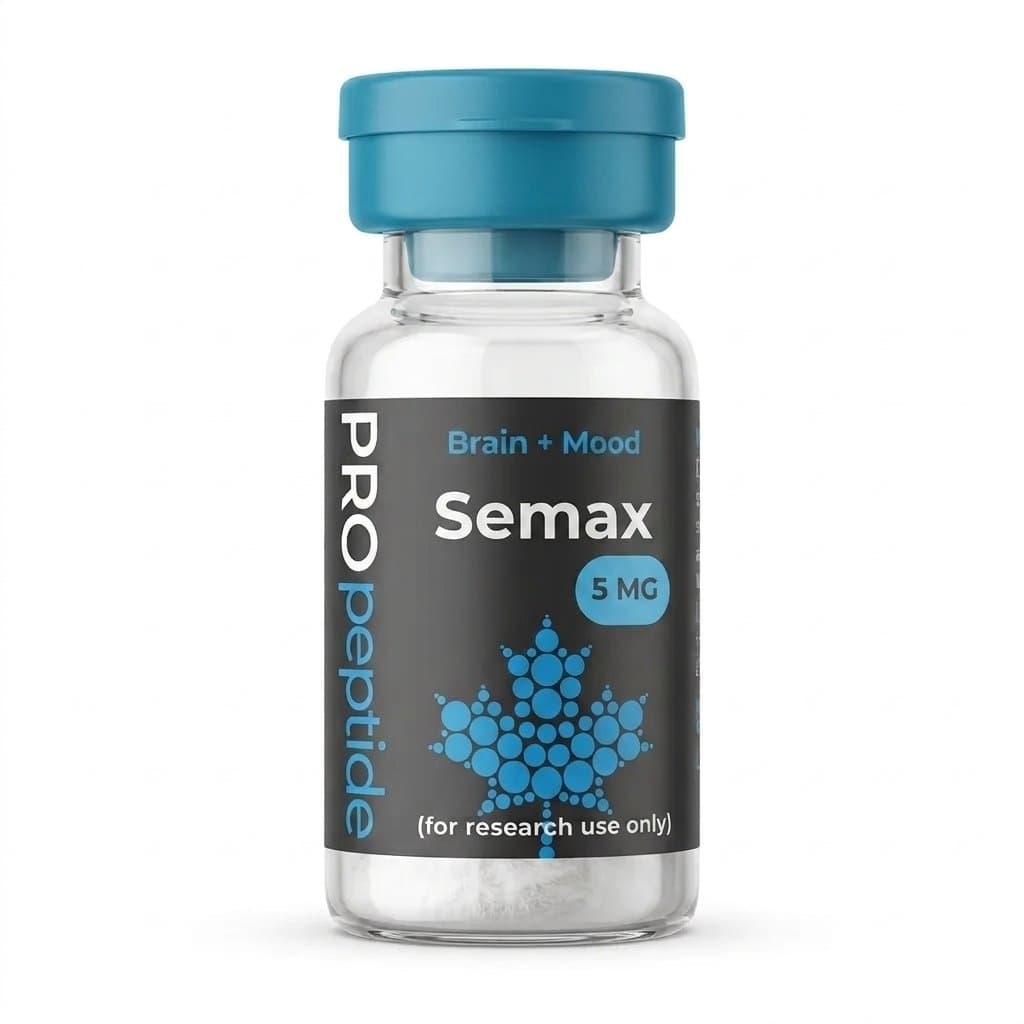
A seven-residue fragment built in Moscow, sold in Russian pharmacies as nasal drops, and listed among that country's Vital and Essential Medicines. The Western file on it is nearly empty. Both facts are true at once.
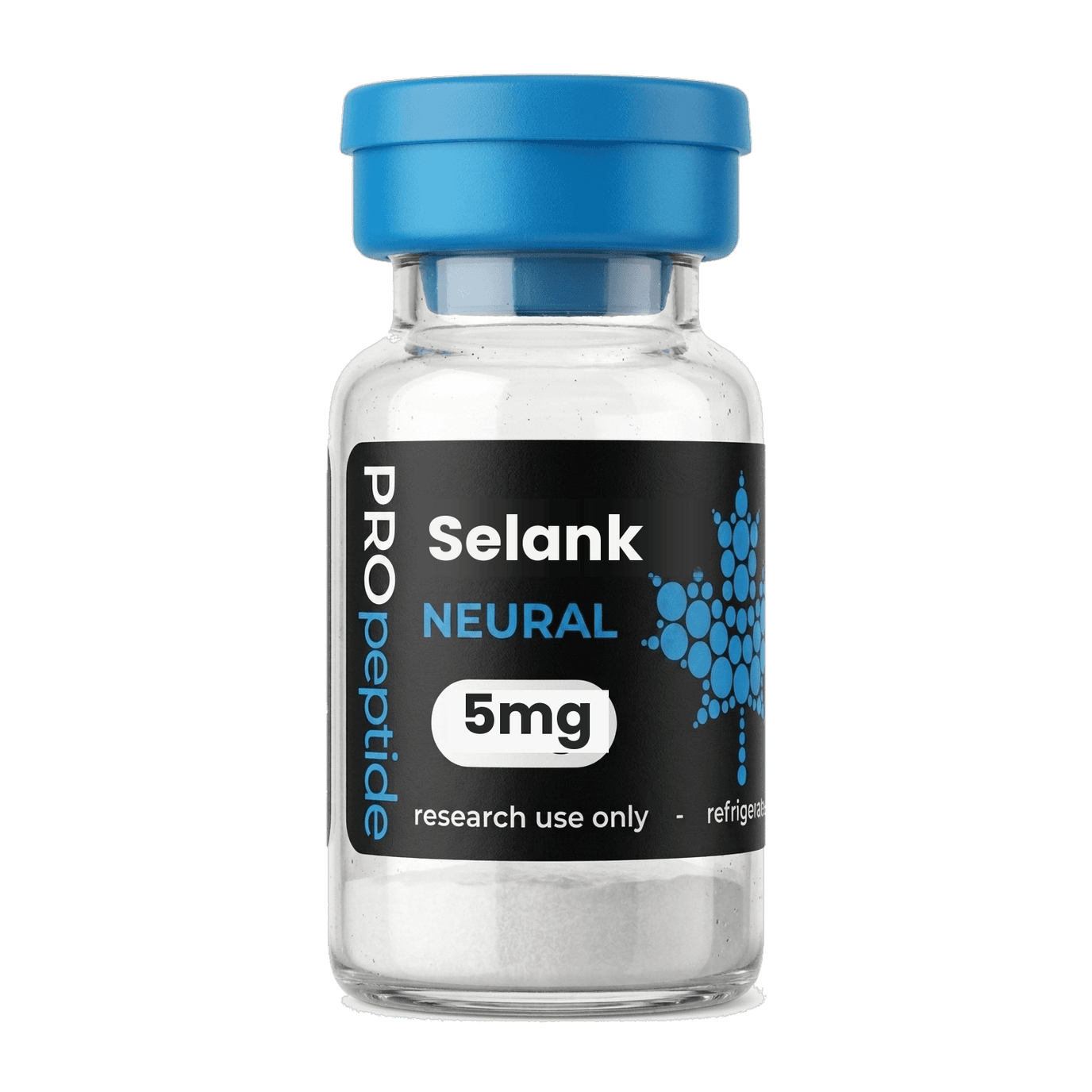
Semax's labmate from the same Moscow institute, built off an immune peptide called tuftsin. Registered in Russia, studied almost entirely without placebo controls, unknown to Western regulators.
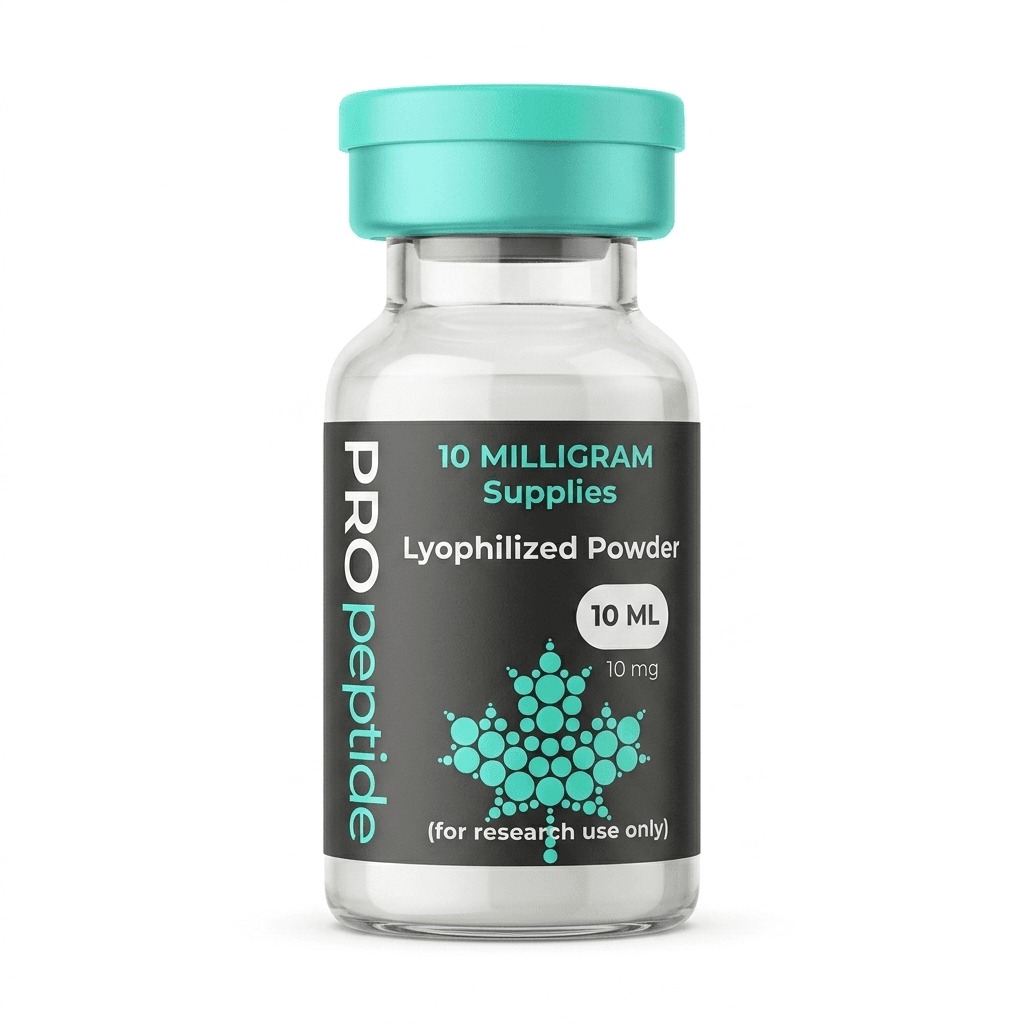
It is water. We know. But it is the one bottle on this shelf where the boring ingredient is the entire product, and getting it wrong ruins everything else you bought.
Order PE-22-28 right now
One last look before you decide.
Freeze-dried, ships cold from Canada
You've got the whole file now, the thin parts included. Nothing above pretended otherwise. If that's the kind of source you were after, PE-22-28 is right here.
Not for human consumption. Not approved by Health Canada or any other regulatory body.
Page last updated October 4, 2026
People also search for PE-22-28
Related searches.