
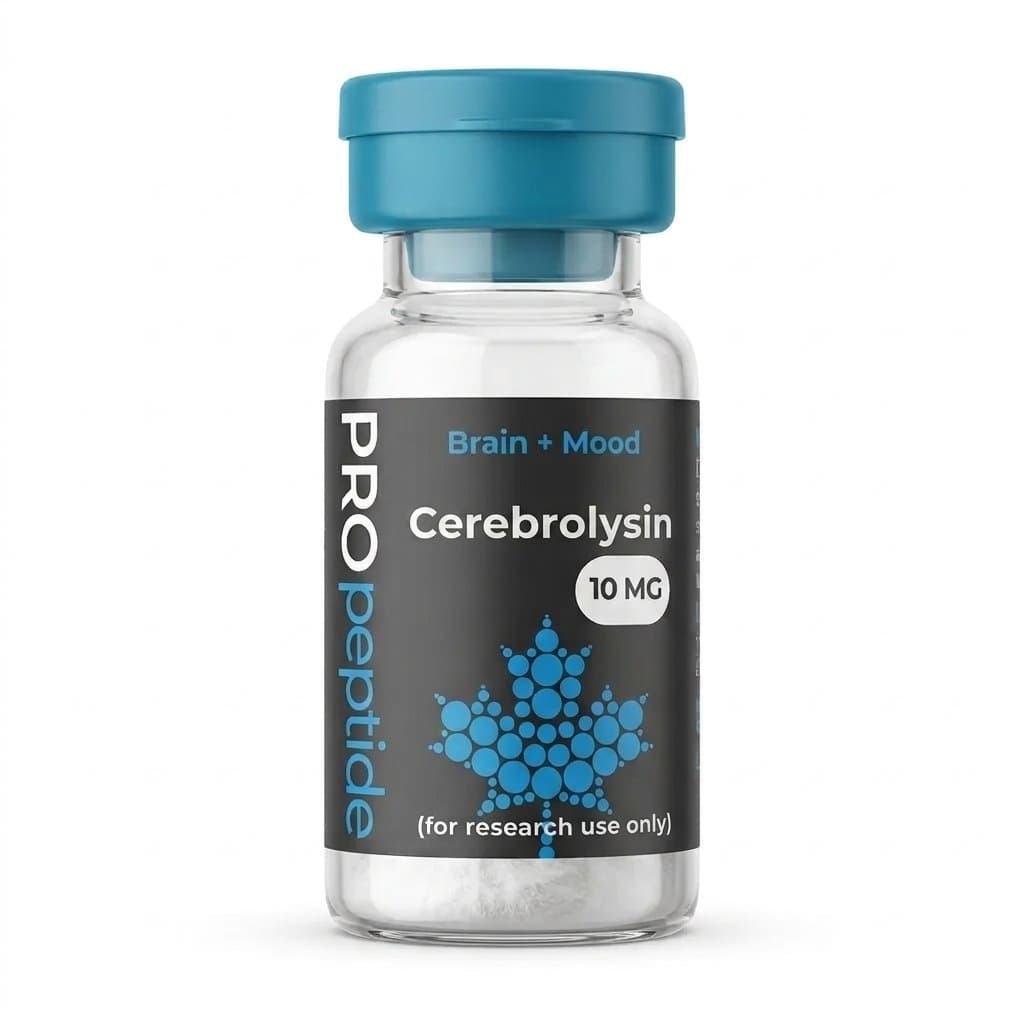
Cerebrolysin Peptide
Not one peptide. A porcine brain extract containing thousands of them, and Cochrane found more serious adverse events than placebo.
Choose your pack
For research use only. Not for human or veterinary use.
What Cerebrolysin is
The plain-language version, first.
Not a molecule. A processed extract of pig brain tissue, in clinical use for decades.
Cerebrolysin is not a peptide but a preparation derived from purified porcine brain protein, which mass spectrometry has characterised as 14,635 distinct peptides originating from 1,643 different porcine proteins. A 2023 Cochrane systematic review pooling seven randomised controlled trials in 1,773 acute ischaemic stroke patients reported more serious adverse events in the treated group than in placebo.
Let's do the composition first, because most pages never get to it.
Cerebrolysin isn't a peptide in the singular. It's an enzymatic digest of pig brain proteins, a soup of fragments, standardised by the recipe rather than by any one ingredient.
No sequence. No molecular weight. A manufacturing method with a trademark on it.
Think of a mixtape with 14,635 songs on it and no track list. That's the vial. It's been in clinical use across Russia, parts of Europe and Asia for decades, mostly around stroke and neurological conditions, which gives it something almost nothing else here has: a large human record.
And a large human record means somebody eventually audits it properly.
Somebody did. In 2023. It's the most important document about this product and it's three paragraphs down.
What is Cerebrolysin?
Mechanism studied, not outcome promised.
You cannot write a receptor story for a mixture, and this is a mixture.
The proposed story is that small brain-derived peptide fragments mimic the brain's own growth and maintenance signals.
As a hypothesis it isn't crazy. Brains do run on peptide signals. Yours is running on a few right now.
But a digest holds thousands of fragments, and a mechanism attributed to a soup is a mechanism attributed to nothing in particular.
Which fragment does what, at what concentration, varying how much from batch to batch: those questions don't have published answers, because the product's defined by its process. You can't write a receptor story for a mixtape.
Here's the honest part, and for once it isn't about missing data.
The data exists. It's the audit of it that hurts, and that's the next section's job.
The research so far for Cerebrolysin
Where the evidence is thin, we say so.
The Cochrane review is the file. Read this section before any other page about it.
In 2023 Cochrane, the closest thing evidence-based medicine has to a supreme court, reviewed the trials. Seven randomised trials, 1,773 people.
The findings, plainly: no reduction in deaths, and a relative risk of 2.39 for serious adverse events. More than double.
That isn't an absence of evidence. That's evidence, pointed the wrong way.
Decades of clinical use generated enough trials to review, and the review found the benefit missing and a safety signal present. Both halves of that sentence matter, and we'd rather you read both.
It's still used in clinics across Eastern Europe and Asia regardless, which says more about regulatory inertia than about the data.
We'll sell you the vial, and we'll also hand you the Cochrane number, because a store that only shows you one of those two things isn't a store you should trust.
Cerebrolysin vial sizes and current Canadian stock are listed below.
Cerebrolysin specs
The chemistry, exactly as released.
Who studies Cerebrolysin
Who tends to order this one, and why.
- 1
Stroke medicine
Acute ischaemic stroke is where the randomised evidence sits, and where the Cochrane review drew its seven trials and 1,773 patients from.
- 2
Neurodegeneration research
Dementia and traumatic brain injury are the other indications it is licensed for in the markets that license it.
- 3
Analytical chemistry
The mass spectrometry work that identified 14,635 peptides from 1,643 porcine proteins is a study of the preparation itself rather than of its effects.
- 4
Evidence reviewers
It is a case study in what happens when a long-licensed biological finally gets a systematic review of its randomised data.
Sold for laboratory research only. This is not guidance for personal use, and nothing here is a recommendation.
Cerebrolysin backstory
How it got here.
Cerebrolysin has been produced since the mid twentieth century and is one of the older biological preparations still in clinical use anywhere. It is manufactured by enzymatic breakdown of purified porcine brain protein into a mixture of low molecular weight peptides and amino acids.
It is licensed in a number of countries across Eastern Europe, Asia and elsewhere, and has been prescribed for stroke, dementia and traumatic brain injury for decades in those markets.
It has never been approved by the FDA or the EMA. The trials that would have supported those applications were largely run in the markets where it was already licensed, and the pooled analyses of them are what the 2023 Cochrane review examined.
- 1
A mid-century preparation
Made by enzymatic breakdown of purified porcine brain protein into low molecular weight peptides and free amino acids. One of the older biologicals still in clinical use.
- 2
Licensed, in some places
Approved and prescribed for decades across parts of Eastern Europe and Asia for stroke, dementia and traumatic brain injury. Never approved by FDA or EMA.
- 3
Cochrane, 2023
Seven randomised trials, 1,773 patients pooled. No mortality benefit, and a relative risk of 2.39 for non-fatal serious adverse events.
Buying Cerebrolysin in Canada
What ships, how fast, and the paperwork.
This one is not a defined peptide. It is a porcine brain-derived mixture. Any purity number on a biological extract answers a narrower question than the same number on a defined molecule, and we would rather say that plainly than let a figure imply more than it can.
Read the Cochrane review. Seven randomised trials, 1,773 patients, no mortality benefit and a relative risk of 2.39 for non-fatal serious adverse events. If you are evaluating this compound, that is the document.
Same day out of British Columbia. Our building, our cold packs, our people, and nothing sitting in a customs queue while you refresh a tracking page.
Then into the fridge. Keep it cold and keep it dark. Once it lands, fridge. That is the whole ask.
Common questions
5 answers, none of them dodges.
Is cerebrolysin a peptide?
Not in the sense every other product on this site is. It is a preparation derived from purified porcine brain protein. Mass spectrometry characterisation identified 14,635 distinct peptides originating from 1,643 different porcine proteins. There is no single sequence, no molar mass and no CAS number for one active molecule, because there is not one.
What did the Cochrane review find?
The 2023 Cochrane systematic review in acute ischaemic stroke pooled 7 randomised controlled trials with 1,773 participants. All-cause mortality showed a relative risk of 0.96, meaning no benefit. Non-fatal serious adverse events showed a relative risk of 2.39, more than double the placebo rate, and the signal was concentrated at the standard dose.
Is cerebrolysin approved anywhere?
Yes, in a number of countries, largely across Eastern Europe and Asia, where it has been licensed and prescribed for stroke, dementia and traumatic brain injury for decades. It has never been approved by the FDA or the EMA.
Can you put a purity number on cerebrolysin?
Not in a way that means much, and we would rather be straight about that. A purity figure on a fifteen residue peptide tells you the vial contains that molecule and little else. On a mixture of thousands of peptides it describes a much narrower property. Same number, different question.
Why is the composition variable?
Because it is a biological extract rather than a synthesised molecule. It is produced by enzymatic breakdown of purified porcine brain protein, and the output of that process is a mixture whose exact composition depends on the input material and the process conditions rather than on a defined synthesis route.
Good pairing options with Cerebrolysin
What researchers stack alongside it.
Pairing is where research gets ahead of itself. These are the compounds researchers put in the same order as Cerebrolysin Peptide, which is a statement about ordering habits, not about evidence. Two things in one cart have not been studied together unless somebody studied them together.
A seven-residue fragment built in Moscow, sold in Russian pharmacies as nasal drops, and listed among that country's Vital and Essential Medicines. The Western file on it is nearly empty. Both facts are true at once.
Semax's labmate from the same Moscow institute, built off an immune peptide called tuftsin. Registered in Russia, studied almost entirely without placebo controls, unknown to Western regulators.
It is water. We know. But it is the one bottle on this shelf where the boring ingredient is the entire product, and getting it wrong ruins everything else you bought.
Order Cerebrolysin right now
One last look before you decide.
Freeze-dried, ships cold from Canada
You've got the whole file now, the thin parts included. Nothing above pretended otherwise. If that's the kind of source you were after, Cerebrolysin is right here.
Not for human consumption. Not approved by Health Canada or any other regulatory body.
Page last updated October 4, 2026
People also search for Cerebrolysin
Related searches.