
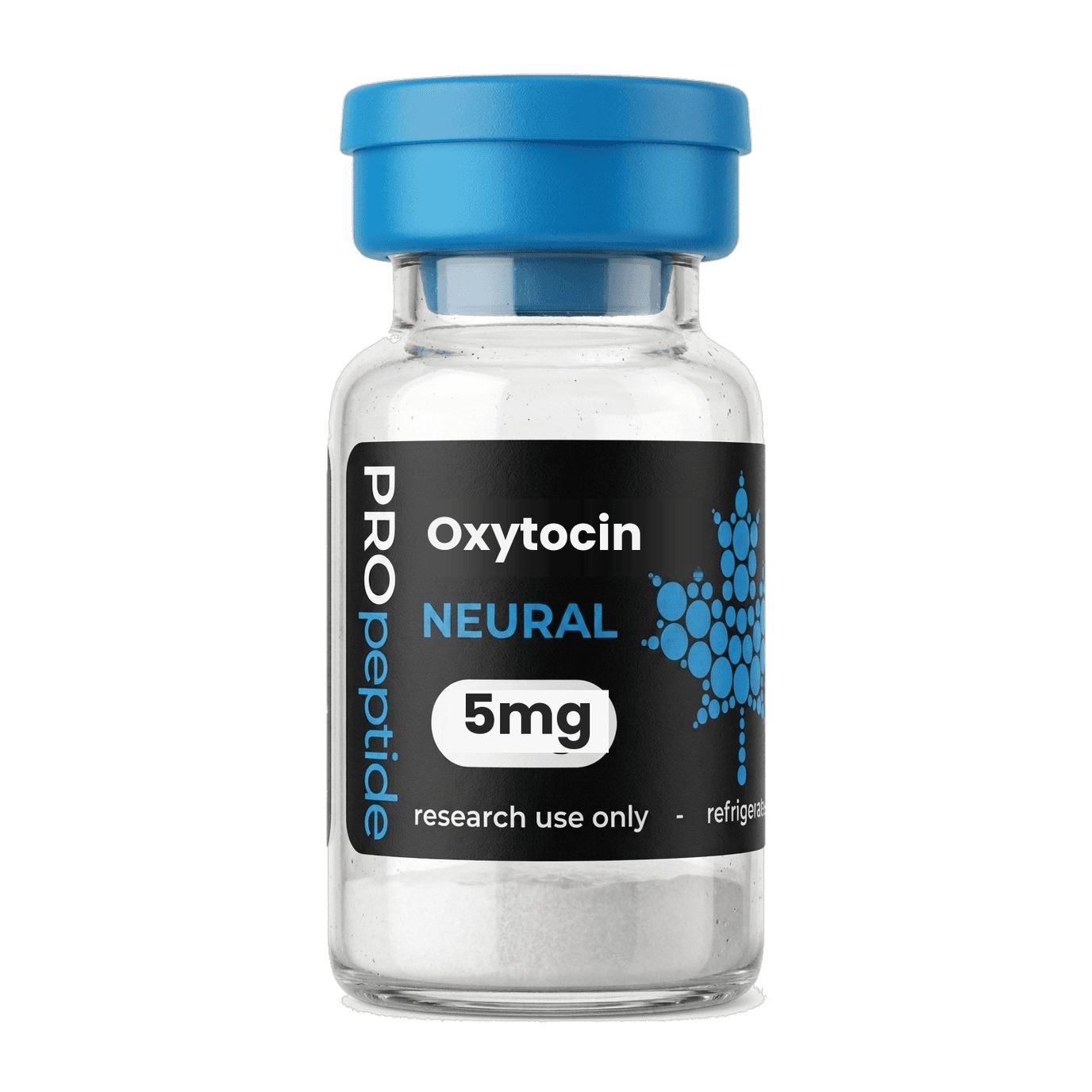
Oxytocin Peptide
The first peptide hormone anybody ever built instead of extracted.
Choose your pack
For research use only. Not for human or veterinary use.
What Oxytocin is
The plain-language version, first.
The molecule that proved peptides could be built rather than harvested.
Oxytocin is a nonapeptide hormone with the sequence CYIQNCPLG and a C-terminal glycine amide, cyclised by a disulfide bond between Cys1 and Cys6, with molecular formula C43H66N12O12S2, molecular weight 1007.19 and CAS number 50-56-6. It differs from vasopressin at two positions only, isoleucine at position 3 and leucine at position 8, and is authorised in Canada as a prescription injection indicated for labour and postpartum uterine control.
Before 1953, if you wanted a peptide hormone you took it out of an animal. Grinding glands was the whole industry.
Then Vincent du Vigneaud built oxytocin from scratch, atom by atom, and collected the 1955 Nobel Prize for it.
This molecule is where synthetic peptide chemistry begins. Everything else on this shelf descends from that proof.
Nine residues with a ring in the middle, made by your hypothalamus, released by your pituitary, with a genuine clinical history in obstetrics running back generations.
And here is the party trick: change just two residues and you get vasopressin, which manages your blood pressure and kidneys instead.
Two letters between hugging and hydration. Molecules do not care how important the difference feels.
oxytocin peptide sequence and structure
Mechanism studied, not outcome promised.
Two residues away from a hormone with an entirely different job.
The receptor story is textbook: oxytocin binds its receptor, smooth muscle in specific tissues responds, and the obstetric uses follow directly from that.
The brain story is where the modern noise lives.
Oxytocin signalling in the brain is real, studied, and stubbornly complicated. The love hormone framing is marketing wearing a lab coat.
The genuinely interesting problem is delivery: peptides do not cross the blood-brain barrier politely, so how much peripheral oxytocin reaches brain receptors is a live methodological fight in the actual literature.
Here's the honest part. The famous behavioural findings have had a rough decade of replication attempts.
The body of work that made oxytocin a headline is precisely the body of work the replication crisis chewed hardest.
The research so far for Oxytocin
Where the evidence is thin, we say so.
A century of clinical history, and a modern hype cycle it never asked for.
Split the file in two and it makes sense.
The clinical half is old and solid. Obstetric use under supervision, well characterised, decades deep. Real medicine, in hospitals, on a different product than a research vial.
The behavioural half is the cautionary tale of a generation. Trust games, nasal sprays, bold headlines, and then years of failed replications.
That second half is taught in methods courses now, as the example of what small-sample behavioural science does to a molecule's reputation.
A Nobel origin, a real clinical legacy, and a pop-science decade it is still living down. All three on one nine-residue molecule.
Oxytocin · 2mg and 5mg vials · lyophilised powder · Canadian stock, ships from BC
Oxytocin specs
The chemistry, exactly as released.
Who studies Oxytocin
Who tends to order this one, and why.
- 1
Receptor pharmacology
Labs mapping oxytocin receptor binding, Gq coupling or cross reactivity with vasopressin receptors, where having the native nonapeptide as the reference ligand beats reaching for an analogue.
- 2
Smooth muscle and calcium work
Bench work on phospholipase C signalling and intracellular calcium release in smooth muscle preparations, where oxytocin is one of the oldest and best characterised triggers on the shelf.
- 3
Analytical method development
Assay and mass spec work that needs a defined nonapeptide with a published formula and mass, plus a disulfide bond that behaves predictably when you reduce it.
- 4
Peptide chemistry teaching
The reference molecule for how peptide synthesis started. If you're showing somebody what a cyclised nonapeptide looks like in practice, this is the one with a Nobel attached to it.
Sold for laboratory research only. This is not guidance for personal use, and nothing here is a recommendation.
Oxytocin backstory
How it got here.
Before 1953 nobody had ever built a peptide hormone. People pulled them out of glands, ground them up, purified them down and then argued about what was actually in the bottle. Du Vigneaud's lab went the other direction and assembled one, bond by bond, then showed the built version did what the natural version did.
That's the moment peptide chemistry stopped being extraction and started being construction. Every product on this website exists downstream of it. Merrifield's solid phase method, the one that turned peptide synthesis into a machine job, was still eleven years away. Du Vigneaud did it in solution, the hard way, one coupling at a time.
The Nobel committee handed him the 1955 prize in chemistry for work on sulphur compounds of biochemical importance, and specifically for the first synthesis of a polypeptide hormone. Seventy odd years later the exact same nine residues come off a synthesiser in an afternoon.
- 1
1953, built not extracted
Du Vigneaud's lab assembles oxytocin in solution. First polypeptide hormone ever made from scratch instead of pulled out of an animal gland.
- 2
The title says octapeptide
The 1953 paper counts cystine as a single residue, so the founding paper of peptide synthesis undercounts its own molecule. Nine residues, eight in the headline.
- 3
1955, Stockholm
The Nobel Prize in Chemistry goes to du Vigneaud for the work. Merrifield's solid phase synthesis, the thing that made peptides routine, is still a decade out.
Buying Oxytocin in Canada
What ships, how fast, and the paperwork.
It's a prescription drug here, and this isn't it. Oxytocin injection sits on Canada's Prescription Drug List with live DINs behind it. What ships from us is a research reagent for laboratory use. Not the approved medicine, not a stand in for it, and not sold for use in people or animals.
Schedule F is a dead term. If a vendor page tells you a compound is Schedule F, that page is at least a decade stale. Schedule F was replaced by the Prescription Drug List on 19 December 2013. Oxytocin sits on that list today.
Ships domestic. Stock sits in British Columbia and orders leave from there, so nothing sits at a border waiting on a customs officer's mood. Lyophilised powder in a sealed vial, 2mg or 5mg.
Common questions
5 answers, none of them dodges.
What exactly is oxytocin?
A nine amino acid peptide hormone, sequence CYIQNCPLG with a glycine amide on the end, closed into a ring by a disulfide bond between the first and sixth cysteines. Formula C43H66N12O12S2, molecular weight 1007.19, CAS 50-56-6. Your hypothalamus makes it and your posterior pituitary stores it. It's also the first peptide hormone anybody ever synthesised in a laboratory.
How different is oxytocin from vasopressin?
Two residues. That's the whole thing. Both are nonapeptides, both get pinched shut by the same Cys1 to Cys6 disulfide, and they only disagree at positions three and eight. Oxytocin runs isoleucine and leucine there, vasopressin runs phenylalanine and arginine. That similarity is exactly why the Pitocin label says the drug is prepared synthetically to avoid possible contamination with vasopressin.
Is oxytocin an approved drug in Canada?
Yes, and that makes it unusual for this catalogue. Health Canada lists marketed DINs 00497398 from Pfizer, 02139561 from Fresenius Kabi and 02550199 from Hikma, every one of them prescription. FDA approved Pitocin under NDA 018261 back in November 1980. The authorised use is labour and postpartum uterine control. The vial sold on this page is a research reagent, not that medicine.
Is oxytocin banned in sport?
No. We ran a full text search of the WADA Prohibited List and oxytocin doesn't appear anywhere on it, not in S2 and not in a subclause. That's genuinely uncommon around here, since gonadorelin, triptorelin and erythropoietin all get named explicitly. Absence from a prohibited list isn't permission for anything else though. It just means the list doesn't mention it.
Why does the 1953 paper call it an octapeptide?
Because cystine counted as one residue back then instead of two cysteines joined by a disulfide. Under that convention oxytocin has eight units. Under the modern one it has nine. Du Vigneaud used the old count in his title, then the field changed how it counted, and the number quietly moved underneath the founding paper of the whole discipline.
Good pairing options with Oxytocin
What researchers stack alongside it.
Pairing is where research gets ahead of itself. These are the compounds researchers put in the same order as Oxytocin Peptide, which is a statement about ordering habits, not about evidence. Two things in one cart have not been studied together unless somebody studied them together.
A seven-residue fragment built in Moscow, sold in Russian pharmacies as nasal drops, and listed among that country's Vital and Essential Medicines. The Western file on it is nearly empty. Both facts are true at once.
Semax's labmate from the same Moscow institute, built off an immune peptide called tuftsin. Registered in Russia, studied almost entirely without placebo controls, unknown to Western regulators.
It is water. We know. But it is the one bottle on this shelf where the boring ingredient is the entire product, and getting it wrong ruins everything else you bought.
Order Oxytocin right now
One last look before you decide.
Freeze-dried, ships cold from Canada
You've got the whole file now, the thin parts included. Nothing above pretended otherwise. If that's the kind of source you were after, Oxytocin is right here.
Not for human consumption. Not approved by Health Canada or any other regulatory body.
Page last updated October 4, 2026
People also search for Oxytocin
Related searches.