
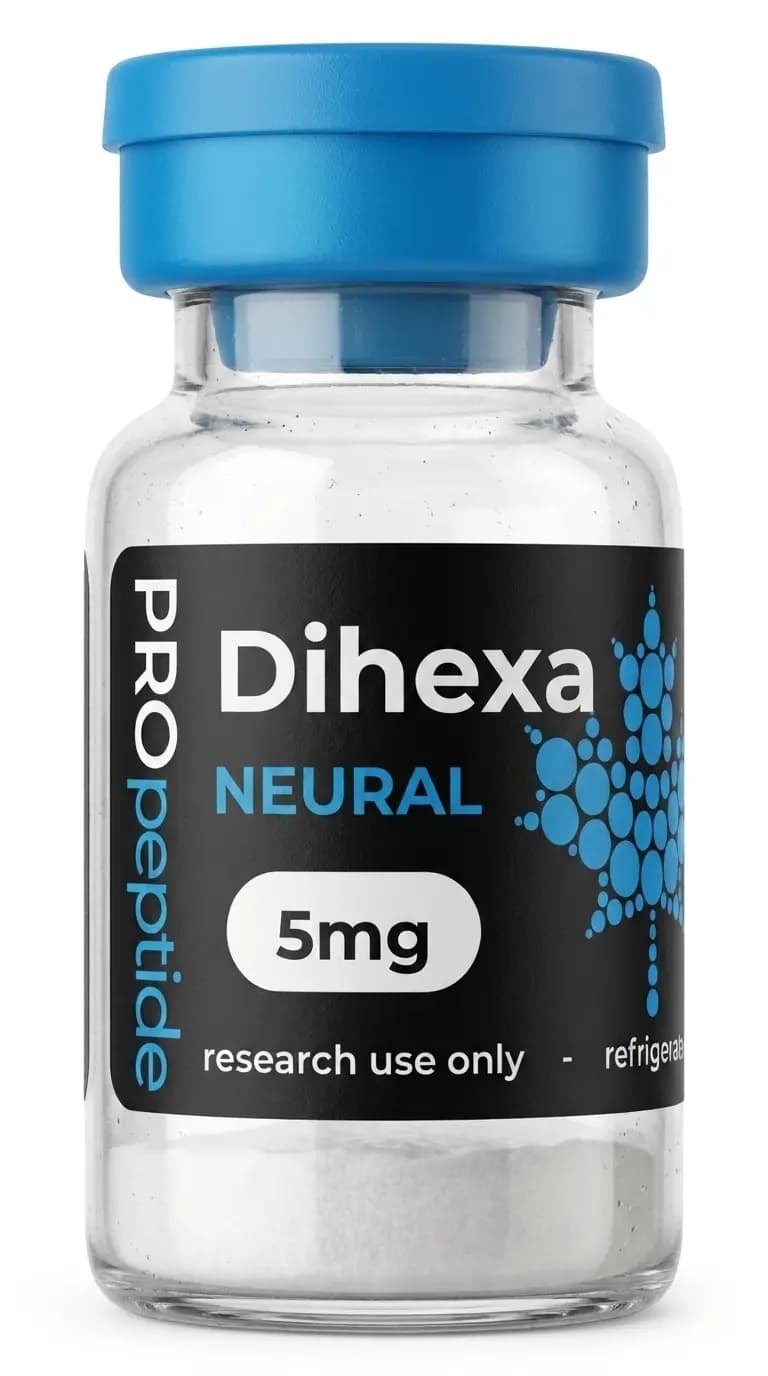
Dihexa
Angiotensin IV derivative, C27H44N4O5. Research use only, not for human consumption.
Choose your pack
For research use only. Not for human or veterinary use.
What Dihexa is
The plain-language version, first.
Dihexa (N-hexanoyl-Tyr-Ile-(6)-aminohexanoic amide, C27H44N4O5, molecular weight 504.7, CAS 1401708-83-5) is an angiotensin IV derived small molecule investigated in rodent models of cognitive impairment. Its three foundational hepatocyte growth factor mechanism papers were retracted in 2025, and no human clinical trials of dihexa have been registered.
Most compounds on this shelf have a thin file. This one has something different and worse.
It had a substantial file, and then part of that file was withdrawn.
Three foundational papers retracted in 2025. Not disputed. Retracted.
Dihexa is a derivative of angiotensin IV, engineered for the two things small molecules always get engineered for, which is surviving the body long enough to matter and getting where it is going.
The chemistry is real and it is not in question. What is in question is a chunk of the evidence that made anybody care.
One independent rodent study survives the retractions. Zero human trials exist. That is the whole standing file.
What is dihexa, and what happened to its evidence base?
Mechanism studied, not outcome promised.
Here's an uncomfortable thing about mechanism sections generally.
They read the same whether the underlying work held up or not. The prose does not know.
So read this one knowing that some of the papers it would normally rest on are no longer there.
The proposed target involves hepatocyte growth factor signalling and its receptor. That pathway is real, well studied, and has nothing to do with this compound's problems.
What a retraction removes is not the pathway. It removes the specific evidence that this molecule engages it the way it was claimed to.
Here's the honest part, and it is blunter than we would normally be.
When foundational papers come out of the literature, the correct response is to treat the compound as less established than it was last year, not to keep quoting the papers.
The research so far for Dihexa
Where the evidence is thin, we say so.
This is the shortest research summary in the catalogue and it is short on purpose.
2025: three foundational papers retracted. That is the single most important fact about this compound and it belongs first, not buried under mechanism.
One independent rodent study survives. Zero human trials. Zero.
A lot of what is written about dihexa online predates the retractions and has not been revisited, which means the internet's confidence level is running about a year behind the literature.
We stock it, we test what is in the vial, and we are not going to describe an evidence base that partly no longer exists.
A compound is only as good as the papers still standing behind it, and three of these are not.
Dihexa, research grade, sold for laboratory use only.
Dihexa specs
The chemistry, exactly as released.
Who studies Dihexa
Who tends to order this one, and why.
- 1
Researchers auditing a nootropic literature
Dihexa is the cleanest available case study in how a compound's reputation can outlive its citations. The gap between forum consensus and the current record is unusually wide here.
- 2
Groups working on angiotensin IV chemistry
The AT4 area is small, and dihexa is its most modified derivative. The hexanoyl and aminohexanoic amide caps are a textbook stability and permeability solve.
- 3
Labs modelling PI3K/AKT in cognition
The surviving 2021 APP/PS1 result points at PI3K/AKT rather than HGF, which makes dihexa an odd but live tool compound for that pathway.
- 4
Anyone comparing dihexa to fosgonimeton
They are different molecules from the same lineage. Athira's failed LIFT-AD trial tested fosgonimeton, and attributing that trial to dihexa is a common and consequential error.
Sold for laboratory research only. This is not guidance for personal use, and nothing here is a recommendation.
Dihexa backstory
How it got here.
Angiotensin IV showing up in memory research was already an odd turn. It's a fragment off a blood pressure hormone. Nobody drew that one on a whiteboard on purpose.
Joseph Harding's lab at Washington State University chased it anyway, and dihexa came out of that chase. The compound got spun into a startup called M3 Biotechnology, which renamed itself Athira Pharma in 2019 and went public with a lot of attention on it.
Then 2021 happened. Leen Kawas, Athira's CEO and a former PhD student in Harding's lab, was placed on leave over allegations that images in published work had been altered. A special committee at the company found she had altered images in her dissertation and in at least four papers. She left the company. In 2025 the three foundational mechanism papers were retracted.
The company moved on to fosgonimeton, a different compound, and that failed its Phase 2/3 trial in Alzheimer's.
We're not telling you this to scare you off. We're telling you because if you buy dihexa and read about it afterward, you're going to find this story anyway, and you should get it from the people selling it rather than from a forum thread.
- 1
A blood pressure fragment with a side gig
Angiotensin IV is part of the renin-angiotensin system. Its effects on rodent memory were not what anyone was looking for when that system was being mapped.
- 2
From a Pullman lab to a public company
Developed in Joseph Harding's lab at Washington State University, spun out into M3 Biotechnology, renamed Athira Pharma in 2019.
- 3
2021 to 2025
Athira's CEO, a former PhD student in the same lab, was placed on leave in 2021 over image alteration allegations and left after a company committee made findings against her. The three foundational mechanism papers were retracted in 2025.
Buying Dihexa in Canada
What ships, how fast, and the paperwork.
Research use only. Sold for laboratory research use only, not for human or veterinary consumption. Health Canada's advisory of 9 April 2026 states that peptides are generally regulated as prescription drugs in Canada, and that "For Research Use Only" labelling does not make these products legal. Dihexa is not named in that advisory, which is not the same as being permitted.
Check which molecule a claim belongs to. Dihexa, PNB-0408 and ATH-1001 are the same compound. Fosgonimeton is not. A lot of published commentary blends the two, and the human trial data belongs entirely to fosgonimeton.
Sport testing. Dihexa is not named on the WADA Prohibited List. It is caught by S0, non-approved substances, and arguably by S2.3, which explicitly names hepatocyte growth factor.
Common questions
5 answers, none of them dodges.
Were dihexa's studies really retracted?
Three of them, in 2025. They're the foundational papers from the Washington State lab describing the hepatocyte growth factor and c-Met mechanism (PMIDs 40312092, 40312093, 40312094). One is the 2014 JPET paper that most dihexa write-ups paraphrase. A retraction doesn't prove the conclusions were wrong, but it does mean those papers and every number in them are no longer citable evidence.
Is there any dihexa research left standing?
Yes, and it's worth knowing. An independent group with no Washington State connection reported that dihexa restored spatial learning in APP/PS1 mice through PI3K/AKT signalling (Sun, 2021, Brain Sciences, PMID 34827486). That's the strongest surviving result. There's also a negative one. PNB-0408 failed to protect against motor or cognitive deficits in a rat model of Huntington's disease (Wells, 2024).
Has dihexa been tested in humans?
No. ClinicalTrials.gov returns zero registered studies for dihexa. This is the single most important fact on the page and it gets buried constantly. Athira Pharma did run human trials, but on fosgonimeton, a different molecule from the same lineage, and its Phase 2/3 LIFT-AD trial in mild to moderate Alzheimer's failed. That trial is not dihexa evidence.
What about the claim that dihexa is far more potent than BDNF?
We went looking for a source and couldn't find one outside the retracted literature. Same with the widely repeated three-fold increase in spine number, which traces back to a retracted paper. If a page quotes either figure at you without naming where it came from, that's the reason. We're not printing numbers we can't stand behind.
What is dihexa chemically?
N-hexanoyl-Tyr-Ile-(6)-aminohexanoic amide. Formula C27H44N4O5, molecular weight 504.7, CAS 1401708-83-5. It's derived from angiotensin IV, a fragment of the renin-angiotensin system, with a hexanoyl cap on one end and an aminohexanoic amide on the other to improve stability and brain penetration. It also appears in the literature as PNB-0408 and ATH-1001.
Good pairing options with Dihexa
What researchers stack alongside it.
Pairing is where research gets ahead of itself. These are the compounds researchers put in the same order as Dihexa, which is a statement about ordering habits, not about evidence. Two things in one cart have not been studied together unless somebody studied them together.
A seven-residue fragment built in Moscow, sold in Russian pharmacies as nasal drops, and listed among that country's Vital and Essential Medicines. The Western file on it is nearly empty. Both facts are true at once.
A fragment derived from CNTF wearing an adamantane cage so it can cross into the brain. Orally active in mice, studied in dementia models, and no human has ever taken it in a trial.
It is water. We know. But it is the one bottle on this shelf where the boring ingredient is the entire product, and getting it wrong ruins everything else you bought.
Order Dihexa right now
One last look before you decide.
Freeze-dried, ships cold from Canada
You've got the whole file now, the thin parts included. Nothing above pretended otherwise. If that's the kind of source you were after, Dihexa is right here.
Not for human consumption. Not approved by Health Canada or any other regulatory body.
Page last updated October 4, 2026
People also search for Dihexa
Related searches.