
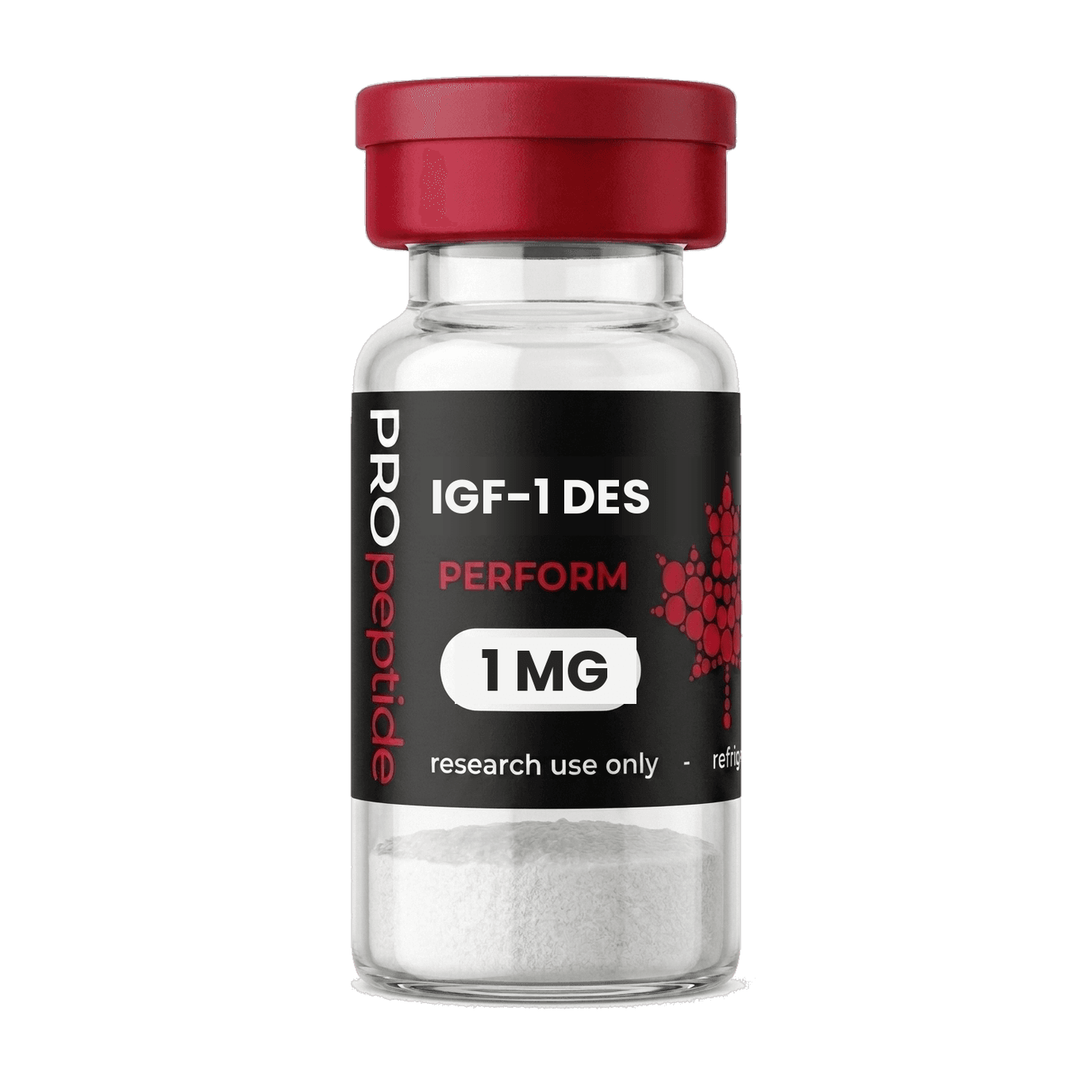
IGF-1 DES Peptide
Three amino acids got cut off the front. They went and became an approved drug without it.
Choose your pack
For research use only. Not for human or veterinary use.
What IGF-1 DES is
The plain-language version, first.
IGF-1 with the first three residues clipped off, on purpose.
IGF-1 DES, written in the literature as des(1-3)IGF-I, is a 67-residue truncated form of human insulin-like growth factor 1 that lacks the N-terminal tripeptide glycine-proline-glutamate, with a monoisotopic mass of approximately 7360.5 Da. Its defining published property is markedly reduced affinity for several insulin-like growth factor binding proteins rather than increased affinity for the IGF-1 receptor.
Small deletions do strange things, and this is one of the cleaner examples.
Take IGF-1. Remove the first three amino acids. That is the entire modification and it has a name: DES(1-3).
Three residues out of seventy. It reads like a rounding error and it is not.
Those three residues are part of what IGF binding proteins grip. Remove them and the molecule becomes considerably harder for those proteins to hold onto.
Which changes not what it does at the receptor, but how much of it is free to get there.
A modification aimed entirely at logistics rather than at the destination.
What IGF-1 DES actually is
Mechanism studied, not outcome promised.
Its edge is evasion, not strength. Those are different things.
Here's the bit people get backwards, and it is worth slowing down for.
Most of the IGF-1 in your blood is not floating free. It is bound up by carrier proteins, which is a deliberate arrangement rather than an accident.
Those carriers are not a nuisance the body forgot to remove. They are the volume knob.
DES(1-3) is studied for slipping that arrangement. Not for hitting the receptor harder, which is the version you will read on forums.
Evasion, not affinity. The distinction matters because it changes what you would expect and what you would worry about.
Here's the honest part. Bypassing a control system is not automatically an improvement.
The carriers exist for a reason, and a molecule designed to be less controllable is a molecule with less control on it. That is the trade, stated plainly.
The research so far for IGF-1 DES
Where the evidence is thin, we say so.
A standard laboratory reagent with a reputation built somewhere else.
This is genuinely well characterised, and almost none of that characterisation is about people.
DES(1-3) IGF-1 is a standard cell culture reagent. Laboratories use it because it works predictably in a dish where binding proteins would otherwise complicate things.
That is a real endorsement. It is an endorsement of a reagent.
The published work is largely in vitro and animal, and it is decent work aimed at questions about IGF biology rather than at outcomes in humans.
No human trials for the uses people actually search for. Nothing approved. Prohibited in sport.
Well understood as a laboratory tool, and that understanding does not transfer to a different use just because the molecule is the same.
Sequence, mass and the papers behind them are on this page. Research use only.
IGF-1 DES specs
The chemistry, exactly as released.
Who studies IGF-1 DES
Who tends to order this one, and why.
- 1
IGF binding protein researchers
The classic tool for separating receptor effects from binding protein effects, because it changes one variable and leaves the receptor arm nearly untouched.
- 2
Skeletal muscle and gut repair labs
The 1990s animal work pointed at gut tissue as the most responsive compartment, which still makes it a reference compound in anabolic and catabolic models.
- 3
Comparative peptide chemists
A clean case study in how a three-residue truncation changes pharmacology without changing receptor affinity. Useful next to full-length IGF-1 and IGF-2.
- 4
Anti-doping and analytical labs
WADA lists IGF-1 and its analogues under S2.3, prohibited at all times, so reference material matters for method development and confiscated-product characterisation.
Sold for laboratory research only. This is not guidance for personal use, and nothing here is a recommendation.
IGF-1 DES backstory
How it got here.
The Adelaide connection is the whole story here. Ballard, Wallace, Francis, Bagley, Forbes, most of the foundational des(1-3) papers come out of the same South Australian orbit between 1988 and 1996, back when the Cooperative Research Centre for Tissue Growth and Repair was chasing IGF analogues for gut repair and catabolic wasting.
They were not building a bodybuilding compound. They were trying to solve a delivery problem. IGF-1 given to an animal gets mopped up by binding proteins before it does much, so the question was how to make a version that survives the trip.
What nobody planned on was the offcut. Gly-Pro-Glu, the three residues nobody wanted, turned out to be neuroactive in its own right. Decades of work on GPE analogues led to trofinetide, FDA approved in March 2023 as the first drug for Rett syndrome. The peptide is still sitting in research catalogues with zero human trials. The garbage got a brand name.
- 1
1988 to 1989, Adelaide
Forbes, Bagley and colleagues at the University of Adelaide sort the IGF binding proteins into categories and work out why a peptide missing three residues behaves so strangely in a bioassay.
- 2
1989, Stockholm
Carlsson-Skwirut and Sara at the Karolinska show recombinant truncated IGF-1 has about a hundredfold lower affinity for the small amniotic binding protein and propose it as the paracrine form of IGF-1.
- 3
March 2023, the offcut wins
Trofinetide, a protease-resistant analogue of the discarded Gly-Pro-Glu tripeptide, is approved by the FDA for Rett syndrome. The three residues nobody wanted outrank the peptide they came from.
Buying IGF-1 DES in Canada
What ships, how fast, and the paperwork.
Check which molecule you are actually reading about. Des(1-3)IGF-I, mecasermin and IGF-1 LR3 are three different things with three different literatures. Papers about one do not transfer to another, and a lot of online summaries mix them freely.
Ignore the escapes-all-binding-proteins claim. It is repeated across peptide sites and it contradicts Forbes 1988. The large serum binding protein still holds this peptide nearly as well as it holds IGF-1. Expect a smaller effect in serum than in a dish.
Canadian regulatory status. Health Canada states that peptides are generally regulated as prescription drugs, and that For Research Use Only labelling does not make a product legal or exempt from regulatory requirements. This is sold as laboratory material, not for human or veterinary use.
Common questions
5 answers, none of them dodges.
Is IGF-1 DES more potent than regular IGF-1?
In cell culture, usually yes, with published ratios of about four to ten times depending on the assay. The reason is not receptor affinity. Bagley 1989 found receptor competition of 14 ng/mL for des(1-3) versus 20 ng/mL for IGF-1, which is essentially the same. The gap comes from binding proteins failing to sequester the truncated peptide.
Does it escape all IGF binding proteins?
No, and this is the most commonly repeated error about it. Forbes 1988 showed the acid-stable subunit of the large serum binding protein binds des(1-3)IGF-I only slightly less than it binds IGF-1. The escape is real for several of the smaller binding proteins and much weaker for the big serum complex, so effects in serum should be smaller than in culture.
Is IGF-1 DES a synthetic invention?
No. Ballard and colleagues reported in 1996 that des(1-3)IGF-I has been isolated from bovine colostrum, human brain and porcine uterus. It appears to result from post-translational cleavage of IGF-1 rather than from a separate gene. That makes it an unusual case among research peptides, most of which have never been found in tissue.
Are there human trials of IGF-1 DES?
None have been published. The available literature is cell culture and rodent work, mostly from 1988 to 1996. The approved IGF-1 medicine is mecasermin, brand name Increlex, which is full-length recombinant IGF-1 approved by the FDA on 30 August 2005 and carrying Canadian DIN 02509733. Data on mecasermin does not transfer to this truncated form.
What happened to the three amino acids that were removed?
Glycine-proline-glutamate turned out to be neuroactive on its own. A protease-resistant analogue of that tripeptide, trofinetide, was approved by the FDA in March 2023 for Rett syndrome under the brand name DAYBUE. So the fragment discarded to make des(1-3)IGF-I became an approved drug while the truncated peptide itself never entered a human trial.
Good pairing options with IGF-1 DES
What researchers stack alongside it.
Pairing is where research gets ahead of itself. These are the compounds researchers put in the same order as IGF-1 DES Peptide, which is a statement about ordering habits, not about evidence. Two things in one cart have not been studied together unless somebody studied them together.
Its main job worldwide is keeping cells alive in laboratory flasks. That is not a slight, it is a large and legitimate industry, and it is what this molecule was built for.
Two pharmaceutical companies tried to reproduce the finding this molecule is famous for. Neither could. It has still never been isolated from actual tissue.
It is water. We know. But it is the one bottle on this shelf where the boring ingredient is the entire product, and getting it wrong ruins everything else you bought.
Order IGF-1 DES right now
One last look before you decide.
Freeze-dried, ships cold from Canada
You've got the whole file now, the thin parts included. Nothing above pretended otherwise. If that's the kind of source you were after, IGF-1 DES is right here.
Not for human consumption. Not approved by Health Canada or any other regulatory body.
Page last updated October 4, 2026
People also search for IGF-1 DES
Related searches.