
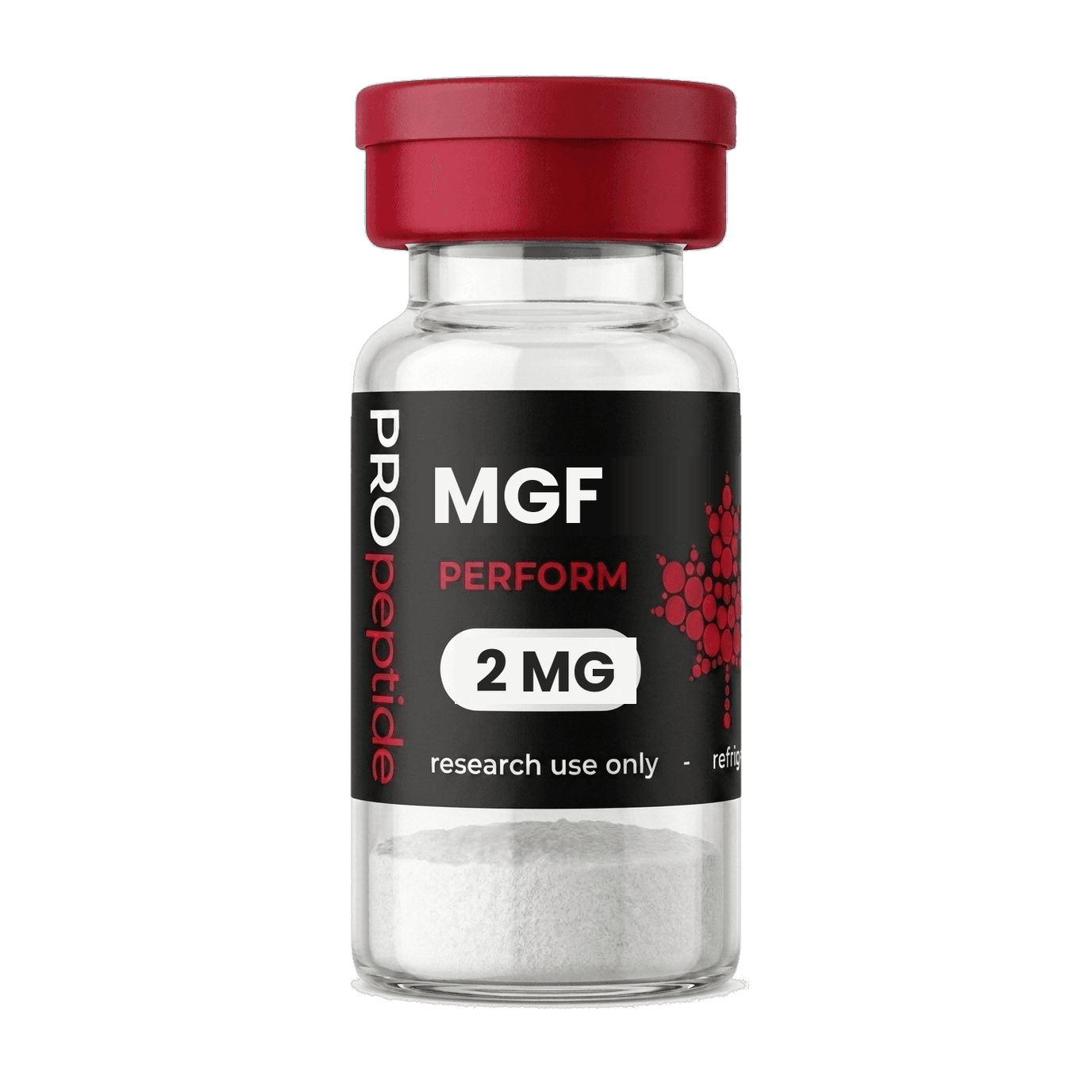
MGF Peptide (Mechano Growth Factor)
Nobody has ever found this thing inside a living animal. That is not a knock. That is the interesting part.
Choose your pack
For research use only. Not for human or veterinary use.
What MGF Peptide (Mechano Growth Factor) is
The plain-language version, first.
Named after an effect that two large companies then could not find.
MGF, or mechano growth factor, is a synthetic 24-residue peptide corresponding to the C-terminal portion of the E-domain of the IGF-1Ec splice variant, sequence YQPPSTNKNTKSQRRKGSTFEERK, monoisotopic mass approximately 2866.5 Da. No equivalent free peptide has been isolated from cells, conditioned medium, animal tissue or biological fluid, and no human clinical trial of it has been published.
Here's a thing that happens in science more often than anybody likes.
A finding lands, it is exciting, it gets a name, and the name outlives the finding.
Mechano Growth Factor. That name is a claim, and the claim is the part that did not survive contact with other laboratories.
What is actually sold under the name is a synthetic version of the C-terminal piece of a proposed IGF-1 splice variant called IGF-1Ec.
And here is the part almost nobody mentions: that peptide has never been isolated from tissue. Not once. It is a sequence predicted from a transcript, synthesised, and sold.
A molecule named for an effect, derived from a variant, that nobody has ever pulled out of an actual muscle.
What MGF peptide actually is
Mechanism studied, not outcome promised.
A splice variant everybody discusses and nobody has held.
Alright. You know when somebody describes a restaurant to you in enormous detail and then you find out they have never been.
The description can still be accurate. It is just built from other people's accounts rather than from going.
That is the mechanism literature here. Coherent, detailed, and standing on a molecule nobody has isolated.
The proposed story involves a splice variant of IGF-1 produced under mechanical load, with the C-terminal extension doing something separate from the IGF-1 receptor signalling everybody already knows about.
It is a reasonable hypothesis. It generated real interest for good reasons.
Here's the honest part. When two pharmaceutical companies independently try to reproduce your headline result and neither can, that is not a footnote.
That is the single most informative thing in the file, and it is the thing most sellers leave out.
The research so far for MGF Peptide (Mechano Growth Factor)
Where the evidence is thin, we say so.
The failed replications are the most useful papers in the file.
The useful papers here are the negative ones, which is not what anybody wants to hear.
The original work generated genuine excitement and it was not fraudulent or silly. It looked promising.
Then the replications came back, from two pharmaceutical companies, and the headline effect did not appear.
A failed replication from one group is a question. From two independent industrial groups with money and reason to want it to work, it is closer to an answer.
No human trials. Nothing approved. Never isolated from tissue.
We would rather hand you the replication failures than the 1996 enthusiasm, because the replication failures are the more recent information.
Sequence, mass and the replication failures are all on this page. Research use only.
MGF Peptide (Mechano Growth Factor) specs
The chemistry, exactly as released.
Who studies MGF Peptide (Mechano Growth Factor)
Who tends to order this one, and why.
- 1
Muscle regeneration labs
Still used as a comparator against IGF-1 and full-length IGF-1Eb in satellite cell and myoblast assays, particularly by groups trying to settle the replication question one way or the other.
- 2
Anti-doping and forensic chemists
Prohibited under WADA S2.3 since 2005 and repeatedly found in adulterated form in seized product, so authentic reference material matters for method development.
- 3
Splice variant and E-domain researchers
The IGF-1Ec E-domain is an open question in its own right, separate from the commercial peptide. Groups working on pro-IGF-1 processing use the synthetic 24-mer as a tool.
- 4
Analytical method developers
A basic, arginine-rich, easily amidated peptide with published high-resolution mass spectrometry data and several documented non-natural analogues. Useful for building identity and impurity workflows.
Sold for laboratory research only. This is not guidance for personal use, and nothing here is a recommendation.
MGF Peptide (Mechano Growth Factor) backstory
How it got here.
Goldspink spent his career on how muscle senses load, and the 1996 rabbit stretch experiment is a genuinely nice piece of work. Cast the leg in plantar flexion, hold it there, watch a second IGF-1 transcript appear that was not there before. That is real science and it holds up.
What happened next is a lesson in how a name travels. The 1996 paper never says mechano growth factor. The label arrives in 1999. By 2005 WADA had banned it. By 2012 doping labs in Belgium were pulling amidated analogues out of black market vials.
The peptide got famous faster than it got tested, and by the time anybody with a real budget checked, the market was already built. Fornaro 2014 reads like two companies quietly closing a file. That is the arc. Great transcript, great name, thin peptide.
- 1
1996, Royal Free Hospital, London
Yang, Alnaqeeb, Simpson and Goldspink clone a second IGF-1 isoform out of stretched rabbit muscle. The paper is careful and the finding is real. It never uses the phrase mechano growth factor.
- 2
1999, the name appears
McKoy and colleagues in J Physiol introduce mechano growth factor as a label for the autocrine splice variant. The name outruns the evidence within a decade and WADA prohibits the class from 2005.
- 3
2014, two companies close the file
Fornaro and colleagues at Novartis and GSK test concentrations up to 500 ng/mL across three cell systems and report no proliferative effect, concluding the results call in to question whether there is a physiological role for MGF.
Buying MGF Peptide (Mechano Growth Factor) in Canada
What ships, how fast, and the paperwork.
Product identity has a documented history of problems. Ghent University found black market MGF was C-terminal amidated rather than the human sequence. Salt Lake City found an R23H mutant in confiscated vials. Thevis 2014 characterised a 12 kDa full-length MGF with an R109H substitution and a missing terminal lysine. Know what sequence you are asking for.
MGF and PEG-MGF are not interchangeable. The 24-mer and the pegylated version have separate literatures, and the pegylated version has essentially none. Papers about one do not describe the other.
Canadian regulatory status. Health Canada states peptides are generally regulated as prescription drugs and that For Research Use Only labelling does not make a product legal or exempt from regulatory requirements. This is sold as laboratory material, not for human or veterinary use.
Common questions
5 answers, none of them dodges.
What is MGF peptide?
MGF, or mechano growth factor, is a synthetic 24-residue peptide matching the C-terminal end of the E-domain of the IGF-1Ec splice variant. Its sequence is YQPPSTNKNTKSQRRKGSTFEERK and its monoisotopic mass is about 2866.5 Da. The parent splice variant is real and load-induced. The free peptide is made synthetically, not purified from tissue.
Has MGF ever been isolated from a living organism?
No. Matheny and colleagues stated it plainly in Endocrinology in 2010: no analogous peptide product of the Igf1 gene has been identified in or isolated from cultured cells, their conditioned medium, or in vivo animal tissues or biological fluids. That has not changed since. The gene produces the transcript, but the free 24-mer has not been caught existing on its own.
Did anyone try to reproduce the muscle effects?
Yes, and it did not work. Fornaro and colleagues at Novartis and GSK published in 2014 that concentrations up to 500 ng/mL failed to increase proliferation of C2C12 cells, primary human myoblasts or primary mouse muscle stem cells. It also failed to delay differentiation or activate p-ERK in cardiac myocytes, while IGF-1 in the same assays worked normally.
Where does the name mechano growth factor come from?
Not from the original paper. Yang, Alnaqeeb, Simpson and Goldspink reported the stretch-induced IGF-1 splice variant in J Muscle Res Cell Motil in 1996 without using the term. The phrase first appears in McKoy and colleagues in J Physiol in 1999. The name arrived three years after the finding it describes.
Are there known problems with MGF product identity?
Yes, and they are well documented by anti-doping laboratories. Ghent University reported in 2012 that two black market MGF preparations were C-terminal amidated analogues rather than human MGF. The Salt Lake City testing laboratory identified an R23H point mutant in confiscated vials in 2017. Thevis and colleagues characterised a 12 kDa full-length MGF sold in 2014 as a non-natural sequence.
Good pairing options with MGF Peptide (Mechano Growth Factor)
What researchers stack alongside it.
Pairing is where research gets ahead of itself. These are the compounds researchers put in the same order as MGF Peptide (Mechano Growth Factor), which is a statement about ordering habits, not about evidence. Two things in one cart have not been studied together unless somebody studied them together.
Its main job worldwide is keeping cells alive in laboratory flasks. That is not a slight, it is a large and legitimate industry, and it is what this molecule was built for.
Three amino acids missing off the front, and the whole point is what that does to where it goes rather than how hard it binds.
It is water. We know. But it is the one bottle on this shelf where the boring ingredient is the entire product, and getting it wrong ruins everything else you bought.
Order MGF Peptide (Mechano Growth Factor) right now
One last look before you decide.
Freeze-dried, ships cold from Canada
You've got the whole file now, the thin parts included. Nothing above pretended otherwise. If that's the kind of source you were after, MGF Peptide (Mechano Growth Factor) is right here.
Not for human consumption. Not approved by Health Canada or any other regulatory body.
Page last updated October 4, 2026
People also search for MGF Peptide (Mechano Growth Factor)
Related searches.