
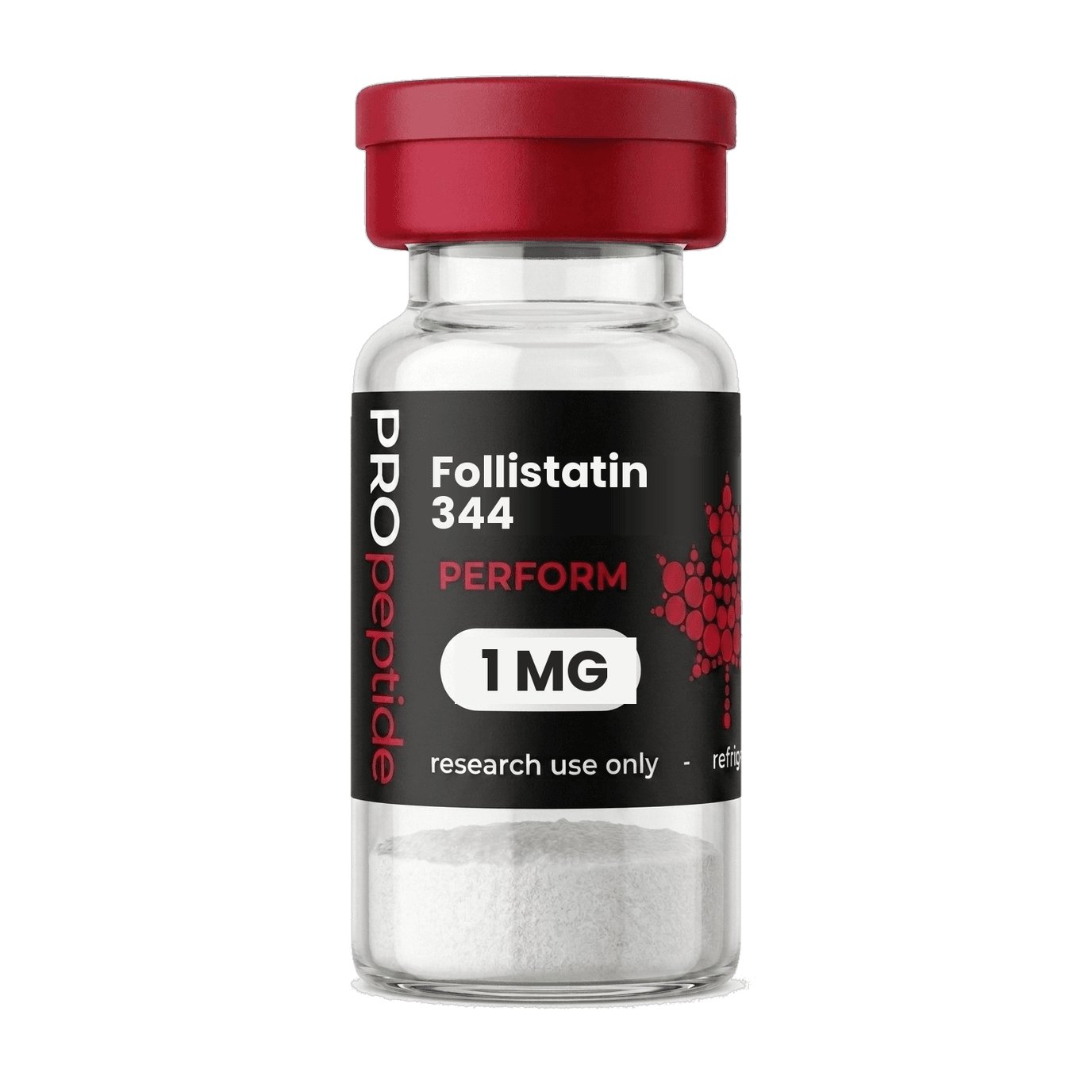
Follistatin 344 Peptide (FS-344)
The 344 is the shipping label, not the gift. Once you know that, the whole product category reads differently.
Choose your pack
For research use only. Not for human or veterinary use.
What Follistatin 344 Peptide (FS-344) is
The plain-language version, first.
The rough draft of a protein, sold under the finished draft's reputation.
Follistatin 344 refers to the 344-residue unprocessed human follistatin precursor, UniProt P19883, which includes a 29-residue signal peptide at positions 1 to 29 and a mature chain at positions 30 to 344. The circulating protein is the 315-residue mature form, a glycoprotein containing 36 cysteines that binds and neutralises activins as well as myostatin.
Protein names hide a lot of biography, and this one hides the important part.
Follistatin-344 is the precursor: the full first-pass translation, signal peptide still attached, before the cell processes it into the working protein.
What your body secretes and uses is the processed form: 315 residues, folded around 36 cysteines forming a precise architecture of disulfide bonds.
Thirty-six cysteines is an enormous folding problem. The protein's function lives in that folded architecture, not in the bare sequence.
So the question a careful buyer asks is not what is follistatin, it is which follistatin, in what fold.
A precursor with the famous name, where the fame belongs to the finished product.
What Follistatin 344 actually is
Mechanism studied, not outcome promised.
The famous myostatin-binding belongs to the folded, processed form.
Follistatin's claim to fame is real and beautifully simple: it binds and neutralises myostatin, the signal that tells muscle tissue to stop growing.
A brake on the brake. No wonder the internet noticed.
That binding is performed by the folded, processed protein, whose shape is the tool. An unfolded or misfolded chain of the same residues is a string, not a key.
Which is why the gene-therapy route exists: deliver the gene, let the cell do its own manufacturing and folding, and you sidestep the problem entirely.
Here's the honest part about any vial of this.
For a 36-cysteine protein, folding verification is the entire product question, and a purity percentage does not answer it. Purity says the right atoms showed up. It says nothing about whether they folded.
The research so far for Follistatin 344 Peptide (FS-344)
Where the evidence is thin, we say so.
Gene-therapy trials built this name. A vial is not gene therapy.
The exciting follistatin results in the literature come from a specific place, and it is not a vial.
The headline animal work and the small human trials in muscular dystrophy used gene therapy, viral vectors delivering the gene so cells produce properly folded protein in place.
Citing gene-therapy results for a vialed precursor protein is citing a different technology.
Direct administration of the protein itself has a far thinner file, precisely because of the folding and delivery problems above.
Nothing approved. Prohibited in sport, category S4, named class.
A real and fascinating biology, a borrowed evidence base, and a folding question no COA can close. Those three sentences are the honest product page.
Sequence numbering, isoforms and the trial record are all laid out on this page. Research use only.
Follistatin 344 Peptide (FS-344) specs
The chemistry, exactly as released.
Who studies Follistatin 344 Peptide (FS-344)
Who tends to order this one, and why.
- 1
Myostatin and activin signalling labs
The canonical binding protein for both ligand families, and the standard tool for separating activin receptor IIB effects from everything downstream.
- 2
Muscular dystrophy and gene therapy groups
The FS344 construct is what actually went into humans in the Nationwide Children's Phase 1 trial, so the precursor form has a specific meaning in this field.
- 3
Protein chemists and expression scientists
A 315-residue, 36-cysteine, N-glycosylated secreted protein is a serious folding and expression problem. Useful as a teaching case in why some molecules cannot be synthesised on a resin.
- 4
Anti-doping analysts
WADA lists follistatin under section S4.3, agents preventing activin receptor IIB activation, not under the growth factor section. That distinction matters for how it is classified and reported.
Sold for laboratory research only. This is not guidance for personal use, and nothing here is a recommendation.
Follistatin 344 Peptide (FS-344) backstory
How it got here.
Follistatin was named for what it does to follicle-stimulating hormone, which tells you where it was found and how far the field has travelled since. It came out of reproductive endocrinology, not muscle biology, and the activin story is the older one.
Muscle arrived with myostatin. Once Se-Jin Lee's group showed myostatin was a brake on muscle growth, everything that binds myostatin got interesting, and follistatin binds it well.
Then came Lee's 2007 PLoS ONE paper, the one that quadrupled muscle mass in mice by stacking a follistatin transgene onto a myostatin-null background. That result is the reason follistatin is on this list at all, and it is also the reason the mechanism cannot be as simple as myostatin blockade.
The human chapter has been humbling. Gene therapy showed real histology. ACE-083 grew measurable muscle volume in a Phase 2 trial and still failed on function, and the programme was terminated. Bigger is not the same as better, and that finding came from a properly run randomised trial.
- 1
Named in reproductive endocrinology
Follistatin was identified for suppressing follicle-stimulating hormone release. Its activin-binding role came first and remains the larger part of its biology. Muscle was a later chapter.
- 2
2007, four times the muscle
Se-Jin Lee crossed a follistatin transgene into myostatin-null mice and produced animals with roughly four times wild type muscle mass, showing follistatin acts on more than myostatin alone.
- 3
2016 to 2022, the human reality check
Acceleron ran ACE-083, a follistatin-Fc fusion, through Phase 2 in FSHD. Muscle volume rose significantly. Function and patient-reported outcomes did not improve consistently, and the trial was terminated.
Buying Follistatin 344 Peptide (FS-344) in Canada
What ships, how fast, and the paperwork.
The 344 in the name is precursor numbering. It counts the 29-residue signal peptide the cell removes during secretion. FS-315 is the predominant serum isoform and FS-288 is the shorter splice variant. Check which molecule a paper or a label is actually describing before comparing them.
This is a glycoprotein, not a synthesisable peptide. Thirty-six cysteines and two N-glycosylation sequons in a 315-residue chain rules out solid-phase peptide synthesis. Recombinant expression is the only route, and glycosylation means observed mass runs above the bare polypeptide figure.
Canadian regulatory status. Health Canada states peptides are generally regulated as prescription drugs and that For Research Use Only labelling does not make a product legal or exempt from regulatory requirements. This is sold as laboratory material, not for human or veterinary use.
Common questions
5 answers, none of them dodges.
What does the 344 in Follistatin 344 mean?
It is the length of the unprocessed human follistatin precursor. UniProt P19883 lists a 344-residue entry with a signal peptide at positions 1 to 29 and the mature chain at 30 to 344. The signal peptide is removed during secretion, so the protein that actually circulates is 315 residues. A genuinely 344-residue product would still carry its uncleaved signal peptide.
What is the difference between FS-344, FS-315 and FS-288?
FS-344 is the precursor including the signal peptide, 38,007 Da. FS-315 is the mature secreted chain of 315 residues, 34,754 Da as bare polypeptide, and the predominant serum isoform. FS-288 is a shorter isoform from alternative splicing. Sidis 2006 found their activin affinities are comparable and what really differs is cell-surface binding.
Does follistatin only block myostatin?
No. It binds and neutralises activins with high affinity as well, and activin signalling covers reproduction, inflammation, fibrosis and wound repair. The activin arm is the main off-target consideration and it is intrinsic to the mechanism. Lee 2007 showed the point directly by adding a follistatin transgene to myostatin-null mice and still quadrupling muscle mass.
Can follistatin be made by peptide synthesis?
No. The mature chain is 315 residues with 36 cysteines and two N-linked glycosylation sequons. That many cysteines means a large number of disulfide bonds that must pair correctly, and glycans require cellular machinery. Recombinant expression in a system capable of folding and glycosylating it is the only practical route, which also means observed mass exceeds the polypeptide figure.
Are there human trials of follistatin?
Not of injected follistatin protein. There are trials of follistatin delivered other ways. NCT01519349 was a completed Phase 1 AAV gene therapy study of rAAV1.CMV.huFollistatin344 in 15 participants at Nationwide Children's Hospital, reported by Mendell in 2015. ACE-083, a follistatin-Fc fusion protein, reached Phase 2 in FSHD with 95 participants.
Good pairing options with Follistatin 344 Peptide (FS-344)
What researchers stack alongside it.
Pairing is where research gets ahead of itself. These are the compounds researchers put in the same order as Follistatin 344 Peptide (FS-344), which is a statement about ordering habits, not about evidence. Two things in one cart have not been studied together unless somebody studied them together.
Its main job worldwide is keeping cells alive in laboratory flasks. That is not a slight, it is a large and legitimate industry, and it is what this molecule was built for.
Three amino acids missing off the front, and the whole point is what that does to where it goes rather than how hard it binds.
It is water. We know. But it is the one bottle on this shelf where the boring ingredient is the entire product, and getting it wrong ruins everything else you bought.
Order Follistatin 344 Peptide (FS-344) right now
One last look before you decide.
Freeze-dried, ships cold from Canada
You've got the whole file now, the thin parts included. Nothing above pretended otherwise. If that's the kind of source you were after, Follistatin 344 Peptide (FS-344) is right here.
Not for human consumption. Not approved by Health Canada or any other regulatory body.
Page last updated October 4, 2026
People also search for Follistatin 344 Peptide (FS-344)
Related searches.