
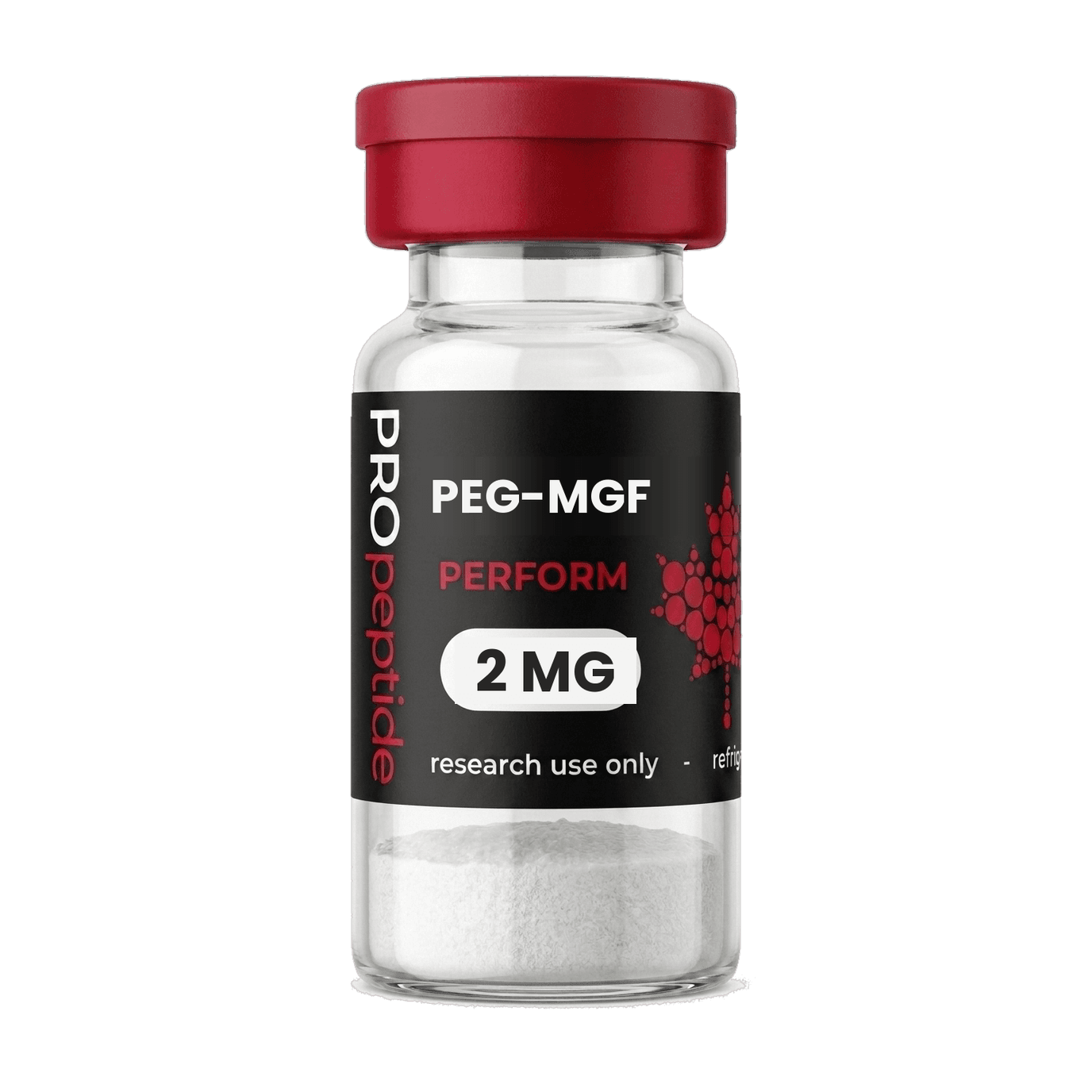
PEG-MGF Peptide (Pegylated Mechano Growth Factor)
Everybody quotes a half-life for this. Nobody can tell you where the number came from.
Choose your pack
For research use only. Not for human or veterinary use.
What PEG-MGF Peptide (Pegylated Mechano Growth Factor) is
The plain-language version, first.
MGF with a chemical tail bolted on, and no published spec for the tail.
PEG-MGF refers to a pegylated version of the synthetic mechano growth factor peptide, in which a polyethylene glycol chain is attached to slow renal clearance. No sequence, PEG molecular weight, attachment site or total molecular weight has been published for the material sold under this name, and no pharmacokinetic study of PEG-MGF has been published in any species.
Start with the parent problem, because this one inherits all of it and then adds a new one.
MGF is a synthetic peptide named for an effect two pharmaceutical companies could not reproduce, never isolated from tissue.
PEG-MGF is that, with a polyethylene glycol chain attached to slow its exit from the body.
Pegylation is a real and well-established technique. Attaching PEG to a protein to extend its half-life is textbook, unglamorous, effective chemistry.
The problem is not the idea. The problem is that for the thing sold under this name, the specifics are not published anywhere.
_No sequence. No PEG molecular weight.
No attachment site. No pharmacokinetic study. Those are not optional details, they are what pegylation means._
What PEG-MGF actually is
Mechanism studied, not outcome promised.
The pegylation idea is sound. The unpublished part is what was actually done.
Think of it like being told a car has a bigger fuel tank, and then asking how big, and nobody knowing.
The modification is real. The claim is directionally sensible. The number is the entire point and the number is missing.
PEG chain length is not a detail. It determines clearance, distribution and whether the thing works at all.
A 5 kilodalton PEG and a 40 kilodalton PEG produce different molecules with different behaviour. Attachment site matters just as much, because pegylating the wrong residue can block the part that does the work.
So when the spec is absent, you cannot reason about the pharmacology at all. There is nothing to reason from.
Here's the honest part, and it is about us as much as anybody.
We can tell you what is in the vial by mass and purity. We cannot tell you a pharmacokinetic story about a modification nobody has published, and we are not going to invent one.
The research so far for PEG-MGF Peptide (Pegylated Mechano Growth Factor)
Where the evidence is thin, we say so.
You cannot have a research file on a molecule nobody has specified.
There is no meaningful research file, and the reason is structural rather than a matter of the work being early.
A research file requires a defined molecule. Different suppliers pegylating differently produce different compounds under one name.
Which means a study of one vendor's PEG-MGF is not necessarily a study of anybody else's.
That is a different situation from a compound that is simply under-studied. Retatrutide is under-studied and well defined. This is well marketed and undefined.
No human trials. Nothing approved. No published characterisation of the pegylated form.
The honest summary of the evidence is that there is not enough specification for evidence to attach to.
We list what is documented and what is not. Research use only.
PEG-MGF Peptide (Pegylated Mechano Growth Factor) specs
The chemistry, exactly as released.
Who studies PEG-MGF Peptide (Pegylated Mechano Growth Factor)
Who tends to order this one, and why.
- 1
Pegylation chemists
A case study in why conjugate specification matters. Groups working on half-life extension use it to illustrate how an unspecified PEG makes a product uncharacterisable.
- 2
Analytical and anti-doping labs
Mechano growth factors are prohibited as a class under WADA S2.3, and modified versions are the hard analytical case. Method development needs material to work against.
- 3
Regulatory and compounding researchers
The FDA nominated-and-withdrawn record is a documented example of a peptide failing the characterisation bar, useful to anyone studying how the compounding bulks lists are built.
- 4
IGF-1 axis researchers
Anyone comparing native IGF-1, MGF and modified analogues in the same experimental system needs the modified arm, even if only to show it behaves like the unmodified one.
Sold for laboratory research only. This is not guidance for personal use, and nothing here is a recommendation.
PEG-MGF Peptide (Pegylated Mechano Growth Factor) backstory
How it got here.
Plain MGF hit the grey market in the mid 2000s and immediately ran into a sales problem. Small, extremely basic peptides do not hang around. Somebody attached PEG, called it PEG-MGF, and the marketing wrote itself: same peptide, lasts longer, fewer administrations.
What never happened is the part where anybody published what they made. Pegylation is a manufacturing decision with a dozen variables and every one of them changes the product. In a regulated setting those variables are in the filing. Here they are in nobody's hands.
The FDA got the closest to a formal look when the substance was nominated for the compounding bulks list and then withdrawn. The agency's notes on it are short and blunt, and they remain the most authoritative thing written about this compound by anyone. That is a strange sentence to write on a product page. It is also true.
- 1
Pegylation arrives from real pharmacology
Attaching polyethylene glycol to slow clearance is a decades-old, well documented strategy behind several approved biologics. Nothing about the concept is fringe. The concept is not the problem here.
- 2
The grey market applies it to MGF
Plain MGF clears quickly, so a pegylated version appeared with a longer-acting claim. No manufacturer published the conjugation chemistry, and no reference standard or published mass followed.
- 3
The FDA writes it down
PEG-MGF was nominated as a bulk drug substance for compounding and withdrawn. The agency noted immunogenicity risk for certain routes, complexities around peptide-related impurities and API characterisation, and no identified human exposure data by any route.
Buying PEG-MGF Peptide (Pegylated Mechano Growth Factor) in Canada
What ships, how fast, and the paperwork.
No half-life figure is defensible. Every hour figure quoted for PEG-MGF online traces back to nothing. Europe PMC returns three records for the term and none is a pharmacokinetic study. We will not print a number we cannot source, and neither should anyone else.
Ask what PEG, and expect no answer. PEG molecular weight, geometry and attachment site define a pegylated product. None of that is published for PEG-MGF, which means identity cannot be checked against any literature value.
Canadian regulatory status. Health Canada states peptides are generally regulated as prescription drugs and that For Research Use Only labelling does not make a product legal or exempt from regulatory requirements. This is sold as laboratory material, not for human or veterinary use.
Common questions
5 answers, none of them dodges.
What is PEG-MGF?
It is a pegylated version of the synthetic mechano growth factor peptide, meaning a polyethylene glycol chain is attached to slow renal clearance and proteolysis. Beyond that general description there is no published specification. The PEG molecular weight, whether it is linear or branched, the attachment residue and the total molecular weight of the finished conjugate are not documented in any public source.
How long does PEG-MGF last in the body?
Nobody has published that. A Europe PMC search on 11 August 2026 returned three records for the term PEG-MGF, none of which is a pharmacokinetic study in any species. The half-life figures circulating on retail sites have no traceable primary source. The FDA has stated it has not identified any human exposure data on products containing PEG-MGF by any route.
What has the FDA said about PEG-MGF?
PEG-MGF appears in the FDA table of bulk drug substances nominated for use in compounding and then withdrawn. The agency wrote that it may pose significant risk for immunogenicity for certain routes of administration and may have complexities with regard to peptide-related impurities and API characterization, and that FDA has not identified any human exposure data on drug products containing PEG-MGF administered via any route of administration.
Does pegylation make MGF work better?
Pegylation changes how long a molecule stays around, not what it does. The underlying MGF 24-mer has no identified receptor, and Fornaro and colleagues at Novartis and GSK reported in 2014 that it produced no proliferative response or p-ERK activation in three muscle cell systems at up to 500 ng/mL. Extending exposure does not create a target.
How does PEG-MGF differ from plain MGF?
Plain MGF is a defined 24-residue peptide with a published sequence and a monoisotopic mass of about 2866.5 Da, characterised in detail by anti-doping laboratories. PEG-MGF is that peptide plus an unspecified polyethylene glycol chain. Because the conjugation is undocumented, the two have completely different levels of available characterisation data and their literatures do not overlap.
Good pairing options with PEG-MGF Peptide (Pegylated Mechano Growth Factor)
What researchers stack alongside it.
Pairing is where research gets ahead of itself. These are the compounds researchers put in the same order as PEG-MGF Peptide (Pegylated Mechano Growth Factor), which is a statement about ordering habits, not about evidence. Two things in one cart have not been studied together unless somebody studied them together.
Its main job worldwide is keeping cells alive in laboratory flasks. That is not a slight, it is a large and legitimate industry, and it is what this molecule was built for.
Three amino acids missing off the front, and the whole point is what that does to where it goes rather than how hard it binds.
It is water. We know. But it is the one bottle on this shelf where the boring ingredient is the entire product, and getting it wrong ruins everything else you bought.
Order PEG-MGF Peptide (Pegylated Mechano Growth Factor) right now
One last look before you decide.
Freeze-dried, ships cold from Canada
You've got the whole file now, the thin parts included. Nothing above pretended otherwise. If that's the kind of source you were after, PEG-MGF Peptide (Pegylated Mechano Growth Factor) is right here.
Not for human consumption. Not approved by Health Canada or any other regulatory body.
Page last updated October 4, 2026
People also search for PEG-MGF Peptide (Pegylated Mechano Growth Factor)
Related searches.