
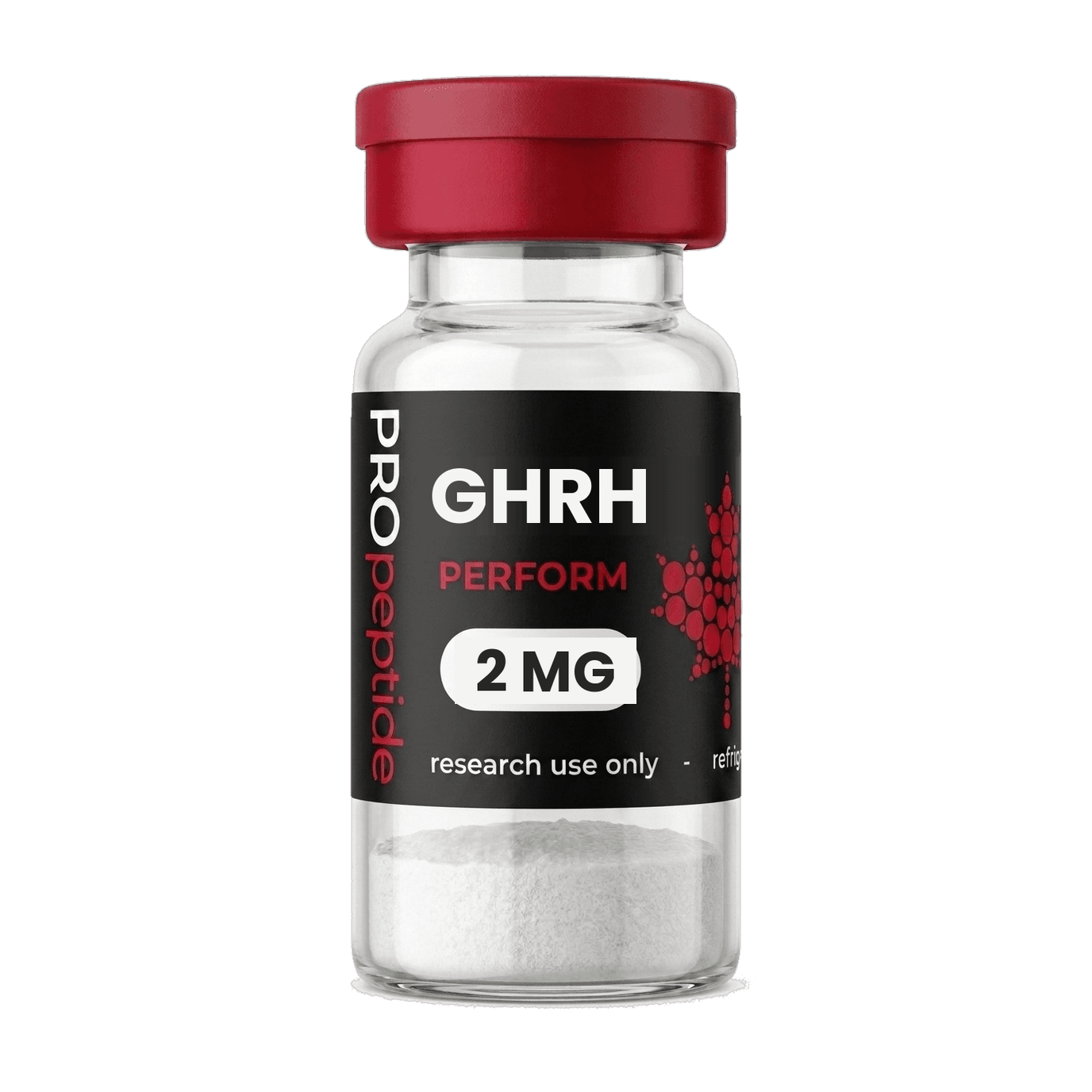
GHRH Peptide
The 44 amino acid original. Every GHRH analogue on the market is a rewrite of this one.
Choose your pack
For research use only. Not for human or veterinary use.
What GHRH is
The plain-language version, first.
The original. Every analogue in this category is an argument with this molecule.
GHRH (somatoliberin) is a 44 amino acid hypothalamic releasing hormone, UniProt P01286, that binds the GHRH receptor on anterior pituitary somatotrophs to stimulate growth hormone synthesis and secretion. It is cleaved by DPP-4 at the Ala2-Asp3 bond, giving a circulating half-life of minutes, and no GHRH(1-44) product is approved for marketing in Canada or the United States.
Every modified GHRH analogue on this shelf is a complaint about this molecule.
Too fragile. Clears too fast. Needs a substitution here, a fatty acid there.
This is the unmodified original they are all complaining about. Forty-four residues, exactly as your hypothalamus writes it.
It was isolated in the early eighties, and here is the odd part of that story: it was first pulled not from a brain but from a pancreatic tumour that happened to be producing it in quantity.
Endocrinology is full of discoveries that arrived through the side door.
The reference molecule for an entire category, sold in its original, fragile, minutes-long form.
What GHRH peptide actually is
Mechanism studied, not outcome promised.
A pulse from the hypothalamus to the pituitary, timed on purpose.
Your body does not send this signal as a steady hum. It sends it in pulses, mostly at night, on a rhythm.
That is not sloppiness. The pulsing is information.
The pituitary reads the rhythm, not just the level. A drumbeat, not a drone.
GHRH binds its receptor on pituitary somatotrophs and each pulse asks for a release of growth hormone. Between pulses, silence, and the silence is part of the signal.
DPP-4 destroying the molecule in minutes is what makes the rhythm crisp. Fast destruction is a feature of pulse-based systems.
Here's the honest part. Because it clears so fast, the unmodified hormone is mostly a research reference rather than a practical tool.
Which is precisely its value. You cannot understand what the analogues changed without the thing they changed it from.
The research so far for GHRH
Where the evidence is thin, we say so.
Foundational endocrinology, and almost none of it about giving the hormone itself.
The literature here is enormous and it is almost all about the biology rather than the bottle.
GHRH's discovery and characterisation is foundational endocrinology. Receptor cloned, pathway mapped, pulsatility documented across decades.
Very little of that involved giving the native hormone as an intervention, because its half-life makes that impractical by design.
So this page's file is really the field's file. The molecule is the textbook, and the textbook is solid.
Nothing approved in this form. The approved things are its descendants.
The best-understood molecule on this shelf, and understood almost entirely as biology rather than as product. That is not a gap. That is what a reference standard looks like.
Full-length GHRH(1-44). Canadian stock, shipping from BC.
GHRH specs
The chemistry, exactly as released.
Who studies GHRH
Who tends to order this one, and why.
- 1
People mapping the two GH pathways
If you’re trying to work out why GHRH compounds and ghrelin receptor compounds behave so differently, GHRH is the clean reference on one side. Same downstream output, completely separate receptor and signalling route.
- 2
Analogue comparison work
Sermorelin, tesamorelin and CJC-1295 are all edits of this molecule. Having the unmodified parent on hand as a comparator is the only way to see what each modification actually bought.
- 3
Anyone tracing DPP-4 biology
GHRH is one of the cleanest textbook DPP-4 substrates, cleaved at a known bond into a known inactive fragment. It turns up in enzymology contexts that have nothing to do with growth hormone at all.
- 4
Readers who want primary literature
The GHRH record is old, specific and easy to verify. Named papers, named PMIDs, named authors, a UniProt entry. That is rarer in this category than it ought to be.
Sold for laboratory research only. This is not guidance for personal use, and nothing here is a recommendation.
GHRH backstory
How it got here.
1982 is the year, and the address is the strange part.
A growth hormone releasing factor had been a hypothesis since the 1960s. Everybody agreed the hypothalamus had to be making something that told the pituitary to release GH, because you could watch the effect happen. Nobody could isolate enough of it from brain tissue to sequence it. Hypothalamic peptides sit at absurdly low concentrations. You'd process thousands of animal brains to end up with a few micrograms and a headache.
Then the break came from an organ nobody was looking at. Patients with acromegaly whose pituitaries looked more or less innocent, but whose pancreatic tumours were quietly pumping out a growth hormone releasing factor. Guillemin's group at the Salk took one of those tumours, pulled the 44 amino acid sequence out of it, made a synthetic copy and showed it worked. Science, 1982.
So the hypothalamic hormone got formally characterised from a tumour in an organ it has no business being in. That's the sort of thing that only really happens in endocrinology.
What followed was fast. Once you have a sequence you can make analogues, and once you know DPP-4 is the weak point you know exactly what to armour. Sermorelin, the 1-29 fragment, showed up first.
Tesamorelin picked up an FDA approval in 2010. CJC-1295 went after the problem with an albumin anchor. The parent stayed in the lab while its edits went out and built careers.
- 1
1982, Science, and a pancreatic tumour
Guillemin’s Salk Institute group isolated the 44 amino acid sequence from a human pancreatic tumour that had caused acromegaly, then synthesised a replica and showed it was fully active (PMID 6812220).
- 2
Six years behind the GHRPs
The growth hormone releasing peptides were discovered in 1976. GHRH was not isolated until 1982. The field had a working synthetic secretagogue before it had the natural hormone that secretagogue was supposedly imitating.
- 3
The edits outgrew the original
Sermorelin, tesamorelin and the CJC compounds are all stabilised rewrites of this sequence. Tesamorelin carries an FDA approval. GHRH(1-44) itself has never been marketed as a drug anywhere.
Buying GHRH in Canada
What ships, how fast, and the paperwork.
GHRH(1-44) is not sermorelin. Sermorelin is GHRH(1-29), a shorter fragment. Tesamorelin adds a trans-3-hexenoyl group to that fragment. CJC-1295 with DAC adds four substitutions plus an albumin anchor. Four different molecules with four different data sets. Check which one a claim was actually measured on before you accept it.
Supplied for laboratory research use only. This is a research chemical. It is not a drug, a supplement or a therapy, and it is not intended for human or veterinary use. In Canada, peptides are generally regulated as prescription drugs, and Health Canada has stated that "for research use only" labelling does not make a product legal.
Prohibited in sport at all times. The WADA 2026 Prohibited List covers GHRH and its analogues under S2.2.4 as a non-Specified substance, banned both in and out of competition. For anyone in a tested pool, this category is not ambiguous.
Common questions
6 answers, none of them dodges.
Is GHRH the same thing as sermorelin?
No. Sermorelin is GHRH(1-29), the first 29 amino acids of this sequence, sold as a shorter and more practical fragment. GHRH(1-44) is the full-length natural hormone, UniProt P01286. They act on the same receptor, but the published human data sits mostly with the analogues, and results measured on one should never be quoted as if they came from the other.
Why does GHRH break down so quickly?
Dipeptidyl peptidase 4 cleaves it between alanine 2 and aspartate 3, and the GHRH(3-44) fragment left behind does not activate the receptor. That single cut gives a circulating half-life measured in minutes. It is also the reason every analogue in this family exists, each one defending that same bond by a different trick: a D-amino acid substitution, a shorter chain, or an albumin anchor.
How is GHRH different from GHRP-6 or MK-677?
Different receptor entirely. GHRH binds the GHRH receptor on pituitary somatotrophs. GHRP-2, GHRP-6, hexarelin and MK-677 bind GHS-R1a, the ghrelin receptor, which also carries appetite signalling and modest cortisol, ACTH and prolactin release. Bowers reported in 1990 that combining a GHRP with GHRH released more growth hormone than either alone, which is the standard evidence that the two pathways run independently.
Is GHRH approved as a medicine anywhere?
No GHRH(1-44) product is marketed as a drug in Canada, the United States or anywhere else. Analogues in the same family did get approvals, most notably tesamorelin, cleared by the FDA in 2010. The parent hormone has featured in pituitary function testing, but it never became a marketed therapeutic product in its own right.
What does the name somatoliberin mean?
It is the formal endocrine name for GHRH, built the way other releasing hormones are named. Somato for growth hormone, liberin for releasing. You will see it on UniProt entry P01286 and throughout the older literature. Its counterpart is somatostatin, which does the opposite job and shuts growth hormone release down. Both are made in the hypothalamus and both act on the pituitary.
Is GHRH banned in sport?
Yes. The WADA 2026 Prohibited List names growth hormone releasing hormone and its analogues under section S2.2.4, alongside CJC-1293, CJC-1295, sermorelin and tesamorelin. It is classed as non-Specified and prohibited at all times, meaning both in competition and out of it. Any athlete in a tested pool should treat the whole category as off limits.
Good pairing options with GHRH
What researchers stack alongside it.
Pairing is where research gets ahead of itself. These are the compounds researchers put in the same order as GHRH Peptide, which is a statement about ordering habits, not about evidence. Two things in one cart have not been studied together unless somebody studied them together.
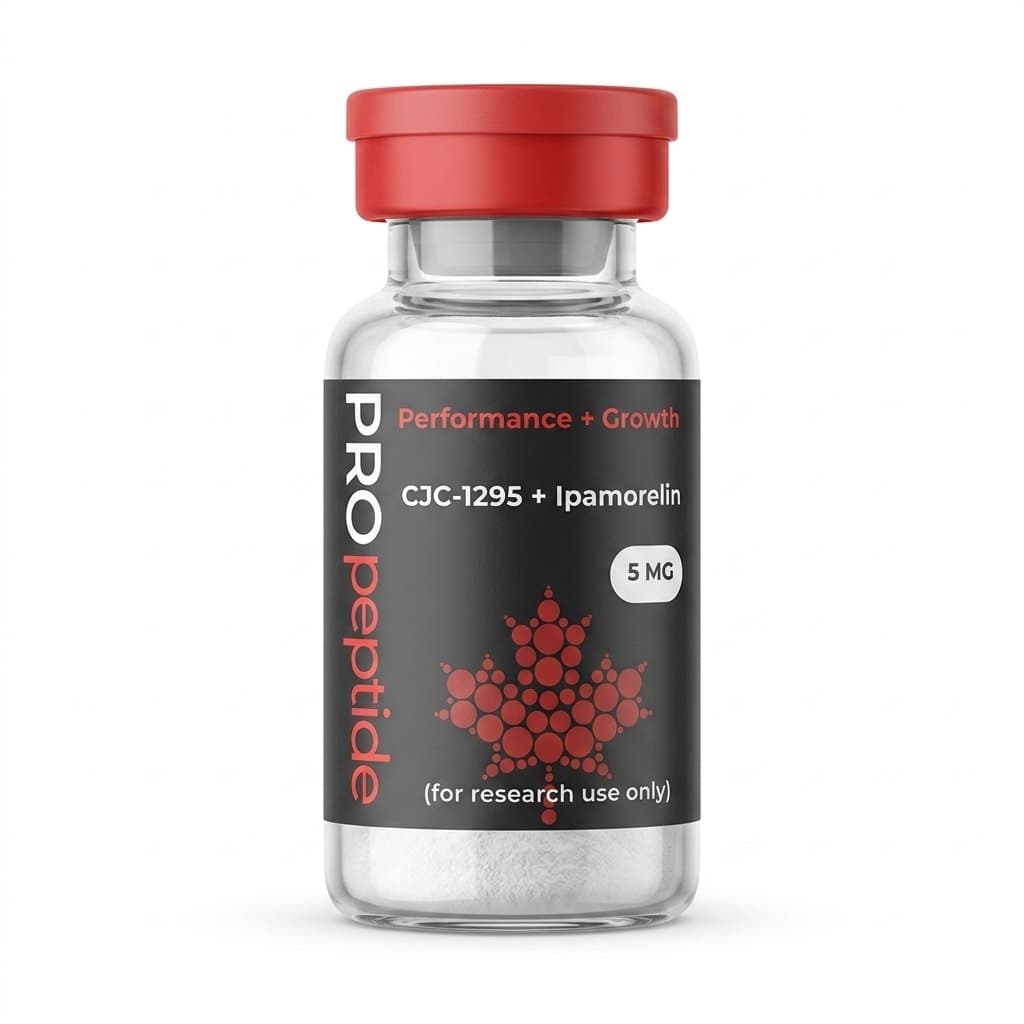
Two different levers on the same pituitary axis, supplied in one blend. The rationale is real physiology. The pairing itself has never been studied, and those are different facts.
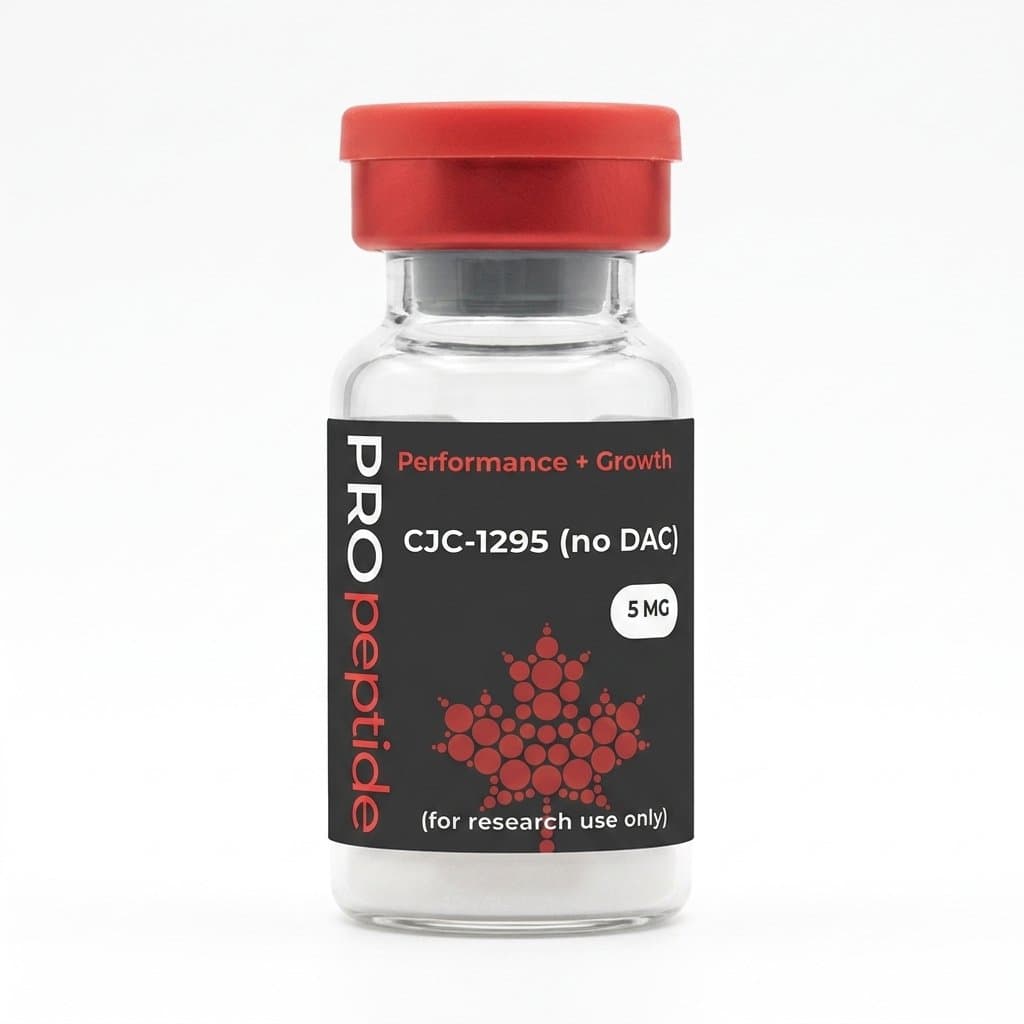
Modified GRF 1-29: the same stabilised GHRH analogue without the albumin anchor. It clears in minutes instead of days, and that difference is the entire product.
It is water. We know. But it is the one bottle on this shelf where the boring ingredient is the entire product, and getting it wrong ruins everything else you bought.
Order GHRH right now
One last look before you decide.
Freeze-dried, ships cold from Canada
You've got the whole file now, the thin parts included. Nothing above pretended otherwise. If that's the kind of source you were after, GHRH is right here.
Not for human consumption. Not approved by Health Canada or any other regulatory body.
Page last updated October 4, 2026
People also search for GHRH
Related searches.