
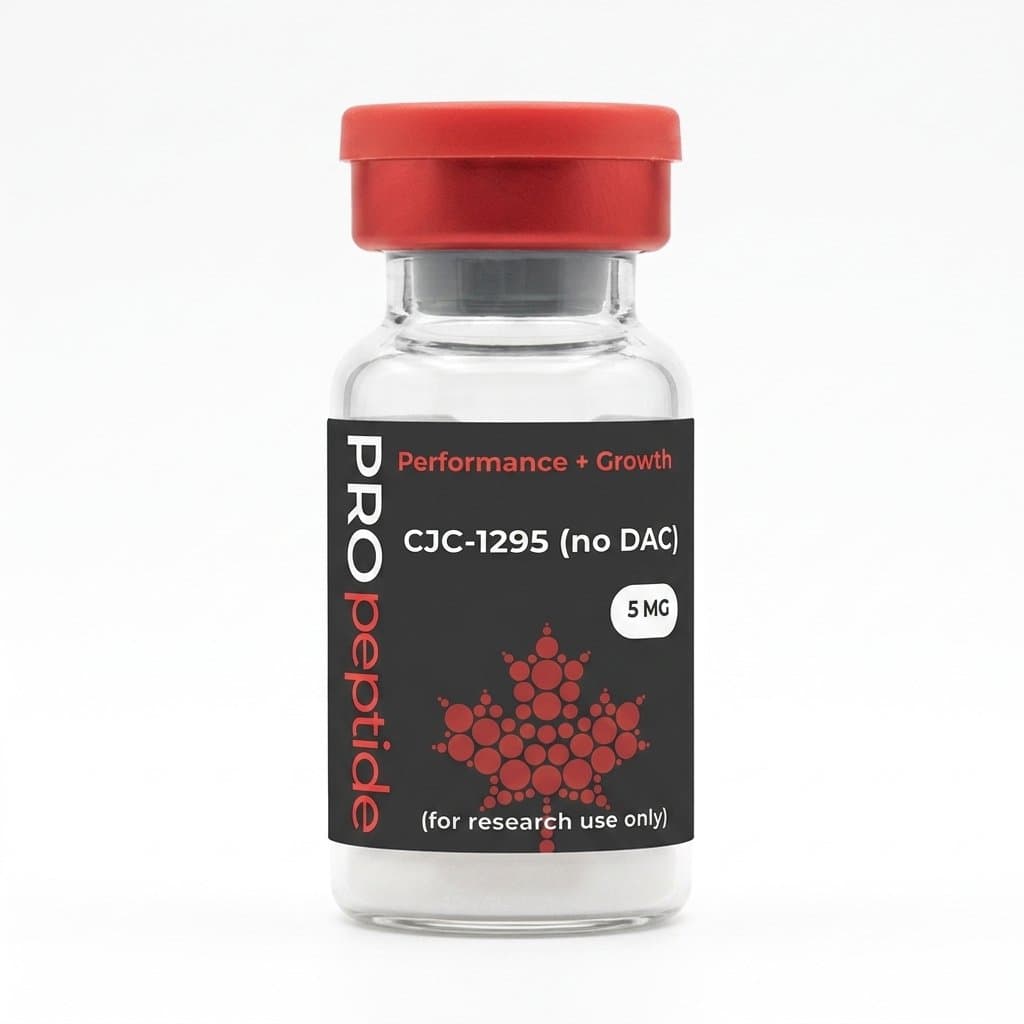
CJC-1295 no DAC Peptide
Four substitutions, each fixing a specific way the natural molecule falls apart.
Choose your pack
For research use only. Not for human or veterinary use.
What CJC-1295 no DAC is
The plain-language version, first.
The DAC version's twin, minus the part that refuses to leave.
It is studied as a DPP-4 resistant analog of GHRH (1-29), primarily for receptor signalling and pituitary response in animal and cell models.
One molecule, two versions, one philosophical argument about rhythm.
Modified GRF 1-29, sold as CJC-1295 without DAC, is sermorelin's sequence with four substitutions armoring it against enzymes.
Its twin adds the DAC group and bonds to albumin for a week. This version skips the anchor and clears in minutes to an hour or two.
Why would anybody choose the short-lived version on purpose? Because this axis runs on pulses, and a fast-clearing analogue can mimic a pulse where a week-long one cannot.
The two versions are opposite answers to the same question about what the pituitary actually wants to hear.
The twin that kept the rhythm. Whether the rhythm matters is the question neither twin has answered in outcomes.
What CJC-1295 no DAC actually does
Mechanism studied, not outcome promised.
Keeps the natural drumbeat its anchored twin abandons.
Four substitutions in twenty-nine residues, each blocking a specific cleavage point that destroys the natural hormone in minutes.
Armour without an anchor: resistant enough to survive delivery, transient enough to arrive and leave like the natural signal does.
At the receptor it behaves as its parent does, asking the pituitary rather than instructing it, feedback loops intact.
The theoretical case for pulse-preservation is genuinely reasonable physiology, and it is the entire argument for choosing this over the DAC version.
Here's the honest part.
The pulse-versus-hum debate that these twins embody has never been settled by an outcomes trial of either. Two elegant answers, no graded exam.
The research so far for CJC-1295 no DAC
Where the evidence is thin, we say so.
Lives in its twin's shadow, including the parts of the file that are missing.
This file borrows from two neighbours and owns very little outright.
From sermorelin it inherits the parent pharmacology. From the DAC version it inherits the pharmacokinetic contrast that defines it.
Dedicated published work on this exact variant is thin: characterisation-level, not outcomes-level.
No approval anywhere. No outcome trials. Prohibited in sport with its whole family.
A rational design with a mostly-inherited file. The strongest sentence anybody can honestly write about it is that its logic is sound, and sound logic is where evidence starts rather than ends.
CJC-1295 no DAC 5mg lyophilised. Ships same day out of BC.
CJC-1295 no DAC specs
The chemistry, exactly as released.
Who studies CJC-1295 no DAC
Who tends to order this one, and why.
- 1
Neuroendocrinology
GHRH receptor pharmacology and the three-input control of pituitary growth hormone release, alongside somatostatin and ghrelin.
- 2
Peptide engineering
A textbook example of targeted stabilisation: four substitutions each addressing a specific, identified degradation route.
- 3
Analytical chemistry
Distinguishing two molecules 279 daltons apart that share a market name is exactly what mass spectrometry is for.
- 4
Anti-doping laboratories
CJC-1295 is named in section S2.2.4 of the WADA 2026 list among growth hormone releasing factors and their analogues, prohibited at all times.
Sold for laboratory research only. This is not guidance for personal use, and nothing here is a recommendation.
CJC-1295 no DAC backstory
How it got here.
Growth hormone releasing factor was isolated in the early 1980s, and the useful discovery came quickly after: the first 29 residues carry essentially the full activity of the 44 residue hormone. That made a much more tractable synthetic target.
GRF(1-29) became sermorelin, which was an approved product for growth hormone deficiency before being discontinued for commercial rather than safety reasons.
The limitation was always duration. A short peptide with a DPP-IV cleavage site at its front end does not last. ConjuChem's approach was to fix the peptide chemically and then attach it to something that circulates for weeks, which is what the albumin-binding DAC does.
The version without the linker is that same stabilised backbone on its own. It kept the CJC-1295 name, which is where most of the confusion started.
- 1
Twenty-nine residues is enough
Growth hormone releasing factor was isolated in the early 1980s, and the first 29 residues turned out to carry essentially the full activity of the 44 residue hormone.
- 2
The fragile front end
GRF(1-29) is cleaved rapidly by DPP-IV and degrades by deamidation and oxidation. Four targeted substitutions close all three routes.
- 3
With and without the linker
ConjuChem added a maleimide that bonds covalently to albumin, producing a week-long half-life. The version without it kept the same name, which is where the confusion began.
Buying CJC-1295 no DAC in Canada
What ships, how fast, and the paperwork.
Check the mass, not the name. With-DAC and no-DAC differ by roughly 279 daltons. They are trivially distinguishable by mass spectrometry and completely indistinguishable by label, and even PubChem carries one as a synonym of the other. This is the compound where the measured mass earns its keep.
Same day out of British Columbia. Our building, our cold packs, our people, and nothing sitting in a customs queue while you refresh a tracking page.
Named on the WADA list. Section S2.2.4 of the 2026 Prohibited List names CJC-1295 among growth hormone releasing factors and their analogues, alongside sermorelin and tesamorelin. Prohibited at all times, in and out of competition, non-specified.
Common questions
5 answers, none of them dodges.
What is the difference between CJC-1295 with and without DAC?
A linker, about 279 daltons, and roughly a hundredfold in duration. The DAC version carries a maleimidopropionyl-lysine at the C terminus that bonds covalently to a free thiol on serum albumin, giving a measured human half-life of 5.8 to 8.1 days. Without it you have the same stabilised 30 residue peptide with nothing carrying it, so clearance is on the order of minutes. They are different pharmacological propositions sold under one name.
What do the four substitutions actually do?
Each closes a specific degradation route in natural GRF(1-29). D-alanine at position 2 blocks dipeptidyl peptidase IV, the main clearance enzyme. Glutamine at position 8 replaces an asparagine that spontaneously deamidates. Alanine at position 15 adds backbone stability. Leucine at position 27 replaces a methionine prone to oxidation. Four changes, four named failure modes.
Is CJC-1295 the same as sermorelin?
Closely related, not identical. Sermorelin is plain GRF(1-29), which was an approved product for growth hormone deficiency before being discontinued for commercial reasons. CJC-1295 is that same 29 residue core with four stabilising substitutions and, in the DAC version, an albumin-binding linker. Same scaffold, engineered differently.
Does the human data apply to the no-DAC version?
Partly. The GRF(1-29) pharmacology is well characterised and applies to both. But the headline human numbers people quote, the 5.8 to 8.1 day half-life, growth hormone elevated for six days, IGF-1 up for 28 days, all come from Teichman and colleagues studying the DAC version. Those kinetics are a property of the albumin linker, not of the peptide, and they do not transfer to the version without it.
Does it flatten natural growth hormone pulses?
The evidence says no, at least for the DAC version where it was measured. Ionescu and Frohman sampled healthy men overnight every 20 minutes before and one week after a single injection. Trough growth hormone rose 7.5-fold and mean growth hormone rose 46 percent, while pulse frequency and amplitude were unaltered. The pituitary kept its own rhythm.
Good pairing options with CJC-1295 no DAC
What researchers stack alongside it.
Pairing is where research gets ahead of itself. These are the compounds researchers put in the same order as CJC-1295 no DAC Peptide, which is a statement about ordering habits, not about evidence. Two things in one cart have not been studied together unless somebody studied them together.
Two different levers on the same pituitary axis, supplied in one blend. The rationale is real physiology. The pairing itself has never been studied, and those are different facts.
A GHRH analogue that bolts itself to your albumin and refuses to leave. A 2006 study measured the half-life at 5.8 to 8.1 days, which for this signalling system is either the feature or the entire problem.
It is water. We know. But it is the one bottle on this shelf where the boring ingredient is the entire product, and getting it wrong ruins everything else you bought.
Order CJC-1295 no DAC right now
One last look before you decide.
Freeze-dried, ships cold from Canada
You've got the whole file now, the thin parts included. Nothing above pretended otherwise. If that's the kind of source you were after, CJC-1295 no DAC is right here.
Not for human consumption. Not approved by Health Canada or any other regulatory body.
Page last updated October 4, 2026
People also search for CJC-1295 no DAC
Related searches.