
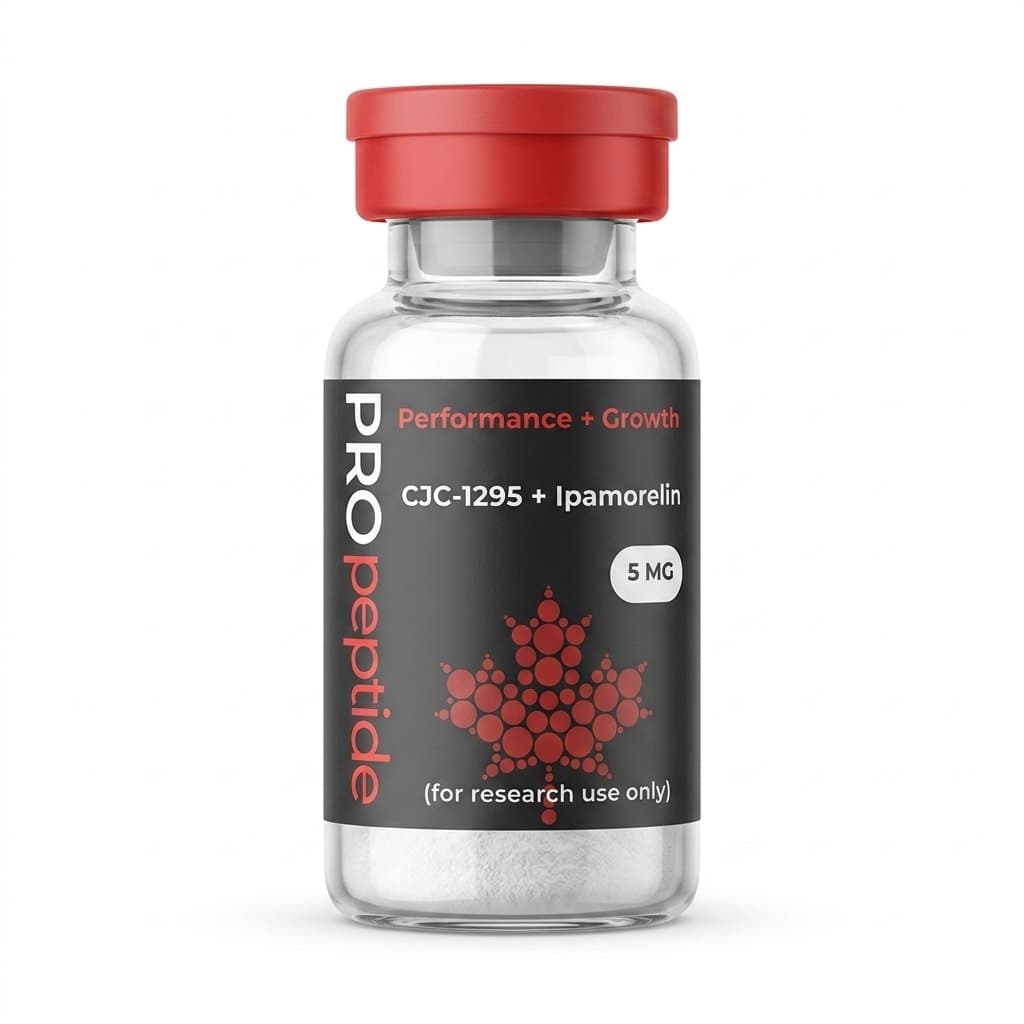
CJC-1295 Ipamorelin Peptide Blend
Two receptors, two pathways, and the most-discussed pairing in the category.
Choose your pack
For research use only. Not for human or veterinary use.
What CJC-1295 Ipamorelin Peptide Blend is
The plain-language version, first.
Both levers of the growth hormone axis in one vial, on a theory.
CJC-1295 ipamorelin is a blend of two compounds that act at different receptors on the same axis: CJC-1295, a 30-residue analogue of growth hormone releasing factor hGRF(1-29) carrying four substitutions that resist degradation, and ipamorelin, a pentapeptide agonist at the growth hormone secretagogue receptor. Both are named on the WADA Prohibited List under section S2, CJC-1295 among GHRH analogues and ipamorelin among growth hormone secretagogues.
The growth hormone axis has two control levers, and this blend pulls both at once.
Lever one: the GHRH receptor. That's the CJC-1295 half, a stabilised analogue of the natural releasing hormone.
Lever two: the ghrelin receptor. That's the ipamorelin half, the politest member of the GHRP family, the one that shows up without the appetite noise.
The rationale is textbook physiology. The two receptors are separate inputs to the same somatotroph cells, and your body already uses them together, on its own, without anybody's help.
So combining them isn't a random stack. It's an imitation of an arrangement that already exists. The doorbell and the knock, at the same door, at the same time.
We sell it by the vial, and the box of ten knocks 25% off.
A sensible theory in a vial. The word doing all the work in that sentence is theory.
What is CJC-1295 ipamorelin?
Mechanism studied, not outcome promised.
The physiology says the levers are synergistic. The literature has not checked this pairing.
The doorbell and the knock. Same door. That's the design.
The GHRH arm asks through its receptor. The ipamorelin arm asks through the ghrelin receptor, and asks unusually cleanly, without the cortisol spillover of its older siblings.
In the body's own signalling, hitting both inputs together produces more than either alone. That much is established physiology, and it's been established since 1990.
What isn't established is this specific pairing at this specific ratio, because nobody's run that study. Not once.
And blends carry a permanent reading problem. Whatever result you get, you can't hand it to either component. It's like your buddy ordering the two-for-one combo and then reviewing it as a single dish.
Here's the honest part. Real physiology underneath, real components each with a real file, and a combination that exists commercially rather than scientifically.
The blend is plausible. Plausible is a starting line, not a finding.
The research so far for CJC-1295 Ipamorelin Peptide Blend
Where the evidence is thin, we say so.
Each component has its own file. The combination has approximately none.
Read this file as three files, because that's what it is.
CJC-1295 alone: real pharmacokinetic work, including the DAC half-life data.
Ipamorelin alone: a genuinely clean selectivity profile, documented by Novo Nordisk in the nineties.
The combination: approximately nothing. No trial of this pairing has been published. We looked.
That's the standard blend problem, and it's on every combo page on the internet: component evidence gets borrowed, dressed up as combination evidence, and handed to you as if somebody had tested the mix. The only way you'd ever know is to check what was actually studied.
Nothing approved, individually or together. Prohibited in sport.
Two respectable files and an empty one, sold as a set. Check which file any claim you read is actually citing.
Blend vial sizes and current Canadian stock are listed below.
CJC-1295 Ipamorelin Peptide Blend specs
The chemistry, exactly as released.
Who studies CJC-1295 Ipamorelin Peptide Blend
Who tends to order this one, and why.
- 1
Neuroendocrinology
The three-input control of pituitary growth hormone release: GHRH driving, somatostatin restraining, ghrelin amplifying through a separate receptor.
- 2
Peptide engineering
Covalent albumin conjugation is an unusual and effective approach to extending a short peptide, and CJC-1295 is its clearest example.
- 3
Pharmacokinetics
A compound with a week-long half-life layered with one that clears in hours is a genuinely unusual arrangement, and nobody has characterised what it produces.
- 4
Anti-doping laboratories
Both components are named in section S2.2.4 of the WADA 2026 list, CJC-1295 among GHRH analogues and ipamorelin among GH secretagogues.
Sold for laboratory research only. This is not guidance for personal use, and nothing here is a recommendation.
CJC-1295 Ipamorelin Peptide Blend backstory
How it got here.
GHRH and GHRP acting together is old physiology. Once both classes existed, endocrinologists tested them together and found the combination produced more growth hormone than either alone, which made sense given they act at different receptors.
CJC-1295 came out of ConjuChem's albumin-conjugation platform, which was a serious piece of pharmaceutical engineering aimed at making short peptides last. Ipamorelin came out of Novo Nordisk's work stripping the GHRP series down to something selective.
Neither reached approval. Both ended up in the same grey market, where the pairing became standard practice long before anybody studied it as a pairing.
That sequence, physiology first, market second, study never, is the thing to understand about this product.
- 1
Old physiology
Once both classes existed, endocrinologists tested GHRH alongside GHRP compounds and found more growth hormone release than either produced alone.
- 2
Two engineering programmes
CJC-1295 came out of ConjuChem albumin-conjugation platform. Ipamorelin came out of Novo Nordisk work stripping the GHRP series down to something selective.
- 3
Paired in practice, not in print
Neither reached approval, both reached the same market, and the pairing became standard well before anybody studied it as a pairing.
Buying CJC-1295 Ipamorelin Peptide Blend in Canada
What ships, how fast, and the paperwork.
Know which CJC-1295 you have. With DAC and without DAC are different molecules, differing by about 279 daltons and by roughly a hundredfold in duration. FDA has flagged that common names make it impossible to know which structure is intended. A measured mass is the only way to tell them apart.
Same day out of British Columbia. Our building, our cold packs, our people, and nothing sitting in a customs queue while you refresh a tracking page.
Both components are named on the WADA list. Section S2.2.4 of the 2026 Prohibited List names CJC-1295 among GHRH analogues and ipamorelin among growth hormone secretagogues. Both prohibited at all times, in and out of competition, and non-specified.
Common questions
5 answers, none of them dodges.
Has anyone studied CJC-1295 and ipamorelin together?
Not in humans, in any published form. We searched ClinicalTrials.gov, PubMed and Europe PMC and found no interventional study, no pharmacokinetic study and no case series giving the two together. The publications that mention both are review articles and doping-control analytical methods. The physiological rationale is established for GHRH and GHRP pairings generally, but this specific combination has not been measured.
Why would combining them make sense?
Because they act at different receptors on the same axis. CJC-1295 is a GHRH receptor analogue. Ipamorelin is a ghrelin receptor agonist. Pituitary growth hormone release responds to both inputs, and GHRH combined with a GHRP-class compound has been shown to produce more growth hormone than either alone. That is genuine physiology; it just predates these two specific molecules.
What is the difference between CJC-1295 with and without DAC?
One residue and a hundredfold in duration. The DAC version carries a maleimidopropionyl-lysine at the C terminus that forms a covalent bond with serum albumin, giving a measured human half-life of 5.8 to 8.1 days. Without it you have the same 29 residue peptide with no albumin conjugation and no multi-day depot. FDA has specifically noted that common names make it impossible to know which structure a label refers to.
How long does each component last?
Very differently, which is part of what makes the combination hard to predict. CJC-1295 with DAC has a measured human half-life of 5.8 to 8.1 days, with growth hormone elevated 2 to 10-fold for at least six days after a single dose. Ipamorelin produces a single growth hormone pulse peaking around 40 minutes with a terminal half-life of about 2 hours.
Does CJC-1295 flatten out natural growth hormone pulses?
Apparently not. Ionescu and Frohman studied healthy men before and one week after a single injection with overnight sampling every 20 minutes. Trough growth hormone rose 7.5-fold and mean growth hormone rose 46 percent, while pulse frequency and amplitude were unaltered. The pituitary maintained its own rhythm despite continuous receptor stimulation.
Good pairing options with CJC-1295 Ipamorelin Peptide Blend
What researchers stack alongside it.
Pairing is where research gets ahead of itself. These are the compounds researchers put in the same order as CJC-1295 Ipamorelin Peptide Blend, which is a statement about ordering habits, not about evidence. Two things in one cart have not been studied together unless somebody studied them together.
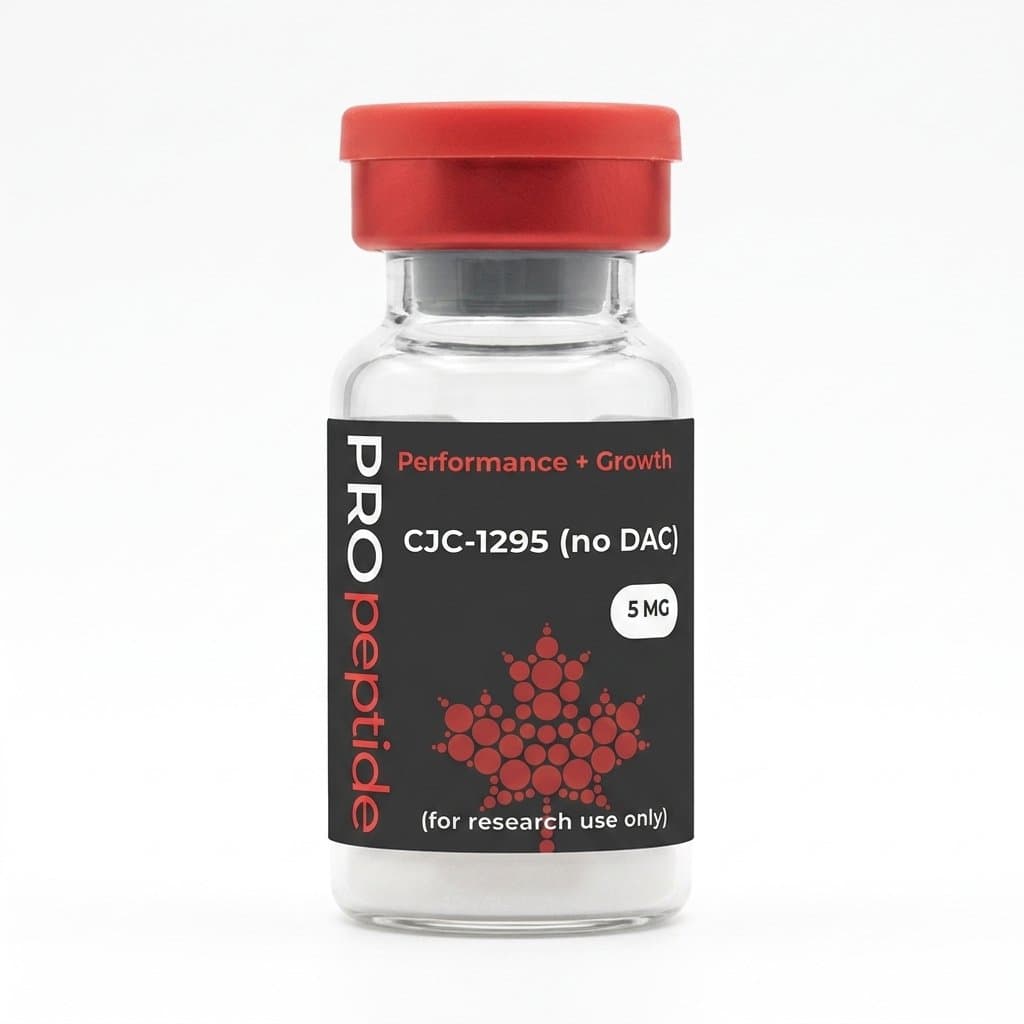
Modified GRF 1-29: the same stabilised GHRH analogue without the albumin anchor. It clears in minutes instead of days, and that difference is the entire product.
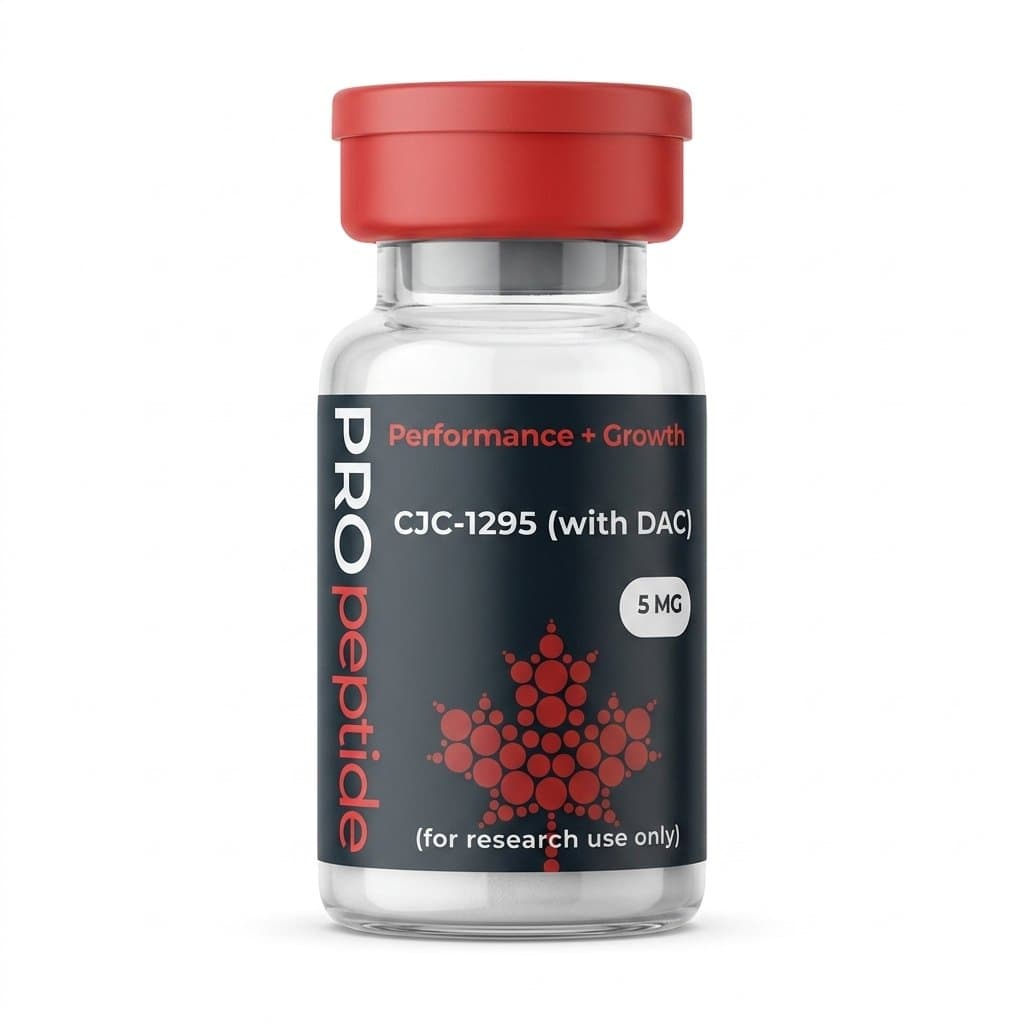
A GHRH analogue that bolts itself to your albumin and refuses to leave. A 2006 study measured the half-life at 5.8 to 8.1 days, which for this signalling system is either the feature or the entire problem.
It is water. We know. But it is the one bottle on this shelf where the boring ingredient is the entire product, and getting it wrong ruins everything else you bought.
Order CJC-1295 Ipamorelin Peptide Blend right now
One last look before you decide.
Freeze-dried, ships cold from Canada
You've got the whole file now, the thin parts included. Nothing above pretended otherwise. If that's the kind of source you were after, CJC-1295 Ipamorelin Peptide Blend is right here.
Not for human consumption. Not approved by Health Canada or any other regulatory body.
Page last updated October 4, 2026
People also search for CJC-1295 Ipamorelin Peptide Blend
Related searches.