
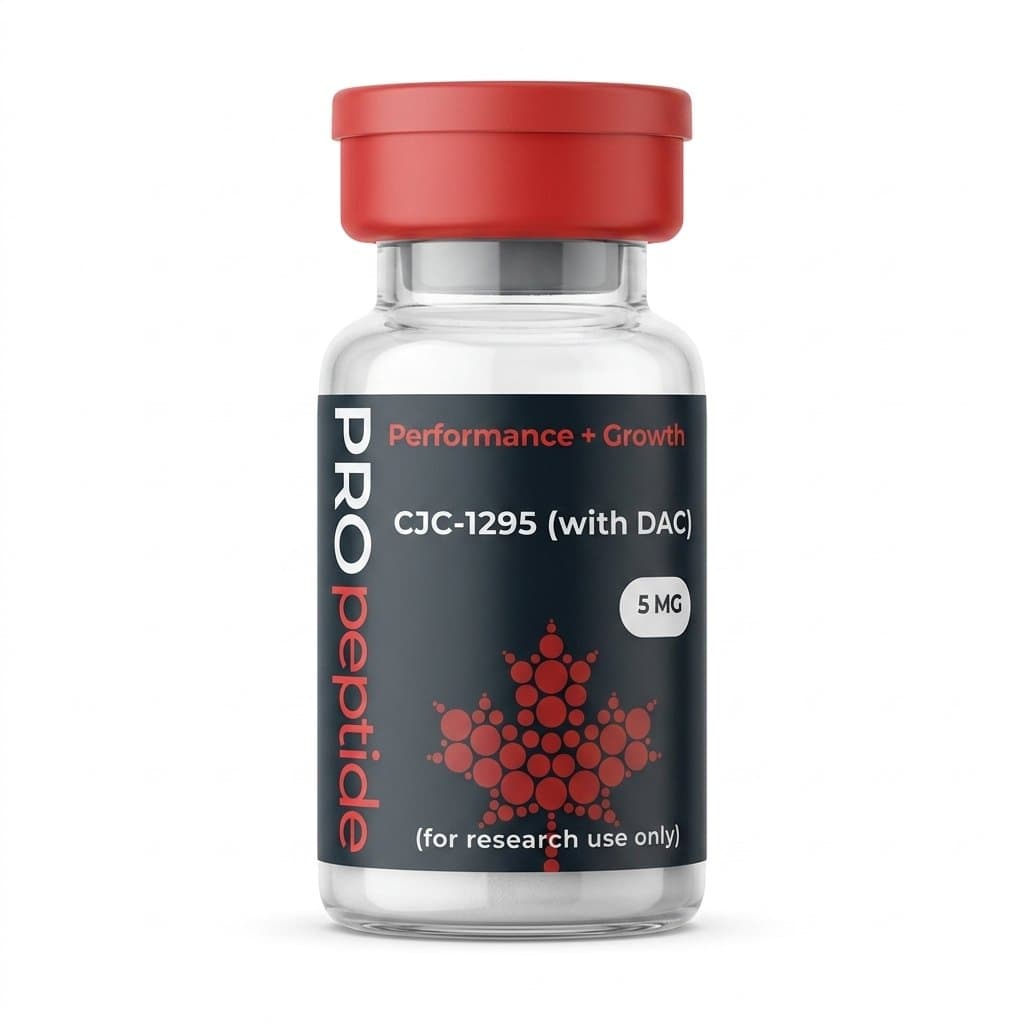
CJC-1295 with DAC Peptide
A GHRH fragment that chemically welds itself to albumin and stays for a week.
Choose your pack
For research use only. Not for human or veterinary use.
What CJC-1295 with DAC is
The plain-language version, first.
The analogue that solved the half-life problem so hard it created a new question.
CJC-1295 with DAC is a synthetic long-acting analogue of growth hormone releasing hormone, CAS 446262-90-4, built from [D-Ala2, Gln8, Ala15, Leu27]hGRF(1-29) with a lysine-30 maleimidopropionyl group that forms a covalent bond with cysteine-34 of serum albumin. It acts at the GHRH receptor, was estimated in a 2006 study to have a half-life of 5.8 to 8.1 days, and has never been approved as a medicine in any jurisdiction.
Listen. Every GHRH analogue is fighting the same enemy, which is that the natural hormone dies in minutes.
Most fixes buy you hours. This one bought the better part of a week.
The DAC group, Drug Affinity Complex, covalently bonds to albumin in your blood. Not rides along. Bonds. It doesn't hitch a ride on the bumper, it welds itself to it.
Albumin's the most abundant protein in circulation and your body's in no hurry to clear it, so anything welded to it inherits that patience.
A 2006 pharmacokinetic study put the half-life at 5.8 to 8.1 days. Against the parent hormone's minutes, that's a factor of thousands. Same family, wildly different clock.
The 5mg vial's the one we stock, and ten of them knock 25% off.
The most complete solution to the half-life problem in this family, and the version of the molecule where the interesting question changes entirely.
What CJC-1295 with DAC actually is
Mechanism studied, not outcome promised.
The natural signal is a drumbeat. This turns it into a hum.
Go back to the drumbeat, because everything about this molecule is a conversation with it.
The natural GHRH signal is pulses with silence between them, and the silence carries information. The pituitary reads rhythm the way you read a doorbell: one ring means somebody's there, a finger held on the button means something's wrong.
A week-long half-life can't pulse. It's a fridge hum where the body expects a beat.
That isn't automatically bad. It's automatically different, and the difference is the real research question this molecule poses: what does the axis do under a hum instead of a beat?
The no-DAC version of this same analogue exists precisely as the other answer, clearing in minutes to hours, keeping the rhythm.
Here's the honest part. Anybody telling you confidently that the hum is fine, or that it's ruinous, is ahead of the data.
The two versions of this molecule are a controlled experiment about rhythm that mostly hasn't been run. That's the honest state of it.
The research so far for CJC-1295 with DAC
Where the evidence is thin, we say so.
Real pharmacokinetic data, and a genuinely open question about rhythm.
There's real human pharmacokinetic data here, which already puts it above most of the shelf.
The 2006 study is the anchor: measured half-life, measured elevations in downstream markers, human subjects, published numbers you can look up tonight.
What it isn't is an outcome trial. It measured what the molecule does to levels, not what the levels do to anything you'd care about.
Development didn't continue to approval anywhere, and the clinical thread thins out after the 2000s. A Phase 2 was terminated in 2006, and we put exactly what is and isn't known about why in the FAQ below.
Prohibited in sport, like the whole family.
Good pharmacokinetics, a genuinely interesting rhythm question, and a file that stops right before the questions people actually want answered. That's the whole picture.
CJC-1295 with DAC, the albumin-anchored GHRH analogue. Canadian stock, shipping from BC.
CJC-1295 with DAC specs
The chemistry, exactly as released.
Who studies CJC-1295 with DAC
Who tends to order this one, and why.
- 1
People studying half-life engineering
Covalent albumin binding is one of the most successful long-acting strategies in peptide chemistry, and CJC-1295 is the clearest worked example in this catalogue. The chemistry is specific, documented and straightforward to follow.
- 2
Anyone comparing pulsatile against continuous signalling
Natural GHRH arrives in bursts. This one holds the receptor occupied for days. That difference is a real research question rather than a marketing angle, and there is very little human data on which way it cuts.
- 3
Researchers who need the with-DAC and no-DAC line straight
These are two different compounds with two different CAS numbers and two different molecular weights. Nearly every kinetics figure circulating online belongs to the DAC version. Getting it wrong invalidates a comparison before it starts.
- 4
Regulatory readers
CJC-1295 sits on the FDA nominated-but-withdrawn table and is the only compound in this group named in Health Canada’s 9 April 2026 advisory. If you track how regulators talk about peptides, this is the case file to read.
Sold for laboratory research only. This is not guidance for personal use, and nothing here is a recommendation.
CJC-1295 with DAC backstory
How it got here.
ConjuChem was a Montreal company, which makes this the most Canadian compound in the group, and their entire idea was albumin.
The problem they were attacking is the oldest one in peptide chemistry. Peptides work and then they're gone. The body treats them as food. Kidneys filter them, enzymes cut them, and a molecule that does something useful for four minutes isn't a drug, it's a demonstration.
Their answer was the Drug Affinity Complex. Find something in the blood that lasts a long time and bolt the peptide to it permanently. Albumin lasts about three weeks and has exactly one accessible free thiol, sitting on cysteine-34 with a pK around 5.0 that makes it more reactive than it has any right to be.
Put a maleimide on your peptide and it will go find that sulfur and hold on. Not a clever fit. A weld.
They applied it to GHRH(1-29) with four stabilising substitutions, and on the pharmacology it worked completely. Teichman's 2006 paper reported growth hormone elevated for six days or more from a single injection, and an estimated half-life of nearly a week for a molecule whose parent hormone lasts minutes. Problem solved, on paper.
Then the clinical programme stopped. The Phase 2 in HIV-associated visceral obesity, 120 patients, was terminated after a participant at an Argentine site died in July 2006. Causality was never publicly established. ConjuChem did not take the compound forward, nobody else picked it up, and CJC-1295 has spent the twenty years since as a research chemical with excellent kinetics and no clinical file behind it.
- 1
A Montreal company and one free thiol
ConjuChem built the Drug Affinity Complex around cysteine-34 of serum albumin, the protein’s only exposed free thiol and unusually reactive at a pK near 5.0. A maleimide on the peptide bonds to it covalently.
- 2
2006, JCEM, days instead of minutes
Teichman and colleagues (PMID 16352683) reported a single subcutaneous injection raising GH 2 to 10 fold for six days or more and IGF-I 1.5 to 3 fold for nine to eleven days, with an estimated half-life of 5.8 to 8.1 days.
- 3
The Phase 2 that stopped
NCT00267527, 120 patients with HIV-associated visceral obesity, is listed as terminated. A participant at a site in Argentina died in July 2006 and the study was halted. Causality was never publicly established.
Buying CJC-1295 with DAC in Canada
What ships, how fast, and the paperwork.
With DAC and no DAC are different molecules. CJC-1295 with DAC is CAS 446262-90-4, molecular weight 3647.2, and carries the maleimide that bonds to albumin. CJC-1295 no DAC is CAS 863288-34-0, molecular weight 3367.9, with no maleimide and no albumin anchor. The 5.8 to 8.1 day half-life belongs to the DAC version only and does not transfer to the other.
Supplied for laboratory research use only. This is a research chemical. It is not a drug, a supplement or a therapy, and it is not intended for human or veterinary use. Health Canada named CJC-1295 in its public advisory of 9 April 2026, states that peptides in Canada are generally regulated as prescription drugs, and says "For Research Use Only" labelling does not make a product legal.
Prohibited in sport at all times. The WADA 2026 Prohibited List names CJC-1295 explicitly under S2.2.4, alongside CJC-1293, sermorelin and tesamorelin. It is non-Specified and banned both in and out of competition, with no permitted window for a tested athlete.
Common questions
5 answers, none of them dodges.
What does DAC actually stand for?
Drug Affinity Complex. It refers to a maleimidopropionyl group attached to lysine 30 of the peptide, which reacts with the free thiol on cysteine-34 of human serum albumin and forms a covalent bond. Albumin circulates for around three weeks, so the peptide effectively inherits that clearance time. It is a permanent chemical attachment rather than a binding affinity that can come apart.
How is CJC-1295 with DAC different from CJC-1295 no DAC?
They are two different molecules. With DAC is CAS 446262-90-4 at molecular weight 3647.2 and carries the maleimide that bonds to albumin. No DAC is CAS 863288-34-0 at molecular weight 3367.9, with no maleimide and no albumin anchor. The 5.8 to 8.1 day half-life reported in 2006 applies only to the DAC version, and quoting it for the other compound is simply incorrect.
What did the Teichman 2006 study find?
In healthy adults, a single subcutaneous injection produced growth hormone increases of 2 to 10 fold lasting six days or more, and IGF-I increases of 1.5 to 3 fold lasting nine to eleven days. The estimated half-life was 5.8 to 8.1 days. After multiple doses, mean IGF-I remained above baseline for up to 28 days. Those figures appear here as published trial history.
Why was the CJC-1295 Phase 2 terminated?
NCT00267527 enrolled 120 patients with HIV-associated visceral obesity and is listed as terminated. A participant at a study site in Argentina died in July 2006 and the trial was halted. Causality was never publicly established and should not be assumed in either direction. No efficacy result was published, and no company has taken the compound into a clinical programme since.
How does CJC-1295 compare to GHRP-2 or MK-677?
Different receptor. CJC-1295 acts at the GHRH receptor, the same one GHRH itself uses, so it does not carry the appetite signalling, ACTH and cortisol response or prolactin release associated with GHS-R1a agonists like GHRP-2, GHRP-6, hexarelin and MK-677. Bowers showed in 1990 that the two pathways are independent, which is why compounds from each side are often examined together.
Good pairing options with CJC-1295 with DAC
What researchers stack alongside it.
Pairing is where research gets ahead of itself. These are the compounds researchers put in the same order as CJC-1295 with DAC Peptide, which is a statement about ordering habits, not about evidence. Two things in one cart have not been studied together unless somebody studied them together.
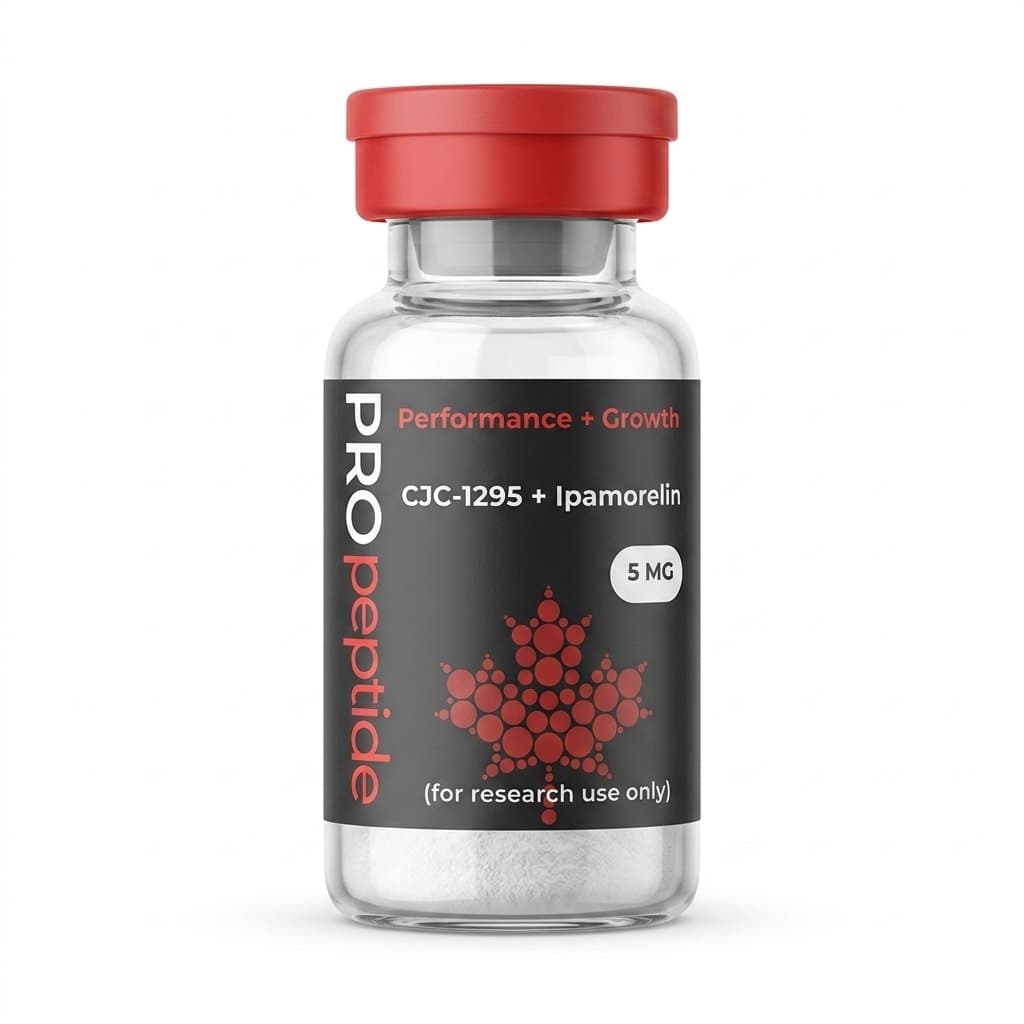
Two different levers on the same pituitary axis, supplied in one blend. The rationale is real physiology. The pairing itself has never been studied, and those are different facts.
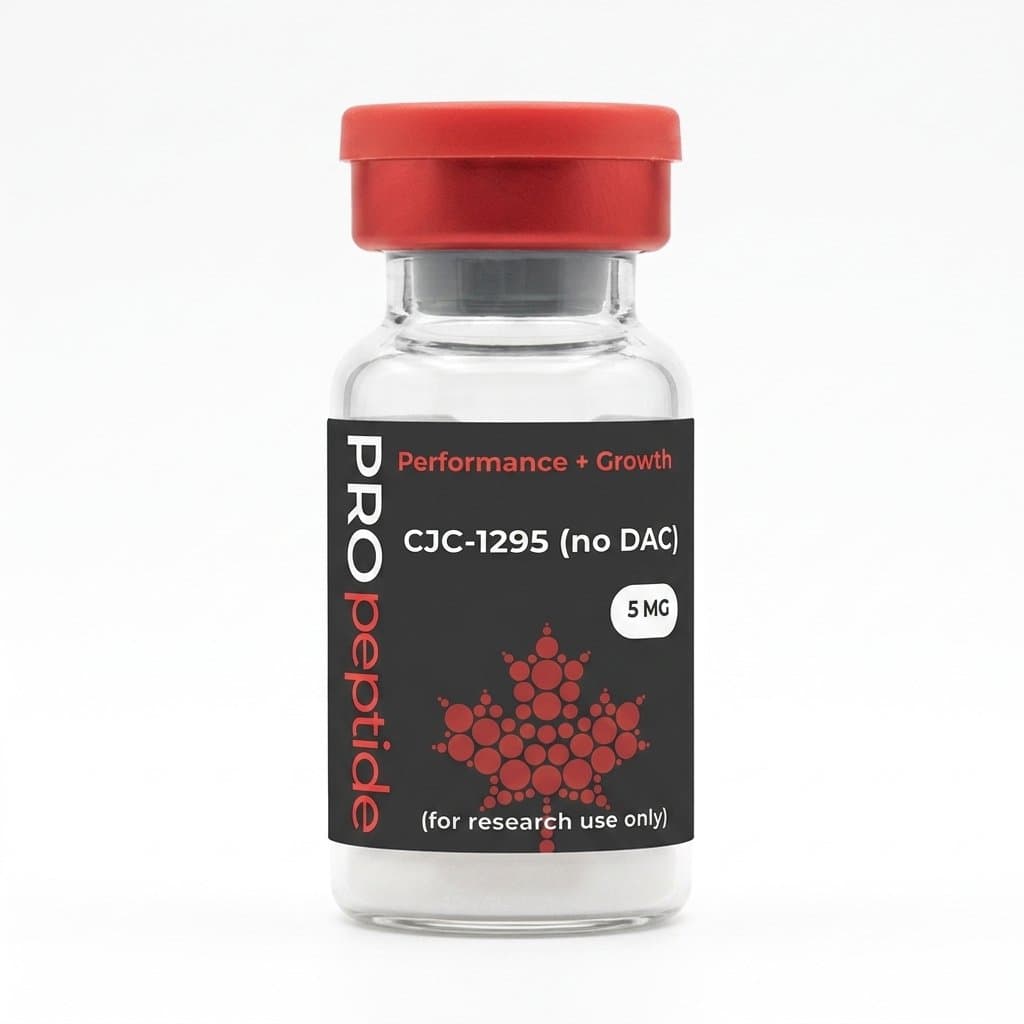
Modified GRF 1-29: the same stabilised GHRH analogue without the albumin anchor. It clears in minutes instead of days, and that difference is the entire product.
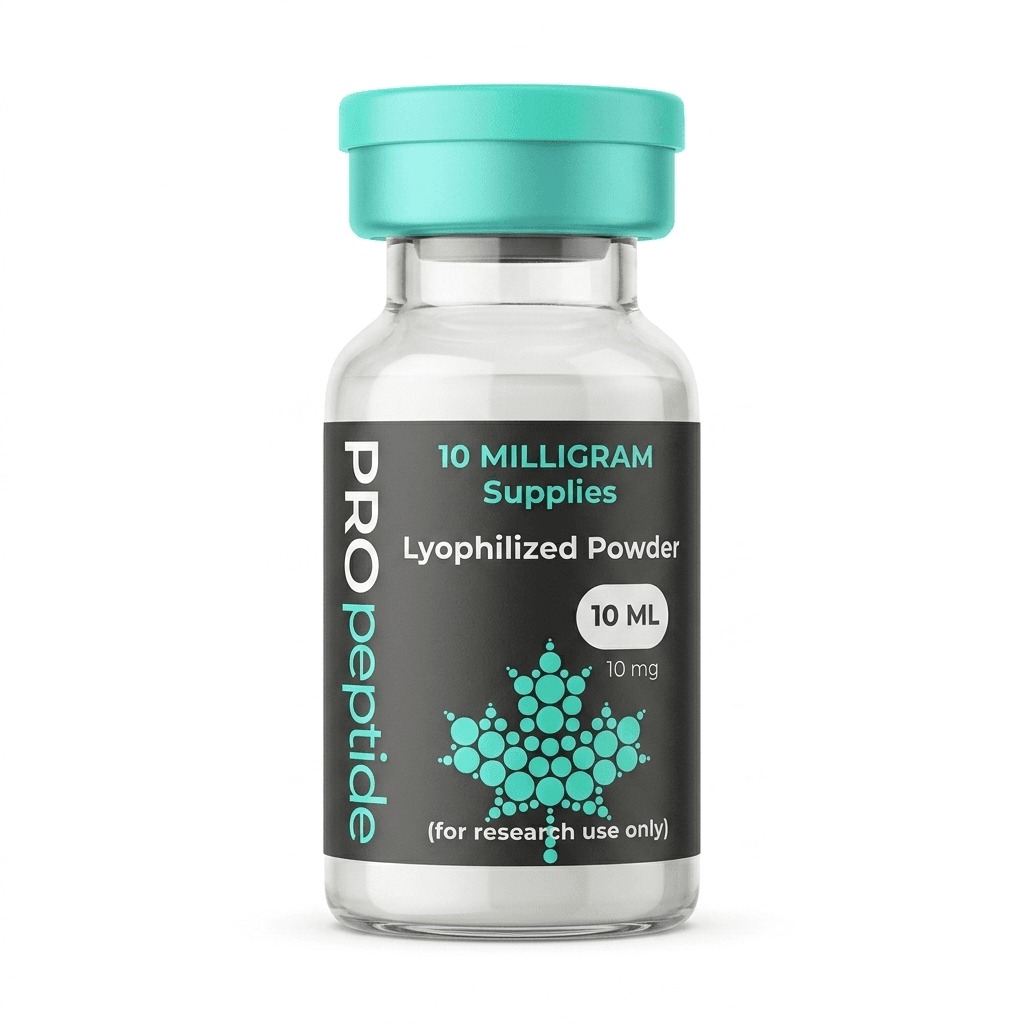
It is water. We know. But it is the one bottle on this shelf where the boring ingredient is the entire product, and getting it wrong ruins everything else you bought.
Order CJC-1295 with DAC right now
One last look before you decide.
Freeze-dried, ships cold from Canada
You've got the whole file now, the thin parts included. Nothing above pretended otherwise. If that's the kind of source you were after, CJC-1295 with DAC is right here.
Not for human consumption. Not approved by Health Canada or any other regulatory body.
Page last updated October 4, 2026
People also search for CJC-1295 with DAC
Related searches.