
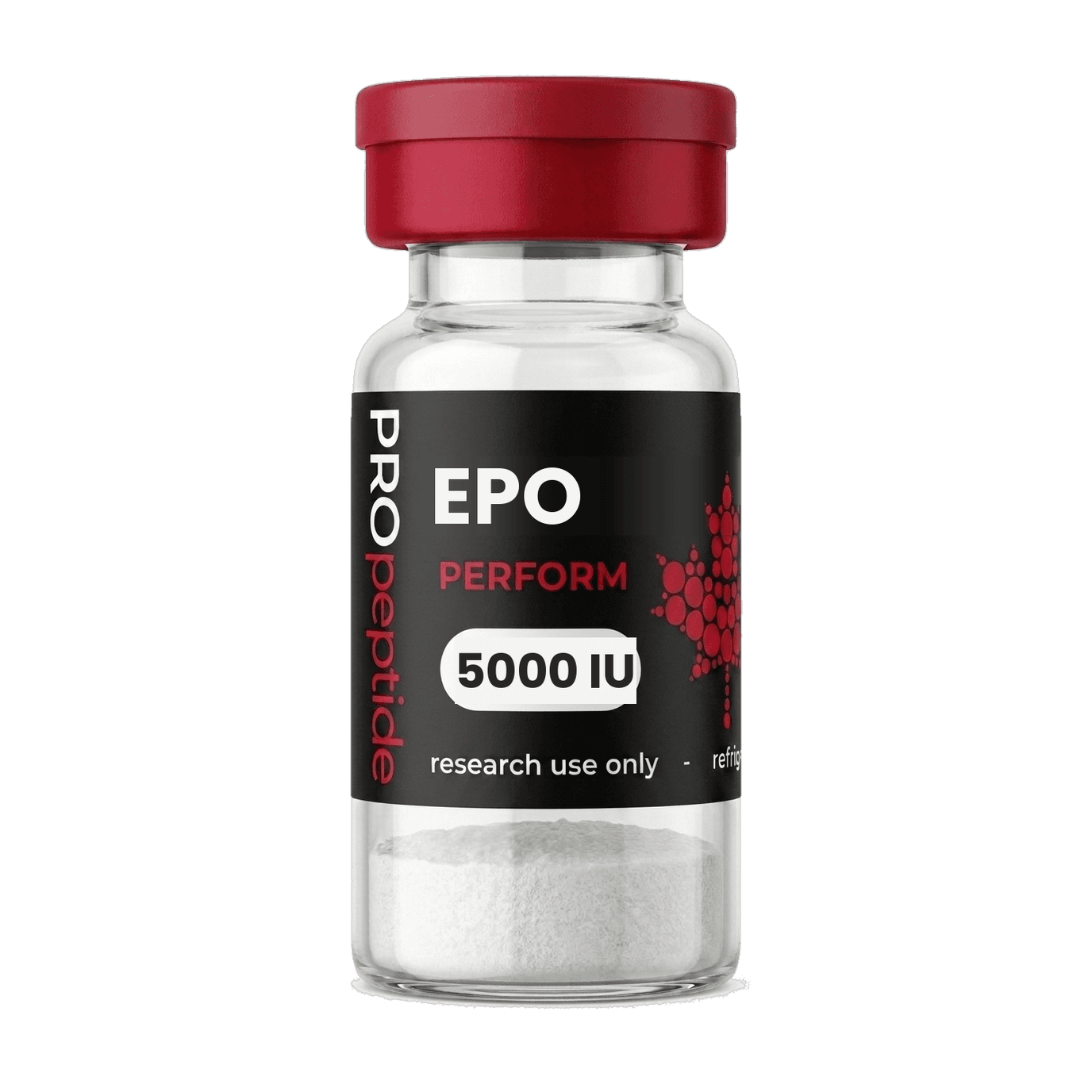
EPO Erythropoietin
About forty percent of it is sugar, and the sugar is what keeps it alive.
Choose your pack
For research use only. Not for human or veterinary use.
What EPO Erythropoietin is
The plain-language version, first.
Barely a peptide at all: a heavily sugar-coated protein where the sugar is the point.
Erythropoietin is a 165 amino acid glycoprotein hormone with N-linked glycosylation at asparagine residues 24, 38 and 83 and O-linked glycosylation at serine 126, catalogued in UniProt entry P01588 under CAS number 11096-26-7. The unmodified polypeptide was calculated at 18,399 daltons in the 1985 cloning paper while approved epoetin drug substance is stated at approximately 30,400 daltons, meaning carbohydrate accounts for roughly 40 percent of molecular mass and sialylation determines serum half life.
Calling EPO a peptide is generous. It is a glycoprotein, and roughly forty percent of its mass is carbohydrate.
The sugar is not decoration. The specific pattern, especially the sialic acid caps, determines whether the molecule survives circulation at all.
Strip the sialylation and the liver clears it in minutes. Which means with EPO, the manufacturing process is the product: two vials with identical protein sequences and different glycosylation are different drugs.
First purified in 1977 from litres of patients' urine, later becoming one of biotech's founding blockbusters as a recombinant product.
A molecule where the hard part is invisible to a mass spec run on the peptide backbone. Hold that thought for the whole page.
epo erythropoietin glycosylation and EPOR signalling
Mechanism studied, not outcome promised.
The most famous molecule in endurance sport, for the most audited reasons.
The core signalling is clean: EPO binds its receptor on marrow progenitor cells and red blood cell production scales up. Kidneys sense oxygen, make EPO, marrow responds.
Simple loop, big consequences, and the consequences are why this molecule has the most sophisticated detection regime in sport.
More red cells means more oxygen carriage and also thicker blood, which is a real physiological trade with real risks documented across its clinical history.
Here's the honest part, unique on this shelf.
This is the single most anti-doping-scrutinised molecule in existence. The biological passport programme exists substantially because of it. There is no casual version of this compound and no version of this page that pretends otherwise.
The research so far for EPO Erythropoietin
Where the evidence is thin, we say so.
A blockbuster drug's file on one side, and a notorious history on the other.
The clinical file is enormous and belongs to the approved recombinant products: anaemia of kidney disease and chemotherapy, decades of use, black-box warnings included, thrombotic risks quantified.
A fully mature drug file, complete with the safety chapters enthusiasts skip.
The glycosylation problem is the research-material catch: activity depends on manufacturing quality that urine-era pioneers spent years and industrial biotech spent fortunes controlling.
Banned in sport since before some of its buyers were born, with dedicated detection science.
A foundational biologic, a mature and cautionary clinical file, and a molecule whose quality question cannot be answered by a purity percentage. All three are the truth of it.
EPO · lyophilised powder · sealed vial · Canadian stock, ships from BC
EPO Erythropoietin specs
The chemistry, exactly as released.
Who studies EPO Erythropoietin
Who tends to order this one, and why.
- 1
Haematology research
Work on erythroid progenitor biology, where EPO is the defining survival signal and the one cytokine the whole lineage is organised around.
- 2
Glycobiology
Groups studying how sugar chains change a protein's fate, since EPO is the standard example of a molecule whose half life is decided by sialylation rather than by sequence.
- 3
Cytokine receptor signalling
JAK STAT work, where EPOR dimerisation feeding JAK2 and STAT5 is one of the cleanest and best mapped examples of the whole receptor family.
- 4
Analytical and biosimilar characterisation
Method development that has to resolve glycoform heterogeneity, which is the reason epoetin biosimilars took until 2018 to clear the FDA at all.
Sold for laboratory research only. This is not guidance for personal use, and nothing here is a recommendation.
EPO Erythropoietin backstory
How it got here.
Eugene Goldwasser spent roughly twenty years trying to get his hands on enough human erythropoietin to work with. The problem was concentration. The hormone circulates at levels so low that ordinary sources are useless, so the hunt turned into a search for anybody excreting unusual amounts of it.
The answer was patients with aplastic anaemia, whose marrow can't respond, so the kidney keeps producing and the surplus ends up in urine. Miyake, Kung and Goldwasser published the purification in the Journal of Biological Chemistry in 1977, PMID 18467. A 930 fold purification at 21% yield, and finally enough protein to sequence.
That material is what let Lin and colleagues clone the gene, published in PNAS in 1985, PMID 3865178. FDA approved the recombinant product in June 1989 under BLA 103234. Twelve years from a jar of urine to a licensed biologic, and the entire chain depended on a disease that made the hormone pile up somewhere a chemist could reach it.
Retacrit arrived a long time later, May 2018 under BLA 125545, as the first epoetin biosimilar the FDA approved.
- 1
1977, purified from urine
Miyake, Kung and Goldwasser pull human erythropoietin out of the urine of aplastic anaemia patients. 930 fold purification, 21% yield, and finally enough material to sequence.
- 2
1985, the gene
Lin and colleagues clone erythropoietin in PNAS, calculating the bare polypeptide at 18,399 daltons. The glycosylated drug substance turns out to weigh about 30,400.
- 3
1989, then 2018
FDA approves Epogen under BLA 103234 in June 1989. Retacrit follows in May 2018 under BLA 125545 as the first epoetin biosimilar the agency ever approved.
Buying EPO Erythropoietin in Canada
What ships, how fast, and the paperwork.
The Canadian brand isn't the American one. Epogen, Procrit and Retacrit don't exist as Canadian products. Epoetin alfa here is EPREX from Janssen, prescription and Schedule D, with DINs including 02231583 through 02231587 and 02240722. A vendor quoting US brand names at a Canadian buyer is copying an American page.
Prohibited at all times in sport. WADA lists erythropoietins in section S2.1, prohibited in and out of competition, non-Specified. That's the strictest handling on the list and it applies year round, not just on race day.
Ships domestic. Stock sits in British Columbia and orders leave from there. Sold as a research reagent for laboratory use, not as the licensed biologic, and not for use in people or animals.
Common questions
5 answers, none of them dodges.
What is EPO?
Erythropoietin, a glycoprotein hormone your kidneys release when tissue oxygen delivery falls. The mature protein is 165 amino acids, with N-linked sugars at residues 24, 38 and 83 and an O-linked sugar at 126. It signals bone marrow progenitors to survive instead of dying off, which raises red cell production over the following days rather than immediately.
Why is EPO around 40% sugar?
Because the glycans do a job the protein can't. The bare polypeptide was calculated at 18,399 daltons in the 1985 cloning paper, while the Epogen and Retacrit labels put the drug substance near 30,400. The difference is carbohydrate. Terminal sialic acids on those chains are what keep it in circulation instead of getting cleared right away.
Is EPO sold in Canada under the same names as the US?
No, and this trips people up constantly. Epogen, Procrit and Retacrit are not Canadian products. The Canadian epoetin alfa is EPREX from Janssen, prescription and Schedule D, with DINs including 02231583 through 02231587 and 02240722. Darbepoetin is Aranesp. In Europe, Retacrit is epoetin zeta, a different INN using the same brand name.
What does the boxed warning actually say?
The title runs, word for word, WARNING: ESAs INCREASE THE RISK OF DEATH, MYOCARDIAL INFARCTION, STROKE, VENOUS THROMBOEMBOLISM, THROMBOSIS OF VASCULAR ACCESS AND TUMOR PROGRESSION OR RECURRENCE. The body adds that no trial has identified a hemoglobin target level, ESA dose, or dosing strategy that does not increase these risks. That language came straight out of three large randomised trials.
Which trials produced that warning?
Three of them. The Normal Hematocrit Trial, 1,233 haemodialysis patients, halted, risk ratio 1.3 for the higher haematocrit arm. ENHANCE, 351 head and neck cancer patients, locoregional progression free survival poorer with epoetin beta at an adjusted relative risk of 1.62. BEST, 939 metastatic breast cancer patients, stopped early, twelve month survival 70% against 76%.
EPO Erythropoietin vs ARA-290
Stacked together constantly, compared almost never.
A molecule and the fragment built to keep half of it. This pair is a designed experiment in separating two jobs.
EPO does both of its jobs: red cell production through the classical receptor, and tissue-protection signalling through a second receptor assembly.
ARA-290 is eleven residues shaped to fit only the tissue-protective assembly. It structurally cannot drive red cell production.
If the interest is the quiet half of EPO's biology, the fragment exists precisely so that question can be asked without the famous half coming along. ARA-290 has its own page here
Good pairing options with EPO Erythropoietin
What researchers stack alongside it.
Pairing is where research gets ahead of itself. These are the compounds researchers put in the same order as EPO Erythropoietin, which is a statement about ordering habits, not about evidence. Two things in one cart have not been studied together unless somebody studied them together.
EPO's peace-treaty fragment: it keeps the tissue-protection signalling and cannot touch red blood cells at all. Roughly 193 people studied, last trial finished in 2015.
In 1950s Rome one clinician made a claim about this hormone that the evidence never supported. Seventy years later the claim is still in circulation and still unsupported.
It is water. We know. But it is the one bottle on this shelf where the boring ingredient is the entire product, and getting it wrong ruins everything else you bought.
Order EPO Erythropoietin right now
One last look before you decide.
Freeze-dried, ships cold from Canada
You've got the whole file now, the thin parts included. Nothing above pretended otherwise. If that's the kind of source you were after, EPO Erythropoietin is right here.
Not for human consumption. Not approved by Health Canada or any other regulatory body.
Page last updated October 4, 2026
People also search for EPO Erythropoietin
Related searches.