
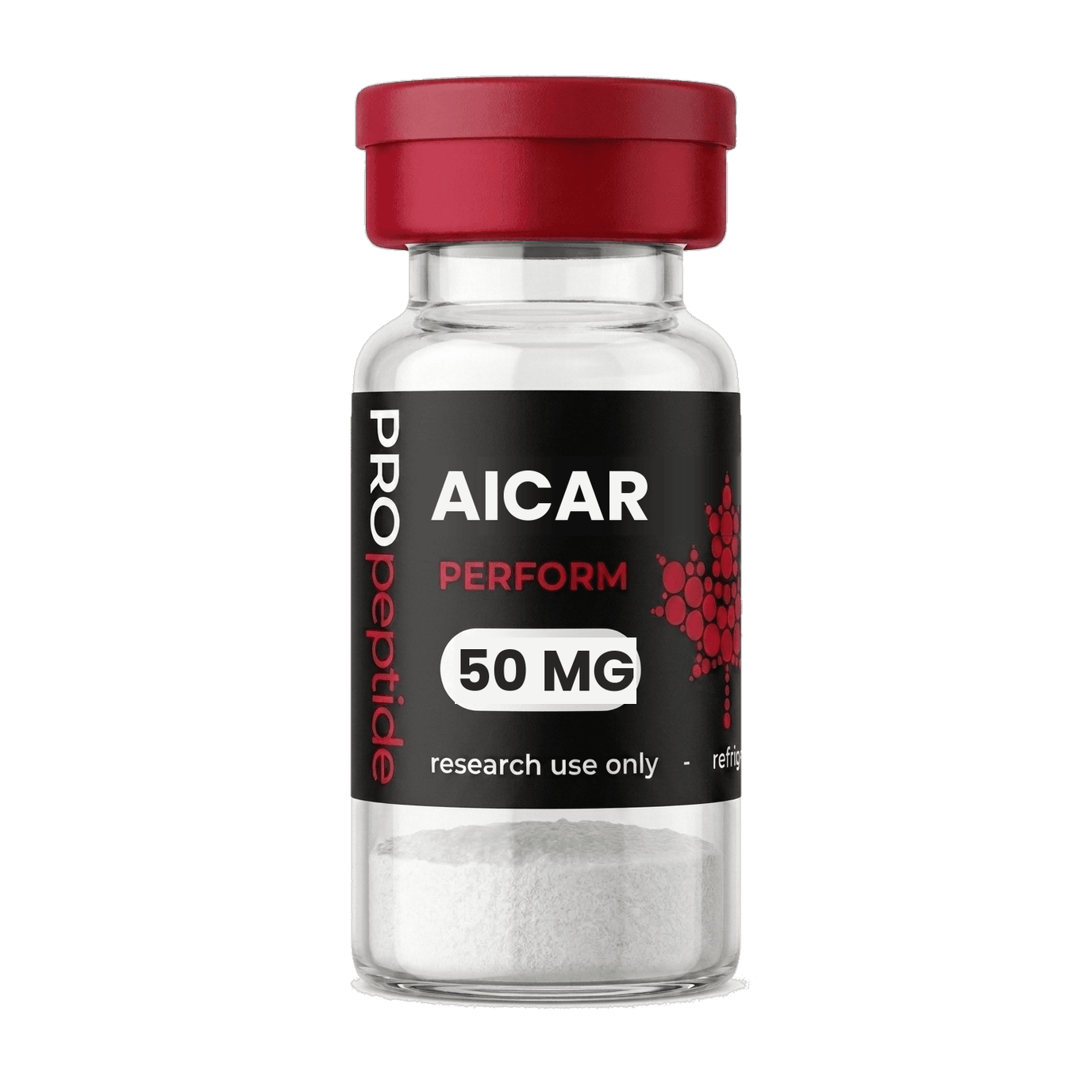
AICAR
A nucleoside analogue, not a peptide. Named on the WADA list by name, and the origin of the phrase exercise in a pill.
Choose your pack
For research use only. Not for human or veterinary use.
What AICAR is
The plain-language version, first.
Not a peptide. Not close to a peptide. Filed here anyway.
AICAR (5-aminoimidazole-4-carboxamide riboside, INN acadesine) is a nucleoside analogue with molecular formula C9H14N4O5, molecular weight 258.23 and CAS 2627-69-2. It is taken up by adenosine transporters and phosphorylated by adenosine kinase to ZMP, an AMP mimetic that binds site 3 on the gamma subunit of AMP-activated protein kinase; it contains no amino acids and no peptide bonds, and it has never been approved by any regulatory authority.
Quick housekeeping before anything else.
This is not a peptide. There are no amino acids in it and there are no peptide bonds. It is a nucleoside.
It ended up in the peptide aisle the way a golf cart ends up in a bike rack. Roughly the right shape, wrong category entirely, nobody wants to be the one to move it.
What it actually is: a molecule your cells convert into something called ZMP, and ZMP happens to look enough like AMP that the cell's energy sensor responds to it.
That sensor is AMPK, and AMPK is essentially the low-battery warning for a cell.
A compound that does not raise the alarm so much as convince the alarm it should be going off.
What AICAR is
Mechanism studied, not outcome promised.
The cell has a low-battery light. This is a molecule that leans on the sensor.
Your phone shows a battery icon. The icon isn't the battery. It's a readout of the battery.
Now imagine leaning on the readout rather than the battery, so the phone starts behaving like it's running low whether or not it is.
That's AICAR. It doesn't drain the cell. It talks to the gauge.
Mechanically, the conversion product ZMP mimics AMP closely enough that AMPK responds as though energy is scarce. AMPK is a genuinely central switch, which is why this compound shows up across an enormous spread of unrelated laboratory literature.
And that spread is the reason to be careful reading it. A switch that broad has consequences that are broad too.
Here's the honest part. This is cell biology, done properly, over decades, in dishes and rodents.
A switch being real is not the same as knowing what happens when you lean on it in a person. Those are separate questions and only one has been answered.
The research so far for AICAR
Where the evidence is thin, we say so.
Decades of clean laboratory work and a very short list of humans.
The laboratory file here is genuinely good, which makes the human gap more noticeable rather than less.
AICAR is a standard research tool. If you want AMPK activated in a dish, this is a thing people reach for and have reached for for a long time.
That is a real endorsement of the molecule as a reagent. It is not an endorsement of anything else.
The human side does not match. There is no controlled outcome trial in healthy adults for endurance, body composition or anything adjacent to why people search for it.
Worth knowing it is also prohibited in sport, and has been for a while, which tells you something about how it has been used regardless of what the file says.
A first-rate laboratory reagent with a reputation built somewhere the laboratory work never went.
Canadian stock, ships from BC. Research use only.
AICAR specs
The chemistry, exactly as released.
Who studies AICAR
Who tends to order this one, and why.
- 1
AMPK signalling researchers
AICAR is the standard pharmacological activator in this field, and understanding its limits matters as much as understanding its mechanism.
- 2
Metabolic enzymology labs
ZMP's promiscuity across AMP-dependent enzymes is a research question in its own right. If you study nucleotide sensing, that promiscuity is the point rather than the problem.
- 3
Anti-doping and analytical chemistry
AICAR is explicitly named on the WADA Prohibited List, so detection method development and endogenous baseline characterisation are active areas of work.
- 4
Purine metabolism researchers
AICAR ribotide accumulation defines AICA-ribosiduria, an inherited ATIC deficiency, and a trial in affected patients is currently recruiting.
Sold for laboratory research only. This is not guidance for personal use, and nothing here is a recommendation.
AICAR backstory
How it got here.
2008 is the year AICAR got famous and the reason it's still sold today.
Narkar's group at Salk published in Cell that four weeks of AICAR in sedentary mice increased running endurance by 44%. No treadmill. No wheel. No training. The paper was called AMPK and PPARdelta agonists are exercise mimetics, and the phrase 'exercise in a pill' went around the world before most people read the methods section.
What the coverage skipped: the compound wasn't new in 2008. Acadesine had been in cardiac surgery development for years already, on the theory that AMPK activation protects ischaemic myocardium.
That theory got its answer in 2012. RED-CABG randomised 3,080 patients out of a projected 7,500 before it was stopped for futility. Primary composite 5.1% versus 5.0%. Odds ratio 1.01. Newman published it in JAMA.
Then a myelodysplastic syndrome study opened in 2013 and terminated after five patients, with renal toxicity in the record.
Meanwhile the mouse paper kept getting cited on forums, and WADA put AICAR on the Prohibited List by name.
The strangest footnote is that AICAR accumulation defines an inherited human disease. AICA-ribosiduria, from ATIC deficiency, is counted in a handful of patients worldwide, and a trial in those patients is recruiting right now.
One mouse study built the market. Two human trials answered the question, and the market never noticed.
- 1
2008: 44% in untrained mice
Narkar and colleagues publish in Cell that four weeks of AICAR in sedentary mice with no training increased running endurance by 44%. The authors call the result unexpected. It becomes the origin of the exercise-in-a-pill phrase.
- 2
2012: RED-CABG stops for futility
Merck's phase 3 acadesine trial in coronary bypass surgery halts after 3,080 of a projected 7,500 patients. The primary composite is 5.1% versus 5.0% on placebo, odds ratio 1.01, published by Newman in JAMA.
- 3
2013: terminated at five patients
A phase 1-2 dose-escalation study in myelodysplastic syndromes (NCT01813838) is terminated with an actual enrolment of five. The recorded reason is renal toxicity.
Buying AICAR in Canada
What ships, how fast, and the paperwork.
This is not a peptide. AICAR is a nucleoside analogue of 258.23 daltons with no amino acids and no peptide bonds. It is stocked and shipped as a small molecule, and any vendor selling it as a peptide has the chemistry wrong.
Named on the WADA Prohibited List. Section S4.4.1 lists AICAR by name among AMPK activators. S4.4 substances are non-Specified, which carries a harsher default sanction. There is no ambiguity in this one's anti-doping status at all.
The human record is two stopped trials. RED-CABG stopped for futility at 3,080 patients with an odds ratio of 1.01. A myelodysplastic syndrome study terminated at five patients with renal toxicity recorded. Never approved by any regulator. Research use only.
Common questions
5 answers, none of them dodges.
Is AICAR a peptide?
No. AICAR is 5-aminoimidazole-4-carboxamide riboside, a nucleoside analogue with the formula C9H14N4O5 and a molecular weight of 258.23. It contains no amino acids and no peptide bonds. Its INN is acadesine and its CAS number is 2627-69-2. It gets shelved with peptides by vendors, which is a marketing habit rather than a chemical fact.
Where did the exercise in a pill claim come from?
One paper. Narkar and colleagues published in Cell in 2008 that four weeks of AICAR in sedentary mice, with no training at all, increased running endurance by 44%. The authors called the result unexpected. That single mouse experiment is the origin of essentially every AICAR performance claim, and it has never been replicated as a human endurance finding.
Has AICAR been tested in humans?
Yes, and the results were not good. RED-CABG was a phase 3 trial in coronary bypass surgery, stopped for futility after 3,080 of a projected 7,500 patients, with a primary composite of 5.1% versus 5.0% on placebo and an odds ratio of 1.01. A later myelodysplastic syndrome study terminated after five patients with renal toxicity recorded as the reason.
Is AICAR banned in sport?
Yes, by name. WADA section S4.4.1 covers activators of AMP-activated protein kinase and gives AICAR and MOTS-c as its examples. S4.4 substances are non-Specified, which carries a harsher default sanction than Specified categories. This is one of the few compounds in this catalogue with a completely unambiguous anti-doping status.
How does AICAR activate AMPK?
Indirectly. Adenosine transporters carry AICAR into the cell, then adenosine kinase phosphorylates it to ZMP. ZMP resembles AMP closely enough to bind site 3 on the AMPK gamma subunit, so the enzyme behaves as if cellular energy is low. AICAR itself doesn't bind AMPK; the phosphorylated metabolite does the work.
Good pairing options with AICAR
What researchers stack alongside it.
Pairing is where research gets ahead of itself. These are the compounds researchers put in the same order as AICAR, which is a statement about ordering habits, not about evidence. Two things in one cart have not been studied together unless somebody studied them together.
Your mitochondria carry their own tiny genome, and it turns out that genome writes peptides. This is the famous one. The FDA searched six databases in 2026 and found no human trial data at all.
A tetrapeptide that parks itself on cardiolipin, the lipid mitochondria keep for themselves. FDA approved it in September 2025 for Barth syndrome, on data from 12 patients, which is a story about rare-disease medicine.
It is water. We know. But it is the one bottle on this shelf where the boring ingredient is the entire product, and getting it wrong ruins everything else you bought.
Order AICAR right now
One last look before you decide.
Freeze-dried, ships cold from Canada
You've got the whole file now, the thin parts included. Nothing above pretended otherwise. If that's the kind of source you were after, AICAR is right here.
Not for human consumption. Not approved by Health Canada or any other regulatory body.
Page last updated October 4, 2026
People also search for AICAR
Related searches.