
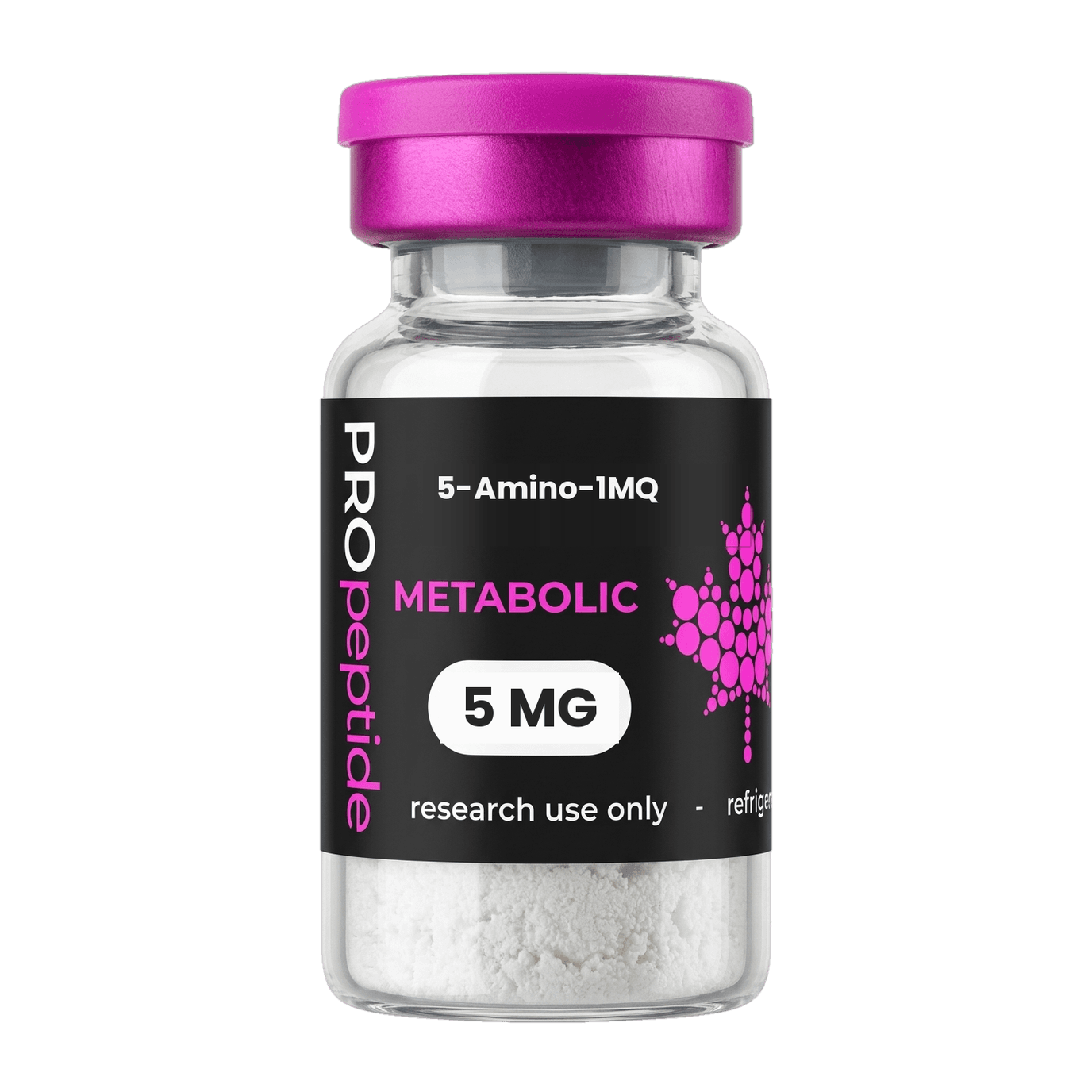
5-Amino-1MQ
The odd one out in a peptide catalogue. Twelve heavy atoms, no amino acids, and a design copied from the enzyme it blocks.
Choose your pack
For research use only. Not for human or veterinary use.
What 5-Amino-1MQ is
The plain-language version, first.
Also not a peptide. We are starting to see a pattern in this category.
5-Amino-1MQ is 5-amino-1-methylquinolinium, a small quinolinium salt with a permanent positive charge on one ring nitrogen, twelve heavy atoms and no amide bonds anywhere, supplied as the iodide at C10H11IN2 and 286.11 daltons, CAS 42464-96-0. It is an inhibitor of nicotinamide N-methyltransferase, and no human clinical trial of it, or of any other NNMT inhibitor, has ever been run.
Second entry in what is becoming an accidental series: things in the peptide aisle that are not peptides.
No amino acids. No peptide bonds. A cation mass of 159.21, which next to a 39-residue molecule is a rounding error.
It is a small molecule. It got shelved here because of who buys it, not because of what it is.
What it does have is a specific target, and the target is genuinely worth knowing about: an enzyme called NNMT.
NNMT sits in a metabolic pathway involving methyl groups, and interest in it comes from the enzyme's own biology rather than from anything this particular inhibitor has demonstrated.
A well-motivated target with a compound attached. Those are two separate quality judgements and people keep collapsing them into one.
What is 5-Amino-1MQ?
Mechanism studied, not outcome promised.
It blocks an enzyme most people have never heard of, and that enzyme is the interesting part.
Right, methyl groups. Stay with me, because this bit is actually neat.
Your cells move small chemical tags around constantly, and a methyl group is one of the most common. Attaching one changes what a molecule does, or where it goes, or how fast it gets cleared.
NNMT is an enzyme that attaches methyl groups to a specific target. Block the enzyme, and the traffic in that lane changes.
That is the entire logic and it is a reasonable one. It is the same logic behind a large amount of legitimate drug discovery.
What makes this compound specifically interesting to a laboratory is that it is a usable tool for asking what NNMT does when it is turned down.
Here's the honest part. Tool compound is a real and respectable category, and it is not the same category as a clinical candidate.
Being useful for asking a question is different from being an answer.
The research so far for 5-Amino-1MQ
Where the evidence is thin, we say so.
Good target biology. Thin compound biology. Do not confuse the two.
The target literature and the compound literature are two different sizes and it matters which one somebody is quoting at you.
NNMT itself has a real and growing body of work. Metabolic researchers find it genuinely interesting and that interest is not manufactured.
This inhibitor has considerably less behind it, and almost all of it is preclinical.
That gap is where most of the confident writing about this compound lives. Somebody reads an enthusiastic paper about the enzyme and attributes the enthusiasm to the molecule.
No human trials. Nothing approved. A target worth watching and a compound that has not yet earned the attention its target is getting.
Interesting enzyme. Unfinished molecule. Both true, and the second one is what is in the vial.
Stock and vial sizes are listed just below.
5-Amino-1MQ specs
The chemistry, exactly as released.
Who studies 5-Amino-1MQ
Who tends to order this one, and why.
- 1
NAD+ metabolism
The cleanest available contrast with NMN and NR. Same endpoint, opposite end of the pathway, and one additional consequence in SAM that the substrate approach does not touch.
- 2
Methyltransferase pharmacology
A selectivity panel across DNMT1, PRMT3, COMT, NAMPT and SIRT1 makes it a useful reference point for what a selective methyltransferase inhibitor looks like.
- 3
Adipocyte biology
Most of the mechanistic work was done in differentiated 3T3-L1 adipocytes, measuring 1-methylnicotinamide, NAD+, SAM and lipogenesis directly.
- 4
Small molecules in a peptide market
A case study in how distribution channel rather than chemistry determines what gets marketed together.
Sold for laboratory research only. This is not guidance for personal use, and nothing here is a recommendation.
5-Amino-1MQ backstory
How it got here.
The molecule is a copy of the enzyme’s own product, and that is not a coincidence.
Quinoline is an NNMT substrate. The enzyme methylates it into 1-methylquinolinium, and 1-methylquinolinium is fluorescent. In 2017 Watowich’s lab at UTMB Galveston built the first real-time fluorescent NNMT assay around exactly that fact, reading out the quinolinium directly. Having spent months watching the product accumulate, they turned it into the starting point for an inhibitor series, and the chemistry moved to Stanton McHardy’s group at UT San Antonio.
The SAR paper landed in the Journal of Medicinal Chemistry in June 2017, where the compound is a numbered entry in a table rather than a named product. The name 5-amino-1MQ enters the literature later that year in Biochemical Pharmacology, where it stops being one row in a table and becomes the lead compound.
There is a neat symmetry underneath all of this. NNMT is inhibited by its own product: 1-methylnicotinamide has a measured IC50 of 9.0 micromolar against the enzyme that makes it.
- 1
The assay came before the drug
NNMT methylates quinoline into a fluorescent product. The Galveston lab built its enzyme assay around detecting that product, then turned the product into the inhibitor.
- 2
Two Texas campuses
Biology at UT Medical Branch in Galveston under Stephan Watowich, chemistry at UT San Antonio under Stanton McHardy. The patent belongs to the UT System.
- 3
Not Scripps
Scripps Research does appear in NNMT inhibitor history, in La Jolla and on a covalent chemotype, but that work is separate and its conclusions were cautionary. This compound is not theirs.
Buying 5-Amino-1MQ in Canada
What ships, how fast, and the paperwork.
Two different masses, both correct. The cation is 159.21 and the iodide salt is 286.11. Roughly 55.6 percent of the solid mass is the cation. The original mouse work dose-corrected for this explicitly, so any figure quoted without stating which mass it refers to is ambiguous.
Not a peptide, and not a supplement. It is a synthetic quaternary quinolinium salt, so it does not meet the statutory definition of a dietary ingredient, and no new dietary ingredient notification was found for it. It has no DIN or NPN in Canada.
Store cool, dry and dark. A crystalline salt rather than a lyophilised peptide, but the same handling logic applies. Treat as a laboratory reagent.
Common questions
5 answers, none of them dodges.
Is 5-Amino-1MQ a peptide?
No. It is a synthetic quaternary quinolinium salt: a single fused bicyclic aromatic ring with a permanently charged nitrogen, twelve heavy atoms, no amide bonds and no amino acid residues. Peptides are amino acids joined by amide bonds. It is sold alongside peptides because it shares a distribution channel and a customer, not because of any structural or pharmacological relationship.
How is it different from NMN or NR?
All three can raise NAD+, but from opposite ends of the pathway. NMN and NR are substrates that feed into the salvage pathway from the front. 5-Amino-1MQ is an inhibitor that blocks the exit, stopping NNMT from methylating nicotinamide into a form the body excretes. There is also a consequence with no NMN or NR equivalent: every NNMT reaction consumes a molecule of SAM, so blocking the enzyme spares the cell’s methyl donor pool. No published study compares them head to head in any species.
Are there human clinical trials?
None. Searches of ClinicalTrials.gov for 5-amino-1MQ, 5-amino-1-methylquinolinium, methylquinolinium and NNMT inhibitor return zero interventional studies. No NNMT inhibitor of any chemotype has reached human trials. A 2026 review in Trends in Pharmacological Sciences describes clinical translation for the class as an emerging prospect rather than an achieved one. There is no published human pharmacokinetic, safety or dose-finding data.
Where did it come from?
The University of Texas. Stephan Watowich’s lab at UT Medical Branch in Galveston built a fluorescent NNMT assay in early 2017 based on the enzyme methylating quinoline into fluorescent 1-methylquinolinium. Stanton McHardy’s chemistry group at UT San Antonio then developed a quinolinium inhibitor series from that scaffold, published in the Journal of Medicinal Chemistry in June 2017. The patent is held by the UT System.
How potent is it?
IC50 of 1.2 micromolar against recombinant human NNMT, and a cellular EC50 of 2.3 micromolar measured in differentiated adipocytes. For context, bisubstrate NNMT inhibitors published since are orders of magnitude more potent. No Ki has been published, so any quoted Ki value is unsourced.
Good pairing options with 5-Amino-1MQ
What researchers stack alongside it.
Pairing is where research gets ahead of itself. These are the compounds researchers put in the same order as 5-Amino-1MQ, which is a statement about ordering habits, not about evidence. Two things in one cart have not been studied together unless somebody studied them together.
Your mitochondria carry their own tiny genome, and it turns out that genome writes peptides. This is the famous one. The FDA searched six databases in 2026 and found no human trial data at all.
A tetrapeptide that parks itself on cardiolipin, the lipid mitochondria keep for themselves. FDA approved it in September 2025 for Barth syndrome, on data from 12 patients, which is a story about rare-disease medicine.
It is water. We know. But it is the one bottle on this shelf where the boring ingredient is the entire product, and getting it wrong ruins everything else you bought.
Order 5-Amino-1MQ right now
One last look before you decide.
Freeze-dried, ships cold from Canada
You've got the whole file now, the thin parts included. Nothing above pretended otherwise. If that's the kind of source you were after, 5-Amino-1MQ is right here.
Not for human consumption. Not approved by Health Canada or any other regulatory body.
Page last updated October 4, 2026
People also search for 5-Amino-1MQ
Related searches.