
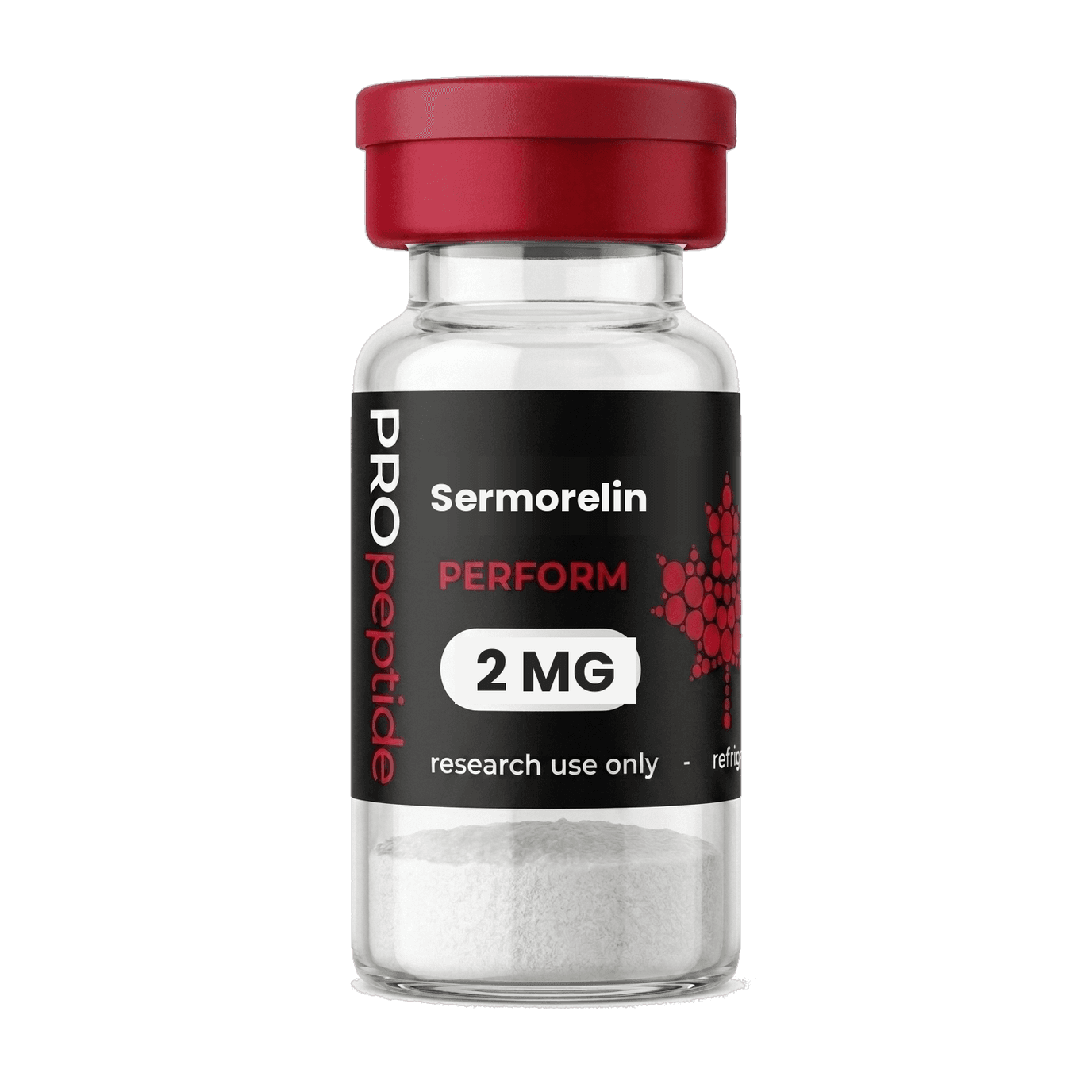
Sermorelin Peptide
The first twenty-nine amino acids of GHRH. The other fifteen turned out to be optional.
Choose your pack
For research use only. Not for human or veterinary use.
What Sermorelin is
The plain-language version, first.
Forty-four residues in the natural hormone. Twenty-nine that matter.
Sermorelin is the 1-29 fragment of growth hormone releasing hormone with a C-terminal amide, sequence YADAIFTNSYRKVLGQLSARKLLQDIMSR-NH2, molecular formula C149H246N44O42S, average mass 3,357.9, CAS 86168-78-7. It is an unmodified fragment rather than an analogue, acts at the GHRH receptor, a class B secretin-family GPCR, and is cleaved rapidly by dipeptidyl peptidase-4 at the Ala2 to Asp3 bond. Approved by the FDA in 1990 and again in 1997 as Geref, it was withdrawn in 2009 for commercial reasons.
There's an old engineering habit where you remove parts from a machine until it breaks, and the last part you removed was apparently load-bearing.
Somebody did that to a hormone.
GHRH is forty-four residues. Sermorelin is the first twenty-nine, and it turns out that is the whole working end.
The other fifteen residues do roughly nothing at the receptor. Nature is not efficient, it is just first.
So what you have here is the minimum viable GHRH, the shortest fragment that still does the parent hormone's job properly.
A molecule defined by everything it proved it did not need.
What sermorelin peptide does at the GHRH receptor
Mechanism studied, not outcome promised.
Somebody kept trimming until it stopped working, then went back one step.
Same deal as the parent hormone, because that is the entire point of a faithful fragment.
It binds the GHRH receptor on the pituitary and asks for growth hormone release. Asks, not orders.
The pituitary still decides. The feedback loops stay wired in. That is what upstream signalling means.
This is the distinction between nudging a system and overriding it, and it is why this family of compounds gets discussed differently from synthetic GH itself.
And like its parent, it is fragile. DPP-4 cuts it apart in minutes, which is the trade you make for keeping the natural sequence.
Here's the honest part. A short half-life is not a flaw somebody forgot to fix.
The natural signal is a pulse, not a drip. A molecule that clears fast mimics the pulse. Whether that matters for any given research question is exactly the kind of thing the research is for.
The research so far for Sermorelin
Where the evidence is thin, we say so.
Two real approvals in its past, both surrendered, neither for the reason forums think.
This one has a genuinely strange regulatory arc and it is worth telling straight.
FDA approved it in the nineties, first as a diagnostic, then in September 1997 for a paediatric indication.
Real approvals. Full programme. And then the product left the market in 2008 anyway.
It left for commercial and manufacturing reasons, not because a safety problem surfaced or an approval was pulled for cause. Drugs exit for boring reasons more often than anybody assumes.
What does not exist: a modern randomised trial in adults for the purposes people actually search this compound for.
An honest past as a medicine, a commercial death unrelated to the science, and a present-day reputation built on questions the trials never asked.
GHRH 1-29, unmodified. Canadian stock, ships from BC.
Sermorelin specs
The chemistry, exactly as released.
Who studies Sermorelin
Who tends to order this one, and why.
- 1
GHRH receptor pharmacology
The least modified GHRH agonist available, which makes it the natural reference point when you want to see what the receptor does without a half-life extension confounding it.
- 2
Pulsatility research
Because it amplifies rather than overrides, it is the compound of choice for studying how the endogenous GH pulse behaves under stimulation.
- 3
Regulatory history
One of very few compounds here with a complete public FDA record: two approvals, two withdrawal letters, and an explicit determination that safety was not the reason.
- 4
Comparative secretagogue work
Side by side with a GHRP it separates GHRH-receptor effects from ghrelin-receptor effects cleanly, since the two pathways are independent and synergistic.
Sold for laboratory research only. This is not guidance for personal use, and nothing here is a recommendation.
Sermorelin backstory
How it got here.
The order these molecules were discovered in is backwards from what you would guess.
Cyril Bowers found the growth hormone releasing peptides in 1976. GHRH itself, the natural hormone, was not isolated until 1982. So the synthetic imitations came first, by six years, and their discoverer spent a while assuming they had to be analogues of some natural GHRH nobody had found yet. He was half right. They turned out to be mimicking a completely different hormone, ghrelin, which took until 1999 to isolate out of stomach tissue.
And GHRH was not pulled out of a hypothalamus. It was isolated from pancreatic tumours in patients with acromegaly, which is why you still see it called GRF, growth hormone releasing factor, in older papers. The tumours were making so much of it that they were easier to purify from than the brain.
Once they had the 44-residue sequence, somebody started truncating. Twenty-nine residues in, it still worked. That is the molecule in this vial.
- 1
Approved twice, for two different jobs
Geref cleared FDA in December 1990 as a pituitary-function diagnostic, then again in September 1997 as a paediatric growth treatment. Same molecule, separate applications.
- 2
Withdrawn for business reasons
FDA put it in writing that both products were not withdrawn for reasons of safety or effectiveness. EMD Serono discontinued them and FDA formally withdrew approval in June 2009.
- 3
A third of GHRH is decoration
The natural hormone is 44 residues. The first 29 carry full activity. That is why the drug is a fragment and not the hormone.
Buying Sermorelin in Canada
What ships, how fast, and the paperwork.
Not the same as CJC-1295. CJC-1295 is this backbone with four substitutions and, in the DAC version, a maleimide that locks onto albumin. Sermorelin is the plain fragment. The multi-day half-life figures in circulation belong to CJC-1295 with DAC, not to this.
No authorised product in Canada. Sermorelin returns nothing in the Health Canada drug database. The approved GHRH analogue here is tesamorelin, under DINs 02423677 and 02438712.
Keep it cold and dark. Lyophilised peptides hold best refrigerated and away from light. Handle as a laboratory reagent.
Common questions
5 answers, none of them dodges.
What is sermorelin?
A 29-amino-acid peptide matching residues 1 to 29 of growth hormone releasing hormone, with a C-terminal amide. It is the shortest fragment of GHRH that retains full activity at the GHRH receptor, which is why it became a drug while the full 44-residue hormone did not.
Was it ever an approved medicine?
Twice. FDA approved Geref in December 1990 as a diagnostic for pituitary growth hormone secretion, and again in September 1997 for idiopathic growth hormone deficiency in children with growth failure. EMD Serono discontinued both, and FDA withdrew the approvals effective June 2009. FDA stated explicitly that they were not withdrawn for reasons of safety or effectiveness.
How is it different from GHRP-2, GHRP-6 or MK-677?
Different receptor entirely. Sermorelin works on the GHRH receptor and amplifies the pulse your pituitary is already generating. The GHRPs and MK-677 work on GHS-R1a, the ghrelin receptor, which sits in tissues beyond the somatotroph and therefore also moves cortisol, prolactin and appetite. The two pathways are independent, which is why combining them is synergistic rather than additive.
What human evidence exists?
Mostly paediatric and mostly from the 1990s. The strongest is a 1996 multicentre study of 110 prepubertal children with growth hormone deficiency, where height velocity went from 4.1 centimetres per year to 8.0 at six months. There is no modern randomised trial in adults for body composition or recovery, and one elderly trial stopped after five participants.
Why does it not last long?
DPP-4 cleaves GHRH between alanine 2 and aspartate 3, and sermorelin has no protection at that bond. Native GHRH clears in minutes for the same reason. Every longer-acting relative in this family, including tesamorelin and CJC-1295, carries a modification aimed specifically at that site.
Sermorelin Peptide vs CJC-1295 no DAC
Stacked together constantly, compared almost never.
Same twenty-nine residues at heart, one generation of chemistry apart.
Sermorelin is GHRH 1-29 unmodified: the natural working fragment, with the natural fragility. DPP-4 takes it apart in minutes.
Modified GRF 1-29 is the same fragment wearing four substitutions, each blocking a cleavage point, trading fidelity for durability.
One is the natural sentence and one is the same sentence laminated. Which you want depends entirely on whether your question needs the natural clearance or resents it. CJC-1295 no DAC has its own page here
Good pairing options with Sermorelin
What researchers stack alongside it.
Pairing is where research gets ahead of itself. These are the compounds researchers put in the same order as Sermorelin Peptide, which is a statement about ordering habits, not about evidence. Two things in one cart have not been studied together unless somebody studied them together.
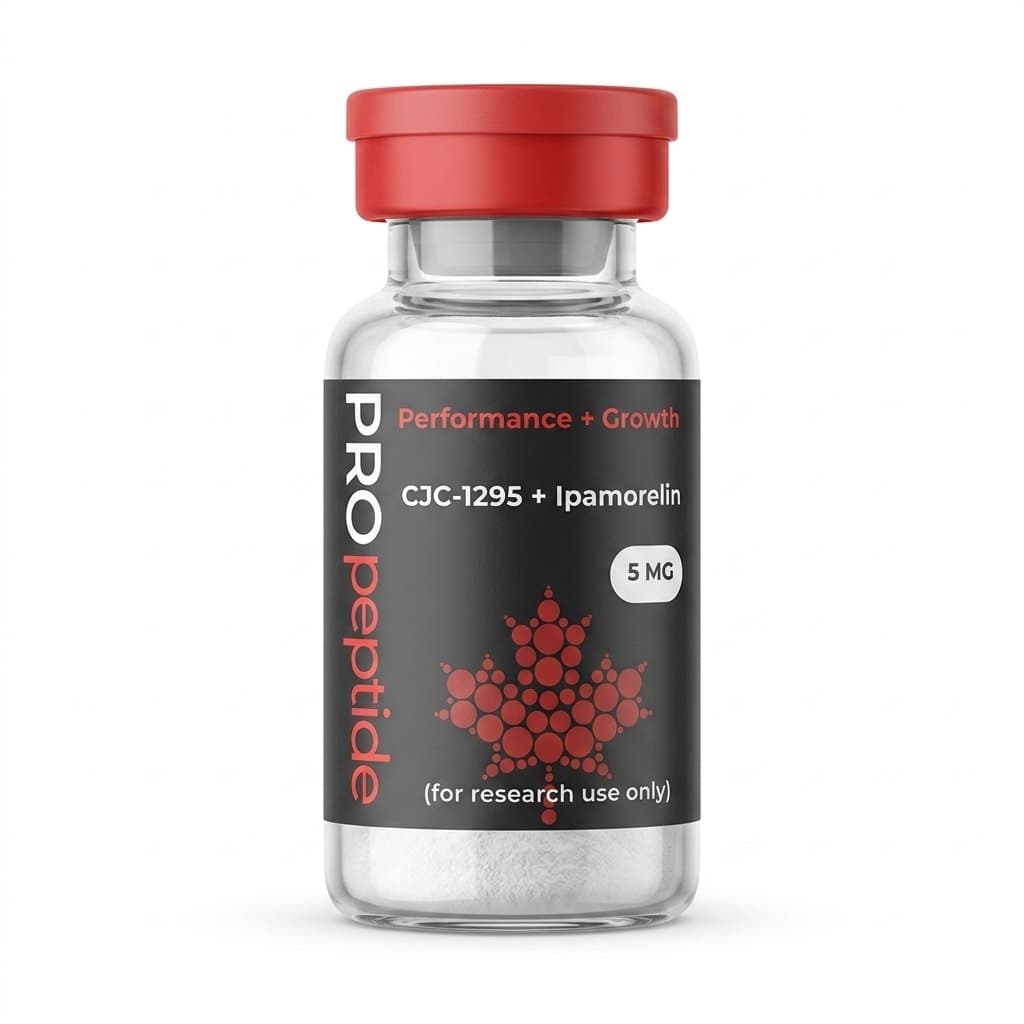
Two different levers on the same pituitary axis, supplied in one blend. The rationale is real physiology. The pairing itself has never been studied, and those are different facts.
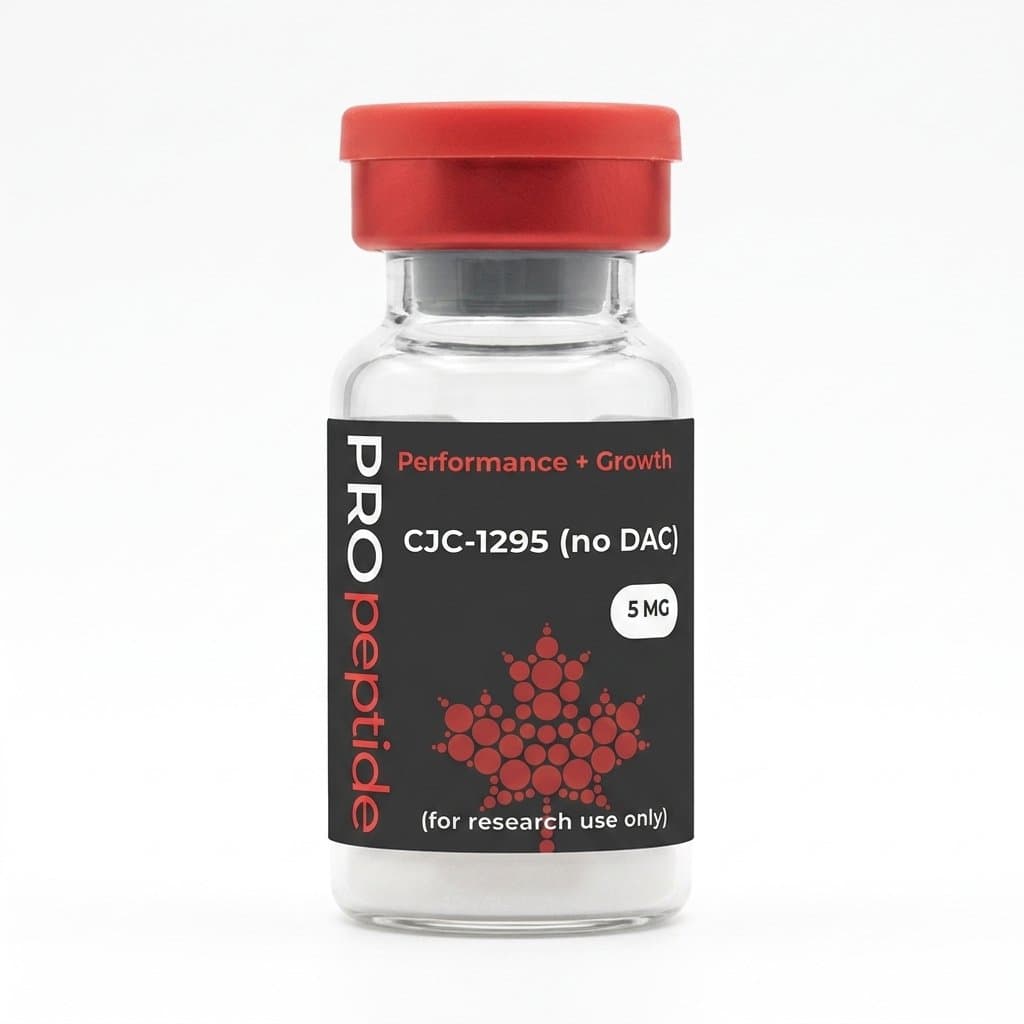
Modified GRF 1-29: the same stabilised GHRH analogue without the albumin anchor. It clears in minutes instead of days, and that difference is the entire product.
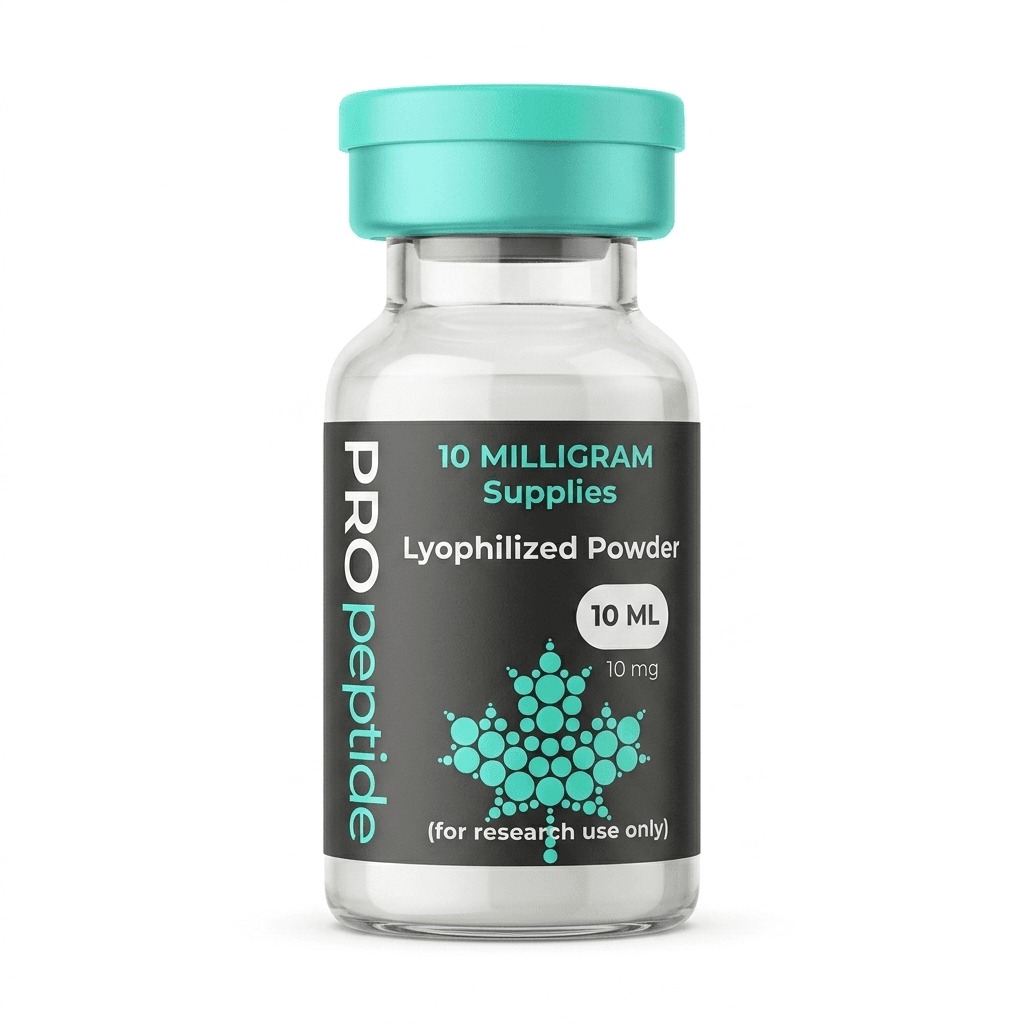
It is water. We know. But it is the one bottle on this shelf where the boring ingredient is the entire product, and getting it wrong ruins everything else you bought.
Order Sermorelin right now
One last look before you decide.
Freeze-dried, ships cold from Canada
You've got the whole file now, the thin parts included. Nothing above pretended otherwise. If that's the kind of source you were after, Sermorelin is right here.
Not for human consumption. Not approved by Health Canada or any other regulatory body.
Page last updated October 4, 2026
People also search for Sermorelin
Related searches.