
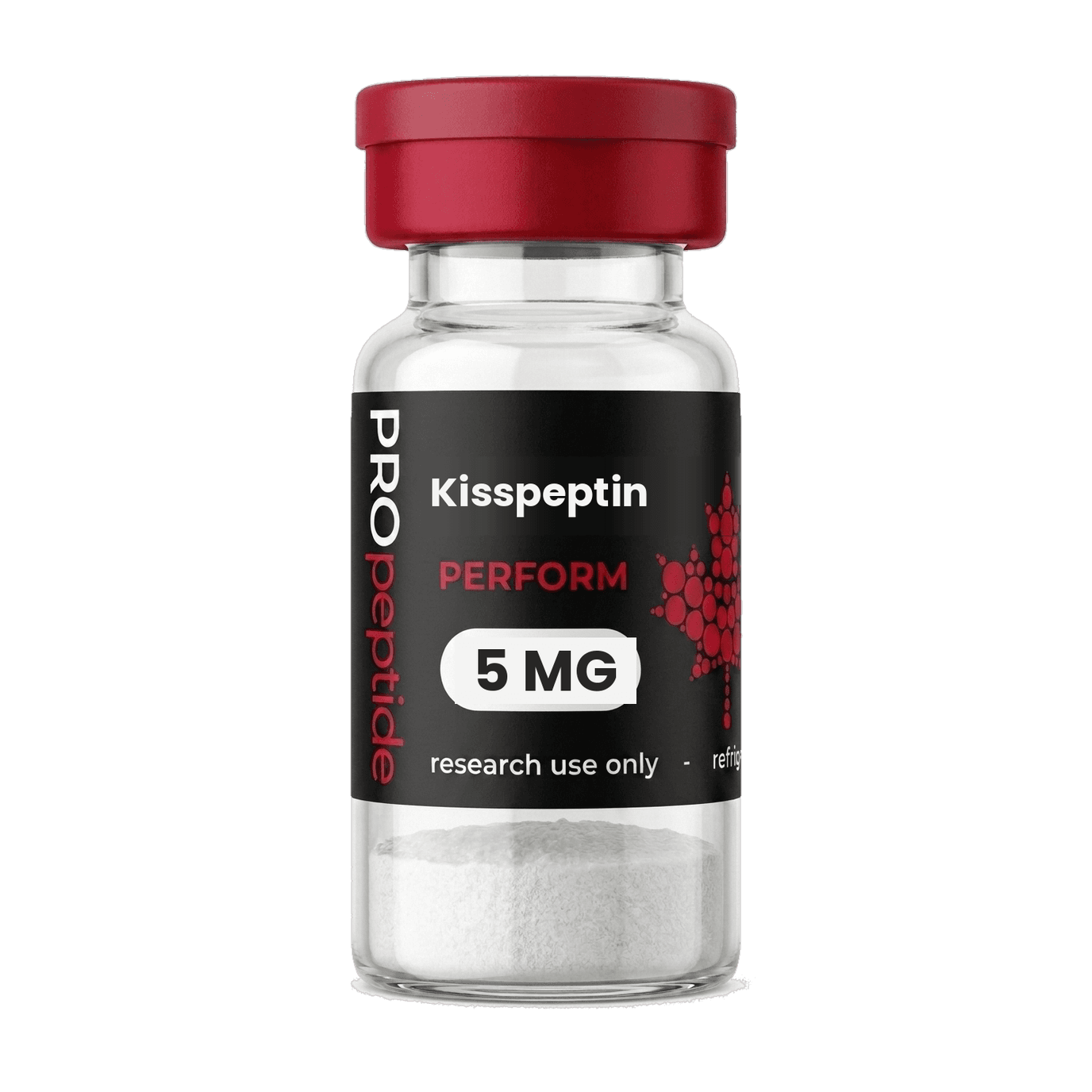
Kisspeptin Peptide
Named by name on the WADA prohibited list, which almost no vendor mentions.
Choose your pack
For research use only. Not for human or veterinary use.
What Kisspeptin is
The plain-language version, first.
Named after chocolate, in charge of puberty. Science is like this sometimes.
Kisspeptin, supplied as kisspeptin-10 or KP-10, is a ten-amino-acid C-terminal fragment of the 138-residue KISS1 precursor protein, residues 112 to 121 of UniProt entry Q15726, with molecular formula C63H83N17O14 and molar mass 1302.4. It is the minimal sequence retaining full activity at the KISS1R receptor, also called GPR54, it is approved nowhere, and it is named explicitly on the WADA 2026 Prohibited List at section S2.2.1 as a testosterone-stimulating peptide prohibited at all times in males.
The name first, because everybody asks.
The gene was discovered in Hershey, Pennsylvania, and the discoverers named it KISS1 after the local product. The peptide it encodes became kisspeptin. That is genuinely the whole story.
What the molecule does is considerably less whimsical: it sits at the top of the reproductive hormone axis and turns the whole thing on.
Before its discovery, GnRH was thought to be the top of that chain of command. Kisspeptin turned out to be the thing that commands GnRH.
Its discovery explained decades-old puzzles about puberty timing in one stroke, which is why endocrinologists treat it with real respect.
A chocolate joke of a name on one of the most important signals in human development.
What is kisspeptin?
Mechanism studied, not outcome promised.
The switch above the switch everybody thought was the top.
Command structures matter, so here is this one from the top.
Kisspeptin neurons signal to GnRH neurons. GnRH tells the pituitary.
The pituitary tells the gonads. Everything downstream, testosterone, estrogen, fertility, runs on that relay.
Kisspeptin is the first domino. Nothing upstream of it has been found doing this job.
The research fascination is obvious: a master input to a whole axis. Academic groups have run genuine human studies using it to probe reproductive physiology, fertility timing and hormone dynamics.
Here's the honest part, and it is a structural one about master switches.
The top of a cascade is the most interesting place to study and the trickiest place to intervene, because everything below it moves at once. The axis also adapts to sustained pushing, which is the recurring lesson of this entire hormonal shelf.
The research so far for Kisspeptin
Where the evidence is thin, we say so.
Twenty years of serious academic work, zero commercial finish line.
The file is unusual: twenty years of real academic human studies and no commercial destination.
University groups, particularly in the UK, have run kisspeptin infusion studies in humans since the 2000s, published in serious journals, aimed at physiology rather than products.
Real human data exists here. It is aimed at understanding the axis, not at any outcome a buyer is imagining.
No approval anywhere. And a specific compliance note: it is explicitly prohibited in sport for male athletes, named in the anti-doping S2 hormone class.
A genuinely important molecule with an honest academic file and nothing at the end of it to sell. Which, on this shelf, counts as one of the cleaner stories.
Kisspeptin vial sizes and current stock are just below.
Kisspeptin specs
The chemistry, exactly as released.
Who studies Kisspeptin
Who tends to order this one, and why.
- 1
Reproductive endocrinology
IVF trigger research, where kisspeptin offers a more physiological LH surge than HCG and appears to lower ovarian hyperstimulation risk.
- 2
Hypothalamic disorders
Hypothalamic amenorrhoea, hypogonadotropic hypogonadism and delayed puberty, where active phase 2 trials are still recruiting.
- 3
Metabolic research
One study found enhanced glucose-stimulated insulin secretion in fifteen healthy men, while explicitly finding no effect on appetite or food intake.
- 4
Anti-doping laboratories
Kisspeptin is a named prohibited substance for male athletes under section S2.2.1, not merely captured by a general clause.
Sold for laboratory research only. This is not guidance for personal use, and nothing here is a recommendation.
Kisspeptin backstory
How it got here.
KISS1 was first identified as a metastasis suppressor gene, which is where the name comes from and why the peptide is sometimes called metastin. Its role in reproduction was discovered later and by a different route.
In the early 2000s, groups studying families with hypogonadotropic hypogonadism found loss of function mutations in GPR54. That placed the receptor, and therefore its ligand, at the top of the reproductive axis, which nobody had expected from a gene named for cancer biology.
The clinical programme that followed has been led largely from Imperial College London, with the fertility application as its focus, because triggering ovulation higher up the axis than HCG does offers a route to fewer complications.
It is one of the more genuinely interesting stories in endocrinology of the last twenty years, and it has still not produced a licensed product.
- 1
Named for cancer, not reproduction
KISS1 was identified as a metastasis suppressor gene, which is why the peptide is also called metastin.
- 2
Found at the top of the axis
Families with hypogonadotropic hypogonadism turned out to carry loss of function mutations in GPR54, placing the receptor and its ligand above GnRH.
- 3
Twenty years, no product
A serious programme at Imperial College London and Massachusetts General, thirty-six registered trials, and still no approval anywhere.
Buying Kisspeptin in Canada
What ships, how fast, and the paperwork.
Named on the WADA list. Section S2.2.1 of the 2026 Prohibited List names kisspeptin and its agonist analogues explicitly, under testosterone-stimulating peptides in males. Prohibited at all times, non-specified, which carries a heavier default sanction. If you are tested, this is not a grey area.
Check which molecule a study used. Most of the large human programme ran on kisspeptin-54, not KP-10. The KP-10 human studies are small physiology work with four to fifteen participants. Those are different molecules and the evidence does not transfer automatically.
Same day out of British Columbia. Our building, our cold packs, our people, and nothing sitting in a customs queue while you refresh a tracking page.
Common questions
5 answers, none of them dodges.
Is kisspeptin banned in sport?
Yes, and by name. The WADA 2026 Prohibited List names kisspeptin and its agonist analogues in section S2.2.1, under testosterone-stimulating peptides in males, in the same bullet list as chorionic gonadotrophin and gonadorelin. Prohibited at all times, in and out of competition, and classed as non-specified, which removes the reduced-sanction pathway available for specified substances.
Is kisspeptin approved anywhere?
No. There is no marketing authorisation in any jurisdiction for any indication. Health Canada Drug Product Database returns no records for it and there is no FDA application. Twenty-one years after the first human administration in 2005, it remains investigational.
What is the difference between kisspeptin-10 and kisspeptin-54?
Length and evidence base. Both are cleavage products of the same KISS1 precursor. KP-10 is residues 112 to 121, the minimal sequence retaining full activity at the receptor. Kisspeptin-54 is residues 68 to 121. The substantial human trial programme, including the IVF trigger studies with 53 and 60 participants, largely used kisspeptin-54. KP-10 human data consists of much smaller physiology studies.
Does kisspeptin affect appetite or weight?
No. A study in fifteen healthy men found kisspeptin enhanced glucose-stimulated insulin secretion but explicitly did not alter gut hormones, appetite or food intake. If it is being marketed to you as a metabolic or weight compound, that claim is contradicted by the study that looked for exactly that effect.
Why is kisspeptin interesting for fertility?
Because it acts higher up the axis than the standard trigger. IVF conventionally uses HCG to trigger final oocyte maturation, acting at the LH receptor, which carries a risk of ovarian hyperstimulation syndrome. Kisspeptin acts above GnRH and produces a more physiological LH surge, which the Imperial College trials were testing as a lower-risk alternative in women at high risk of that complication.
Kisspeptin Peptide vs Gonadorelin
Stacked together constantly, compared almost never.
These two are adjacent rungs on the same ladder, and which rung you are studying is the entire choice.
Kisspeptin sits at the top. It is the signal that commands the GnRH neurons, discovered decades after everyone assumed the ladder was fully mapped.
Gonadorelin is the next rung down: GnRH itself, the ten-residue pulse the pituitary listens for, Nobel citation attached.
Studying kisspeptin asks how the axis is commanded. Studying GnRH asks how the command is delivered. Same ladder, one rung apart, and the rhythm rules apply to both. Gonadorelin has its own page here
Good pairing options with Kisspeptin
What researchers stack alongside it.
Pairing is where research gets ahead of itself. These are the compounds researchers put in the same order as Kisspeptin Peptide, which is a statement about ordering habits, not about evidence. Two things in one cart have not been studied together unless somebody studied them together.
In 1950s Rome one clinician made a claim about this hormone that the evidence never supported. Seventy years later the claim is still in circulation and still unsupported.
Not a molecule. FSH and LH activity extracted from postmenopausal urine and standardised in international units. Still marketed in Canada in 2026, which makes it the rare extract with live approvals.
It is water. We know. But it is the one bottle on this shelf where the boring ingredient is the entire product, and getting it wrong ruins everything else you bought.
Order Kisspeptin right now
One last look before you decide.
Freeze-dried, ships cold from Canada
You've got the whole file now, the thin parts included. Nothing above pretended otherwise. If that's the kind of source you were after, Kisspeptin is right here.
Not for human consumption. Not approved by Health Canada or any other regulatory body.
Page last updated October 4, 2026
People also search for Kisspeptin
Related searches.