
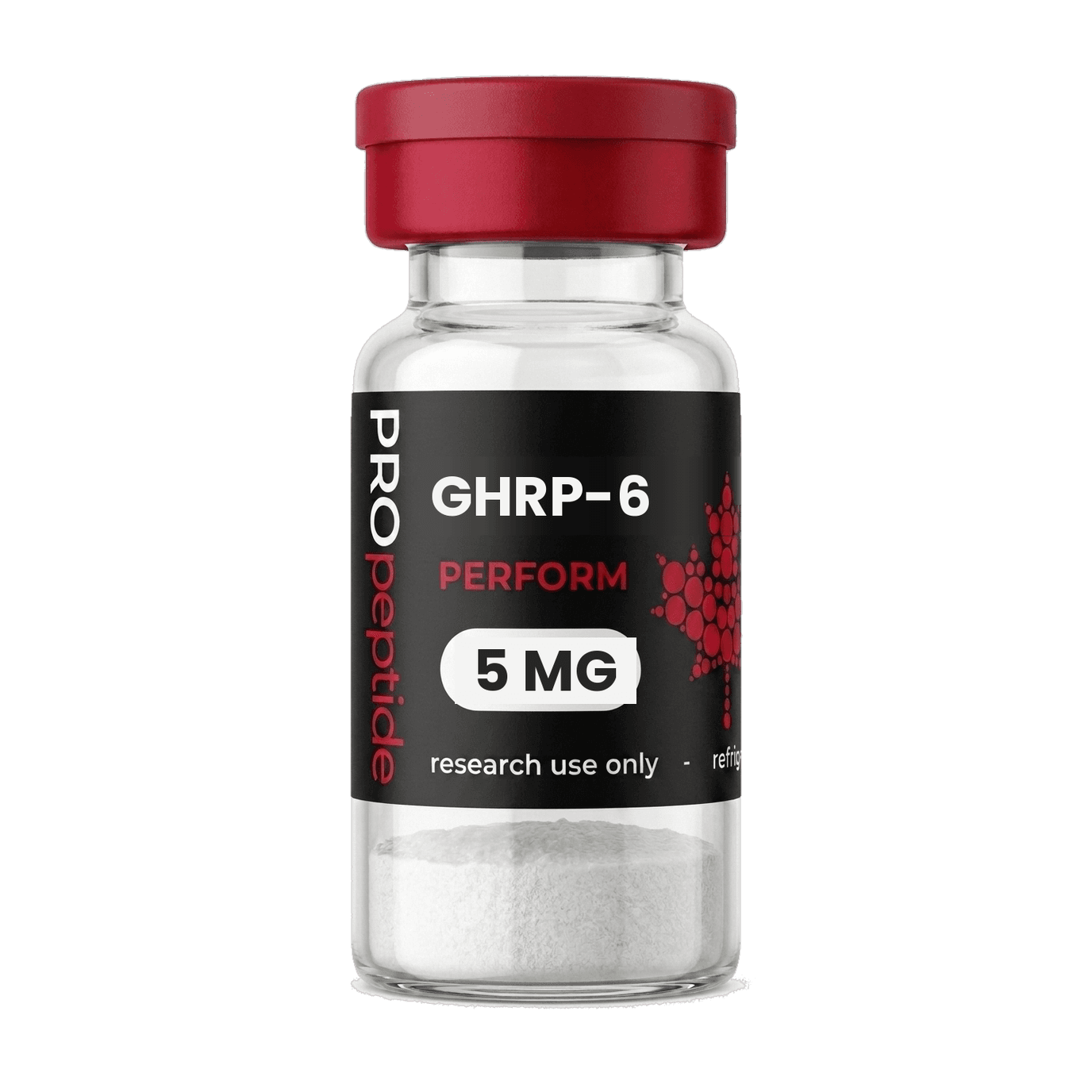
GHRP-6 Peptide
The first one. Every other growth hormone releasing peptide is an edit of these six amino acids.
Choose your pack
For research use only. Not for human or veterinary use.
What GHRP-6 is
The plain-language version, first.
The original synthetic key that found a lock nobody knew existed.
GHRP-6 is a synthetic hexapeptide growth hormone secretagogue, sequence His-D-Trp-Ala-Trp-D-Phe-Lys-NH2, CAS 87616-84-0, and the first of the growth hormone releasing peptides. It acts as an agonist at GHS-R1a, the ghrelin receptor, and has never been approved as a medicine in any jurisdiction.
This is one of the best backwards stories in pharmacology, and it starts in 1976.
Researchers built synthetic peptides looking for growth hormone release, and one of them worked. It also made subjects noticeably hungry, and nobody could say why.
The molecule was a key that fit a lock no one had found yet. The lock took twenty more years.
In the nineties, the receptor it was hitting got identified, and then the receptor's natural key was discovered and named ghrelin.
So the synthetic came first, the receptor second, the natural hormone last. Science ran the whole thing in reverse order.
GHRP-6 is the key that proved the lock existed. That is its actual place in history, and it is a real one.
What GHRP-6 peptide actually is
Mechanism studied, not outcome promised.
It worked a receptor two decades before the receptor's natural owner was discovered.
Same door as GHRP-2, because they are siblings. The ghrelin receptor, not the GHRH receptor.
Press it and a pituitary releases growth hormone. Press it and appetite signalling moves too, famously so.
The hunger is not a side effect in the sloppy sense. It is the receptor doing its other job, the one it was named for.
That is the recurring lesson of this whole family: the ghrelin door was never wired to one thing. Any key that opens it gets everything behind it.
GHRP-6 is the least selective of the family, the original from which the more polished siblings were refined.
Here's the honest part. First is not best. First is first.
The refinements exist because this molecule's rough edges were the to-do list.
The research so far for GHRP-6
Where the evidence is thin, we say so.
Its greatest contribution is the discovery it caused, not the effects it has.
The file splits into a historic contribution and a modern absence, and the gap between them is wide.
The contribution is real. This molecule is genuinely part of how ghrelin was discovered, and that thread runs through foundational papers of the field.
The modern file is thin where it counts: no controlled outcome trial for body composition, injury or ageing, and no long-term human safety data.
Nothing approved anywhere, unlike its sibling GHRP-2's narrow Japanese certificate.
Prohibited in sport.
A molecule that helped write a chapter of endocrinology and then never got a chapter of its own. Respect the history. Do not mistake it for evidence.
GHRP-6, the original hexapeptide. Canadian stock, shipping from BC.
GHRP-6 specs
The chemistry, exactly as released.
Who studies GHRP-6
Who tends to order this one, and why.
- 1
Anyone mapping the GHRP family tree
GHRP-2, hexarelin and MK-677 are all structural or conceptual descendants of this molecule. If you want a baseline for the family, this is the compound everything else got measured against.
- 2
Ghrelin system researchers
GHS-R1a work is where the interesting modern literature lives, and GHRP-6 is the compound that opened the door. Appetite, energy balance and gut-brain signalling all run through the receptor it binds.
- 3
People comparing the two GH pathways
Bowers 1990 put GHRP-6 and GHRH in the same experiment and showed the combination beat either alone. That result is still the standard demonstration that the two receptors operate independently.
- 4
Readers who want numbers with a citation attached
The 1990 dose-response figures are published, specific and traceable to a PMID. In a category where most claims float free of any source, that is worth something on its own.
Sold for laboratory research only. This is not guidance for personal use, and nothing here is a recommendation.
GHRP-6 backstory
How it got here.
1976. Cyril Bowers, Tulane, and a project that had nothing to do with growth hormone.
He was working on analogues of met-enkephalin, one of the body's own opioid peptides. Pain chemistry. Some of those analogues released growth hormone, which was on nobody's list of expected outcomes. Bowers pulled the thread anyway, and the growth hormone releasing peptides came out of it.
The chronology is the good part. GHRP-6 existed in 1976. GHRH, the hormone it was supposedly imitating, wasn't isolated until 1982, and then out of a pancreatic tumour rather than a hypothalamus. The receptor GHRP-6 actually binds was cloned by Merck in 1996, at which point the natural ligand was still a mystery. Ghrelin turned up in 1999 from Kojima's group in Japan, isolated from stomach tissue.
So for twenty-three years the field had a working drug for a receptor it hadn't found, imitating a hormone it hadn't isolated, in a system that turned out to be mostly about hunger. Everyone kept noting that subjects got hungry, and nobody had anywhere to hang the observation. When ghrelin landed, that loose thread stopped being a curiosity and became the whole point.
Then the compound got overtaken by its own descendants. GHRP-2 picked up a Japanese approval. Hexarelin picked up a second receptor and a small paediatric literature.
MK-677 got a full Merck development programme and eventually a Phase 3 under a different company. GHRP-6 got none of that. It just stayed the thing everything else was measured against.
- 1
1976, and it was an accident
Cyril Bowers was working on met-enkephalin analogues at Tulane when some of them turned out to release growth hormone. The whole GHRP family came out of opioid chemistry, six years before GHRH was isolated.
- 2
A drug, then a receptor, then a hormone
GHRP-6 arrived in 1976. Merck cloned GHS-R1a in 1996 without knowing its natural ligand. Ghrelin was isolated from stomach in 1999. The order of discovery ran completely backwards.
- 3
The hunger clue nobody could read
Appetite stimulation was observed in GHRP research for over two decades before ghrelin explained it. The unexplained detail turned out to be the receptor’s primary job rather than a quirk of the compound.
Buying GHRP-6 in Canada
What ships, how fast, and the paperwork.
Hexarelin is this molecule plus one methyl group. Hexarelin is GHRP-6 with a methyl added to the D-tryptophan indole, a difference of exactly 14.03 in molecular weight. GHRP-2 changes the first two residues instead. Close relatives with separate data sets, so keep each citation attached to the compound it was actually measured on.
Supplied for laboratory research use only. This is a research chemical. It is not a drug, a supplement or a therapy, and it is not intended for human or veterinary use. In Canada, peptides are generally regulated as prescription drugs, and Health Canada has stated that "for research use only" labelling does not make a product legal.
Prohibited in sport at all times. The WADA 2026 Prohibited List names GHRP-6 explicitly under S2.2.4, alongside GHRP-1 through GHRP-5 and examorelin. It is non-Specified and banned both in and out of competition, with no permitted window for a tested athlete.
Common questions
5 answers, none of them dodges.
What makes GHRP-6 the original?
It came first. Cyril Bowers’ group at Tulane developed it in 1976, out of work on met-enkephalin analogues rather than anything growth-hormone related. GHRP-2 is the same six-residue scaffold with the first two amino acids swapped. Hexarelin adds one methyl group to it. MK-677 was Merck’s attempt to reach the same receptor with an orally active small molecule. All of them trace back to this sequence.
Why does GHRP-6 have a reputation for hunger?
Because it binds GHS-R1a, which is the ghrelin receptor. Ghrelin is the hormone the stomach releases when empty, and the receptor sits in the hypothalamic arcuate nucleus driving appetite circuitry. Appetite stimulation was reported in GHRP research for more than twenty years before ghrelin was isolated in 1999 and made sense of it. It is a native receptor function, not an unrelated quirk.
What did the Bowers 1990 study actually show?
Eighteen normal men received intravenous boluses at 0.1, 0.3 and 1.0 micrograms per kilogram. Mean peak growth hormone rose from 1.2 micrograms per litre at baseline to 7.6, 16.5 and 68.7 across the three levels. Prolactin and cortisol roughly doubled, but only at the top dose, and LH and TSH did not change. Those are published historical trial figures, reported here as history.
Is GHRP-6 approved as a medicine?
No, and it never has been, anywhere. Unlike GHRP-2, which Japan approved as a diagnostic agent, GHRP-6 carries no marketing authorisation in any country. ClinicalTrials.gov also returns zero registered studies for it. The FDA placed it in Category 2 on the 503B bulk substances list and Category 3 for 503A, citing potential cortisol effects and increased blood glucose from decreases in insulin sensitivity.
How is GHRP-6 different from GHRH?
Different receptor and different behaviour. GHRP-6 works at GHS-R1a, the ghrelin receptor, which also carries appetite signalling, drives cortisol and prolactin release, and desensitises under sustained exposure. GHRH acts at the GHRH receptor and does none of that. Bowers showed in 1990 that combining the two released more growth hormone than either alone, which is the standard evidence that the pathways are independent.
Good pairing options with GHRP-6
What researchers stack alongside it.
Pairing is where research gets ahead of itself. These are the compounds researchers put in the same order as GHRP-6 Peptide, which is a statement about ordering habits, not about evidence. Two things in one cart have not been studied together unless somebody studied them together.
The polite one. A Novo Nordisk ghrelin agonist defined by what it does not release: no meaningful cortisol or ACTH even at high doses, which is the entire reason anybody remembers it.
The one with an actual approval. Japan cleared it as a growth hormone diagnostic, sold as GHRP Kaken 100. Never approved in North America for anything.
It is water. We know. But it is the one bottle on this shelf where the boring ingredient is the entire product, and getting it wrong ruins everything else you bought.
Order GHRP-6 right now
One last look before you decide.
Freeze-dried, ships cold from Canada
You've got the whole file now, the thin parts included. Nothing above pretended otherwise. If that's the kind of source you were after, GHRP-6 is right here.
Not for human consumption. Not approved by Health Canada or any other regulatory body.
Page last updated October 4, 2026
People also search for GHRP-6
Related searches.