
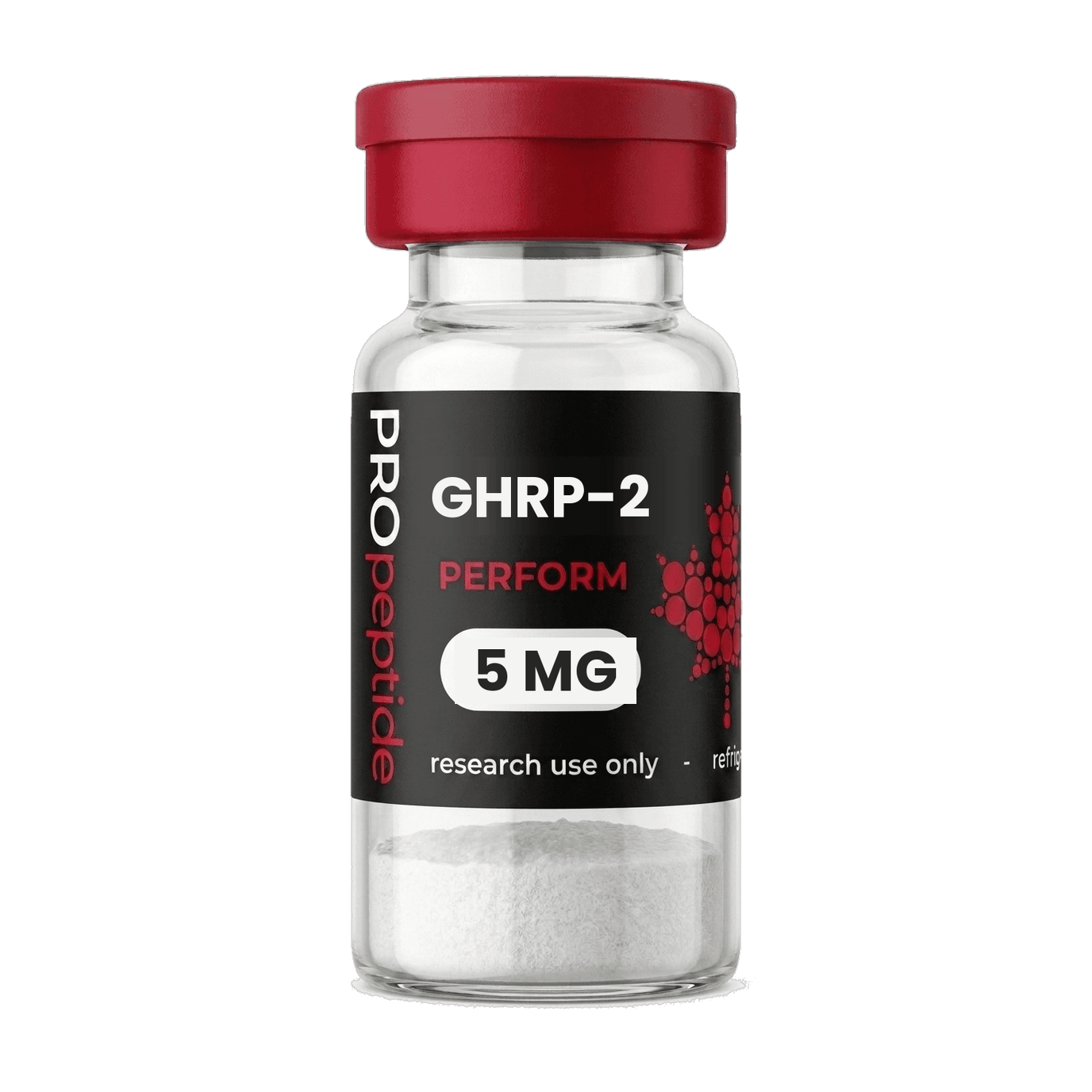
GHRP-2 Peptide
The only compound in this family a regulator anywhere ever approved. As a diagnostic, in Japan.
Choose your pack
For research use only. Not for human or veterinary use.
What GHRP-2 is
The plain-language version, first.
Six residues with a Japanese approval certificate and a very specific job.
GHRP-2 (pralmorelin) is a synthetic hexapeptide growth hormone secretagogue, sequence D-Ala-D-2-Nal-Ala-Trp-D-Phe-Lys-NH2, CAS 158861-67-7, that acts as an agonist at GHS-R1a, the ghrelin receptor, to stimulate pituitary growth hormone release. It is approved in Japan as a diagnostic agent for assessing growth hormone deficiency and is not approved for any use in Canada or the United States.
Here's a distinction that sounds pedantic and is actually the whole story.
Some drugs are approved to fix something. Others are approved to ask something.
GHRP-2 is approved in Japan as a diagnostic. Its job is to ask a pituitary whether it can still respond, and measure the answer.
Sold there as GHRP Kaken 100, which makes it one of the few compounds in this family to hold any approval anywhere.
Six amino acids, synthetic, working the ghrelin receptor rather than the GHRH receptor, which puts it on the other of the two levers this axis has.
An approved question mark. That is a real and honourable job for a molecule, and it is the job on the certificate.
What GHRP-2 peptide actually is
Mechanism studied, not outcome promised.
Works the ghrelin receptor, which is a different door than GHRH entirely.
This axis has two levers and people constantly blur them together.
GHRH is the hypothalamus asking politely through the front door. Ghrelin, the so-called hunger hormone, pulls a completely different handle on the same machine.
GHRP-2 is a synthetic key for the ghrelin door. It never touches the GHRH receptor at all.
Which is why a clinic can use it diagnostically: press the ghrelin lever hard, and a healthy pituitary answers with a measurable pulse. A damaged one answers weakly. The answer is the product.
It also does what ghrelin-door keys tend to do, including nudging appetite signalling and other downstream systems, because that door was never wired to growth hormone alone.
Here's the honest part. Diagnostic approval means the safety bar was cleared for one supervised dose in a clinic.
One dose, one measurement, one afternoon. That is the approved life of this molecule, and it says nothing about any other life.
The research so far for GHRP-2
Where the evidence is thin, we say so.
Approved as a question, not as an answer.
The file is real and it is narrow, and both halves matter.
Japan's approval means genuine pharmacology, real human administration data, and a regulator satisfied for a single diagnostic use.
That is more human evidence than most of this shelf. It is also evidence about an afternoon, not a protocol.
No approval in North America. No controlled outcome trial for body composition, performance or anything in that direction.
And it is prohibited in sport, which surprises nobody who has read this far.
A six-residue tool with a passport from exactly one country, stamped for exactly one purpose. Everything beyond that purpose is unstudied, and we are not going to pretend otherwise.
GHRP-2 (pralmorelin) hexapeptide. Canadian stock, shipping from BC.
GHRP-2 specs
The chemistry, exactly as released.
Who studies GHRP-2
Who tends to order this one, and why.
- 1
People comparing GHRPs head to head
GHRP-2 and GHRP-6 differ by two residues at the front of a six amino acid chain. If you want to watch how far a small structural change moves receptor behaviour, that pair is about as controlled a comparison as this category offers.
- 2
Anyone studying receptor specificity
The Arvat 1997 finding that ACTH and cortisol release resembled the human CRH response is the cleanest published example of a GHS-R1a agonist doing considerably more than growth hormone. It is the paper the specificity argument runs on.
- 3
Readers of diagnostic protocols
GHRP-2 is the rare compound here with a genuine approved use. Understanding what a diagnostic approval covers, and what it deliberately leaves out, is worth more than most of the marketing written about this molecule.
- 4
Regulatory trackers
Approved in Japan, unapproved in North America, FDA 503B Category 2 since September 2023, prohibited by WADA at all times. Three regulators looking at one hexapeptide and landing in three different places.
Sold for laboratory research only. This is not guidance for personal use, and nothing here is a recommendation.
GHRP-2 backstory
How it got here.
Start in 1976, which is six years before anybody had GHRH and twenty-three years before anybody had ghrelin.
Cyril Bowers was at Tulane working on met-enkephalin analogues. Opioid peptides. Pain chemistry. Some of those analogues turned out to release growth hormone, which was nobody's target and nobody's hypothesis. Bowers followed it anyway, and that accident became the growth hormone releasing peptides.
Sit with the order of events for a second, because it runs backwards. The synthetic secretagogues arrived in 1976. GHRH, the hormone they were supposedly imitating, wasn't isolated until 1982.
The receptor they actually bind was cloned by Merck in 1996, at a point when nobody knew what its natural ligand was. Ghrelin didn't turn up until 1999, pulled out of stomach tissue by Kojima's group in Japan. So the field had a drug, then a receptor, and only then a hormone.
It's like finding a key, then finding the house it opens, then spending three more years working out who lives there.
GHRP-2 was the second generation. Put the sequences side by side and the edit is obvious. GHRP-6 runs His-D-Trp at positions one and two.
GHRP-2 runs D-Ala-D-2-Nal. Residues three through six are identical. The entire difference is two swaps at the front end.
Kaken Pharmaceutical in Japan took that molecule all the way through to a diagnostic approval. And then the road stopped. It never crossed to North America, nobody registered a Western trial, and it has been an approved Japanese diagnostic and a research chemical everywhere else for about two decades.
- 1
1976, Tulane, and the wrong target
Cyril Bowers found growth hormone release in analogues of met-enkephalin, an opioid peptide. The GHRP family came out of pain chemistry, six years before GHRH was isolated and twenty-three years before ghrelin.
- 2
Two swaps at the front end
GHRP-6 is His-D-Trp-Ala-Trp-D-Phe-Lys-NH2. GHRP-2 is D-Ala-D-2-Nal-Ala-Trp-D-Phe-Lys-NH2. Positions three through six are identical, so the whole structural difference lives in the first two residues.
- 3
Japan said yes, nobody else did
Kaken Pharmaceutical markets pralmorelin as GHRP Kaken 100 for assessing growth hormone deficiency. It has never been approved in Canada or the United States, and it carries no ClinicalTrials.gov registrations at all.
Buying GHRP-2 in Canada
What ships, how fast, and the paperwork.
Pralmorelin and GHRP-2 are one molecule. Pralmorelin is the international nonproprietary name. GHRP-2 is the research name. KP-102 and GPA-748 are development codes. GHRP Kaken 100 is the Japanese brand. All of it is CAS 158861-67-7, so a claim attached to any of those names is a claim about this compound.
Supplied for laboratory research use only. This is a research chemical. It is not a drug, a supplement or a therapy, and it is not intended for human or veterinary use. In Canada, peptides are generally regulated as prescription drugs, and Health Canada has stated that "for research use only" labelling does not make a product legal.
Prohibited in sport at all times. The WADA 2026 Prohibited List names GHRP-2 (pralmorelin) explicitly under S2.2.4, among the growth hormone releasing peptides. It is non-Specified and banned both in and out of competition, so a tested athlete has no window in which it is permitted.
Common questions
5 answers, none of them dodges.
Is GHRP-2 an approved drug anywhere?
In Japan, yes. Kaken Pharmaceutical markets pralmorelin as GHRP Kaken 100, approved as a diagnostic agent for assessing growth hormone deficiency. That approval covers a controlled administration in a clinical setting with a laboratory measurement afterward. It is not an approval for repeated or long-term use, and it does not extend to Canada or the United States, where GHRP-2 has never been approved for anything.
What is the difference between GHRP-2 and GHRP-6?
Two amino acids. GHRP-6 is His-D-Trp-Ala-Trp-D-Phe-Lys-NH2 and GHRP-2 is D-Ala-D-2-Nal-Ala-Trp-D-Phe-Lys-NH2. Positions three through six are identical, so the entire structural difference sits in the first two residues. Both act at GHS-R1a, the ghrelin receptor, and both came out of Cyril Bowers’ programme at Tulane. GHRP-6 came first and GHRP-2 was the later refinement.
Does GHRP-2 affect cortisol and prolactin?
The published work says yes. Arvat and colleagues reported in Peptides in 1997 that GHRP-2 raised prolactin, ACTH and cortisol, and that the ACTH and cortisol release was similar to the response produced by human CRH. The authors concluded the activity is not fully specific. That follows from the receptor itself, since GHS-R1a is the ghrelin receptor rather than a dedicated growth hormone receptor.
Are there clinical trials on GHRP-2?
Not on ClinicalTrials.gov. Searching the registry returns zero registered studies for GHRP-2. What exists instead is a body of late 1990s endocrinology characterising what the peptide does acutely, plus the Japanese diagnostic approval. There is no randomised outcome trial for body composition, recovery or ageing, and no long-term human safety data set to point at.
How does GHRP-2 differ from GHRH or CJC-1295?
Different receptor. GHRP-2 works at GHS-R1a, the ghrelin receptor, which also carries appetite signalling, drives ACTH, cortisol and prolactin release, and desensitises under sustained exposure. GHRH and CJC-1295 act at the GHRH receptor and do none of that. Bowers showed in 1990 that a GHRP combined with GHRH released more growth hormone than either alone, which is how the field established the two pathways run independently.
Good pairing options with GHRP-2
What researchers stack alongside it.
Pairing is where research gets ahead of itself. These are the compounds researchers put in the same order as GHRP-2 Peptide, which is a statement about ordering habits, not about evidence. Two things in one cart have not been studied together unless somebody studied them together.
The polite one. A Novo Nordisk ghrelin agonist defined by what it does not release: no meaningful cortisol or ACTH even at high doses, which is the entire reason anybody remembers it.
Six residues from 1976 that made research subjects hungry twenty years before anybody knew why. The why turned out to be ghrelin, and this molecule is how the field found it.
It is water. We know. But it is the one bottle on this shelf where the boring ingredient is the entire product, and getting it wrong ruins everything else you bought.
Order GHRP-2 right now
One last look before you decide.
Freeze-dried, ships cold from Canada
You've got the whole file now, the thin parts included. Nothing above pretended otherwise. If that's the kind of source you were after, GHRP-2 is right here.
Not for human consumption. Not approved by Health Canada or any other regulatory body.
Page last updated October 4, 2026
People also search for GHRP-2
Related searches.