
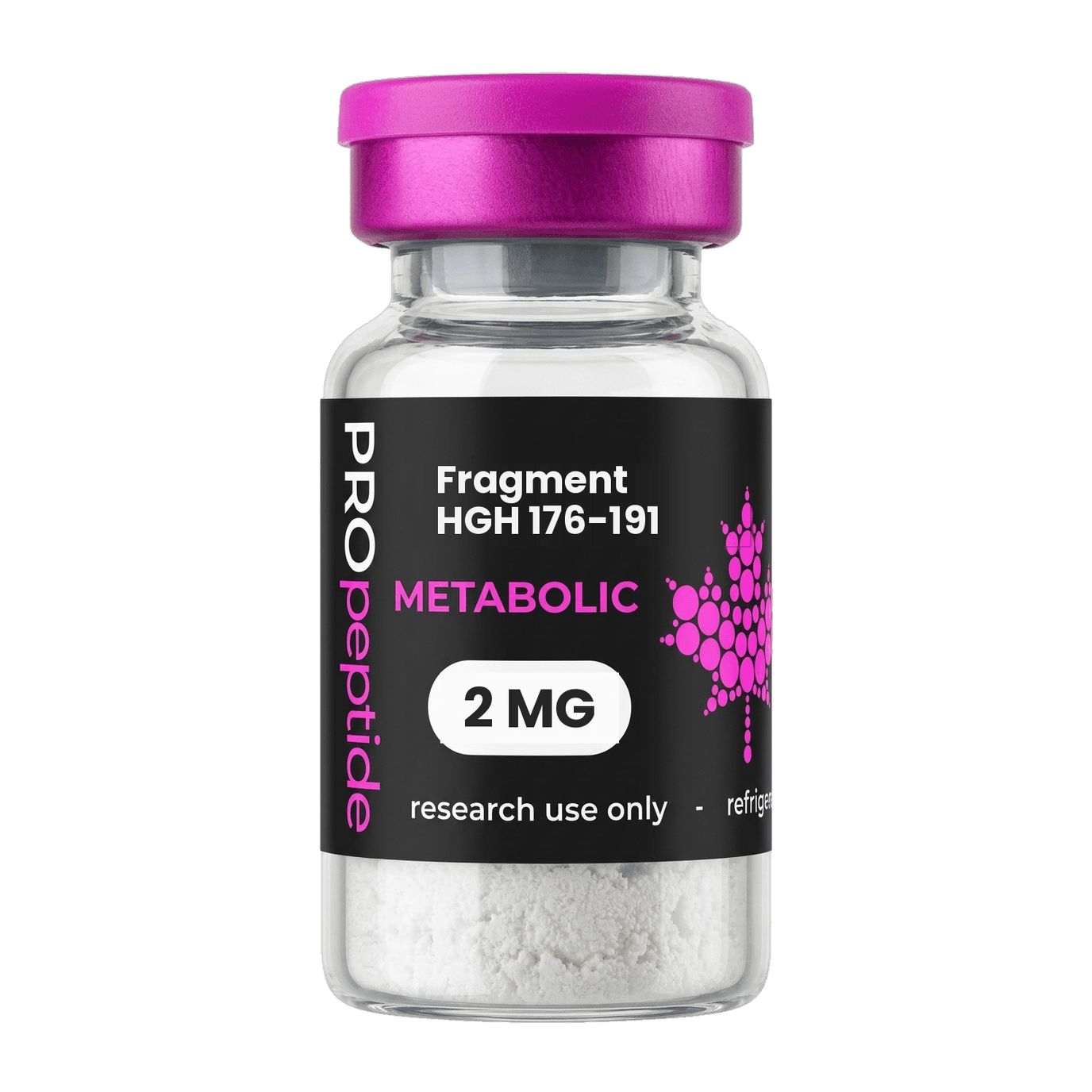
Fragment HGH 176-191 Peptide
One oxygen atom separates this from the molecule everybody quotes trials for. One.
Choose your pack
For research use only. Not for human or veterinary use.
What Fragment HGH 176-191 is
The plain-language version, first.
Sixteen residues off the end of growth hormone, and a case of mistaken identity.
Fragment HGH 176-191 is a 16-residue synthetic peptide corresponding to residues 176 to 191 of human growth hormone, sequence FLRIVQCRSVEGSCGF, containing a disulfide bond between Cys182 and Cys189, with a free peptide molecular weight of approximately 1799.1 Da. It is a distinct molecule from AOD-9604, which is Tyr-hGH(177-191) and differs by a single residue substitution of phenylalanine to tyrosine.
Growth hormone is 191 amino acids. This is the last sixteen of them, on their own.
That is the entire description, and it is also where the trouble starts.
Because there is a second molecule, AOD-9604, which is this fragment with a modification added, and the two get treated as interchangeable constantly.
They are not interchangeable. One had a full commercial development programme and a pivotal trial. The other is the bare fragment.
And almost every confident claim circulating about the bare fragment traces back to papers about the modified one.
If you are reading about 176-191 and the citation is an AOD-9604 paper, you are reading about a different compound with a different development history.
What Fragment HGH 176-191 actually is
Mechanism studied, not outcome promised.
The claims attached to it were borrowed from its better-dressed cousin.
Here's the thing nobody selling this wants to spell out.
To describe the mechanism honestly you have to keep saying which molecule you mean, and that ruins the pitch.
The bare fragment has its own literature. It is older, thinner and considerably less exciting than the borrowed version.
Ng and Bornstein published on synthetic C-terminal fragments of human growth hormone in the American Journal of Physiology in 1978, working in rats, on peptides including this region.
1978. That is the era we are talking about for the fragment on its own.
Here's the honest part. A compound whose reputation is assembled mostly from papers about its neighbour is not a compound with a strong file.
It is a compound with a strong marketing inheritance, which is a very different asset.
The research so far for Fragment HGH 176-191
Where the evidence is thin, we say so.
Two literatures, routinely confused, and one of them is not about this.
Two literatures. One commonly mistaken for the other. That is the whole shape of this.
On the bare fragment: Ng and Bornstein, 1978, in rats, on synthetic hGH C-terminal fragments. Old, small, and genuinely about this sequence.
On AOD-9604: a full commercial programme through the 2000s, a pivotal readout that did not deliver, and a later repositioning as a supplement ingredient.
People quote the second file and attach it to the first molecule, usually without noticing they have done it.
So when you go reading, check the compound name in the methods section rather than the title. It sorts out most of the confusion in about thirty seconds.
We are not going to inherit somebody else's citations on your behalf. This is the older, thinner file, and that is what it is.
The sequence, the mass, and the trial record for both molecules are on this page. Research use only.
Fragment HGH 176-191 specs
The chemistry, exactly as released.
Who studies Fragment HGH 176-191
Who tends to order this one, and why.
- 1
Lipid and adipocyte metabolism labs
The classic tool for asking whether growth hormone's metabolic effects can be separated from its growth signalling, using a fragment that carries one and not the other.
- 2
Anti-doping and analytical chemists
WADA section S2.2 names hGH 176-191 and AOD-9604 explicitly. Distinguishing two molecules separated by 16 daltons is a genuine analytical problem and needs authentic reference material.
- 3
Peptide structure researchers
A compact disulfide-constrained 16-mer where the 1978 work already showed that both sequence length and physical configuration determine activity. Useful for structure-activity teaching.
- 4
Comparative pharmacology groups
Running 176-191 alongside AOD-9604 in the same assay is the only honest way to find out whether the single residue substitution matters, and almost nobody has published that comparison.
Sold for laboratory research only. This is not guidance for personal use, and nothing here is a recommendation.
Fragment HGH 176-191 backstory
How it got here.
In the late seventies, before anybody had a fat loss market to sell into, researchers were carving up growth hormone to find out which piece did what. Ng and Bornstein in Melbourne made a whole ladder of synthetic C-terminal fragments, 172-191, 176-191, 177-191, 178-191, 179-191, 180-191, and dosed them into rats. Four of the six did something. Two were inert. Their conclusion was that the active peptides needed both a minimum sequence and the right physical configuration, which is a 1978 way of saying the disulfide loop matters.
What they were measuring was glucose and insulin, not body fat.
The fat loss framing arrived later and it arrived attached to a different molecule. Metabolic Pharmaceuticals in Australia developed AOD-9604 by swapping the leading phenylalanine for a tyrosine, ran it through obesity trials, and never got it approved. The fragment kept the story and lost the citations.
- 1
1978, dissecting the hormone
Ng and Bornstein synthesised a ladder of hGH C-terminal fragments and tested them in rats. The fragments containing 176-191 raised blood glucose and plasma insulin and reduced insulin sensitivity. The fat loss framing did not exist yet.
- 2
The tyrosine swap
AOD-9604 was created by replacing the leading phenylalanine of 176-191 with tyrosine, giving Tyr-hGH(177-191) at about 1815.1 Da. One atom of oxygen separates the two molecules.
- 3
2013, the evidence lands on the other one
Stier and colleagues pooled six randomised double-blind placebo-controlled trials of AOD-9604 covering roughly nine hundred human exposures. The bare fragment has no registered human trial. The compound with the data was never approved either.
Buying Fragment HGH 176-191 in Canada
What ships, how fast, and the paperwork.
176-191 and AOD-9604 are different molecules. The fragment starts with phenylalanine and weighs about 1799.1 Da. AOD-9604 starts with tyrosine and weighs about 1815.1 Da, CAS 221231-10-3. Human trial data belongs to AOD-9604 and does not transfer. Check which one a source is actually describing.
Two mass figures are in circulation. Around 1799.1 is the free peptide. Around 1859.1 is the acetate salt, the free peptide plus one acetate equivalent at 60.05 Da. Neither number is wrong, they describe different things, and mixing them up makes identity checks look like failures.
Canadian regulatory status. Health Canada states peptides are generally regulated as prescription drugs and that For Research Use Only labelling does not make a product legal or exempt from regulatory requirements. This is sold as laboratory material, not for human or veterinary use.
Common questions
5 answers, none of them dodges.
Is Fragment HGH 176-191 the same as AOD-9604?
No. Fragment 176-191 is FLRIVQCRSVEGSCGF with a free peptide mass near 1799.1 Da. AOD-9604 is Tyr-hGH(177-191), YLRIVQCRSVEGSCGF, near 1815.1 Da, CAS 221231-10-3. The only difference is phenylalanine at the front becoming tyrosine, which adds a single oxygen atom. They are separate entries in PubChem and separate molecules for any analytical purpose.
Are there human trials of Fragment HGH 176-191?
None could be identified. A ClinicalTrials.gov intervention search on 11 August 2026 returned zero registered studies for hGH 176-191 or for growth hormone fragment 176-191. The human data that circulates online belongs to AOD-9604, which was pooled across six randomised placebo-controlled trials by Stier and colleagues in 2013 and still never reached approval.
What did the original research on 176-191 find?
Ng and Bornstein reported in the American Journal of Physiology in 1978 that synthetic hGH C-terminal fragments including 176-191 produced a short-lived rise in blood glucose and a more sustained rise in plasma insulin in rats, and that a 5 nmol per kg dose reduced insulin sensitivity. That is historical rodent data on the exact fragment, reported here as history rather than guidance.
Why do I see two different molecular weights?
Because two different things are being weighed. The free peptide is approximately 1799.1 Da with formula C78H123N23O22S2. The commonly quoted 1859.1 figure is the acetate salt, which adds one acetate equivalent at about 60.05 Da. Both numbers appear in databases and vendor listings. Knowing which one applies prevents a correct identity result from looking like a failure.
Does the fragment raise IGF-1 or release growth hormone?
No on both counts. The 176-191 region is the C-terminal lipolytic domain of growth hormone and is structurally separable from the receptor-binding domain that drives growth signalling. The Stier 2013 pooled analysis of the closely related AOD-9604 specifically recorded no effect on IGF-1, which fits the structural argument for this region.
Fragment HGH 176-191 Peptide vs AOD-9604
Stacked together constantly, compared almost never.
This is the single most important comparison on this page, because these two are mistaken for each other constantly and the mistake runs one direction.
The bare fragment is the last sixteen residues of growth hormone on their own. Its own literature is older and thinner. Ng and Bornstein, 1978, in rats.
AOD-9604 is this fragment with a modification added. It had a full commercial programme through the 2000s and a pivotal readout.
Almost every confident claim about the bare fragment cites an AOD-9604 paper. Check the compound name in the methods section rather than the title and most of the confusion sorts itself out. AOD-9604 has its own page here
Good pairing options with Fragment HGH 176-191
What researchers stack alongside it.
Pairing is where research gets ahead of itself. These are the compounds researchers put in the same order as Fragment HGH 176-191 Peptide, which is a statement about ordering habits, not about evidence. Two things in one cart have not been studied together unless somebody studied them together.
The trial read out and it did not work. So rather than shelve the compound, somebody changed what it was for a living. That is the whole story and it is why you can buy it.
Almost nothing on this shelf ever finished. This one went the entire distance, cleared an FDA approval in 2010, and it was built in Montreal.
It is water. We know. But it is the one bottle on this shelf where the boring ingredient is the entire product, and getting it wrong ruins everything else you bought.
Order Fragment HGH 176-191 right now
One last look before you decide.
Freeze-dried, ships cold from Canada
You've got the whole file now, the thin parts included. Nothing above pretended otherwise. If that's the kind of source you were after, Fragment HGH 176-191 is right here.
Not for human consumption. Not approved by Health Canada or any other regulatory body.
Page last updated October 4, 2026
People also search for Fragment HGH 176-191
Related searches.