
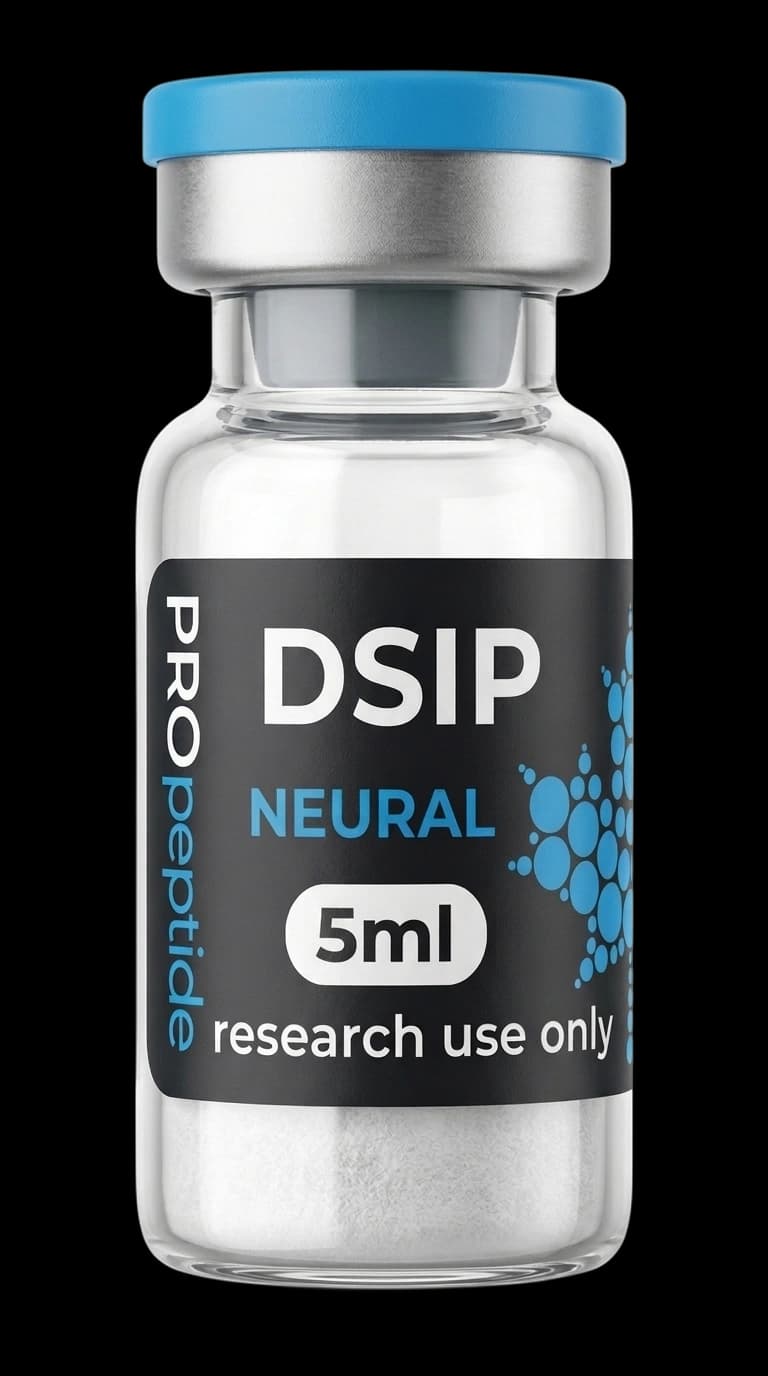
DSIP Peptide
Isolated from the blood of sleeping rabbits in the 1970s, and studied in about fifty people since.
Choose your pack
For research use only. Not for human or veterinary use.
What DSIP is
The plain-language version, first.
It is studied for effects on sleep architecture and stress signalling, primarily in animal models, with limited and contradictory human findings.
Nobody names a compound this confidently anymore.
Delta Sleep-Inducing Peptide. Not delta-sleep-associated. Not delta-sleep-related.
Inducing. Somebody wrote that down and everybody else went along with it.
Nine amino acids carrying a claim in the actual name, which is a hell of a way to start a research programme.
It came out of work in the seventies on whether something circulating in one animal could carry a sleep state to another. That is a genuinely interesting question and it was asked seriously.
The name comes from that era, when the finding looked cleaner than it turned out to be.
Forty-odd years later the name is still doing more work than the file underneath it.
What DSIP peptide actually does
Mechanism studied, not outcome promised.
Here's the unusual thing about this one, and it is unusual.
For most compounds here, mechanism is the well-lit part and human outcomes are the dark part. Nine residues, a known receptor, a measurable binding constant.
With DSIP the mechanism is also the dark part. Four decades in, there is no agreed receptor and no settled account of what it does.
That is rare. Most molecules this old have been pinned down or abandoned, and this one has managed neither.
Proposals exist. They are proposals. Different groups have suggested different routes and none has become the consensus answer.
Here's the honest part. A compound whose name asserts an effect, and whose mechanism is still open after forty years, is carrying a claim it has not backed.
We would rather point that out than repeat the name and hope you do not notice.
The research so far for DSIP
Where the evidence is thin, we say so.
The human file is small, old, and worth reading precisely because of both.
About five human studies, running roughly from 1981 to 1992. All intravenous, all small, all from a period with different methodological standards than today.
Then it essentially stops. Not a failure, not a scandal, just a line of work that quietly did not continue.
That gap is informative on its own. Compounds that deliver tend to attract follow-up, and thirty years of near-silence is a data point even though it is not a result.
Nothing approved anywhere. No modern randomised trial.
The boldest name on the shelf attached to one of the thinnest and oldest files on the shelf. Both of those are worth knowing before you read anybody else's description of it.
DSIP 5mg lyophilised. Ships same day out of BC.
DSIP specs
The chemistry, exactly as released.
Who studies DSIP
Who tends to order this one, and why.
- 1
Sleep medicine
The full human record sits here: five studies, forty to fifty subjects, chronic insomnia and healthy volunteers, all between 1981 and 1992.
- 2
Neuropeptide history
One of the cleanest examples of the humoral approach to physiology, finding a molecule by inducing a state and sampling for what appears.
- 3
Trial methodology
A clear case study in how effect sizes shrink as designs tighten, and why concurrent placebo control matters more than sample size alone.
- 4
Regulatory reviewers
FDA assessed emideltide in July 2026 for opioid withdrawal, chronic insomnia and narcolepsy and recommended against adding it to the compounding list.
Sold for laboratory research only. This is not guidance for personal use, and nothing here is a recommendation.
DSIP backstory
How it got here.
The humoral theory of sleep goes back a long way. If sleep pressure builds through the day, something must be building with it, and finding that something was a real goal of mid-century physiology.
Monnier's group took the most direct route available: induce the state, sample the blood, isolate what appears. That produced DSIP and a name that describes exactly where it was found rather than what it does.
Clinical interest ran from 1981 to 1992 and then stopped. There was no scandal and no failed pivotal trial, because there was never a pivotal trial. The studies were small, the best-controlled ones were unpersuasive, and the field moved on to mechanisms with clearer receptors.
One Russian research product, Deltaran, combines emideltide with glycine and appears in the animal literature. It is not a registered drug in the markets FDA searched.
- 1
A circulating sleep factor
Mid-century physiology asked whether sleep pressure builds because something accumulates. Finding that something was a genuine research goal.
- 2
Rabbits, thalamic stimulation, blood
Monnier and Schoenenberger in Basel induced delta sleep, sampled the blood and isolated what appeared. That is where the nine residue sequence came from.
- 3
1981 to 1992, then nothing
Clinical interest ran for a decade and stopped. No scandal and no failed pivotal trial, because there was never a pivotal trial.
Buying DSIP in Canada
What ships, how fast, and the paperwork.
Every human study used the intravenous route. All five published sleep studies administered DSIP intravenously. There is no published human data for subcutaneous administration, which is how it is generally used outside research settings.
Same day out of British Columbia. Our building, our cold packs, our people, and nothing sitting in a customs queue while you refresh a tracking page.
Then into the fridge. Keep it cold and keep it dark. Sealed and freeze-dried it handles a rough trip without ice. Once it lands, fridge.
Common questions
6 answers, none of them dodges.
Where did DSIP come from?
From the blood of sleeping rabbits. Monnier and Schoenenberger group in Basel induced delta sleep by electrically stimulating the thalamus, drew blood from those animals, and isolated a nine residue peptide that appeared during that state. They named it delta sleep-inducing peptide after the sleep stage it was found alongside.
How many people have been studied on DSIP?
Roughly forty to fifty, across about five sleep studies conducted between 1981 and 1992. Most came from a single investigator, Dieter Schneider-Helmert. Every study used intravenous administration. There are no registered clinical trials of emideltide on ClinicalTrials.gov.
Did the controlled studies show a benefit?
Not convincingly. Monti and colleagues in 1987 ran a randomised double-blind placebo-controlled crossover in six subjects and found no significant difference against baseline or placebo, describing the effects as of little clinical significance. Bes and colleagues in 1992 used the strongest design in the set, a double-blind matched-pairs parallel-group study in sixteen chronic insomniacs, and while sleep efficiency and latency reached significance the authors judged the effects weak and concluded short-term DSIP is not likely to be of major therapeutic benefit.
What did FDA decide about DSIP?
It reviewed emideltide in July 2026 for opioid withdrawal, chronic insomnia and narcolepsy, and described the insomnia evidence as inconclusive and at best preliminary. Its advisory committee voted 6 in favour, 7 against with 1 abstention, declining to recommend it for the compounding list. It was the only one of seven peptides reviewed that week that the committee did not back.
Is there a known DSIP receptor?
No. There is no well-characterised receptor and no established signalling pathway. Graf and Kastin, reviewing the field in 1984, concluded there was insufficient evidence that DSIP reliably induces or maintains sleep. That absence of a settled mechanism is part of why a mixed clinical record was never resolved either way.
What is the narcolepsy evidence?
One patient. Schneider-Helmert published a report in European Neurology in 1984 describing a single 35 year old male. It is a case report rather than a trial, and it should be read as one.
Good pairing options with DSIP
What researchers stack alongside it.
Pairing is where research gets ahead of itself. These are the compounds researchers put in the same order as DSIP Peptide, which is a statement about ordering habits, not about evidence. Two things in one cart have not been studied together unless somebody studied them together.
A seven-residue fragment built in Moscow, sold in Russian pharmacies as nasal drops, and listed among that country's Vital and Essential Medicines. The Western file on it is nearly empty. Both facts are true at once.
Semax's labmate from the same Moscow institute, built off an immune peptide called tuftsin. Registered in Russia, studied almost entirely without placebo controls, unknown to Western regulators.
It is water. We know. But it is the one bottle on this shelf where the boring ingredient is the entire product, and getting it wrong ruins everything else you bought.
Order DSIP right now
One last look before you decide.
Freeze-dried, ships cold from Canada
You've got the whole file now, the thin parts included. Nothing above pretended otherwise. If that's the kind of source you were after, DSIP is right here.
Not for human consumption. Not approved by Health Canada or any other regulatory body.
Page last updated October 4, 2026
People also search for DSIP
Related searches.