
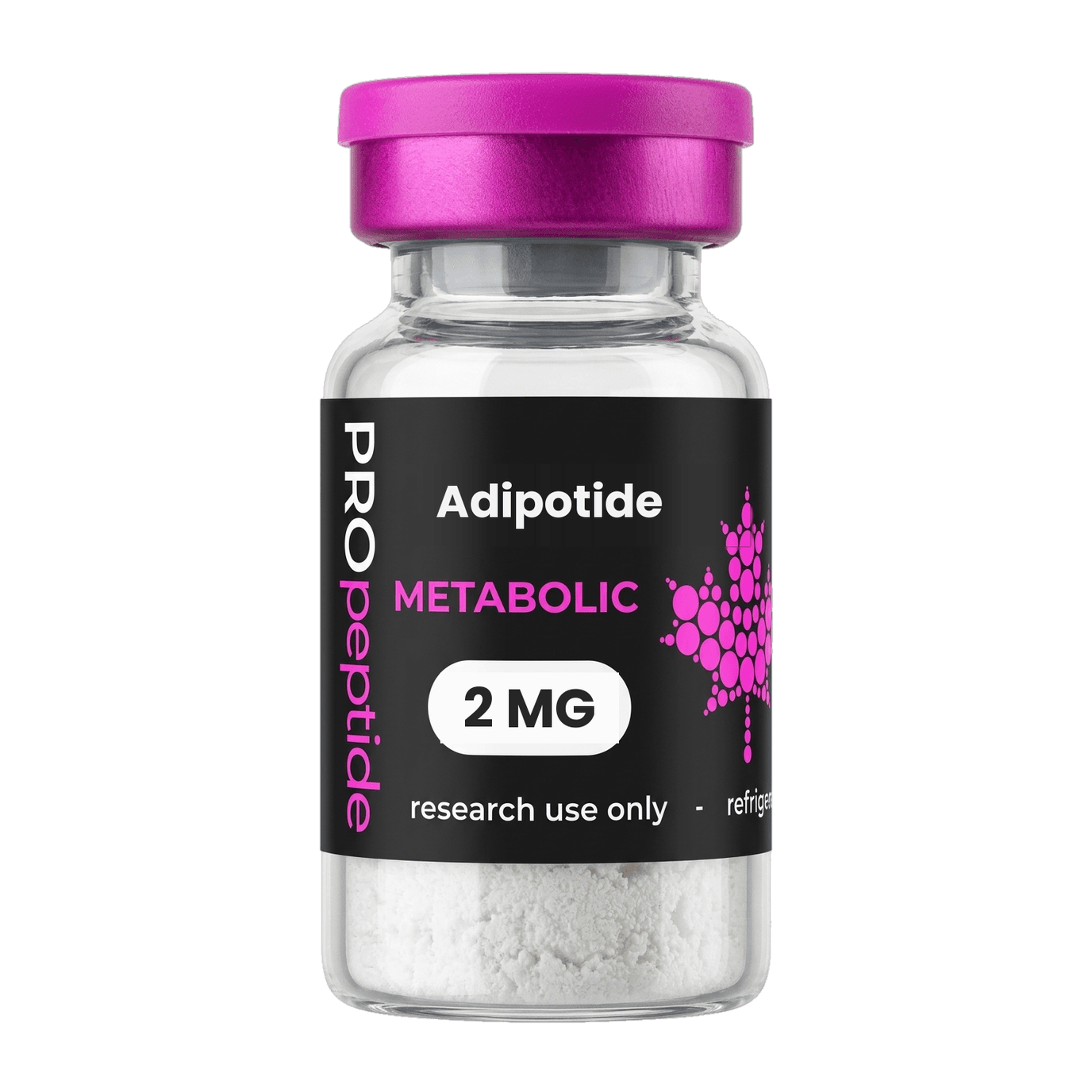
Adipotide (FTPP)
A vascular homing sequence welded to a proapoptotic sequence, studied in animals only, and not comparable to anything else on this shelf
Choose your pack
For research use only. Not for human or veterinary use.
What Adipotide (FTPP) is
The plain-language version, first.
Two halves welded together: a postcode, and a demolition order.
Adipotide (FTPP) is a ligand-directed peptidomimetic with the structure CKGGRAKDC-GG-(D)(KLAKLAK)2, in which the CKGGRAKDC homing motif is disulfide-cyclised and the (KLAKLAK)2 effector is composed entirely of D-amino acids; its molecular formula is C111H206N36O28S2 with a molecular weight of 2557.2 for the linear free acid, CAS 859216-15-2. It induces apoptosis in the endothelial cells of white adipose tissue vasculature by binding the receptor prohibitin, rather than acting directly on adipocytes.
Almost everything else on this shelf is a signalling molecule. It arrives, it binds a receptor, it says something, it leaves.
This one is a different category of object entirely.
It is two peptides bolted together. One half is a homing sequence. The other half is designed to trigger cell death.
The homing half is CKGGRAKDC, identified by in vivo phage display, and its binding partner is prohibitin on the vasculature of white adipose tissue.
The second half is a proapoptotic sequence. Its job is to make cells die once the first half has decided where.
A targeting system attached to a demolition charge is a legitimate design in oncology-adjacent research. It is also not a supplement, and nothing about it should be read casually.
What adipotide is
Mechanism studied, not outcome promised.
It doesn't target the tissue. It targets the tissue's plumbing.
Think about how you would demolish one building on a street without touching the others.
You would not go after the building. You would go after what keeps it supplied.
That is the design here. It aims at the blood vessels serving a tissue rather than the tissue itself.
The reasoning is that a targeting motif can be specific to a vascular bed in a way it usually cannot be to the cells behind it. Find the plumbing, and the rest follows.
Which is clever. It is also exactly why this compound sits in a different risk conversation from everything around it on this shelf.
Here's the honest part, and it is not a small one. A mechanism whose entire function is to kill cells has a safety question built into it that no amount of targeting specificity makes go away.
Anybody discussing this one the way they would discuss a research peptide with a receptor and a half-life has not understood what it is.
The research so far for Adipotide (FTPP)
Where the evidence is thin, we say so.
Animal work only, and the animal work is where the caution comes from.
The file here is small, it is animal only, and it is worth reading in full rather than in summary.
Kolonin, Saha, Chan, Pasqualini and Arap published the original work in Nature Medicine in 2004, PMID 15133506, identifying the homing sequence and establishing prohibitin as its target on white adipose vasculature.
Barnhart and colleagues took it into primates in Science Translational Medicine in 2011, PMID 22072637.
That second paper is the one people cite and the one people should read properly, because primate work is where dose-limiting problems tend to surface first.
And the ceiling, plainly: no human trials. Not one that disappointed, not one running. None.
Two papers, twenty years, animals only, and a mechanism built around killing cells. We would rather you had that sentence than a headline.
Canadian stock, cold-shipped from BC. Research use only.
Adipotide (FTPP) specs
The chemistry, exactly as released.
Who studies Adipotide (FTPP)
Who tends to order this one, and why.
- 1
Vascular targeting researchers
This is the canonical worked example of ligand-directed delivery: a homing motif found by in vivo selection, fused to a payload that only fires once it's inside a cell.
- 2
Phage display and library screening labs
CKGGRAKDC is one of the better-known in vivo phage display hits, and the prohibitin identification is a clean case of target deconvolution after the fact.
- 3
Apoptosis and mitochondrial biology labs
The all-D (KLAKLAK)2 effector is a standard proapoptotic construct in its own right, useful to anyone studying mitochondrial membrane disruption.
- 4
Adipose tissue biology researchers
The idea that fat mass can be reduced by removing its blood supply rather than its cells is a distinct experimental question, and this is the tool that framed it.
Sold for laboratory research only. This is not guidance for personal use, and nothing here is a recommendation.
Adipotide (FTPP) backstory
How it got here.
In vivo phage display sounds like science fiction and it's actually kind of blunt-force. You build a library of billions of bacteriophage, each displaying a different short sequence on its coat. The library goes into a living animal. You wait. Then you harvest the tissue you care about and see what stuck around.
Do it enough rounds and the tissue itself gives you the answer. No modelling, no structure-based design. The animal does the screening for you.
That's how CKGGRAKDC surfaced in 2004. It homed to white adipose tissue vasculature, and when Kolonin's group chased down the receptor it turned out to be prohibitin, a protein nobody had pencilled in for that job.
They fused the homing sequence to (KLAKLAK)2, an all-D proapoptotic construct, and published in Nature Medicine.
Seven years later Barnhart's team ran it in primates and reported the intended vascular effect on adipose tissue, alongside reversible renal proximal tubule changes at optimal doses.
Then it went into humans on 24 May 2012 at MD Anderson. Four patients enrolled. Terminated at the principal investigator's request. No results ever posted.
That's the whole file. A brilliant discovery method, a striking primate result, and a human trial that reads like a sentence stopping halfway through.
- 1
Found by phage display
The homing sequence CKGGRAKDC was identified by in vivo phage display, a method that screens vast peptide libraries for ones that bind a specific vascular bed.
- 2
A receptor on the plumbing
Its binding partner was established as prohibitin, present on the vasculature serving white adipose tissue rather than on the tissue cells themselves.
- 3
Two halves, bolted together
The targeting sequence is joined to a proapoptotic sequence whose function is to trigger cell death once the first half has determined location.
- 4
Where it stands
Animal work only, two decades on. The primate study is the one worth reading properly, because primate work is where dose-limiting problems tend to surface.
Buying Adipotide (FTPP) in Canada
What ships, how fast, and the paperwork.
Not a conventional peptide. Adipotide is a ligand-directed peptidomimetic with an all-D effector segment and a disulfide-cyclised homing motif. It doesn't behave like a linear peptide and shouldn't be handled or described as one.
The human dataset is four patients. NCT01262664 terminated at an actual enrolment of four with no results posted. There is no published human efficacy or safety data at all, and it has never been approved by any regulator anywhere.
Prohibited in sport under S0. With no regulatory approval from any health authority, adipotide falls under WADA category S0 even though it isn't named on the list. Canadian stock, shipped from BC, research use only.
Common questions
5 answers, none of them dodges.
What is Adipotide?
A two-part synthetic peptide. One part is a homing sequence, CKGGRAKDC, that binds prohibitin on the vasculature of white adipose tissue. The other is a proapoptotic sequence designed to trigger cell death once the first part has determined where.
How is it different from the other peptides you sell?
Fundamentally. Almost everything else here is a signalling molecule that binds a receptor, says something and leaves. This one is a targeting system attached to something designed to kill cells. It belongs in a different risk conversation entirely.
Why target blood vessels rather than the tissue?
Because a targeting motif can often be specific to a vascular bed in a way it cannot be to the cells behind it. The design reasoning is that the supply route is the more addressable target.
Is there any human data?
None. No human trials have been run. The published record is two animal papers, the second of which is in primates, and that is the entire file.
Why is caution emphasised so heavily here?
Because a mechanism whose function is to cause cell death carries a safety question that targeting specificity reduces but does not remove. Anyone discussing this the way they would discuss a receptor agonist has misunderstood what it is.
Adipotide (FTPP) vs AOD-9604
Stacked together constantly, compared almost never.
Two compounds aimed at the same tissue by completely opposite philosophies, and both files ended in a lesson.
Adipotide does not signal at all. It is a homing sequence welded to a cell-death sequence, aimed at the blood vessels serving white adipose tissue. Animal work only, primates included, no human trial ever.
AOD-9604 took the polite route, a signalling fragment of growth hormone, and it went all the way to a pivotal human trial that did not beat placebo.
One was never asked the human question and one was asked and answered no. Neither file supports what either compound gets bought for, and the two of them together are the whole cautionary tale of this category. AOD-9604 has its own page here
Good pairing options with Adipotide (FTPP)
What researchers stack alongside it.
Pairing is where research gets ahead of itself. These are the compounds researchers put in the same order as Adipotide (FTPP), which is a statement about ordering habits, not about evidence. Two things in one cart have not been studied together unless somebody studied them together.
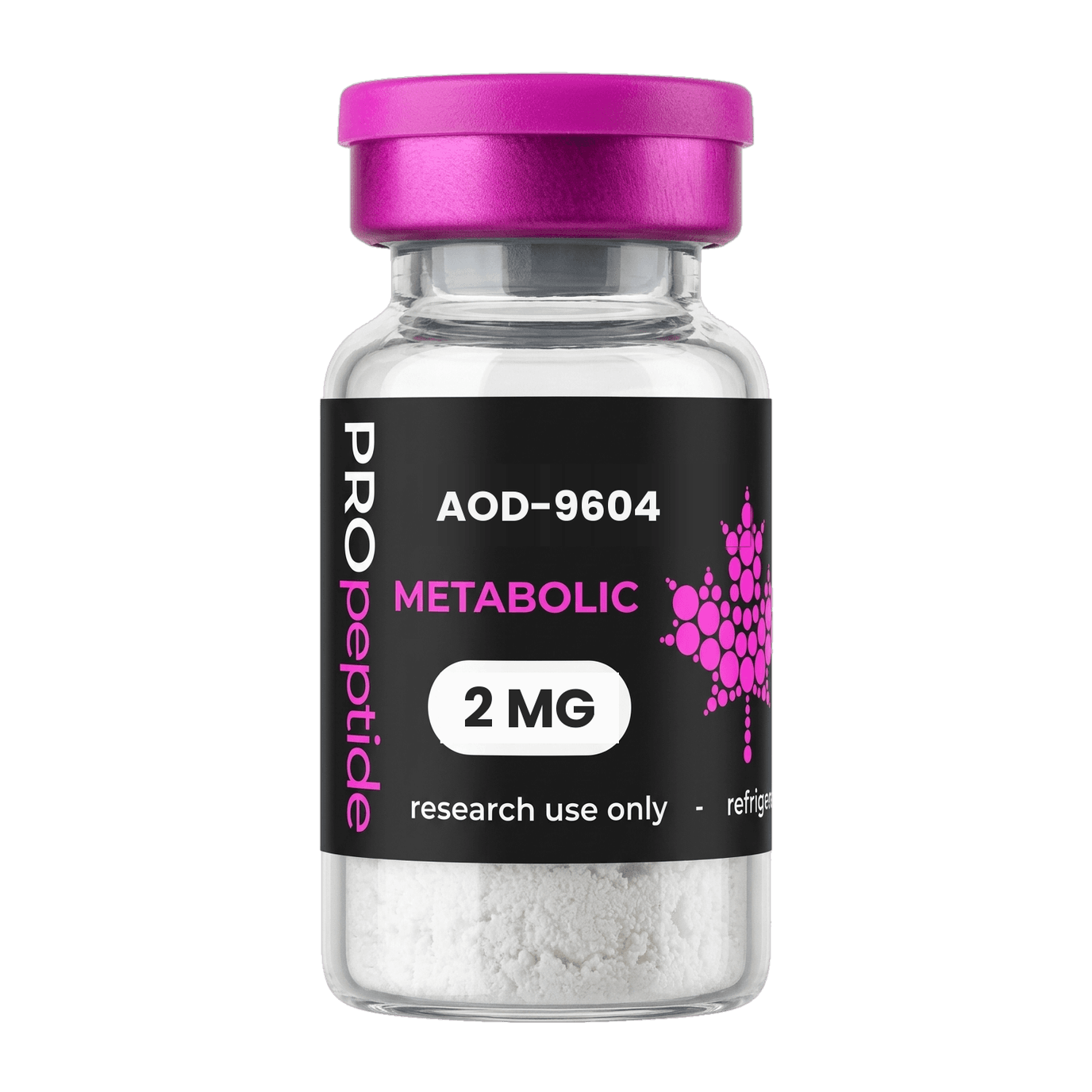
The trial read out and it did not work. So rather than shelve the compound, somebody changed what it was for a living. That is the whole story and it is why you can buy it.
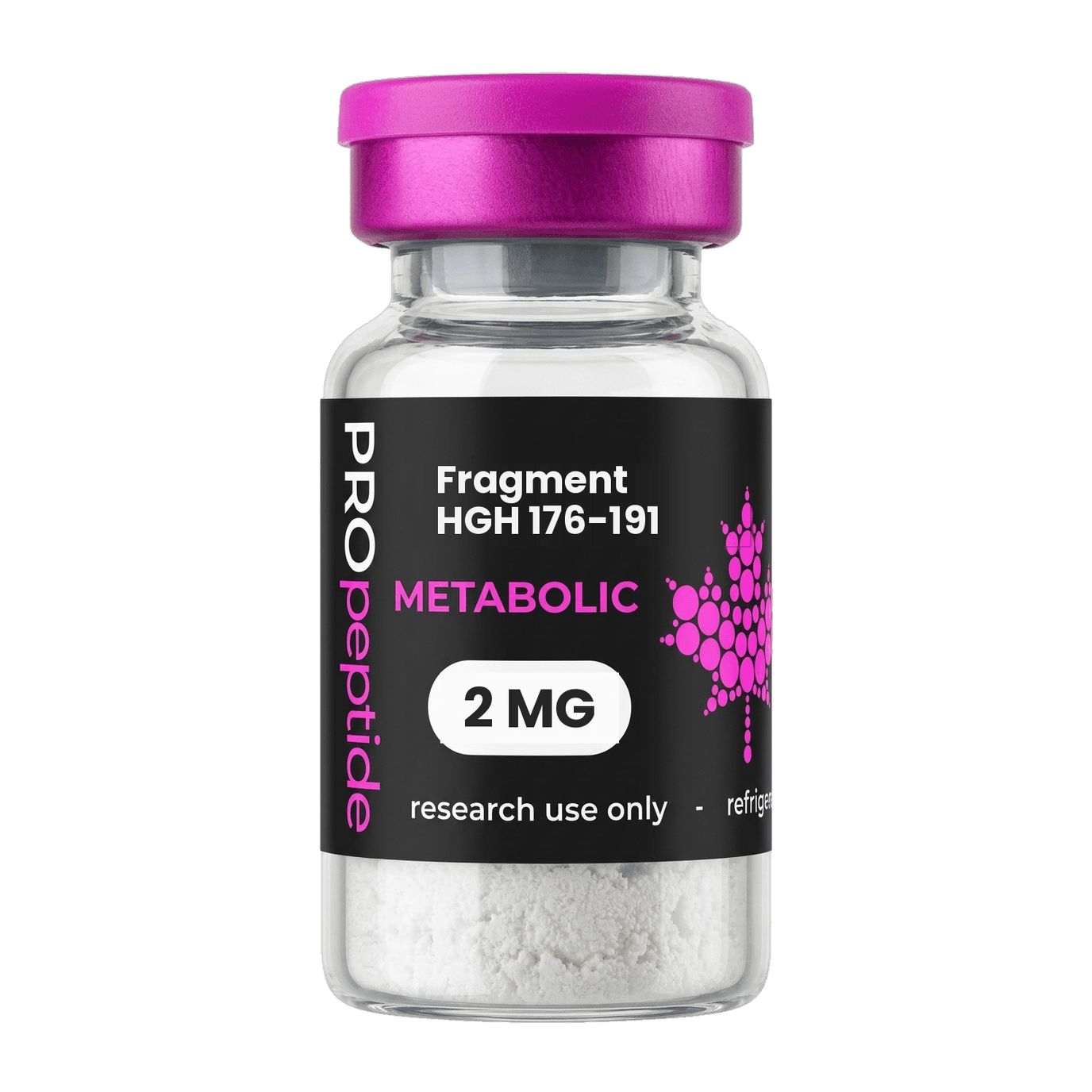
Nearly everything written about this compound is actually about a different molecule. Sorting out which is which is most of the work of understanding it.
It is water. We know. But it is the one bottle on this shelf where the boring ingredient is the entire product, and getting it wrong ruins everything else you bought.
Order Adipotide (FTPP) right now
One last look before you decide.
Freeze-dried, ships cold from Canada
You've got the whole file now, the thin parts included. Nothing above pretended otherwise. If that's the kind of source you were after, Adipotide (FTPP) is right here.
Not for human consumption. Not approved by Health Canada or any other regulatory body.
Page last updated October 4, 2026
People also search for Adipotide (FTPP)
Related searches.