
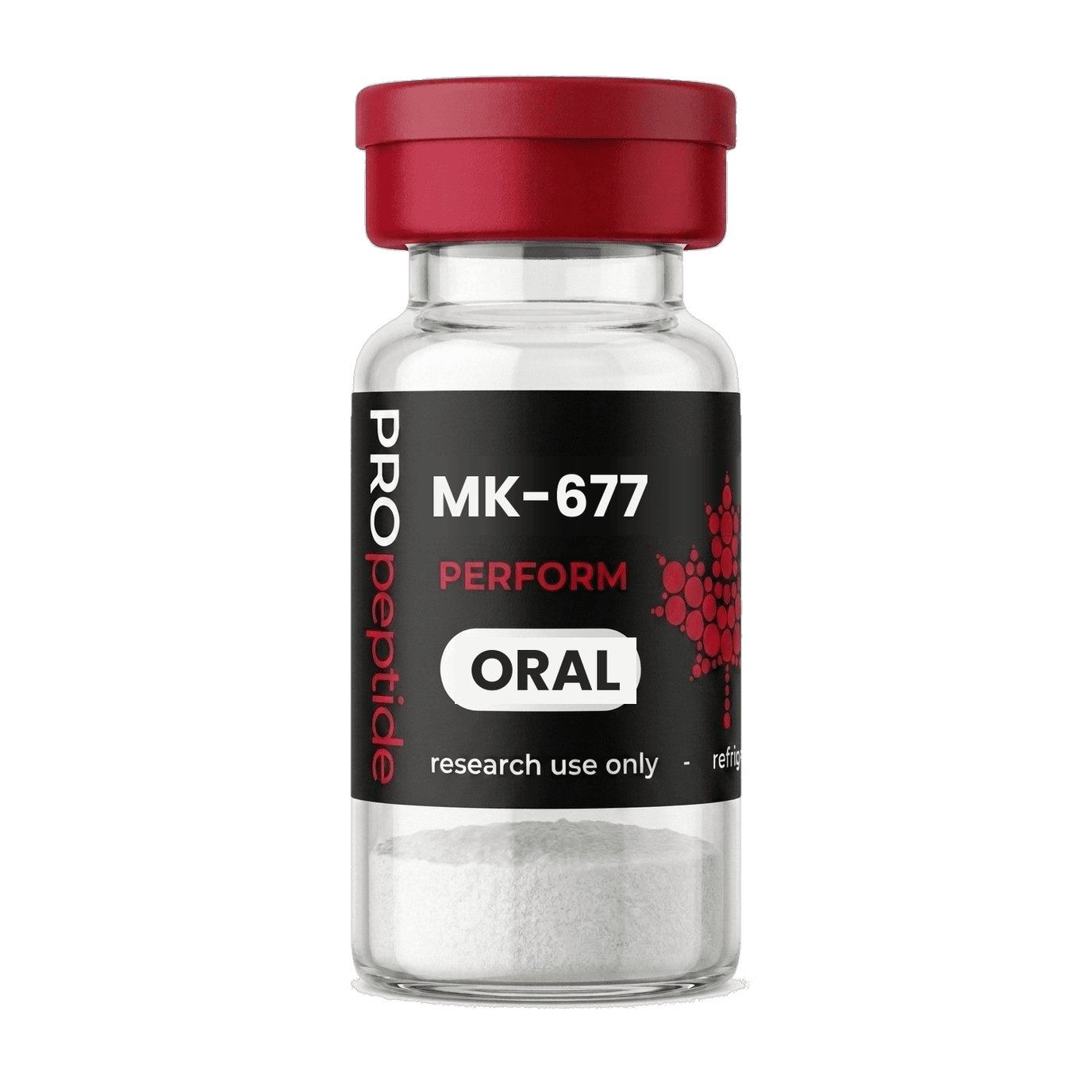
MK-677 Ibutamoren Oral
Not a peptide. A Merck small molecule carrying the biggest trial record in this family, and the most negative one.
Choose your pack
For research use only. Not for human or veterinary use.
What MK-677 Ibutamoren Oral is
The plain-language version, first.
A deliberate non-peptide, engineered to do a peptide's job orally.
MK-677 (ibutamoren) is a non-peptide, orally bioavailable spiroindoline small molecule, free base CAS 159634-47-6, that acts as an agonist at GHS-R1a, the ghrelin receptor, to increase growth hormone and IGF-1 secretion. It is not approved as a medicine in any jurisdiction and is currently in Phase 3 development as Lumos Pharma's LUM-201 for paediatric growth hormone deficiency.
Every peptide on this shelf has the same enemy: your digestive system. Merck's answer in the nineties was to stop bringing peptides to the fight.
MK-677 is a spiroindoline, a small synthetic molecule built to work the ghrelin receptor while shrugging off digestion entirely.
Oral, long-acting, and by that combination able to hold receptor engagement around the clock rather than in pulses.
It is now in phase 3 under the name LUM-201 for paediatric growth hormone deficiency, which makes it the rare shelf item with a live clinical future.
The only compound in this family with hundreds of randomised patients behind it, and the story those patients told is the interesting part.
What MK-677 ibutamoren actually is
Mechanism studied, not outcome promised.
Impersonates ghrelin at the receptor, around the clock, which is the whole trade.
Same door as the GHRPs, radically different visit.
The injectable peptides ring the ghrelin doorbell and leave: a spike, then silence. MK-677's long half-life leans on the doorbell continuously, around the clock, for as long as it is taken.
Sustained elevation instead of pulses, which is a different physiological proposition entirely, and the axis notices.
The trials documented what sustained ghrelin signalling brings alongside its target effects: appetite signalling, water retention, and blood sugar drift, because the ghrelin receptor was never a single-purpose button.
Here's the honest part, delivered by the data rather than by us.
The best-studied compound in the category produced the best-documented trade-offs in the category. Those two facts are one fact.
The research so far for MK-677 Ibutamoren Oral
Where the evidence is thin, we say so.
Hundreds of randomised patients, which makes its non-approval genuinely informative.
This file is the category's reference library, and its ending is the lesson.
Hundreds of randomised patients across trials in ageing, hip fracture and growth hormone deficiency through the nineties and 2000s. Real endpoints, real durations, published results.
The hormonal elevations were real and sustained. The downstream outcomes people assume follow from that were, across trials, underwhelming enough that development stopped for decades.
The blood sugar signal in older adults is documented, not rumoured.
Now revived as LUM-201 in a paediatric indication, phase 3, unapproved as yet anywhere.
The one compound here where the question was actually asked properly in humans, and the answer was: elevations yes, outcomes not so much. That result deserves more respect than it gets.
MK-677 (ibutamoren), oral small molecule. Canadian stock, shipping from BC.
MK-677 Ibutamoren Oral specs
The chemistry, exactly as released.
Who studies MK-677 Ibutamoren Oral
Who tends to order this one, and why.
- 1
Anyone who wants outcome data, not biomarker data
This is the one compound in the family where somebody actually asked whether raising IGF-1 changes anything clinically. The Alzheimer’s trial answered that with 563 randomised patients, and the answer was no.
- 2
People comparing oral against injectable secretagogues
MK-677 and the GHRPs reach the same receptor by completely different routes and produce completely different exposure patterns. A sustained oral rise is not the same signal as an injected pulse, and this pair is how you study that difference.
- 3
Medicinal chemists
Turning a hexapeptide into an orally bioavailable spiroindoline is a textbook peptidomimetic problem. The L-692,429 to MK-677 progression is documented in Science and PNAS, so the entire design path is readable.
- 4
Regulatory and safety trackers
MK-677 is the only compound in this cluster in FDA Category 2 on both the 503B and 503A tracks, the only one with a trial terminated early on a cardiac safety signal, and the only one currently in active Phase 3.
Sold for laboratory research only. This is not guidance for personal use, and nothing here is a recommendation.
MK-677 Ibutamoren Oral backstory
How it got here.
Merck's problem in the late eighties was a delivery problem, not a biology problem.
Bowers had already shown at Tulane that a six amino acid peptide could make the pituitary release growth hormone. That worked. But peptides don't survive a stomach, and a drug that has to go in by needle is a much harder product than one you swallow.
So Merck's chemists took the question apart from a different angle. Never mind copying the peptide. What shape does the receptor actually want?
L-692,429 was the first answer, published in Science in 1993. A non-peptide that hit the same target. MK-677, internally L-163,191, was the good version, and Patchett's group described it in PNAS in 1995 with an EC50 of 1.3 nanomolar.
They also noted it was clearly distinguishable from GHRH, which mattered a lot at the time, because nobody had found the receptor's natural ligand yet. GHS-R1a was cloned in 1996. Ghrelin turned up in 1999.
Then Merck did the thing almost nobody in this catalogue's history did. They ran the trials. Alzheimer's disease.
Hip fracture repair models. Hundreds of randomised patients, registered, published, peer reviewed. And the answers came back no.
IGF-1 climbed and the Alzheimer's didn't move. The hip fracture study stopped early on a heart failure signal.
That should have been the end of it. It wasn't. The molecule passed to Lumos Pharma, got renamed LUM-201, and picked up a completely different indication: children with growth hormone deficiency who still have a working pituitary. Phase 3 started on 20 May 2026. Thirty-one years after the PNAS paper, somebody is still asking.
- 1
Merck reverse-engineered a peptide
Starting from Bowers’ GHRP-6, Merck chemists built a non-peptide that hit the same receptor. L-692,429 came first, in Science in 1993 (PMID 8503009). MK-677, code L-163,191, was the refined result.
- 2
1995, PNAS, EC50 1.3 nM
Patchett and colleagues described MK-677 in PNAS (PMID 7624358), reporting an EC50 of 1.3 nanomolar, noting it was clearly distinguishable from GHRH, and that oral dosing gave only modest increases in cortisol.
- 3
Still in front of a regulator
After the Merck-era trials, the molecule passed to Lumos Pharma as LUM-201. A Phase 3 in paediatric growth hormone deficiency, NCT06948214, started on 20 May 2026.
Buying MK-677 Ibutamoren Oral in Canada
What ships, how fast, and the paperwork.
This is not a peptide. MK-677 is a spiroindoline small molecule, free base CAS 159634-47-6, molecular weight 528.7. There is no amino acid chain in it anywhere. Anyone selling it as a peptide either has not read the structure or is not being careful, and the distinction changes how the compound behaves in almost every respect.
Supplied for laboratory research use only. This is a research chemical. It is not a drug, a supplement or a therapy, and it is not intended for human or veterinary use. Health Canada has stated that "for research use only" labelling does not make a product legal, and the FDA lists MK-677 in Category 2 on both the 503B and 503A bulk substances tracks.
Prohibited in sport at all times. The WADA 2026 Prohibited List names ibutamoren (MK-677) explicitly under S2.2.4 among the growth hormone secretagogues and mimetics. It is non-Specified and banned both in and out of competition, with no permitted window for a tested athlete.
Common questions
5 answers, none of them dodges.
Is MK-677 a peptide?
No. MK-677, or ibutamoren, is a non-peptide small molecule built on a spiroindoline core joined to a piperidine, free base CAS 159634-47-6 with a molecular weight of 528.7. It contains no amino acid chain. That is precisely why it can be taken orally, where the peptide secretagogues in the same family cannot survive a digestive tract at all.
What did the Alzheimer’s trial show?
NCT00074529 randomised 563 patients. Sevigny and colleagues reported in Neurology in 2008 that IGF-1 rose 72.9 percent at twelve months and that there was no clinical effect on Alzheimer’s disease progression. It is the clearest demonstration in this whole family that moving a hormone reliably does not guarantee moving an outcome, and it was run at a scale nothing else here has matched.
Why was the hip fracture trial stopped?
NCT00128115 randomised 123 patients and was terminated early due to a safety signal of congestive heart failure. Adunsky and colleagues reported in 2011 that MK-0677 has an unfavorable safety profile in that patient population. The FDA cites that signal in placing MK-677 in Category 2 on both its 503B and 503A bulk drug substances lists, the only compound in this cluster with that status.
Is there any positive trial data on MK-677?
Yes, in a different population. Nass and colleagues published a two-year randomised controlled trial in Annals of Internal Medicine in 2008, in 65 healthy older adults, reporting that MK-677 restored growth hormone and IGF-1 without serious adverse events. That result does not cancel the hip fracture finding, and the hip fracture finding does not cancel it. Different patients, different endpoints, different answers.
What is LUM-201?
LUM-201 is the same molecule under Lumos Pharma’s development programme. After the Merck-era trials the compound changed hands and picked up a new indication: children with growth hormone deficiency who retain some pituitary function. A Phase 3 trial, NCT06948214, started on 20 May 2026. That makes MK-677 the only compound in this family currently in active late-stage development.
MK-677 Ibutamoren Oral vs Ipamorelin
Stacked together constantly, compared almost never.
Same receptor, opposite philosophies, and between them the whole design space of this category.
MK-677 holds the ghrelin receptor around the clock: oral, long-acting, a sustained hum. It carries the category's largest human file and its best-documented trade-offs.
Ipamorelin visits the same receptor in pulses and leaves, famous for what it does not disturb: no meaningful cortisol or ACTH movement.
Continuous versus pulsatile is the real choice here, and only one side of it has ever been tested at scale in people. The trade-offs it found are on both pages. Ipamorelin has its own page here
Good pairing options with MK-677 Ibutamoren Oral
What researchers stack alongside it.
Pairing is where research gets ahead of itself. These are the compounds researchers put in the same order as MK-677 Ibutamoren Oral, which is a statement about ordering habits, not about evidence. Two things in one cart have not been studied together unless somebody studied them together.
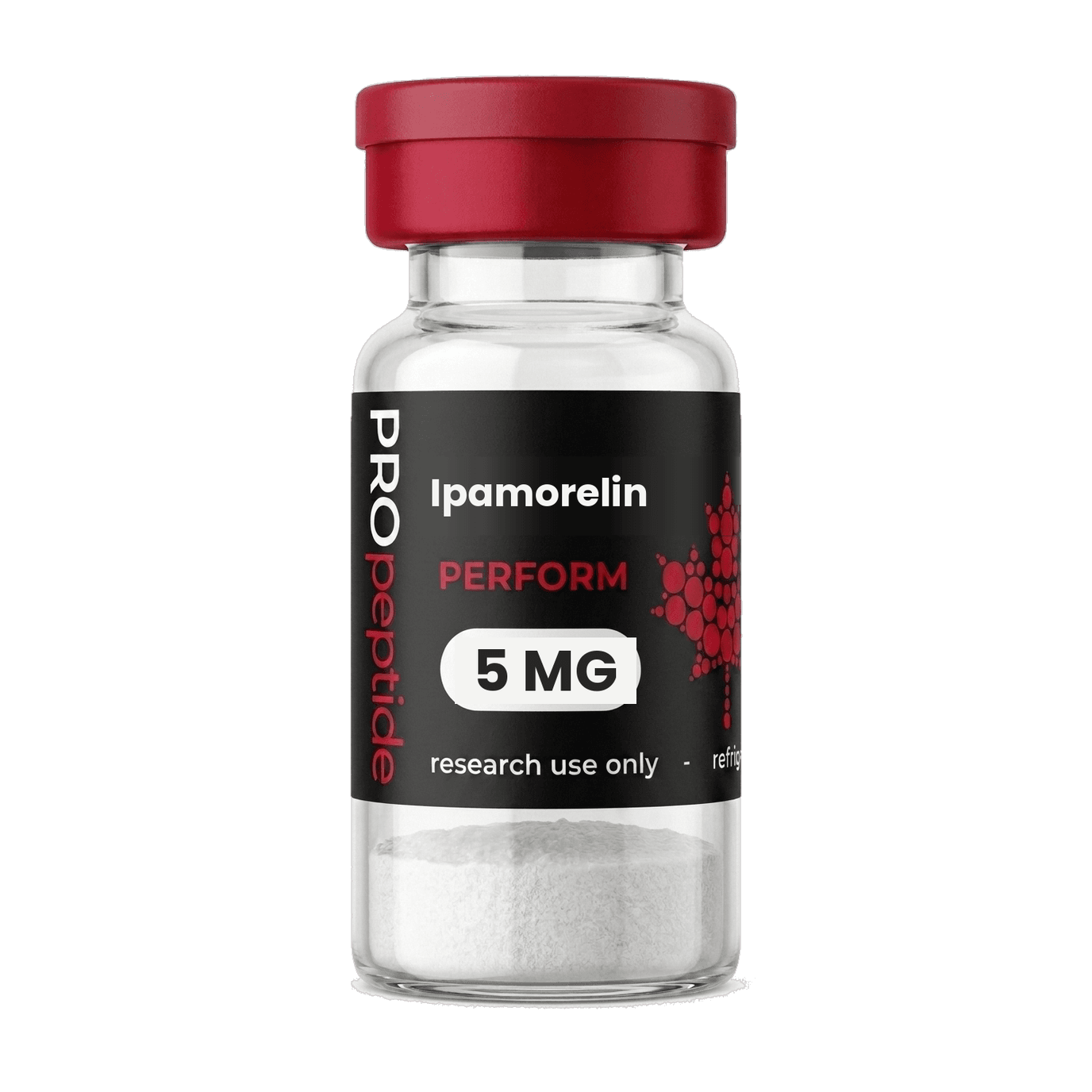
The polite one. A Novo Nordisk ghrelin agonist defined by what it does not release: no meaningful cortisol or ACTH even at high doses, which is the entire reason anybody remembers it.
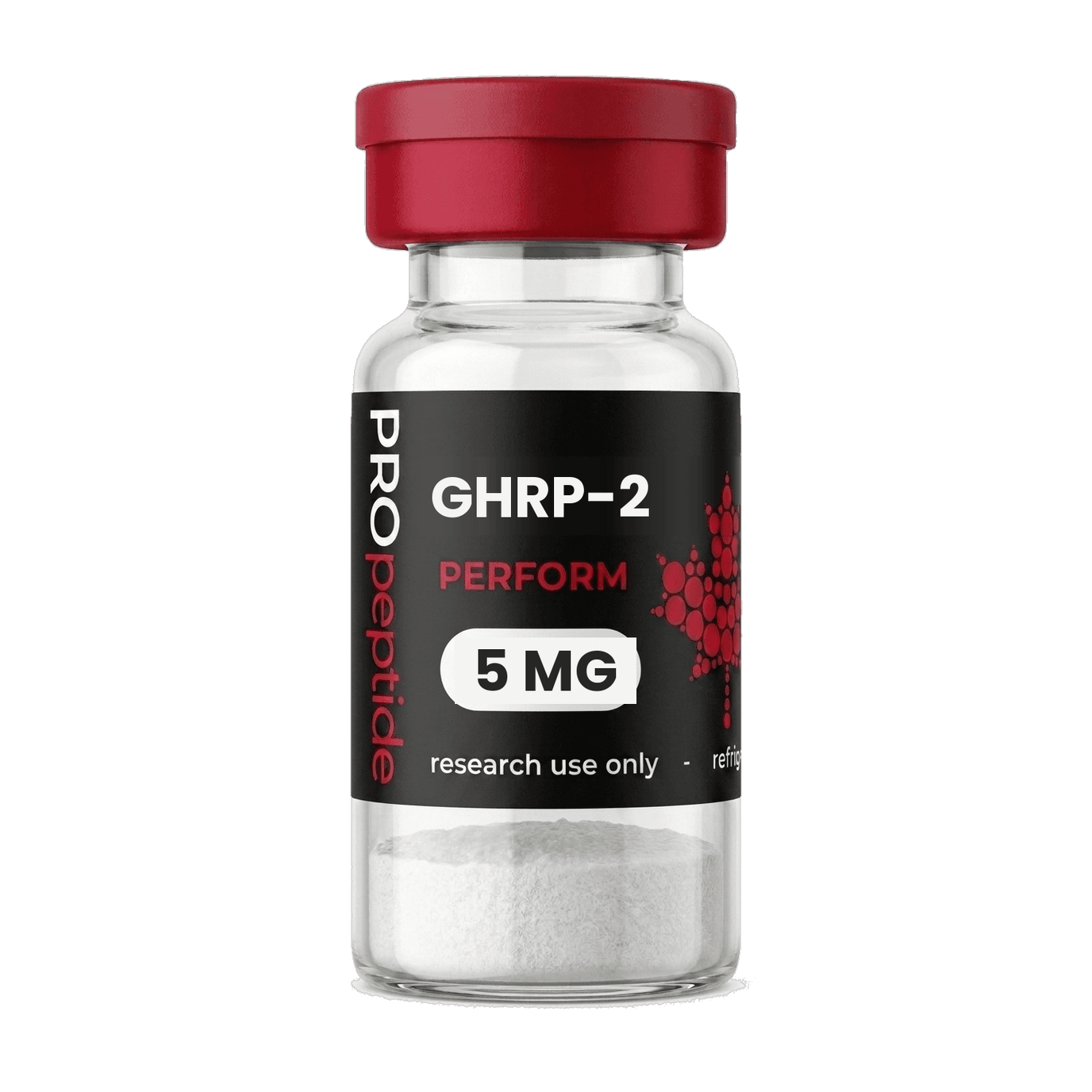
The one with an actual approval. Japan cleared it as a growth hormone diagnostic, sold as GHRP Kaken 100. Never approved in North America for anything.
It is water. We know. But it is the one bottle on this shelf where the boring ingredient is the entire product, and getting it wrong ruins everything else you bought.
Order MK-677 Ibutamoren Oral right now
One last look before you decide.
Freeze-dried, ships cold from Canada
You've got the whole file now, the thin parts included. Nothing above pretended otherwise. If that's the kind of source you were after, MK-677 Ibutamoren Oral is right here.
Not for human consumption. Not approved by Health Canada or any other regulatory body.
Page last updated October 4, 2026
People also search for MK-677 Ibutamoren Oral
Related searches.