
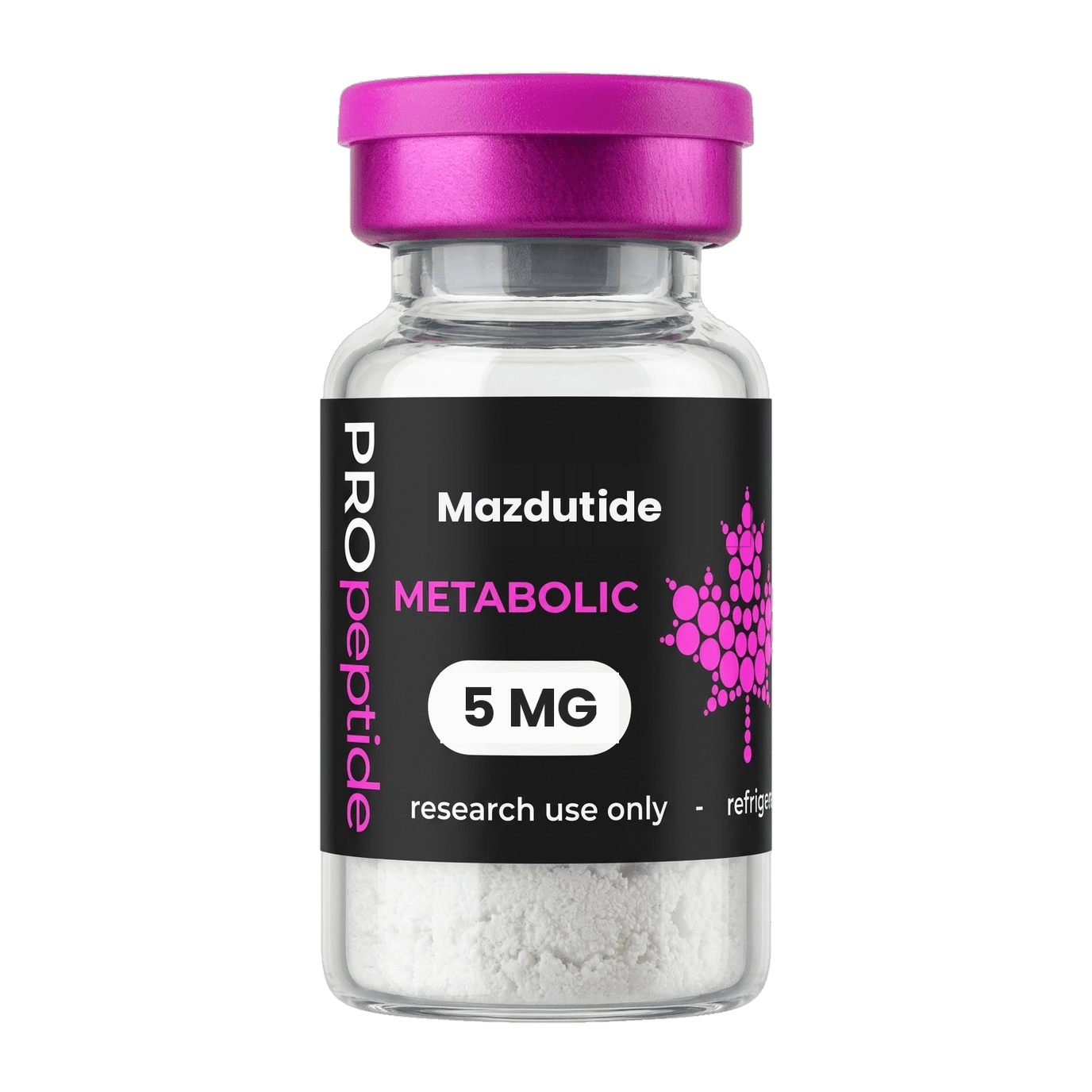
Mazdutide Peptide
The first dual glucagon and GLP-1 receptor agonist any regulator has ever approved. That regulator was China's, and only China's.
Choose your pack
For research use only. Not for human or veterinary use.
What Mazdutide is
The plain-language version, first.
Nature got to the dual agonist first. It just never told anybody.
Mazdutide (IBI362, LY3305677) is a 34-amino-acid oxyntomodulin analogue acting as a dual glucagon receptor and GLP-1 receptor agonist, with an Aib substitution at position 2, a C-terminal amide, and an acyl chain on Lys20. The WHO INN record gives a molecular formula of C210H322N46O67 and a molecular weight of approximately 4563, CAS 2259884-03-0; it is approved by China's NMPA and by no other regulatory authority.
Here's a slightly annoying fact if you're a medicinal chemist.
Everybody has spent years building molecules that pull two receptors at once. Clever work, real engineering, genuine achievement.
Your gut has been making one since before anybody thought of it.
It's called oxyntomodulin. It comes off the same precursor protein as GLP-1, it is a perfectly ordinary human peptide, and it engages both the GLP-1 receptor and the glucagon receptor without anybody designing it to.
Mazdutide is an analogue of that.
So the job here wasn't invention. It was taking something nature already built and fixing the part nature had no reason to care about, which is how long it lasts.
Native oxyntomodulin clears in minutes. Nature is not optimising for weekly dosing.
What mazdutide is
Mechanism studied, not outcome promised.
Two receptors, one peptide, and no chemist required for the original draft.
Alright. Proglucagon is one precursor protein that gets cut into different pieces depending on which tissue is doing the cutting.
Cut it one way, you get glucagon. Cut it another way, you get GLP-1. Cut it a third way and you get oxyntomodulin, which happens to talk to both receptors.
Same source material. Different scissors. Completely different job.
That's a genuinely elegant bit of biology and it is also the whole basis of this molecule.
This analogue takes that natural dual-acting peptide and does the standard two things: stabilise it against the enzymes that clear it, and add a lipid so it binds albumin and sticks around.
Here's the honest part. Being derived from a human peptide sounds reassuring and it is not an argument about anything.
Plenty of things your body makes are unpleasant in the wrong amount, and a modified version of a natural molecule is still a modified molecule with its own behaviour.
Natural origin is a fact about where it came from. It is not a safety claim, and we are not making one.
The research so far for Mazdutide
Where the evidence is thin, we say so.
Approved in one country, unapproved everywhere else, and unusually easy to misread because of it.
This one is easy to misread, so here is the shape of it plainly.
It holds regulatory approval in China and nowhere else. Not Canada.
Not the United States. Not Europe.
One approval is not no approval, and it is also not the same thing as approved.
That matters for reading the literature, because a good deal of the clinical work sits with one sponsor in one jurisdiction, which is a narrower base than the multi-region programmes behind some of its neighbours on this shelf.
It is not a criticism of the work. It is a note about how much independent replication exists, which is a different question and the one people forget to ask.
Approved somewhere, unapproved here, and thinner outside its home programme than the headline suggests.
Canadian stock, cold-shipped from BC. Research use only.
Mazdutide specs
The chemistry, exactly as released.
Who studies Mazdutide
Who tends to order this one, and why.
- 1
Dual-agonist pharmacology labs
If you're characterising GCGR/GLP-1R co-agonism, mazdutide is now the reference compound, because it's the only one a regulator has ever signed off on.
- 2
Energy expenditure researchers
The glucagon arm is the part meant to move metabolic rate. That's a distinct readout from appetite suppression and it's the reason this molecule exists at all.
- 3
Liver metabolism researchers
Glucagon receptor agonism drives hepatic fat oxidation, which is why this class keeps turning up in liver fat discussions alongside the weight data.
- 4
Regulatory and market analysts
A mechanism approved in one jurisdiction and unapproved everywhere else is a rare, clean case study. Mazdutide is currently that case study.
Sold for laboratory research only. This is not guidance for personal use, and nothing here is a recommendation.
Mazdutide backstory
How it got here.
Oxyntomodulin was described as a gut hormone long before anyone thought of it as a drug template. Same proglucagon gene as GLP-1, different processing, hits the glucagon receptor and the GLP-1 receptor both, and gets cleared so fast it was never going to be useful on its own.
Eli Lilly built an engineered version and gave it the internal code OXM3. On 21 August 2019 Lilly licensed the China rights to Innovent Biologics, and the molecule picked up two more names along the way: IBI362 on the Innovent side, LY3305677 on the Lilly side.
Innovent ran the GLORY programme in Chinese participants. GLORY-1 reported at 48 weeks in NEJM. GLORY-2 pushed the dose to 9 mg and reported in JAMA.
On 27 June 2025 the NMPA approved mazdutide for chronic weight management as Xinermei, and in September 2025 for type 2 diabetes.
That made it the first dual glucagon and GLP-1 receptor agonist approved anywhere in the world. Not the first in China. The first, full stop. The mechanism the entire Western pipeline has been chasing crossed the finish line in China first.
- 1
2019: Lilly hands off China
Eli Lilly licenses the China rights to its engineered oxyntomodulin analogue, internal code OXM3, to Innovent Biologics on 21 August 2019. The molecule carries two designations from then on, IBI362 and LY3305677.
- 2
2025: the GLORY data lands
GLORY-1 (n=610) reports -11.00% at 4 mg and -14.01% at 6 mg versus +0.30% on placebo at week 48 in NEJM. GLORY-2 (n=461) later reports -16.65% at 9 mg over 60 weeks in JAMA.
- 3
27 June 2025: a world first
China's NMPA approves mazdutide for chronic weight management as Xinermei, making it the first dual glucagon and GLP-1 receptor agonist approved by any regulator anywhere. Type 2 diabetes approval follows that September.
Buying Mazdutide in Canada
What ships, how fast, and the paperwork.
Approved in China only. Xinermei is a real approved product in China. Mazdutide has no FDA, EMA or Health Canada authorisation, and what we ship is a research material rather than any approved drug product.
The anti-doping answer is unresolved. Mazdutide isn't named on the 2026 WADA list, but S0 catches unapproved substances and WADA hasn't said whether an NMPA approval counts. Anyone in tested sport should ask their anti-doping authority directly rather than guess.
Canadian stock, ships from BC. Held in Canada so it isn't sitting in a customs queue while the cold chain degrades. Research use only, and not for any human or veterinary application.
Common questions
5 answers, none of them dodges.
What makes mazdutide different from semaglutide?
Semaglutide hits one receptor. Mazdutide hits two, the GLP-1 receptor and the glucagon receptor, because its backbone is closer to oxyntomodulin than to GLP-1. The glucagon arm is meant to add energy expenditure and hepatic fat oxidation rather than more appetite suppression. It's a different bet, not a stronger version of the same one.
Is mazdutide approved anywhere?
In China, yes. The NMPA approved it for chronic weight management on 27 June 2025 under the brand Xinermei, and for type 2 diabetes in September 2025. That was the first approval of a dual glucagon and GLP-1 receptor agonist by any regulator anywhere in the world. The FDA, EMA and Health Canada have not approved it.
Why would glucagon activity belong in a molecule like this?
Glucagon raises blood sugar, which sounds disqualifying on its own. It also raises energy expenditure and drives fat oxidation in the liver. The dual-agonist argument is that pairing it with GLP-1 lets the incretin arm handle glycaemia while the glucagon arm contributes metabolic effects that GLP-1 doesn't produce by itself.
What weight change did the trials report?
GLORY-1 randomised 610 Chinese adults and reported -11.00% at 4 mg and -14.01% at 6 mg against +0.30% on placebo at week 48 (NEJM 2025). GLORY-2 tested 9 mg in 461 Chinese adults over 60 weeks and reported -16.65% versus -1.50% (JAMA 2026). Both were run under medical supervision using pharmaceutical material.
Is mazdutide banned in sport?
It isn't named on the 2026 WADA Prohibited List. WADA's S0 category catches substances with no approval from any governmental regulatory health authority, and whether China's NMPA approval takes mazdutide out of S0 has not been publicly determined. That's an open question, not a clearance. Anyone in tested sport should confirm with their own anti-doping authority.
Mazdutide Peptide vs Tirzepatide
Stacked together constantly, compared almost never.
Two dual agonists, two completely different second buttons, and the difference is the entire design argument.
Mazdutide pairs GLP-1 with the glucagon receptor, following a template nature already built in oxyntomodulin. Approved in China only.
Tirzepatide pairs GLP-1 with GIP, the receptor the field spent twenty years dismissing. Approved in Canada and the United States.
Same first receptor, opposite bets on the second. One bet has approvals on three continents and the other has one, which is worth more than any forum comparison of the two. Tirzepatide has its own page here
Good pairing options with Mazdutide
What researchers stack alongside it.
Pairing is where research gets ahead of itself. These are the compounds researchers put in the same order as Mazdutide Peptide, which is a statement about ordering habits, not about evidence. Two things in one cart have not been studied together unless somebody studied them together.
Cut six amino acids off the front of a peptide and it got roughly ten thousand times more active. That result, from 1987, is the reason this entire shelf exists.
For twenty years GIP was the incretin receptor nobody wanted, written off as the one that was not earning its place in the system. Tirzepatide was built to pull it on purpose, and the field had to go back and re-read its own literature.
It is water. We know. But it is the one bottle on this shelf where the boring ingredient is the entire product, and getting it wrong ruins everything else you bought.
Order Mazdutide right now
One last look before you decide.
Freeze-dried, ships cold from Canada
You've got the whole file now, the thin parts included. Nothing above pretended otherwise. If that's the kind of source you were after, Mazdutide is right here.
Not for human consumption. Not approved by Health Canada or any other regulatory body.
Page last updated October 4, 2026
People also search for Mazdutide
Related searches.