
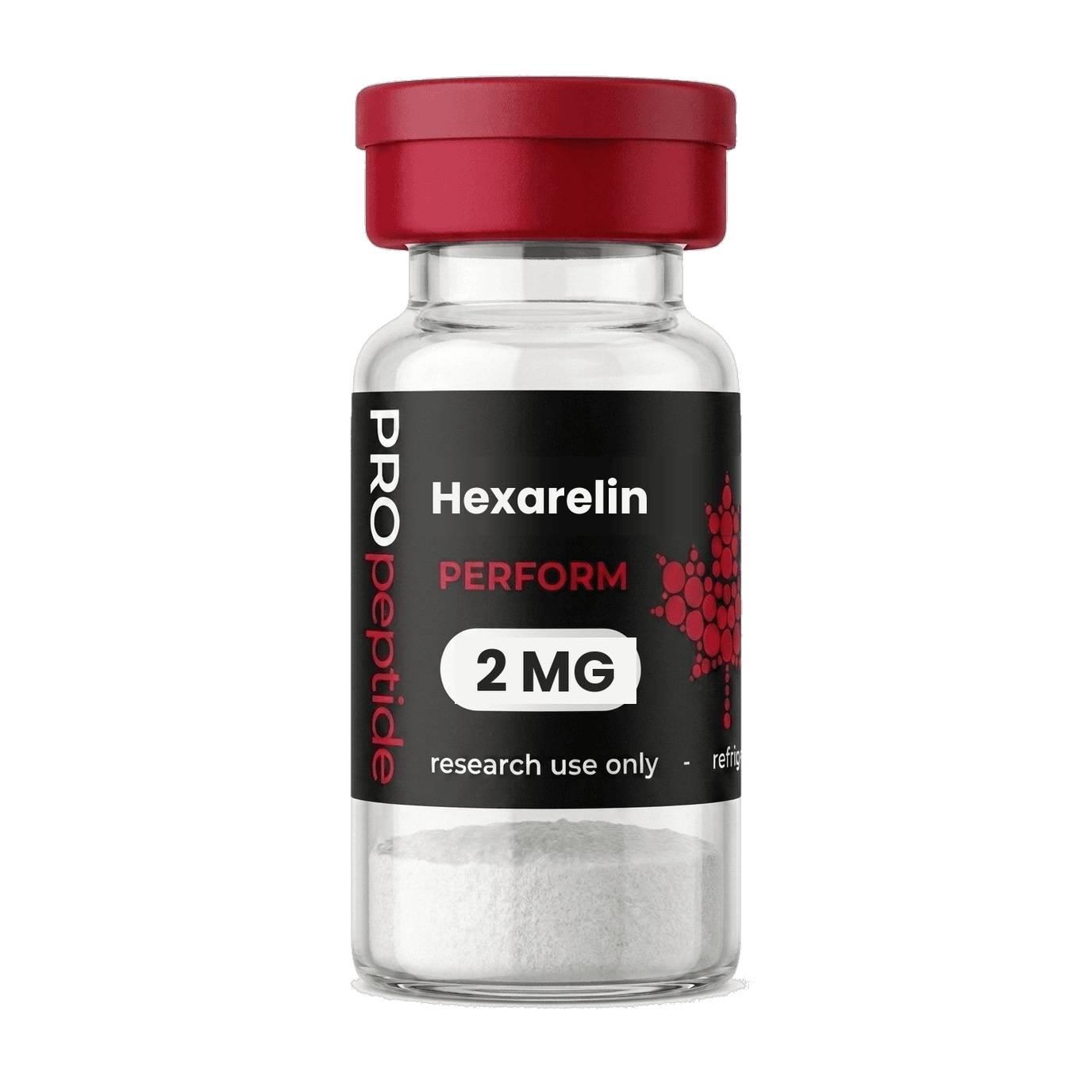
Hexarelin Peptide
GHRP-6 plus one methyl group, and the only one in the family with a second receptor.
Choose your pack
For research use only. Not for human or veterinary use.
What Hexarelin is
The plain-language version, first.
One methyl group away from GHRP-6, and measurably a different animal.
Hexarelin (examorelin) is a synthetic hexapeptide growth hormone secretagogue, sequence His-D-2-Me-Trp-Ala-Trp-D-Phe-Lys-NH2, CAS 140703-51-1, structurally identical to GHRP-6 apart from a single methyl group on the tryptophan at position two. It is an agonist at GHS-R1a, the ghrelin receptor, also binds the cardiac scavenger receptor CD36, and has never been approved as a medicine in any jurisdiction.
Chemistry has a running joke where the tiniest possible change refuses to be tiny.
Hexarelin is GHRP-6 with one methyl group added. 14.03 daltons. A rounding error's rounding error.
And it behaves differently enough to have its own literature, including binding in cardiac tissue at a site called CD36 that its parent does not share.
Nobody planned the second target. It showed up in the data, the way second targets usually do.
Same family as the other GHRPs, same ghrelin-receptor door, more potent at it than the parent.
_One methyl group. A second target.
A separate literature. Molecules do not respect the size of your edit._
What hexarelin peptide actually is
Mechanism studied, not outcome promised.
The famous thing here is what happens when you keep pressing the button.
The most instructive thing about hexarelin is not what it does. It is what stops happening.
Press the ghrelin-receptor button with this molecule repeatedly, and the response shrinks. Substantially. It is the best-documented desensitisation in the whole GHRP family.
A doorbell that quiets down the more you lean on it. The receptor system defends itself.
That is not a quirk of hexarelin so much as hexarelin being potent enough to show the phenomenon clearly. Downregulation is what receptor systems do when oversignalled.
There is also the CD36 cardiac binding, a genuinely separate mechanism that made cardiology researchers look twice at a growth hormone peptide.
Here's the honest part. Potency plus documented tolerance is a combination that undermines exactly the use pattern forums imagine for it.
The system adapts. That finding is in the file, it is solid, and it is the one thing every enthusiastic description leaves out.
The research so far for Hexarelin
Where the evidence is thin, we say so.
The tolerance data is the file's most useful contribution.
This file's best material is the least marketable, which tells you something about which papers get quoted.
The desensitisation work is genuinely good: documented, replicated in kind across the family, and clear in its direction. Response declines under repetition and hormone levels can suppress rather than climb.
A study found the growth hormone response dropped sharply within a week of repeated administration and stayed down.
The CD36 cardiac line generated real academic interest and remains preclinical in its important parts.
No approval anywhere. No controlled outcome trial for the popular questions. Prohibited in sport.
The file's central finding is that the body pushes back. We would rather lead with that than bury it, because it is the difference between this page and an advertisement.
Hexarelin (examorelin) hexapeptide. Canadian stock, shipping from BC.
Hexarelin specs
The chemistry, exactly as released.
Who studies Hexarelin
Who tends to order this one, and why.
- 1
Structure-activity researchers
Hexarelin and GHRP-6 differ by a single methyl group and 14.03 in molecular weight. If you want to see how far one small chemical edit shifts receptor behaviour, this is about as tight a comparison as peptide chemistry offers.
- 2
Anyone studying receptor desensitisation
Maccario 2002 is the clearest documentation of GHS-R1a tolerance anywhere in this family, and it shows the tolerance is selective rather than uniform. Growth hormone blunted, ACTH and cortisol abolished, prolactin untouched.
- 3
CD36 and cardiac signalling work
Hexarelin is the only compound in this cluster with a well-described second receptor outside the growth hormone axis. The cardiovascular literature on it is a separate body of work from the endocrine literature.
- 4
People who read old clinical papers
The mid-1990s intranasal paediatric studies are small, specific and traceable to PMIDs. They also contain a result nobody followed up: growth velocity improving while the acute growth hormone response fell by half.
Sold for laboratory research only. This is not guidance for personal use, and nothing here is a recommendation.
Hexarelin backstory
How it got here.
Hexarelin is a European story, which already makes it odd in a family that otherwise ran through New Orleans and New Jersey.
Start with what it is. Somebody looked at GHRP-6, Bowers' 1976 hexapeptide, and asked what happens if you methylate the tryptophan at position two. The answer was a more stable molecule at the same receptor.
That's it. That's the invention. One carbon, three hydrogens, and the compound gets its own name, its own CAS number and its own literature.
Then it went somewhere the rest of the family never did. Through the mid nineties hexarelin was tested in children with short stature, given intranasally. Laron's group reported growth velocity climbing from 5.3 to 8.3 centimetres per year in eight kids.
Klinger's group found the growth hormone response cratering after a week and the children growing better anyway. Those are small studies from thirty years ago and they deserve to be read as small studies from thirty years ago. But it was real clinical work in real patients, which is more than almost anything else in this catalogue can say.
Around the same time, cardiologists noticed hexarelin doing things in hearts that didn't track with growth hormone at all. That thread eventually led to CD36 and a body of cardiovascular literature running parallel to the endocrine one.
And then it stopped. No company took it forward. No regulator approved it. It doesn't appear in any FDA bulk substances category. Hexarelin is the compound in this family with the most interesting unfinished business and the smallest chance anyone finishes it.
- 1
One methylation, one new compound
Hexarelin is GHRP-6 with a methyl group added to the D-tryptophan at position two. The molecular weight difference is exactly 14.03. That single edit produced a separate compound with its own CAS number and its own literature.
- 2
Mid-nineties paediatric work
Laron 1995 (PMID 8548949) reported growth velocity rising from 5.3 to 8.3 centimetres per year in eight short children on intranasal hexarelin. Klinger 1996 (PMID 8766941) found the GH peak halved after seven days while growth still improved.
- 3
The heart detour
Cardiovascular effects that did not track with growth hormone led researchers to CD36, a scavenger receptor in cardiac tissue. Mao 2014 (PMID 25278975) covers that arm, mostly from animal models and isolated heart work.
Buying Hexarelin in Canada
What ships, how fast, and the paperwork.
Hexarelin and examorelin are one compound. Examorelin is the international nonproprietary name and hexarelin is the research name, both CAS 140703-51-1. WADA lists it as examorelin. If a source names one and you are reading about the other, it is still the same molecule.
Supplied for laboratory research use only. This is a research chemical. It is not a drug, a supplement or a therapy, and it is not intended for human or veterinary use. In Canada, peptides are generally regulated as prescription drugs, and Health Canada has stated that "for research use only" labelling does not make a product legal.
Prohibited in sport at all times. The WADA 2026 Prohibited List names examorelin (hexarelin) explicitly under S2.2.4 among the growth hormone releasing peptides. It is non-Specified and banned both in and out of competition, with no permitted window for a tested athlete.
Common questions
5 answers, none of them dodges.
What is the difference between hexarelin and GHRP-6?
A single methyl group. Hexarelin carries a methylated D-tryptophan at position two where GHRP-6 has a plain one, and the molecular weight difference is exactly 14.03, which is one CH2. Everything else in the six-residue sequence is identical. That small edit produced a separate compound with its own CAS number, its own CD36 interaction and its own body of literature.
What is CD36 and why does it matter here?
CD36 is a scavenger receptor present in cardiac tissue, and it is a second binding target for hexarelin beyond GHS-R1a. It is the basis of the cardioprotection literature on this compound, covered by Mao and colleagues in 2014. Most of that evidence comes from animal models and isolated heart preparations, so the human relevance stays an open question rather than an established finding.
Does hexarelin stop working with repeated use?
The published data says the response changes. Maccario reported in the European Journal of Endocrinology in 2002 that prior hexarelin exposure blunted the growth hormone response, abolished the ACTH and cortisol response, and did not modify the prolactin increase. Klinger’s 1996 work found the growth hormone peak fell from 70.6 to 34.1 milliunits per litre after seven days of intranasal treatment and stayed suppressed.
Was hexarelin ever studied in people?
Yes, in small mid-1990s studies. Laron and colleagues reported in 1995 on eight short children given intranasal hexarelin, with growth velocity rising from 5.3 to 8.3 centimetres per year. Klinger’s 1996 work tracked the growth hormone response across a week of treatment. Both are small, old and never replicated at scale, and ClinicalTrials.gov holds no registered studies for the compound.
Is hexarelin approved anywhere?
No. It has never received marketing authorisation in any country, for any indication. It also differs from the rest of this family on the American compounding lists. GHRP-2, GHRP-6 and MK-677 all appear in an FDA bulk drug substances category, while hexarelin appears in none of them at all. There are no registered clinical trials for it either.
Good pairing options with Hexarelin
What researchers stack alongside it.
Pairing is where research gets ahead of itself. These are the compounds researchers put in the same order as Hexarelin Peptide, which is a statement about ordering habits, not about evidence. Two things in one cart have not been studied together unless somebody studied them together.
The polite one. A Novo Nordisk ghrelin agonist defined by what it does not release: no meaningful cortisol or ACTH even at high doses, which is the entire reason anybody remembers it.
The one with an actual approval. Japan cleared it as a growth hormone diagnostic, sold as GHRP Kaken 100. Never approved in North America for anything.
It is water. We know. But it is the one bottle on this shelf where the boring ingredient is the entire product, and getting it wrong ruins everything else you bought.
Order Hexarelin right now
One last look before you decide.
Freeze-dried, ships cold from Canada
You've got the whole file now, the thin parts included. Nothing above pretended otherwise. If that's the kind of source you were after, Hexarelin is right here.
Not for human consumption. Not approved by Health Canada or any other regulatory body.
Page last updated October 4, 2026
People also search for Hexarelin
Related searches.