
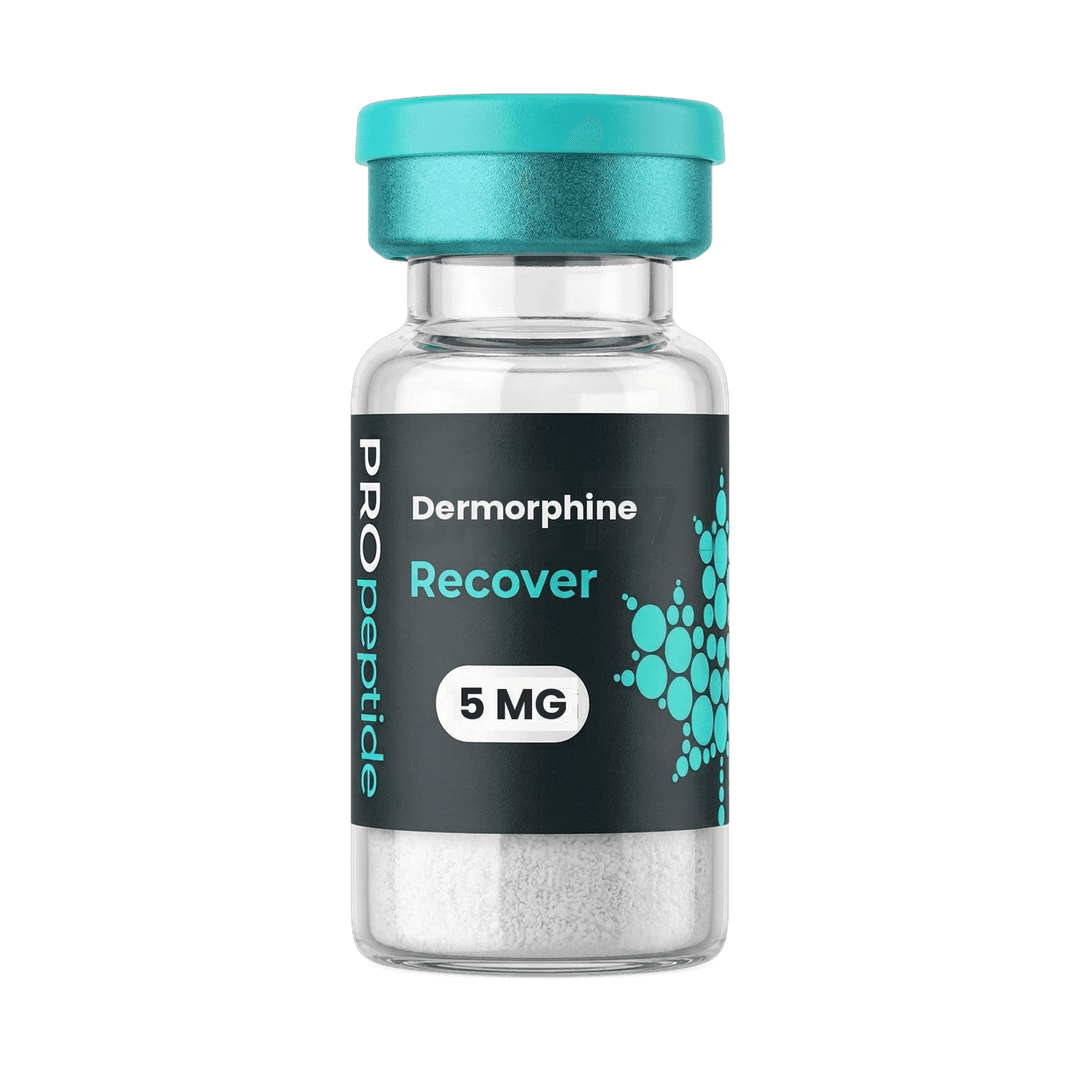
Dermorphine Peptide
Everything alive builds its peptides from left-handed amino acids. In 1981 a South American tree frog turned up carrying one with a right-handed piece bolted into position two. The whole human record is a single 150-patient trial from 1985.
Choose your pack
For research use only. Not for human or veterinary use.
What Dermorphine Peptide is
The plain-language version, first.
Dermorphine is a seven-amino-acid opioid peptide originally isolated from the skin of South American Phyllomedusa frogs. It contains a D-alanine at position two, and the published human record is a single trial from 1985.
Everything alive builds its peptides from left-handed amino acids. That is close to a law of biology, taught as one, enforced by every ribosome on the planet. > In 1981 a South American tree frog turned up carrying a peptide with a right-handed piece bolted into position two. A D-alanine, sitting where biology says no D-amino acid should be, installed after the fact by an enzyme science had not met yet. The frog is Phyllomedusa, the peptide is dermorphine, and the backwards residue is not decoration. It is armour: enzymes built to dismantle left-handed chains cannot get a grip on it. _A molecule that breaks biology's writing rules, found in the skin of something that sleeps on a leaf._
What is dermorphine?
Mechanism studied, not outcome promised.
A right-handed residue in a molecule biology normally builds left-handed. It is what stops enzymes taking the peptide apart on contact.
Naloxone blocks the receptor activity, which is what confirmed the mechanism back in 1981.
Opioid receptor work, and unusually potent at it in the classic assays, which is exactly why this page reads carefully. The D-alanine does two jobs at once: it locks the shape the receptor recognises and it defeats the enzymes that would normally end the conversation quickly. > Naloxone blocks the activity, which is how the mechanism was confirmed back in 1981.
A clean, classical pharmacology story. And an obligation comes with it: potent opioid receptor activity is not a casual property.
This compound has a genuine misuse history in one specific industry, horse racing, where its detection is a doping story decades old. Here's the honest part. _The chemistry is a marvel.
The receptor it works is one of the most consequential in pharmacology, and this page gives that the weight it deserves._
The research so far for Dermorphine Peptide
Where the evidence is thin, we say so.
One randomised double-blind trial, 150 postoperative patients, intrathecal, 1985. Plus receptor pharmacology from 1981 and a gene-cloning paper from 1987.
Any human study after 1985. Any human data by a subcutaneous, intramuscular, oral or intranasal route. Any modern pharmacokinetics.
Keppel Hesselink and Schatman went through the citation record in 2018 and found roughly fifteen pharmacology papers had cited the 1985 clinical trial, and not one clinical researcher. The reasons given for abandonment were no patent protection and an intrathecal-only route. Nobody showed it failed. Nobody followed up.
The file is small, old and strange in proportion. The discovery work dates to 1981, the D-amino acid finding rewrote a rule of peptide biology, and the entire human record is one 150-patient trial from 1985. > One trial, four decades ago, and the thread was never picked up. What continued instead was analytical chemistry: detection methods, because the compound's post-discovery life happened mostly in racing laboratories. Nothing approved for any human use anywhere. _A biochemical landmark with a forty-year-old human file and a doping-lab afterlife. All three parts true, and the first one is why it is still worth reading about._
Dermorphine vial sizes and current Canadian stock are listed below.
Dermorphine Peptide specs
The chemistry, exactly as released.
Who studies Dermorphine Peptide
Who tends to order this one, and why.
A research compound does not have one audience. It has a handful of rooms where the same question keeps coming up, and the question is a different question in each of them.
Opioid pharmacology
Groups working on mu-receptor selectivity and on peptide agonists as alternatives to alkaloid opioids.
Peptide chemistry
The D-amino acid substitution is a textbook example of engineering protease resistance into a short peptide.
Post-translational biology
The L to D isomerisation the frog performs is still one of the cleaner examples of the mechanism in animals.
Doping control laboratories
Analytical chemists who developed detection methods after the 2011 and 2012 horse racing cases.
Sold for laboratory research only. This is not guidance for personal use, and nothing here is a recommendation.
Dermorphine Peptide backstory
How it got here.
Frog skin was a serious pharmacological hunting ground in the twentieth century, and Vittorio Erspamer in Rome was the person who made it one. His group worked through amphibian skin extracts for decades and pulled out a long list of bioactive peptides.
Dermorphine came out of Phyllomedusa sauvagei in 1981. The 1987 gene work established that the frog manufactures it with a normal L-amino acid and then isomerises one residue post-translationally, which was a new mechanism at the time.
After 1985 the clinical trail stops. The compound resurfaced publicly in 2011 and 2012, not in medicine, but in North American horse racing, where analytical chemists built an assay for it after intelligence suggested it was being used at the track.
- 1
Found in a frog, 1981
Erspamer group in Rome, from the skin of Phyllomedusa sauvagei. Seven residues, selective mu-opioid agonist, roughly forty times morphine on isolated receptor preparations.
- 2
One human trial, 1985
Basso and colleagues, 150 postoperative patients, intrathecal. Analgesia lasted 43 hours against 34 for morphine and 11 for pentazocine.
- 3
A new mechanism, 1987
Richter, Egger and Kreil cloned the gene and found it codes for ordinary L-alanine. The frog isomerises one residue after translation, which nobody knew animals did.
- 4
Then nothing
Forty years with no further human study. It resurfaced in 2011 and 2012 in North American horse racing, where labs built an assay for it.
Buying Dermorphine Peptide in Canada
What ships, how fast, and the paperwork.
The hard part of buying research material is almost never the compound. It is the logistics. What leaves the building, how fast it moves, and what is in the box beside the vial. Here is ours, plainly.
Same day out of British Columbia
Our building, our cold packs, our people, and nothing sitting in a customs queue while you refresh a tracking page.
Then into the fridge
Keep it cold and keep it dark. Sealed and freeze-dried it handles a rough trip without ice. Once it lands, fridge.
Know what the record actually is
One human trial, in 1985, by spinal injection in a hospital. There is no human data for this compound by any other route. Anyone telling you otherwise is filling in a blank.
Stuff people ask about Dermorphine Peptide
If your question is not here, email us. Real human answers.
One. Basso and colleagues published a randomised, double-blind, three-arm postoperative trial in Peptides in 1985 with 150 patients, comparing intrathecal dermorphine against intrathecal morphine and intramuscular pentazocine. Nothing has been published in humans since. Forty years, one trial.
That number comes from Broccardo and colleagues in the British Journal of Pharmacology in 1981, and it describes potency on isolated guinea-pig ileum and mouse vas deferens receptor preparations, not clinical potency in a person. In whole-animal analgesia tests the ratios reported were far larger and route-dependent. Read it as an in vitro receptor figure, because that is what it is.
Not because it failed. Keppel Hesselink and Schatman reviewed the record in 2018 and the reasons given were no patent protection, an intrathecal-only route that was commercially unattractive in the 1980s, and publication in a peptide journal rather than a clinical one. Only about fifteen pharmacology papers ever cited the clinical trial and no clinical researcher did.
Intrathecally, meaning into the cerebrospinal fluid, in a hospital, by an anaesthetist. The animal work used intracerebroventricular and intravenous routes. There is no published human data for subcutaneous, intramuscular, oral or intranasal dermorphine at all.
It blocks enzymatic breakdown. Natural proteins are built from L-amino acids, and the peptidases that clear them are shaped accordingly. Swapping position two to the D form makes the molecule a poor substrate. Broccardo and colleagues described it as of crucial importance to activity.
Richter, Egger and Kreil cloned the precursor cDNA and published it in Science in 1987. The gene codes for ordinary L-alanine at the position where the finished peptide carries D-alanine. The frog builds a normal peptide and then flips one residue into its mirror image after translation. That mechanism was not known to exist in animals until this molecule raised the question.
Good pairing options with Dermorphine Peptide
What researchers stack alongside it.
Pairing is where research gets ahead of itself. These are the compounds researchers put in the same order as Dermorphine Peptide, which is a statement about ordering habits, not about evidence. Two things in one cart have not been studied together unless somebody studied them together.
Cholera taught researchers how the gut's tight junctions swing open. Larazotide is the counter-move, and its phase 3 stopped for futility in 2022. The whole arc is on this page.
Found in pig intestine in 1970, then it kept turning up everywhere else: lungs, brain, pancreas, immune cells. Its 461-patient phase 3 stopped for futility, which is a specific word with a specific meaning.
Order Dermorphine Peptide right now
One last look before you decide.
Freeze-dried, COA on the page, ships cold
If you are researching Dermorphine Peptide and you want a source you do not have to second-guess, start with the paperwork on this page. For research use only.
Not for human consumption. Not approved by Health Canada or any other regulatory body.
Page last updated August 20, 2026
People also search for Dermorphine Peptide
Other names for the same compound.